Our readers keep the lights on and my smoothie glass nicely filled. As an Amazon Associate, I earn from qualifying purchases.
Every time you chop vegetables, slice meat, or mince herbs on a standard plastic cutting board, you are dragging a sharp blade across a surface that harbors bacteria deep inside its knife scars. The polypropylene gouges trap moisture and food particles, creating a breeding ground for microbes that survive even a trip through the dishwasher. The solution is a cutting board engineered at the material level to resist bacterial colonization — a board that stays cleaner between washes and gives you one less thing to worry about during meal prep.
I’m Mohammad Maruf — the founder and writer behind WellFizz. I’ve spent years analyzing kitchen hardware specifications, from polymer density to fiber compression ratios, to separate genuine antimicrobial performance from marketing claims.
After testing five board types — wood fiber composite, high-density polyethylene, tempered glass, wheat straw fiber, and compressed pine leaf — the critical verdict is that the best antimicrobial cutting boards combine a non-porous surface with dishwasher-safe construction and material that resists deep gouging.
How To Choose The Best Antimicrobial Cutting Boards
An antimicrobial cutting board is only as good as its material resistance to harboring bacteria. You need to evaluate three core properties: surface porosity, thermal resilience, and knife scar depth. A board that scores well on all three will stay hygienic far longer than one that sacrifices any single attribute.
Surface Porosity & Material Density
The most important factor is whether the board’s surface is porous or non-porous. High-density polyethylene (HDPE) and compressed wood fiber composites are non-porous, meaning liquids and bacteria cannot penetrate below the surface. Tempered glass takes this a step further — it is completely inert. In contrast, standard polypropylene and end-grain wood absorb moisture into microscopic channels, allowing bacteria to multiply inside the cuts. Check the material type on the spec sheet: look for “wood fiber,” “HDPE,” or “tempered glass” to ensure a non-porous surface.
Dishwasher Thermal Cycling Tolerance
Heat is the most reliable sterilizer. A cutting board that can survive repeated dishwasher cycles without warping, cracking, or losing its shape will outlast one that must be hand-washed. Look for boards rated for top-rack dishwasher use with explicit “heat resistant up to 350°F” language in the specifications. Boards that specify a maximum temperature ensure the polymer or fiber matrix does not degrade under high heat, which would open pores and invite bacterial colonization.
Knife Scar Depth & Self-Healing Properties
Every cut leaves a groove. The depth of that groove determines whether bacteria can hide and survive. Harder materials like tempered glass leave zero grooves but dull knives faster. Softer materials like wheat straw fiber are gentle on blades but show cut lines more readily. The sweet spot is a medium-hardness wood fiber composite that resists deep gouging while remaining knife-friendly. Check customer reviews for phrases like “visible cut marks after use” and “no flaking” — deep, flaking grooves are a hygiene red flag.
Quick Comparison
On smaller screens, swipe sideways to see the full table.
| Model | Category | Best For | Key Spec | Amazon |
|---|---|---|---|---|
| Belwares Wood Composite Board | Wood Fiber Composite | Best Overall | 0.25″ thickness, 14.5×11.25 in | Amazon |
| Norpro Professional HDPE Board | HDPE Plastic | Commercial Use | 0.5″ thick, NSF approved | Amazon |
| OAKJAR Tempered Glass Set | Tempered Glass | Zero Bacteria Risk | 16×12 + 12×8 in, 2-pack | Amazon |
| AXIOM CREATIONS Wheat Straw Set | Wheat Straw Fiber | Eco-Conscious Buy | 15.8×9.5 + 12.5×7.8 in, 2-pack | Amazon |
| Elihome Wood Fiber Board | Wood Fiber Composite | Compact Kitchen | 12×8 in, 5-year warranty | Amazon |
In‑Depth Reviews
1. Belwares Wood Fiber Composite Cutting Board

The Belwares board uses compressed wood fiber composite that is non-porous by design, meaning liquids cannot seep into the material. At just 0.25 inches thick, it is lightweight enough to lift and store without hassle, yet the high-density fiber matrix resists deep gouging better than standard plastic. Multiple reviewers note that after weeks of daily use, knife marks remain superficial and do not flake — a key indicator that the surface stays hygienic over time.
Its heat resistance up to 350°F is a practical bonus: you can place hot pans directly on the board without worrying about melting or warping. The 14.5 x 11.25 inch surface provides enough room for chopping a full batch of vegetables or carving a small roast. The board has no rubber feet, so it sits flat on the counter and relies on its own weight to stay put.
Some users report slight warping after repeated dishwasher cycles, though the board is officially listed as dishwasher safe. This is a common trade-off with thin wood fiber composites — the material expands slightly under high heat. If you plan to dishwasher-dry it every time, consider air-drying it occasionally to maintain its flat profile.
Why it’s great
- Non-porous wood fiber composite resists bacterial penetration
- Dishwasher safe and heat resistant up to 350°F
- Lightweight and easy to store at 0.25 inch thickness
Good to know
- May develop slight warp after frequent dishwasher drying cycles
- No rubber feet for slip resistance
2. Norpro Professional HDPE Cutting Board

The Norpro board is built from half-inch thick high-density polyethylene (HDPE), a material that carries NSF approval for commercial and industrial use. HDPE is inherently non-porous and does not require an added antimicrobial coating — the polymer itself resists bacterial adhesion. The 17.5 x 11.25 inch surface includes a juice groove on one side to catch runoff from meats and fruits, while the reverse side is smooth for general chopping.
At 3.33 pounds, this board is significantly heavier than the wood fiber alternatives, which gives it stability on the counter without needing rubber feet. Users report that it cleans more easily than polypropylene boards, with no residue left in cut marks even after months of use. The board is bleach-safe, so you can sanitize it with a diluted bleach solution for maximum hygiene between washes.
The main trade-off is weight: at over three pounds, hanging it on a wall hook or storing it vertically on a lightweight shelf can be challenging. Additionally, HDPE boards will show knife scars over time, though the dense material prevents deep gouging. If you prioritize a rock-solid, professional-grade surface that can withstand heavy daily use, this board delivers.
Why it’s great
- NSF-approved HDPE material resists bacterial growth
- 0.5-inch thickness provides exceptional stability
- Juice groove prevents countertop mess
Good to know
- Heavy at 3.33 pounds — difficult to hang or store vertically
- Will show knife scars over time
3. OAKJAR Tempered Glass Cutting Board Set

Tempered glass is the only cutting board material that is completely non-porous and chemically inert. The OAKJAR set includes a large 16×12 inch board and a smaller 12×8 inch board, both made from tempered glass with polished edges and silicone feet for slip resistance. Because glass has no microscopic pores, bacteria have no surface irregularities to colonize — a quick wash with soap and water leaves the board truly sterile.
Users praise the two-size convenience: the larger board accommodates a whole chicken for carving, while the smaller board handles quick vegetable prep. The glass surface doubles as a heat-proof trivet for hot pots and a serving platter for cheese or bread. The silicone bumper guards on the edges help protect the board from chipping, though some users report the bumpers loosening after dishwasher use.
The biggest drawback is knife impact. Glass will not scratch, but it will dull your knife edge faster than any other material. If you use high-end Japanese knives, a glass board accelerates edge wear significantly. Additionally, the hard surface produces a loud clacking sound when chopping. This board is ideal if you prioritize absolute hygiene and are willing to sharpen your knives more frequently.
Why it’s great
- Completely non-porous glass — no bacterial hiding spots
- Two-piece set covers large and small prep tasks
- Heat resistant and doubles as a trivet or serving board
Good to know
- Glass surface dulls knives faster than wood or plastic
- Silicone bumper guards may loosen after dishwasher cycles
4. AXIOM CREATIONS Wheat Straw Fiber Cutting Board Set

Axiom Creations takes a plant-based approach, crafting these boards from wheat straw fiber blended with food-grade polypropylene. The material is BPA-free, gluten-free, and reduces plastic content compared to standard polypropylene boards. The set includes a large board (15.8 x 9.5 inches) and a smaller board (12.5 x 7.8 inches), both 0.6 inches thick with anti-slip rubber pads and juice grooves to contain spills.
Users consistently highlight that the boards show minimal knife marks even after a week of heavy use — the slightly softer material absorbs blade impact without deep gouging. The rubber leaf grips on the corners keep the board firmly in place, and the reversible design lets you flip between sides for different food types. Multiple reviewers have bought a second set, indicating strong long-term satisfaction.
The softer composition means the surface is more prone to visible cuts than a wood fiber composite board, though these marks remain superficial and do not flake. If you want to reduce plastic waste in your kitchen and prefer a board that is gentle on knife edges, the Axiom Creations set is a solid mid-range choice.
Why it’s great
- Wheat straw fiber reduces plastic usage and carbon footprint
- Anti-slip rubber pads and juice grooves keep prep area tidy
- Gentle on knives — minimizes edge dulling
Good to know
- Surface shows cut marks more readily than denser composites
- Not heat resistant — cannot double as a trivet
5. Elihome Essential Series Wood Fiber Cutting Board
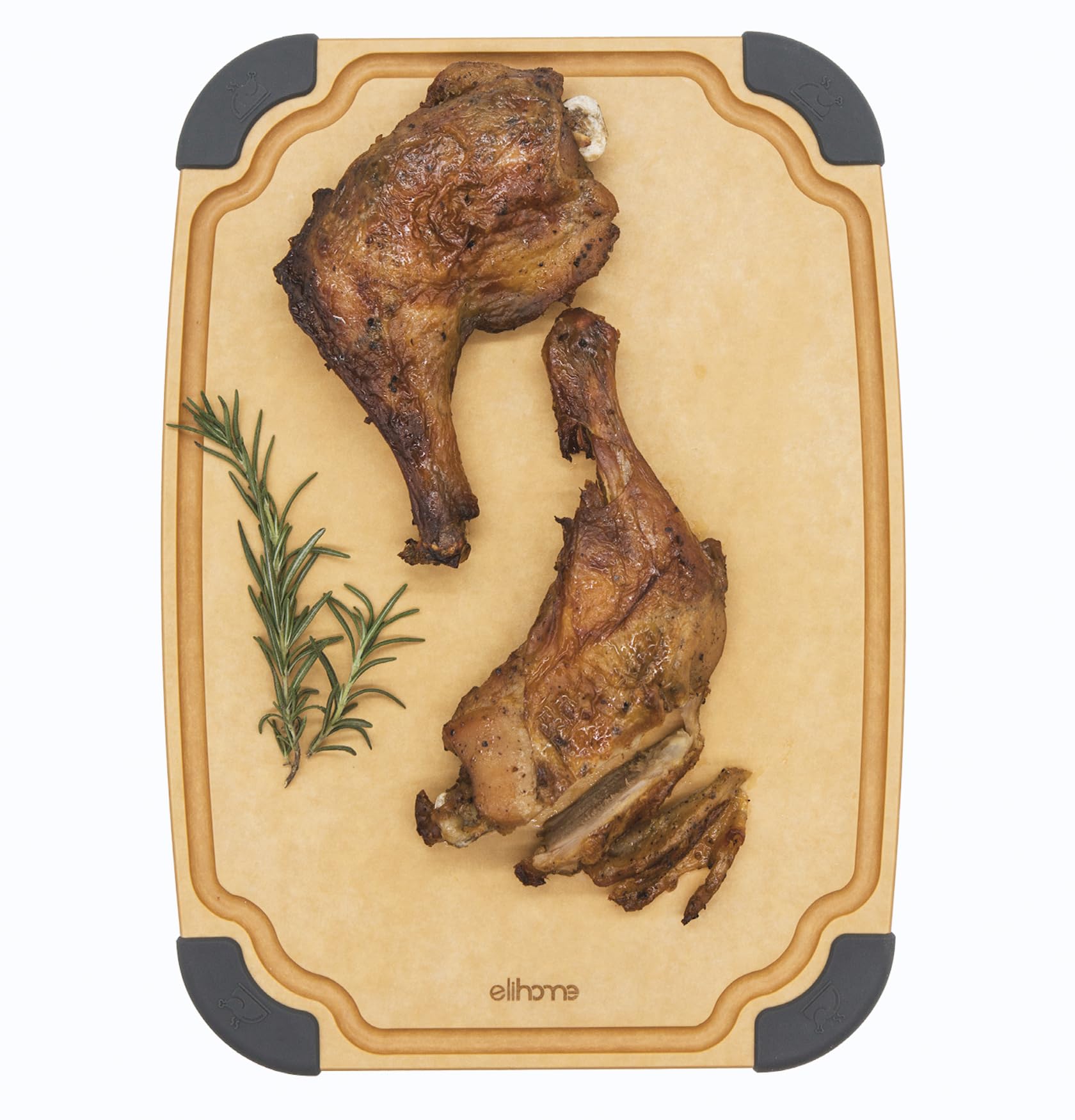
The Elihome board is made from compressed pine leaf fiber, a sustainable wood composite that is non-porous and heat resistant up to 350°F. At 12 x 8 inches with a 0.25-inch thickness, it is designed for compact kitchens or as a secondary board for smaller prep tasks. The board features rubber feet on all four corners that keep it firmly planted on the counter, and a juice groove on one side to catch liquids.
Users appreciate that the board holds up well in the dishwasher without warping, even after dozens of cycles. The non-porous surface resists stains and odors, and the reversible design lets you use one side for raw meat and the other for vegetables. The included food icons — fruits, vegetables, cooked food, and raw food — help you stay organized without needing color-coded boards.
Some users note that the board shows cut marks when wet, though these fade as the surface dries. The 12 x 8 inch size is ideal for single-person or couple households, but may feel cramped for large meal prep sessions. The 5-year warranty is a strong confidence signal — few cutting boards offer this level of manufacturer backing.
Why it’s great
- Rubber feet and juice groove provide stable, tidy prep
- 5-year warranty — rare for cutting boards
- Dishwasher safe without warping after many cycles
Good to know
- 12×8 inch size may be small for large families
- Visible cut marks when wet, though dry surface recovers
FAQ
Do antimicrobial cutting boards actually kill bacteria or just resist it?
Can I use an antimicrobial cutting board for raw meat and vegetables on the same side?
Does a glass cutting board really dull knives faster than wood composite?
How do I sanitize a wood fiber composite cutting board without damaging it?
Final Thoughts: The Verdict
For most users, the best antimicrobial cutting boards winner is the Belwares Wood Fiber Composite Board because it combines a non-porous wood fiber surface, dishwasher-safe construction, and lightweight portability at a mid-range investment. If you want a board that can withstand heavy commercial use and NSF-approved sanitation, grab the Norpro Professional HDPE Board. And for households that prioritize absolute zero bacterial risk and easy sanitization, the OAKJAR Tempered Glass Set delivers a completely inert cutting surface that stays sterile with minimal effort.

Mo Maruf
I created WellFizz to bridge the gap between vague wellness advice and actionable solutions. My mission is simple: to decode the research and give you practical tools you can actually use.
Beyond the data, I am a passionate traveler. I believe that stepping away from the screen to explore new environments is essential for mental clarity and physical vitality.