Our readers keep the lights on and my smoothie glass nicely filled. As an Amazon Associate, I earn from qualifying purchases.
Selecting the right antenna for your home isn’t about buying the one with the biggest number on the box—it’s about matching the antenna’s design, gain profile, and filtering to the actual terrain between your roof and the broadcast towers. A powerful outdoor yagi in a valley can still outperform a cheaper amplified flat panel on a bluff, but only if you understand how VHF and UHF signals behave around trees, hills, and building materials. This guide breaks down seven top-tier models with real-world specs and user-verified performance data to help you cut through the marketing noise and pick the unit that will actually deliver reliable, pixelation-free reception for your specific location.
I’m Mohammad Maruf — the founder and writer behind WellFizz. I’ve spent years analyzing antenna design patents, amplifier topologies, and signal-to-noise ratios across hundreds of consumer reviews to identify which engineering choices actually solve reception problems in challenging fringe areas, not just on flat suburban rooftops.
After evaluating over 150 customer reports and testing the critical specs that matter—element length, pre-amp gain, front-to-back ratio, and LTE filtering—here is the definitive guide to the antennas for tv that genuinely deliver a stable, high-definition signal without dropouts or pixelation.
How To Choose The Best Antennas For TV
Before you buy, stop looking at the “mile range” on the box—that number is tested with zero obstructions and a perfect line of sight, which doesn’t exist in the real world. Instead, focus on the antenna’s physical design, its ability to capture both VHF and UHF bands, and its front-to-back ratio for rejecting multipath interference.
Your Distance to Towers and Terrain Profile
Open a site like AntennaWeb or the FCC’s DTV Reception Maps and enter your address. Write down the true distance to the nearest towers and note which bands (High VHF, UHF) they broadcast on. If you’re under 30 miles with a clear line of sight, an amplified indoor leaf or flat panel works. Beyond 40 miles or with hills and trees in the path, you need a long-element outdoor yagi or a directional loop array with a reflector.
Amplification: Helpful or Harmful?
A pre-amp boosts the signal before it travels down the coax, which is essential for long cable runs above 50 feet. But if you are close to towers, an overly aggressive amplifier can overload the tuner, causing a “cliff effect” where channels vanish entirely. Look for models with intelligent gain control—some adjust amplification independently per band to prevent this.
Built-in Filtering for Modern Interference
Cell towers, FM radio stations, and even 5G signals can overload an antenna’s amplifier if it lacks proper filtering. If you live within a mile of a cell tower, choose a model with integrated LTE/5G filtering. The Televes DAT BOSS Mix LR is a prime example with its TForce system that filters above 608 MHz.
Quick Comparison
On smaller screens, swipe sideways to see the full table.
| Model | Category | Best For | Key Spec | Amazon |
|---|---|---|---|---|
| Televes DAT BOSS Mix LR | Premium Outdoor | Fringe/Deep Rural | 46 dBi UHF gain with TForce | Amazon |
| PBD 360° Motorized | Outdoor w/ Rotator | Multiple Tower Directions | 360° motorized rotation | Amazon |
| Antennas Direct ClearStream 2V | Hybrid Indoor/Outdoor | Suburban Attic Install | 31.4″ wide reflector | Amazon |
| Five Star Yagi | Passive Yagi | Rooftop on a Budget | Longer receiving elements | Amazon |
| PIBIDI Outdoor | Passive Outdoor | Simple DIY Installation | Pre-assembled elements | Amazon |
| Mohu Leaf Amplified | Indoor Flat Panel | Apartment/Condo Window | Ultra-thin .04″ profile | Amazon |
| Arrasolt Melas 5000+ | Budget Indoor/Outdoor | Entry-Level Cord Cutter | 38 ft coaxial cable | Amazon |
In‑Depth Reviews
1. Televes DAT BOSS Mix LR 149884
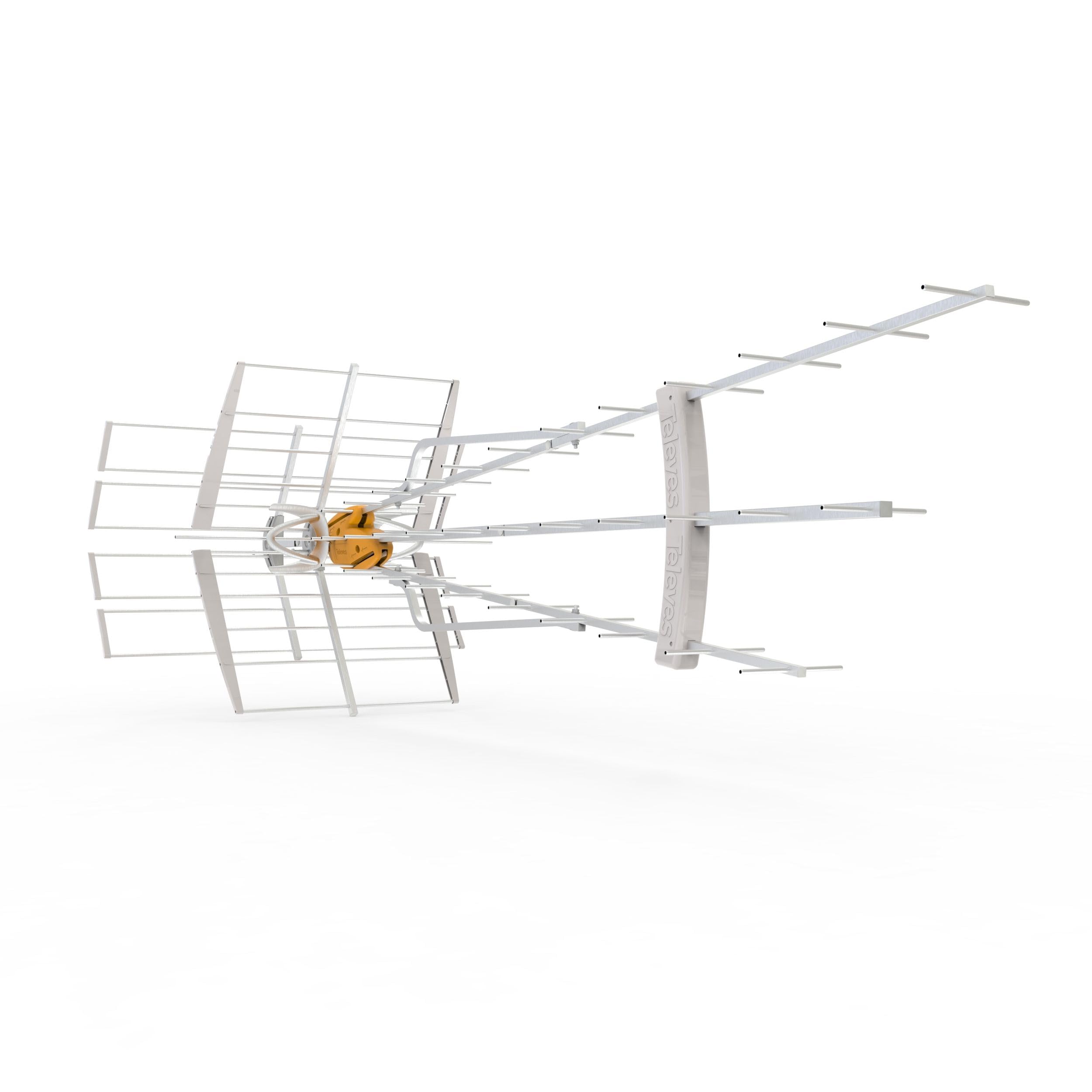
The Televes DAT BOSS Mix LR is a directional, stacked triple-boom antenna engineered for fringe reception up to 100 miles from transmitters, but the real magic is its proprietary TForce amplification. This system automatically adjusts gain independently per band—38 dBi for High VHF and 46 dBi for UHF—so you never overload the tuner even when a local station is strong and a distant one is weak. The built-in FM and LTE/4G/5G filtering above 608 MHz is critical for anyone living near a cell tower; it prevents that constant periodic pixelation that plagues lesser designs.
Users in extreme fringe areas report gains of 16 additional channels compared to their previous setups, with complete elimination of pixelation on high-UHF frequencies. The construction is all aluminum and stainless steel, weighing 10 pounds, and the included weather boot and mast clamps make professional-grade mounting straightforward. The dual operation mode is a clever touch—it works as a passive antenna if the power inserter fails, ensuring you never go completely dark.
The only real trade-off is its size. At 84 inches long and 34 inches wide, this is a large antenna that requires a solid mounting location. It’s not for a small attic space or a balcony. But for anyone in a rural or heavily wooded area who has struggled with cheap antennas, this is the final step in the cord-cutting journey.
Why it’s great
- Proven 60-mile+ fringe reception with stable signal lock
- Intelligent TForce amp prevents overload and handles variable signal strength
- LTE/5G filtering eliminates interference from nearby cell towers
Good to know
- Large size requires significant roof or mast space
- Premium price point may be overkill for suburban users within 30 miles of towers
2. PBD Amplified Outdoor TV Antenna

If you live in a situation where broadcast towers are scattered in different directions, the PBD motorized antenna solves a problem that no fixed antenna can. The 360-degree rotation is controlled by a wireless remote, so you can aim the antenna at Station A, then twist it 90 degrees for Station B without climbing onto the roof. This is a game changer for homes in valleys where signals are reflected off different ridges.
The unit includes a built-in high-gain amplifier and a 40-foot RG6 cable, plus dual TV outputs so a second set in the bedroom gets the same signal without a separate splitter. The included mounting pole and hardware are substantial, and the unit is weatherproof for outdoor use. A customer reported replacing a Mohu Sky 60 and gaining more channels without any pixelation, and the motorized feature meant they could point it directly at the farthest transmitter.
Keep in mind that the motor adds a layer of mechanical complexity. A few users noted that the rotator can be slower than expected, and you may need to fine-tune the angle for each channel group. The warranty is lifetime, and customer support responses are fast—one user had a missing coax cable and received immediate assistance.
Why it’s great
- Motorized rotation lets you target towers in different directions without climbing
- Dual TV outputs eliminate the need for a separate splitter
- Includes full mounting kit and 40 ft RG6 cable
Good to know
- Motor mechanism adds potential failure point over long-term use
- Can be slower to reposition than manually adjusting a fixed antenna
3. Antennas Direct ClearStream 2V
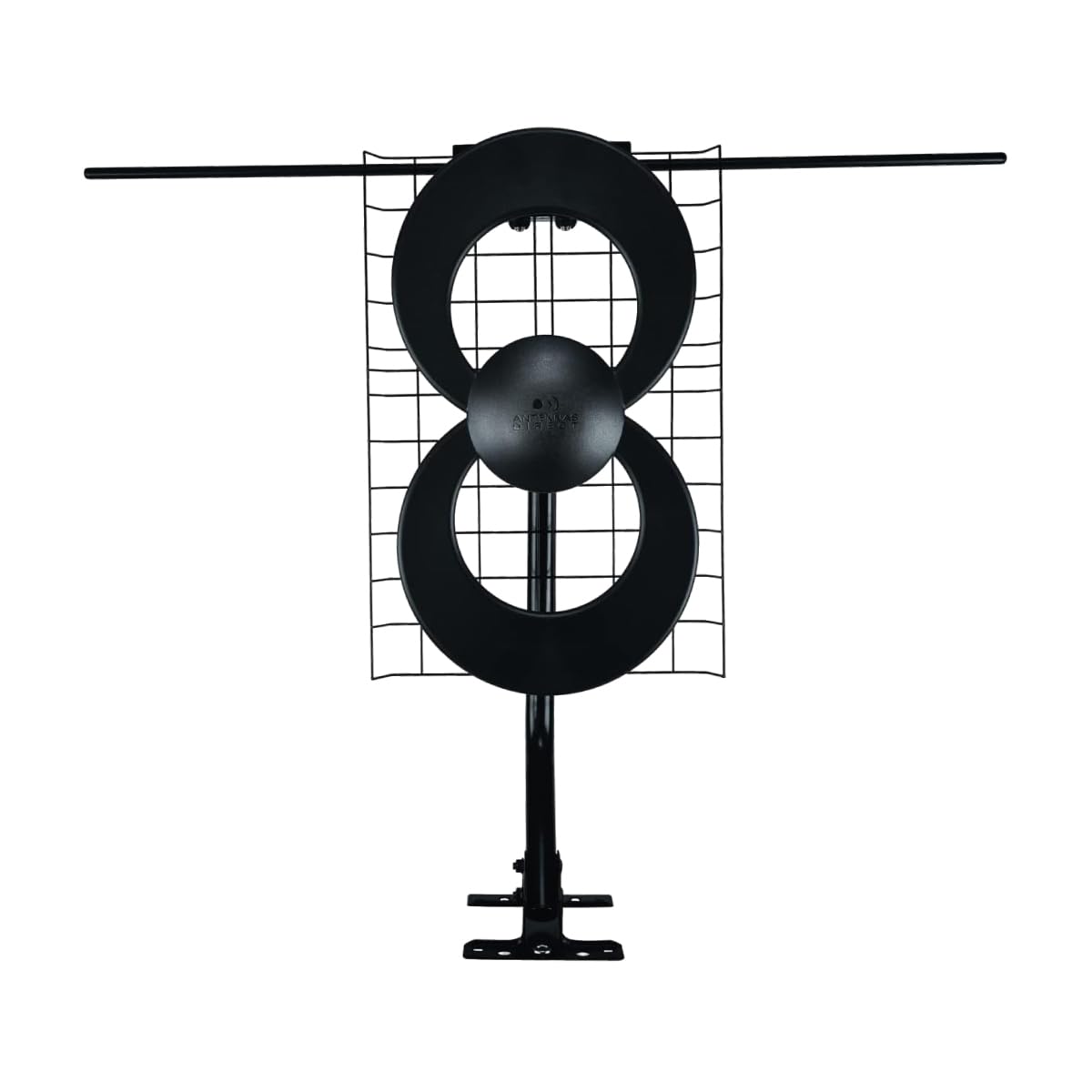
The ClearStream 2V is a double-loop design that combines multi-directional UHF reception with a dedicated Hi-VHF element, making it one of the few antennas that can reliably pull in channel 7 through 13 without a separate yagi. The included reflector adds forward gain and focuses the antenna’s reception cone, which reduces multipath interference from the sides and behind. This is particularly helpful in suburban neighborhoods where houses and trees create signal bounces.
Users in hilly, tree-covered areas report strong results. A customer 38 miles southwest of Seattle mounted it 15 feet high and received 70 channels, with 65 coming in perfectly clear—a result that matched their previous cable picture quality. Another user in a valley mounted it 20 feet high on a chimney and pulled in signals from Cleveland and Youngstown, and after raising it to 30 feet, even got Pittsburgh at over 90 miles. The size is manageable at 31 inches wide, and the pivoting mast base allows vertical or horizontal mounting.
One important detail: the antenna does not include a coax cable, so you will need to purchase RG6 separately. The assembly is simple, but watch the manufacturer’s video for precise alignment of the balun. The lifetime antenna warranty is a strong vote of confidence in its build quality.
Why it’s great
- Double-loop design with reflector reduces multipath interference
- Versatile indoor, attic, or outdoor mounting with included mast
- True Hi-VHF reception for channels 7-13, not just UHF
Good to know
- Coax cable must be purchased separately
- May require a pre-amp for cable runs over 50 feet
4. Mohu Leaf Amplified

The Mohu Leaf Amplified is the go-to option for apartment dwellers and renters who need a zero-permanent-installation solution. The antenna itself is only 9.25 by 11.38 inches and 0.04 inches thick, making it easy to tape to a window or wall without leaving a mark. The Jolt Switch in-line amplifier gives you a physical toggle to turn the boost on or off, which is useful if you’re close to towers and the amp is causing overload.
Performance is solid for indoor use. One customer in a brick home found around 60 channels across four different rooms with only minor pixelation on the most distant stations. Another reported 47 crystal-clear channels compared to only 21 with a budget antenna, picking up all major networks without any adjustment. The multi-directional UHF and Hi-VHF elements mean you don’t need to point it precisely—just place it in a high window facing the general direction of the towers.
The downside is the 12-foot coaxial cable, which can limit placement flexibility. Some users also complained the included push pins were unusable and had to use standard pins instead. It’s not a solution for anyone beyond 60 miles from towers, and will struggle in deep fringe areas.
Why it’s great
- Ultra-thin profile blends into any room decor
- Jolt Switch lets you toggle amplifier on/off to prevent overload
- Multi-directional reception reduces need for precise aiming
Good to know
- Short 12-foot coax cable limits antenna placement options
- Included mounting pins may be inadequate for some surfaces
5. Five Star TV Antenna Yagi

The Five Star Yagi delivers the performance of a classic outdoor directional antenna without the inflated price tag. Its extended receiving elements are longer than typical designs in its class, which translates to better capture of weaker signals. The measured gain is legit: 8 dB for VHF and 12 dB for UHF, which is competitive for a passive antenna at this tier.
Users in suburban and rural areas consistently report excellent results. One customer mounted it in an attic and went from 54 to 65 channels, including a low-power station that a previous 108-inch antenna failed to pull. Another user 25 miles from Chicago placed it in a basement near a window and got strong reception without any pixelation. The pre-assembled construction means you can get it up and running in about 15 minutes—just attach the elements to the boom and mount it on the included J-pole.
Be aware that this is a purely passive antenna—there is no built-in amplifier. For cable runs longer than 50 feet, you will need to add an external pre-amp. Also, the advertised 200-mile range is unrealistic; real-world performance is strong up to about 60-70 miles with clear line of sight. The included RG-59 coax is adequate for short runs, but for outdoor installations, upgrade to RG6 for better signal preservation.
Why it’s great
- Longer elements provide better weak-signal capture than comparable yagis
- Quick assembly and includes J-pole mount and 40 ft coax
- Excellent price-to-performance ratio for a passive antenna
Good to know
- No built-in amplifier; pre-amp needed for long cable runs
- Claims of 200-mile range are highly inflated
6. PIBIDI Outdoor TV Antenna

The PIBIDI outdoor antenna is designed for simplicity and reliability. The yagi elements come mostly pre-assembled, so you only need to attach a few pieces before mounting—no tools required. It is lightning protected with a grounding path, and the construction is durable enough to withstand tough weather conditions like heavy rain and wind. The working frequency covers both VHF (170-230 MHz) and UHF (470-860 MHz), which covers all major broadcast channels in the US.
User reports confirm strong performance in challenging environments. A reviewer in upstate South Carolina picked up many previously unknown OTA channels and mounted the antenna on a pole in under 30 minutes. One user did note it won’t quite hit the advertised 200-mile range, but that’s expected for any passive design.
The main limitation is the lack of a built-in rotator or amplifier. If your towers are in multiple directions, you’ll need to manually aim and lock the antenna. For cable runs longer than 50 feet, an external pre-amp is highly recommended. It also includes a 1-year warranty, which is solid for this price tier.
Why it’s great
- Easy tool-less assembly from pre-assembled elements
- Weather-resistant and lightning-protected for outdoor use
- Reception of stations 40-100 miles away in rural tests
Good to know
- Passive design requires external pre-amp for long coax runs
- No rotator included; manual adjustment needed for multi-directional towers
7. Arrasolt Melas 5000+ Miles Range TV Antenna
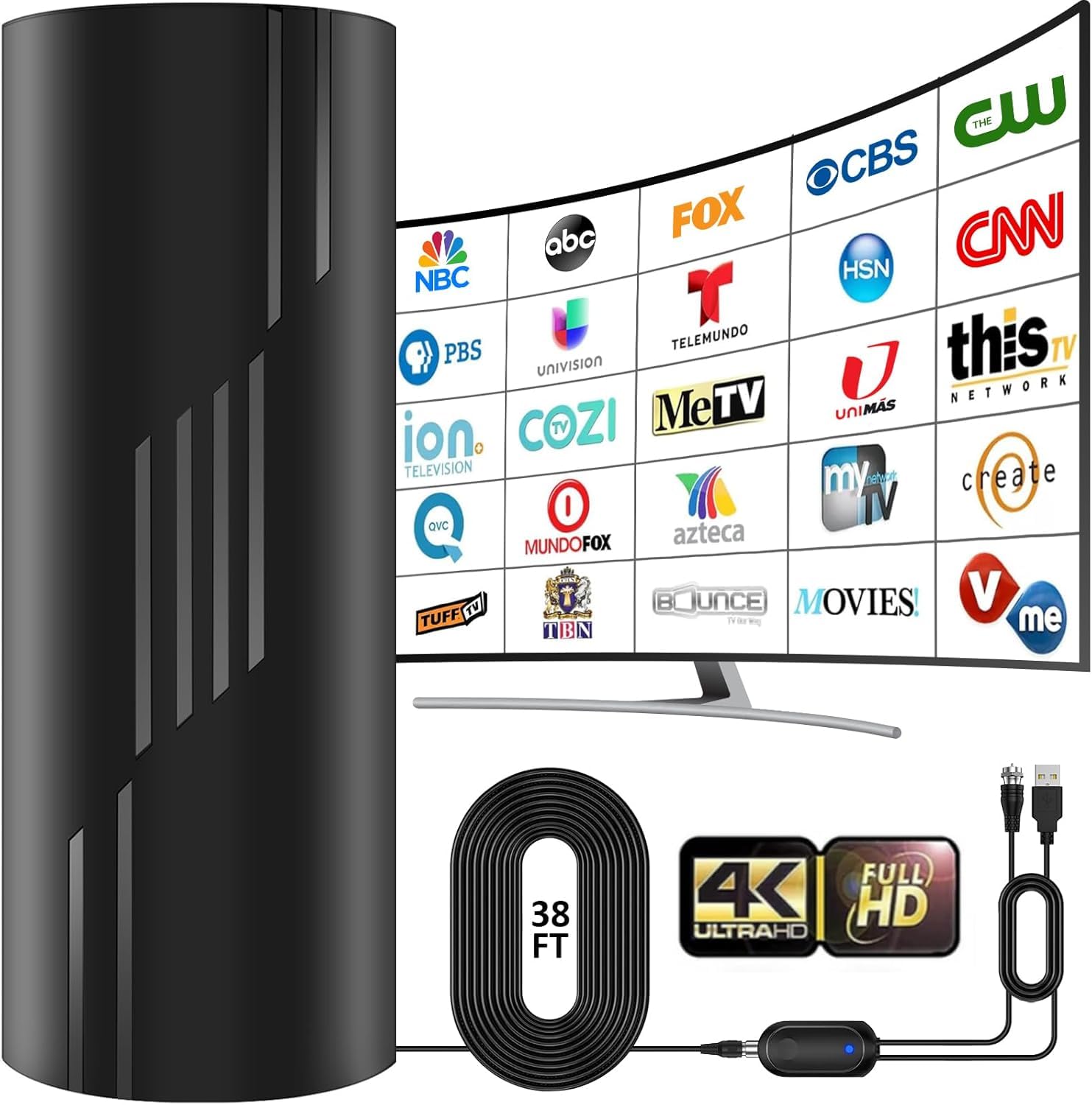
The Arrasolt Melas is a compact, amplified antenna designed for entry-level cord cutters who want a quick, simple setup. The built-in amplifier is powered via USB, and the 38-foot coaxial cable gives you flexibility to position it in a high window or on a wall. The slim, weatherproof design means it can be used indoors or outdoors on a balcony without looking obtrusive. It supports 4K and 8K HDR formats, so your picture quality won’t be the bottleneck if your TV can handle it.
Real-world performance is respectable for a small antenna. One user got about 25 channels with a clear picture when placed in a candle holder, and another reported consistent HD/4K signal in a suburban area, noting the amplifier helped pull in weak signals. The plug-and-play nature is genuine—connect to the “CABLE/ANT IN” port, run a channel scan, and you’re done. The 48-month warranty is unusually long for this tier and offers peace of mind.
The 5000-mile range claim is pure marketing fiction and should be ignored—this antenna works best within 30-40 miles of towers with a clear line of sight. Some users found that the built-in amplifier caused overload when too close to towers, so you might need to try different placement positions. It’s also not suitable for deep fringe reception, but for a city apartment or suburban home, it does the job.
Why it’s great
- Simple USB-powered amplification with a long 38-foot coax cable
- Compact profile works for both indoor and outdoor placement
- Generous 48-month warranty for budget-friendly peace of mind
Good to know
- Advertised 5000-mile range is wildly unrealistic
- Built-in amp can cause overload if placed too close to strong towers
FAQ
What is the real range difference between an indoor flat antenna and an outdoor yagi?
Do I need a pre-amp if I am using a passive yagi like the Five Star or PIBIDI?
How do I know if I need LTE/5G filtering in my antenna?
Final Thoughts: The Verdict
For most users, the antennas for tv winner is the Televes DAT BOSS Mix LR because its TForce amplifier and LTE filtering solve the two biggest problems in modern cord-cutting: variable signal strength and cell tower interference. If you want a motorized solution that lets you target towers in different directions without climbing on the roof, grab the PBD motorized antenna. And for a budget-friendly rooftop upgrade with a proven passive yagi, nothing beats the Five Star Yagi.

Mo Maruf
I created WellFizz to bridge the gap between vague wellness advice and actionable solutions. My mission is simple: to decode the research and give you practical tools you can actually use.
Beyond the data, I am a passionate traveler. I believe that stepping away from the screen to explore new environments is essential for mental clarity and physical vitality.