Our readers keep the lights on and my smoothie glass nicely filled. As an Amazon Associate, I earn from qualifying purchases.
Waking up on a cold, hard tent floor with a deflated mat is a classic camping misery. The right air mat for camping should suspend you above rocks and roots, insulate you from ground chill, and pack down small enough that you don’t resent carrying it. The difference between a great night outdoors and a miserable one often comes down to thickness, pump style, and fabric durability.
I’m Mohammad Maruf — the founder and writer behind WellFizz. I’ve spent countless hours cross-referencing consumer test data, analyzing foam densities, TPU coatings, and valve designs to separate the air mats that hold air from those that leave you sleeping on the ground by 3 a.m.
Whether you’re a weekend car camper or a thru-hiker trimming grams, this guide will help you find the best air mat for camping that matches your sleep style and budget without the guesswork.
How To Choose The Best Air Mat For Camping
Air mats vary widely in construction, insulation, and pump mechanisms. Picking the wrong one can mean a sleepless night or a heavy pack. Focus on these three factors to narrow your search fast.
1. Thickness and Sleeping Position
Side sleepers need at least 4 inches of loft to keep hips and shoulders off the ground. Back and stomach sleepers can manage with 2 to 3 inches, provided the mat doesn’t compress to zero under body weight. Thicker mats also offer more ground clearance, which helps with insulation in cold conditions.
2. Insulation and R-Value
R-value measures how well a mat resists ground heat loss. A rating of 1.0 to 2.0 suits summer-only use. For three-season camping (spring through fall), aim for R-value 2.5 to 4.0. Winter campers need 4.5 and above. If you sleep cold, prioritize insulation over pack weight.
3. Inflation System and Weight
Built-in foot pumps are the fastest hands-free option, inflating a mat in 30 to 90 seconds. Self-inflating foam mats are heavier but offer more comfort and durability. Manual inflation (mouth or hand pump) saves weight but adds effort and potential moisture inside the mat. Match the system to how often you set up camp and how much you’re willing to carry.
Quick Comparison
On smaller screens, swipe sideways to see the full table.
| Model | Category | Best For | Key Spec | Amazon |
|---|---|---|---|---|
| OGERY 6″ Thick | Premium | Car campers who want maximum loft | 6” thickness / 2.4 lbs | Amazon |
| Wevelel Memory Foam | Premium | 4-season campers needing high R-value | R-Value 9.5 / 3.1” thick | Amazon |
| VALEHOWL Ultralight | Mid-Range | Backpackers who want 4-season capability | R-Value 3.0 / 1.8 lbs | Amazon |
| Oramoose 4″ Thick | Mid-Range | Side sleepers wanting 4″ comfort on a budget | 4” thickness / 1.9 lbs | Amazon |
| KASIMO Built-in Pillow | Mid-Range | Campers wanting integrated pillow and pad linking | Built-in pillow / 1.8 lbs | Amazon |
| Amazon Basics Quick-Inflate | Budget | Budget-focused first-time campers | 1.4 lbs / 2” thick | Amazon |
| MalloMe Self-Inflating | Budget | Campers who prefer foam + air hybrid feel | Memory foam / 1.5” thick | Amazon |
In‑Depth Reviews
1. OGERY 6″ Extra-Thick Camping Sleeping Pad

The OGERY delivers the most loft of any mat in this comparison at a full 6 inches thick, making it a standout for side sleepers who need to keep hips and shoulders suspended above the tent floor. The built-in foot pump inflates the pad in under two minutes of steady stepping, and the dual-layer air valves prevent backflow during inflation. At 2.4 pounds, it’s not the lightest option, but the 50D polyester shell with TPU waterproof coating holds up well against rough terrain and campsite debris.
Customer feedback consistently highlights the mat’s ability to stay inflated through temperature drops overnight. One user reported sleeping comfortably with a toddler on the same pad without any sagging. The integrated pillow works best for back sleepers, though some side sleepers found the pillow too low. The fabric does produce a crinkling sound when shifting positions, a common trade-off with thick TPU-coated mats. The pack size is compact enough for car camping and short backpacking trips but may feel bulky for ultralight hikers.
For campers who prioritize ground clearance and all-night air retention over minimal weight, the OGERY strikes an excellent balance. The included carry bag and clear instructions make setup and breakdown straightforward. Consider this mat if you sleep cold or have chronic back pain and need consistent elevation from the ground.
Why it’s great
- 6-inch thickness provides superior ground separation for side sleepers
- Durable 50D polyester and TPU coating resists punctures and moisture
- Foot pump inflates quickly without extra gear or batteries
Good to know
- Crinkly fabric noise when shifting during sleep
- Bulky pack size may not suit ultralight backpackers
- Built-in pillow is low for side sleepers
2. Wevelel Memory Foam Sleeping Pad

The Wevelel takes a different approach by using high-density memory foam instead of pure air chambers. With a verified R-value of 9.5, this mat is purpose-built for winter camping and cold-ground conditions where standard air mats would leach body heat. The 3.1-inch thickness and 50D stretch knit fabric create a quiet, noiseless surface that won’t crinkle when you move — a significant advantage over TPU-coated mats. The self-inflating core requires opening three valves, letting the foam expand for about 10 seconds, then topping off with 20 seconds of foot-pump action.
At 6.59 pounds, this is a car-camping or base-camp mat, not a backpacker’s companion. The 800-pound static weight capacity means it can handle two smaller adults or one larger person without bottoming out. Users in the field, including military personnel, reported staying warm in temperatures in the high 30s to low 40s Fahrenheit. The built-in pillow is low-profile, so some users supplement it with a separate camping pillow. Deflation requires the dual-use valve system: opening only the first layer lets air out while preventing air from re-entering, making rolling and packing easier than traditional foam mats.
If you camp in cold weather or simply want a hotel-like sleeping surface that won’t rustle every time you roll over, the Wevelel delivers unmatched insulation and comfort. The trade-off is weight and pack size, so reserve this mat for trips where you drive to the campsite or have a short carry from the car to the tent.
Why it’s great
- R-Value 9.5 provides exceptional cold-weather insulation
- Memory foam and knit fabric are silent during movement
- Dual-use valve makes deflation easier than standard foam mats
Good to know
- Heavy at 6.59 pounds — car camping only
- Built-in pillow may be too low for some sleepers
- Deflation takes more effort than pure air mats
3. VALEHOWL Ultralight Camping Sleeping Pad
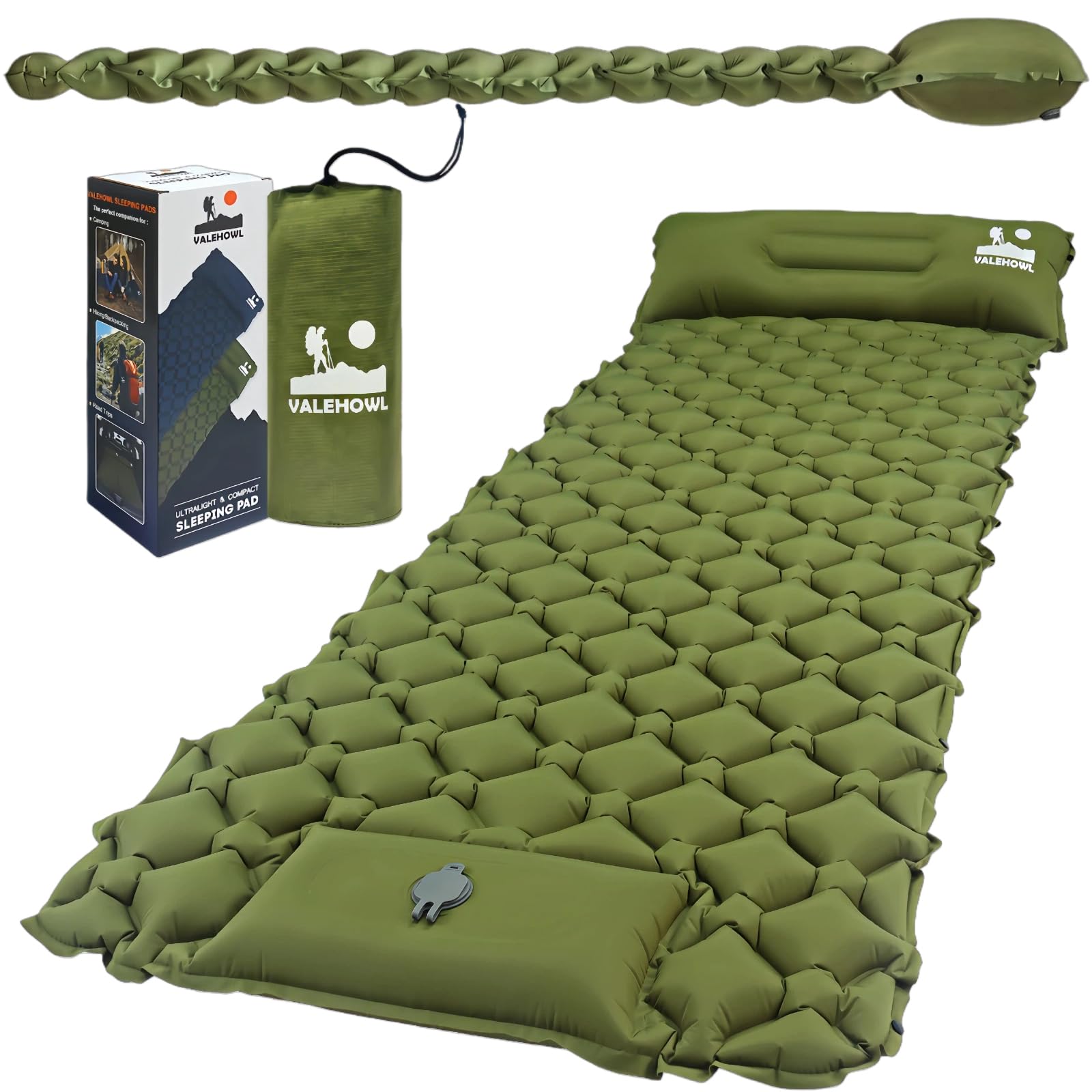
The VALEHOWL targets the sweet spot between packability and all-season versatility. At 1.8 pounds with a packed size of 10 by 5 inches, it fits into a backpack’s side pocket without crowding your main compartment. The R-value of 3.0 is sufficient for three-season use from spring through fall, and the honeycomb air chamber design distributes body pressure evenly across the 75-by-25-inch surface. The 40D nylon outer layer resists abrasion from rocks and branches, while the TPU inner coating creates a fully airtight seal that users have relied on down to freezing temperatures.
The built-in foot pump inflates the mat in about 40 seconds according to the manufacturer, though some users found it closer to a minute. The two-stage deflation system allows fine-tuning of firmness and rapid packing. Side snap buttons let you connect two pads for a double-wide sleeping surface, though one user noted that the button spacing varies slightly between units, making alignment imperfect. The integrated ergonomic pillow supports neck alignment but sits in a fixed position that may not suit every body type — some users replaced it with their own pillow for better comfort.
For backpackers who hike several miles into camp and need a mat that won’t weigh down their pack, the VALEHOWL offers an impressive balance of weight, warmth, and durability. Ensure both valve plugs are fully seated and clamped before sleeping to prevent slow air loss, a common oversight that accounts for most negative reviews.
Why it’s great
- Lightweight 1.8-pound design fits backpack side pockets
- R-Value 3.0 works for three-season camping conditions
- 40D nylon with TPU coating resists punctures and moisture
Good to know
- Pillow position may not suit all sleepers
- Connector button spacing can vary between units
- Requires careful valve sealing to prevent overnight air loss
4. Oramoose 4″ Thick Camping Sleeping Pad

The Oramoose brings 4 inches of thickness at a weight of just 1.9 pounds, making it one of the most dimensionally generous options for the pack weight. The V-shape support channels create a stable platform that keeps hips and shoulders suspended for side sleepers, and the 400-pound capacity means larger-framed users won’t bottom out. The built-in pillow contours to the neck curve, reducing the gap between head and shoulders better than many integrated pillows we’ve evaluated. The 40D nylon fabric handles rocky terrain and pet claws without tearing, and the TPU coating blocks ground moisture effectively.
Inflation via the foot pump takes around 30 seconds per the manufacturer, though user reports average closer to two to three minutes for full firmness. Some users found the pump less efficient when the valve wasn’t fully sealed, requiring a learning curve on the first use. The 24-hour air retention claim holds up in most cases, but a small percentage of units developed seam leaks after two to three nights of use — a risk consistent with budget-tier mats. The deflation valve releases air instantly, and the mat rolls down to a compact 9.4 by 4.3 inches, fitting into side pockets of most hiking packs.
For campers who want near-premium thickness and width without the premium price, the Oramoose delivers tangible value. The ability to link multiple pads together makes it practical for couples or family trips. Just be prepared to test the seal on your first outing and return it promptly if any seam defects appear.
Why it’s great
- 4-inch thickness supports side sleepers at 1.9 pounds
- 400-pound weight capacity accommodates larger users
- Compact pack size fits most backpack side pockets
Good to know
- Foot pump requires a learning curve for efficient inflation
- Small percentage of units experience seam leaks over time
- Not as durable as premium-grade 50D or 70D fabrics
5. KASIMO Camping Sleeping Pad with Built-in Pillow

The KASIMO focuses on convenience features that simplify camp setup. The integrated pillow eliminates the need to pack a separate camp pillow, saving both weight and bulk. The body-mapping technology uses variable-thickness air channels that cradle the torso while providing extra support under the hips. The 40D nylon top and 50D pongee bottom with TPU coating create a hybrid fabric that balances durability against ground abrasion with a softer sleeping surface. At 1.76 pounds and a rolled size of 11 by 3.9 inches, it competes directly with the VALEHOWL on portability.
The foot pump fills the mat in 30 to 60 seconds, and the dual-layer valves include anti-leakage films that prevent backflow. Users consistently report no overnight air loss, even after multiple nights of use. The side buttons let you connect two pads to create a double-wide sleeping surface, which works well for couples. Some users noted that the fabric has a crinkly texture similar to the OGERY, producing noise when shifting positions. The 3-inch thickness provides adequate ground clearance for back and stomach sleepers but may feel insufficient for dedicated side sleepers who need more loft.
If you want an all-in-one sleep system that reduces the number of gear items you need to carry, the KASIMO delivers reliable performance at a weight that won’t weigh you down. The included storage bag, repair patches, and clear instructions make it a solid choice for beginners and intermediate campers alike.
Why it’s great
- Integrated pillow saves pack space and weight
- Dual-layer valves prevent air backflow during inflation
- Connector buttons allow linking two pads for double width
Good to know
- 3-inch thickness may not suit dedicated side sleepers
- Crinkly fabric sound when shifting positions
- Pillow position is fixed and not adjustable
6. Amazon Basics Camping Sleeping Pad

The Amazon Basics pad is the lightest option here at 1.4 pounds, making it an easy choice for backpackers who prioritize minimal pack weight above all else. The Insta-Pump Technology uses a built-in foot pump that inflates the pad in under 60 seconds, and the 190T polyester fabric provides basic water resistance for damp tent floors. The inflated dimensions of 75 by 22 inches with a 2-inch thickness create a slim profile that works well for stomach sleepers and back sleepers who don’t need much loft. The packed size of 12 by 4 inches fits neatly into a backpack’s main compartment or side pocket.
Customer satisfaction is generally high, with many users reporting multiple nights of leak-free performance and comfortable sleep on hard surfaces. However, a notable number of reviews describe the built-in pump failing to function properly, requiring mouth inflation instead. Some units do not hold inflation overnight, deflating completely within a few hours — this appears to be a quality-control issue rather than a design flaw. The 2-inch thickness provides minimal cushioning against rocks and roots, so campervans or well-prepared tent sites are recommended over raw ground.
For budget-conscious campers or those assembling a first-time camping kit, the Amazon Basics pad offers an affordable entry point. Test it at home before your first trip to confirm the pump works and the mat holds air. If you need a reliable mat for uneven or rocky terrain, consider stepping up to a thicker model.
Why it’s great
- Ultralight 1.4-pound design ideal for weight-conscious backpackers
- Budget-friendly entry point for first-time campers
- Quick inflation with built-in foot pump when it works
Good to know
- 2-inch thickness offers minimal ground insulation for side sleepers
- Built-in pump has quality-control issues with some units
- Deflation overnight reported by a subset of users
7. MalloMe Camping Mattress Sleeping Pad
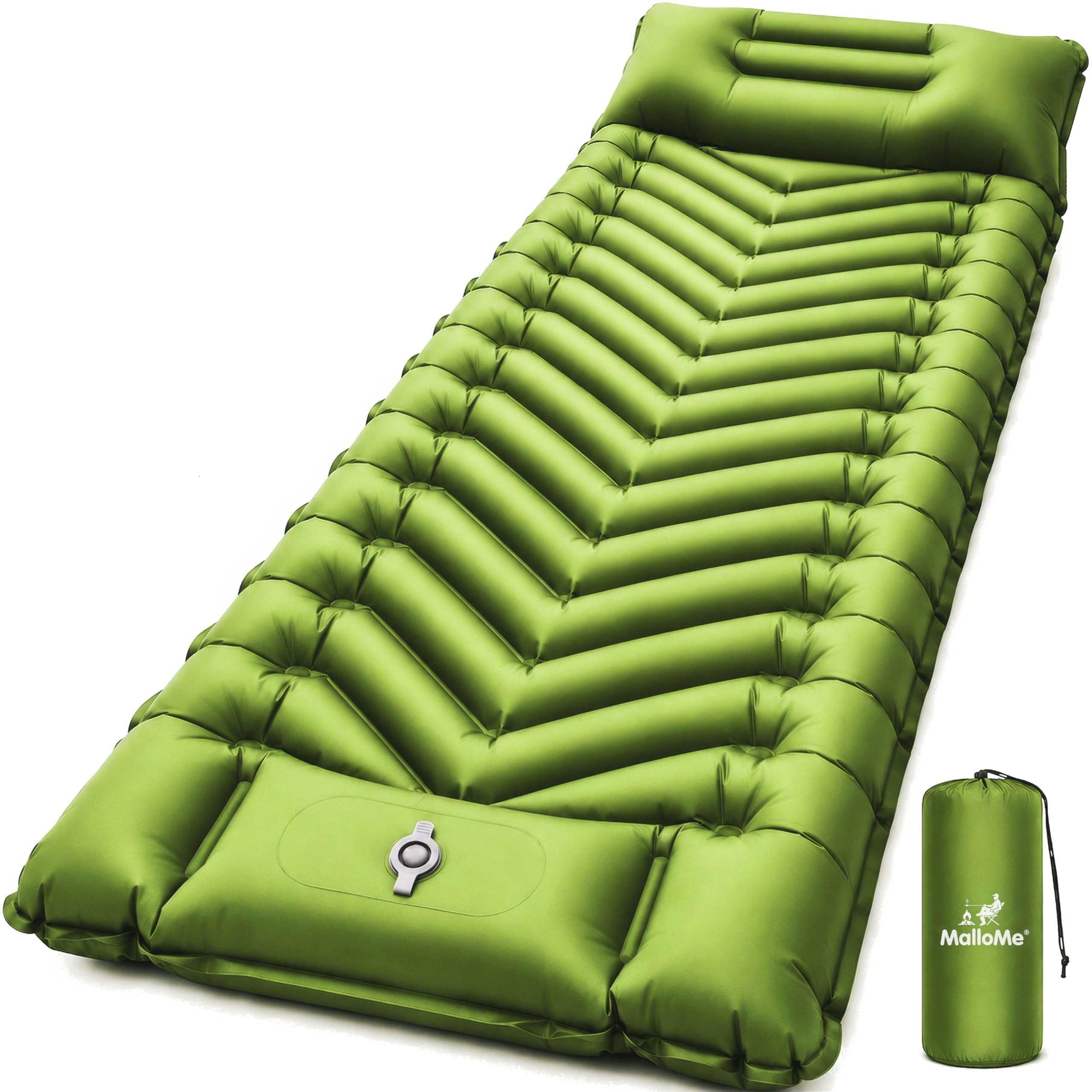
The MalloMe employs a patented Chevron V-shape air-cell design that combines an air core with memory foam for a plush surface that contours to body shape. The 50D polyester outer fabric is 25 percent tougher than standard 40D options, providing better resistance against punctures and seam stress. The self-inflating mechanism uses foam expansion to draw air into the pad, eliminating the need for a separate pump — though the initial inflation takes 30 minutes or more for full expansion, and many users top it off with a few breaths for desired firmness. The built-in pillow adds to the convenience for car campers.
At 1.5 inches of thickness, this mat is noticeably thinner than the air-only options in this guide. The self-inflating foam core provides better insulation per inch than a pure air chamber, but side sleepers will likely feel the ground through the pad. The plush top fabric is soft and quiet, avoiding the crinkling noise common to TPU-coated pads. Users up to 6 feet 2 inches report adequate length, and the included storage sack makes packing manageable. The pad rolls to approximately the size of a foam sleeping pad, larger than most air mats when deflated.
For campers who sleep on their back or stomach and value a soft, quiet surface over maximum loft, the MalloMe delivers a comfortable hybrid experience. It works best for car camping, festival weekends, or as a guest bed where weight isn’t a constraint. If you need substantial ground clearance for side sleeping, a thicker air-only mat will serve you better.
Why it’s great
- Memory foam surface is soft, quiet, and contours to body shape
- Self-inflating design requires no pump or mouth inflation
- 50D fabric offers enhanced puncture resistance over standard mats
Good to know
- 1.5-inch thickness provides minimal ground clearance for side sleepers
- Full self-inflation takes 30 minutes or longer
- Deflated pack size is bulkier than pure air mats
FAQ
What R-value do I need for three-season camping?
How do I prevent my air mat from deflating overnight?
Are built-in foot pumps reliable for long-term use?
Can I use an air mat for camping in winter?
How do I clean and store an inflatable camping mat?
Final Thoughts: The Verdict
For most users, the best air mat for camping winner is the OGERY 6″ Extra-Thick pad because it delivers exceptional ground clearance, durable materials, and reliable air retention at a weight that works for both car camping and short backpacking trips. If you want maximum insulation for cold-weather adventures, grab the Wevelel Memory Foam pad. And for backpackers who need a lightweight, packable four-season option, nothing beats the VALEHOWL Ultralight pad.

Mo Maruf
I created WellFizz to bridge the gap between vague wellness advice and actionable solutions. My mission is simple: to decode the research and give you practical tools you can actually use.
Beyond the data, I am a passionate traveler. I believe that stepping away from the screen to explore new environments is essential for mental clarity and physical vitality.