Our readers keep the lights on and my smoothie glass nicely filled. As an Amazon Associate, I earn from qualifying purchases.
If you are buying pre-sliced deli meat, you are paying a massive markup for someone else to run a machine you could own yourself. A meat slicer pays for itself within months, but picking the wrong one means shredded meat, a motor that bogs down on a block of cheddar, and a cleaning process that takes longer than the meal prep itself. The goal is uniform, clean slices without fighting the machine at every turn.
I’m Mohammad Maruf — the founder and writer behind WellFizz. I’ve spent years analyzing small kitchen appliance specs, comparing motor torque, blade metallurgy, and safety certifications to identify the models that actually hold up to weekly use without falling apart.
For the home cook who wants consistent results without breaking the bank, finding the right affordable meat slicer means prioritizing a sharp, durable blade, a motor strong enough for semi-frozen roasts, and a design that doesn’t require a toolkit to clean.
How To Choose The Best Affordable Meat Slicer
The wrong slicer can turn a weekend meal prep session into a grinding chore. Home-use models vary wildly in motor quality, blade sharpness, and real-world usability. Here are the three factors that separate a daily driver from a paperweight.
Blade Size and Metallurgy
The 7.5-inch diameter is the sweet spot for home kitchens — large enough to slice a brisket flat but compact enough to store. Blade material matters more than marketing claims: SUS420 and German high-carbon steel hold an edge longer than basic 304 stainless, but all three are acceptable if you sharpen periodically. A serrated blade excels on crusty bread and soft cheeses; a smooth blade gives cleaner cuts on raw meat and deli roasts.
Motor Power (200W Baseline)
At the budget-friendly tier, 150W to 200W is the standard range. A 200W motor with a blade speed of 70–100 RPM will handle boneless hams, blocks of cheese, and partially frozen meat without stalling. Motors below that threshold may struggle with anything denser than cooked turkey breast. DC motors are quieter and deliver steadier torque than universal AC motors — a feature worth the mid-range premium.
Cleaning Accessibility
Every review collected for this category mentions cleaning difficulty. Models with tool-free blade removal, detachable food carriages, and dishwasher-safe components save significant time. A slicer that requires disassembly with a star bit or leaves inaccessible crevices where fat residue collects will quickly stop being used.
Quick Comparison
On smaller screens, swipe sideways to see the full table.
| Model | Category | Best For | Key Spec | Amazon |
|---|---|---|---|---|
| Borlebbi 200W DC Motor | Premium | Quiet operation & cheese slicing | 200W DC Motor; 42 dB | Amazon |
| TOKASS 200W | Premium | Long motor life & dual blades | High-Carbon Steel Blades | Amazon |
| FOHERE 200W | Mid-Range | Dual raw/cooked blades | Die-cast Aluminum Body | Amazon |
| VEVOR 7.5″ | Mid-Range | Compact storage & ETL safety | 200W / 70-100 RPM | Amazon |
| Nutrichef 200W | Mid-Range | Sourdough bread slicing | Removable 7.5″ Blade | Amazon |
| OSTBA 150W | Budget | Entry-level dual blade use | 6.7″ Dual Blades | Amazon |
| Cogace Foldable Slicer | Budget | Ultra-compact storage | 0-20mm Thickness Range | Amazon |
In‑Depth Reviews
1. Borlebbi 200W DC Motor Meat Slicer

The Borlebbi stands out because it uses a 200W DC motor, which delivers steady torque at significantly lower noise levels than universal AC motors. Users consistently report it can shave cheddar paper-thin without the cheese crumbling — a test that stalls many budget-friendly competitors. The two 7.5-inch stainless steel blades (serrated and smooth) cover raw meat, crusty bread, and soft cheese without changing the setup.
The detachable design makes cleaning manageable: the blade unlocks with a tab, and the food carriage slides off for rinsing. The suction feet grip firmly on a stainless steel baking sheet, addressing the stability issue that plagues lightweight plastic models. A few users noted the blade lock mechanism can be fiddly, but the quiet, precise slicing justifies the mid-range investment.
For the home cook who wants deli-quality results without the noise or the hassle of a commercial-grade unit, the Borlebbi earns the top spot. The cord length is generous, and the 0-15mm thickness dial adjusts smoothly during operation, letting you switch from shaved beef for Philly cheesesteaks to thick-cut bread without stopping.
Why it’s great
- DC motor runs quieter than any AC unit in this tier
- Slices hard cheese paper-thin without crumbling
- Easy blade unlock tab for cleaning
Good to know
- Can be easy to misplace the blade lock tab
- Meat bits occasionally get behind the blade into the gear compartment
2. TOKASS 200W Meat Slicer

The TOKASS is built around an upgraded motor design focused on extended service life — the primary failure point in budget-tier slicers. It pairs that with German high-carbon steel blades, which resist rust and hold sharpness longer than basic 304 stainless. The dual-blade kit (serrated and non-serrated) lets you switch between raw brisket for jerky and cooked roast beef without cross-contamination.
Safety is a clear priority: the unit requires pressing a child lock button simultaneously with the power switch to start — a good safeguard for households with curious kids. The stepless thickness adjustment knob ranges from ultra-thin (barely a millimeter) to roughly 3/4-inch thick, giving you the full spectrum for deli slicing through bread. The stainless steel tray adds convenience for catching slices.
Users praise its performance on holiday roasts and homemade beef jerky, noting that the 200W motor powers through semi-frozen top round without bogging down. The main complaint — common across nearly every slicer in this class — is that some components don’t fully disassemble, so wiping down the interior requires patience. Still, the build quality and warranty support make it a compelling premium option.
Why it’s great
- German high-carbon steel blade holds edge longer than typical stainless
- Child safety lock and dual-switch start prevent accidents
- Stepless thickness dial covers ultra-thin to 3/4-inch
Good to know
- Some parts do not come apart fully, making deep cleaning harder
- Motor can struggle slightly if meat is completely frozen
3. FOHERE 200W Meat Slicer

The FOHERE packs genuine value: a 200W motor and two 7.5-inch 304 stainless steel blades (serrated for bread and soft foods, smooth for raw meat) in a machine that uses die-cast aluminum for the body rather than thin-gauge steel or plastic. That aluminum housing resists rust and adds heft, keeping the unit stable during aggressive slicing of dense foods like block cheese or semi-frozen pork belly.
The 0-15mm thickness dial delivers precise control, and users confirm it handles homemade jerky, pastrami, and even frozen meat for smoking without complaint. The food pusher doubles as a blade guard, and the non-slip feet keep the slicer planted on the counter. Several reviewers noted the blade change process is straightforward, and the included smooth blade excels at producing uniform deli slices.
Where it falls short of the premium tier: the slide carriage can feel slightly clunky, and a half-inch gap between the slide and blade wall means narrow items like a single sausage can tip and fall through. Cleaning requires attention — the aluminum body wipes clean, but the blade area demands the same careful disassembly as other models. Despite those quirks, the build materials and motor performance make it a smart choice for the mid-range shopper.
Why it’s great
- Die-cast aluminum body resists rust and adds stability
- Includes both serrated and smooth blades for raw/cooked separation
- Motor handles semi-frozen meat and hard cheese reliably
Good to know
- Slide can feel clunky, with a gap that swallows narrow items
- Blade assembly still requires careful manual cleaning
4. VEVOR 7.5″ 200W Electric Deli Slicer
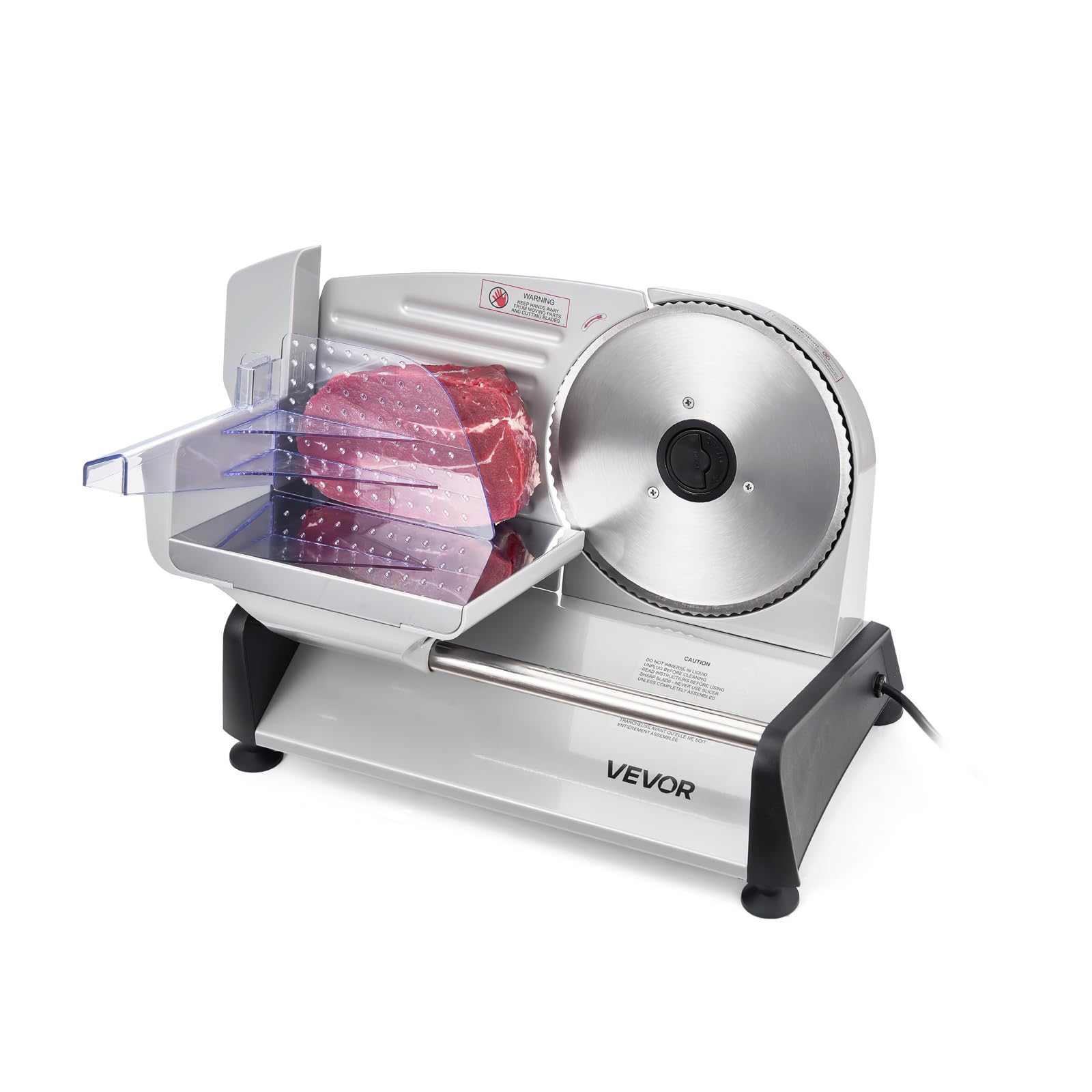
VEVOR brings a solid mid-range contender with a 190mm (7.5-inch) SUS420 stainless steel blade powered by a 200W motor running at 70-100 RPM. The SUS420 steel is a cut above generic stainless — it maintains edge sharpness longer and resists staining from acidic foods like tomatoes or citrus-marinated meats. ETL certification adds credibility to the safety claims, including a housing that stands 1mm above the blade to prevent accidental contact.
The 0-15mm (0-0.6 inch) thickness adjustment knob allows fine control, and users confirm it can slice 10 pounds of sukiyaki meat in one session without hiccups once the back plate and sliding plate are properly aligned out of the box. The compact footprint (15.16 x 10.04 x 10.83 inches) fits easily in a standard cabinet, and the rubber suction feet hold well on smooth surfaces.
The learning curve is real: several reviewers had to spend time adjusting the alignment of the back plate and thickness knob to get consistent cuts. Cleaning is typical for this class — the blade and carriage disassemble, but the black guide piece requires a star bit to remove, which is an unnecessary friction point. For anyone willing to do a one-time dial-in, the VEVOR delivers reliable performance at a price that undercuts most dual-blade models.
Why it’s great
- SUS420 blade resists staining and holds an edge well
- ETL certified with blade guard safety design
- Compact enough for drawer or cabinet storage
Good to know
- Requires alignment adjustment out of the box
- Guide piece needs a star bit tool for removal
5. Nutrichef 200W Electric Meat Slicer

The Nutrichef prioritizes ease of entry: its 200W motor and 7.5-inch stainless steel blade sit in a lightweight black ABS and aluminum body, and the blade removes without tools for cleaning. That convenience is a real advantage for anyone who does not want to spend 15 minutes scrubbing a slicer after every use. The adjustable dial spans 0-15mm, and the safety guard with a hub-based blade removal system makes it approachable for first-time owners.
Buyers have put this machine through its paces on sourdough bread, homemade seitan, and thin-shaved deli meats, consistently praising the uniform cuts and the strong suction feet that keep the unit planted. The compact dimensions (13.9 x 9.9 x 10.9 inches) are among the smallest in this roundup, a benefit for kitchens with limited counter real estate. The blade rotates slowly, which reduces noise but also means you cannot rush through a large batch.
The trade-off for that lightweight build: users report that the carriage can be slightly small for large roasts, and the slow blade speed means slicing a whole block of cheese takes a bit longer. A few reviewers noted minor crumb buildup behind the blade guard, though the removable design makes a quick rinse feasible. For a home user slicing a few pounds per session, the Nutrichef offers a hassle-free experience that prioritizes cleanability over raw speed.
Why it’s great
- Tool-free blade removal simplifies cleanup significantly
- Lightweight and compact for small kitchens
- Strong suction feet keep the unit stable during use
Good to know
- Carriage is small for large cuts of meat or thick loaves
- Slow blade rotation extends slicing time for batch work
6. OSTBA 150W Meat Slicer Machine

The OSTBA enters the budget-friendly tier with a 150W motor and two 6.7-inch 304 stainless steel blades (one serrated, one non-serrated). The smaller blade diameter and lower wattage mean this machine is best suited for lighter-duty slicing: cooked roast beef, boneless chicken breast, bread, and soft cheeses. The 0-15mm thickness dial is responsive, and users confirm it produces clean slices on brisket for pho and bottom round for homemade lunch meat.
The party piece here is dishwasher-safe components. Both blades and the food carriage can go directly into the dishwasher, which is rare at this price point and addresses the #1 complaint about home slicers. The suction cup feet prevent sliding, and the food pusher doubles as a blade guard. A few reviewers noted the motor runs slower than expected, but the torque is adequate for the intended use case.
The main constraint is power: the 150W motor will bog down on hard things like frozen meat, large blocks of aged cheddar, or dense salami. Some users also observed that the blade does not always produce a perfectly clean cut — there can be minor tearing on very soft bread or ripe tomatoes. For a first-time buyer looking to slice a few pounds per week without a major investment, the OSTBA delivers functional performance with the best cleanup in its class.
Why it’s great
- Dishwasher-safe components solve the cleaning pain point
- Dual blades (serrated and smooth) for food separation
- Lightweight and easy to store in a cabinet
Good to know
- 150W motor struggles with frozen or very dense foods
- Cut quality can be inconsistent on soft bread or ripe produce
7. Cogace Foldable Meat Slicer

The Cogace takes a different approach: a foldable design that collapses for storage in a drawer or closet, freeing counter space when not in use. The 6.7-inch German RSG stainless steel blade is genuinely sharp for the price point, and the 0-20mm thickness range is the widest in this roundup, offering flexibility from paper-thin jerky slices through thick-cut bread. CE/ETL certifications and a child safety lock add legitimacy to the safety claims.
Users who have put it to work on turkey, ham, and beef for jerky report that the RSG blade cuts cleanly and the foldable hinge mechanism feels solid — one reviewer dropped it without breakage. The one-twist disassembly for cleaning is straightforward, and the plastic body makes it lightweight enough to move between the counter and storage easily. The thickness dial is smooth, and the suction feet hold well on smooth surfaces.
That said, the plastic construction raises durability concerns for heavy use. A vocal minority of buyers found it flimsy and difficult to clean thoroughly due to crevices in the hinge area. For the user with minimal counter space who needs a slicer for occasional use (a few pounds per session), the Cogace foldable is a legitimately novel solution. For weekly bulk meal prep, the all-metal options above will last longer.
Why it’s great
- Foldable design is genuinely space-saving for small kitchens
- German RSG blade is sharp for entry-level use
- Widest thickness range (0-20mm) in the budget tier
Good to know
- Plastic construction feels flimsy for regular heavy-duty use
- Motor can overheat if run for long continuous sessions
- Cleaning crevices around the hinge area is tedious
FAQ
Should I slice meat completely frozen or thawed?
How often do I need to sharpen the blade on a home slicer?
Is a serrated blade or a smooth blade better for home use?
Can I slice cheese without it sticking or crumbling?
What is the real difference between 150W and 200W for home slicing?
Final Thoughts: The Verdict
For most users, the affordable meat slicer winner is the Borlebbi 200W DC Motor because it delivers quiet operation, consistent torque for cheese and semi-frozen meat, and a detachable design that does not punish you at cleanup time. If you want two dedicated blades for raw and cooked foods without paying a premium, grab the FOHERE 200W. And for a kitchen with zero counter space to spare, nothing beats the Cogace Foldable Slicer.

Mo Maruf
I created WellFizz to bridge the gap between vague wellness advice and actionable solutions. My mission is simple: to decode the research and give you practical tools you can actually use.
Beyond the data, I am a passionate traveler. I believe that stepping away from the screen to explore new environments is essential for mental clarity and physical vitality.