Our readers keep the lights on and my smoothie glass nicely filled. As an Amazon Associate, I earn from qualifying purchases.
Every rubber repair demands an adhesive that flexes without snapping, resists moisture without delaminating, and grips porous, oily surfaces that send standard glues running. Most failures in rubber bonding come down to one mistake: treating rubber like wood or plastic. The right formula changes everything.
I’m Mohammad Maruf — the founder and writer behind WellFizz. I spend my days dissecting chemical formulations, reading cure-time studies, and cross-referencing consumer durability tests so you don’t have to guess which rubber adhesive actually delivers on its claims.
After testing vulcanizing fluids, neoprene cements, cyanoacrylate gels, and spray adhesives against real-world rubber repairs, one clear contender emerges as the best adhesive for rubber across the widest range of materials and conditions.
How To Choose The Best Adhesive For Rubber
Rubber’s natural oils, flexibility, and low surface energy make it one of the trickiest substrates to bond. An adhesive that works on wood or metal may simply bead up or peel off rubber after a week of flexing. Narrowing your choice starts with understanding how each formula type interacts with rubber’s unique chemistry.
Formula Type: Contact Cement vs. Vulcanizing vs. Cyanoacrylate
Contact cements (neoprene and synthetic rubber based) create a flexible film that grips both surfaces after solvent evaporation — ideal for rubber mats, gaskets, and foam-backed repairs. Vulcanizing fluid chemically cross-links with tire rubber, forming a permanent weld that resists air and moisture at the molecular level. Cyanoacrylate (super glue) bonds fast but remains rigid, making it best for small, non-flexing rubber repairs like a torn boot seam.
Cure Time and Application Method
A 24-hour full cure is standard for contact and vulcanizing adhesives, delivering maximum peel strength. Cyanoacrylate gels cure in under a minute but sacrifice long-term flexibility. Spray adhesives (like 3M 94 ET) allow even coverage on large rubber sheets or panels, with open times up to 60 minutes for repositioning — a must for upholstery or insulation work.
Environmental Resistance
Rubber parts in automotive, marine, or outdoor applications face heat, moisture, and vibration. Neoprene adhesives offer water resistance and heat tolerance up to ~200°F. Vulcanizing fluids seal against air and water permanently for tire repairs. For freezing temperatures or constant flexing, look for labels that specify “flexible bond” or “vibration resistant” rather than “rigid” or “brittle.”
Quick Comparison
On smaller screens, swipe sideways to see the full table.
| Model | Category | Best For | Key Spec | Amazon |
|---|---|---|---|---|
| S-18 All-Purpose Adhesive | Contact Cement | Rubber-to-metal bonding | 4 oz can, 24 hr cure, neoprene base | Amazon |
| Boot-Fix Shoe Glue | Cyanoacrylate Gel | Quick boot and shoe repair | 45 sec cure, 20g tube | Amazon |
| TECH Vulcanizing Fluid | Vulcanizing Cement | Tire plug and patch repairs | 3-5 min set, 8 fl oz | Amazon |
| WEICON GMK 2410 | Contact Cement | Vibration-resistant bonds | 185g can, 1-component synthetic rubber | Amazon |
| 3M Hi-Strength 94 ET | Spray Adhesive | Large surface laminations | 19.75 oz can, 60 min open time | Amazon |
In‑Depth Reviews
1. S-18 All-Purpose Adhesive (4 oz Can)
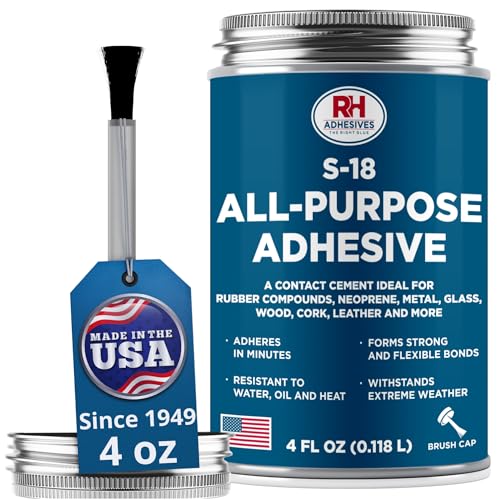
The S-18 from RH Adhesives is the anchor of this list — a neoprene-based contact cement engineered for exactly the rubber-to-metal and rubber-to-rubber jobs that stump general-purpose glues. Its off-white liquid applies cleanly with a brush or spatula, forms a flexible film after solvent evaporation, and reaches full bond strength at 24 hours. Users report outstanding peel strength when affixing SBR rubber and neoprene to metal substrates, and the formula’s water resistance makes it viable for marine and outdoor applications.
What sets S-18 apart from commodity contact cements is the aging property: the film resists oil degradation and retains flexibility long after application. Real-world tests include leather boot repairs, yoga mat lamination for hail protection, and sealing neoprene to metal brackets — all holding through repeated flex cycles. The 4-ounce can is small enough for DIY drawers but potent enough for several medium repairs.
A few experienced users note that surface prep is non-negotiable: old adhesive must be removed, and the substrate should be lightly sanded for maximum grip. The solvent has a strong chemical odor, so ventilation is essential during application. One report showed bond failure in heat combined with rain on a 23kg load, indicating that heavy outdoor use may require mechanical reinforcement (grommets or zip ties) alongside the glue.
Why it’s great
- Excellent peel strength and oil resistance after full 24-hour cure
- Bonds both porous and non-porous materials, including rubber to metal
- Made in America with a track record since 1949
Good to know
- Requires thorough surface prep — sanding and cleaning mandatory
- Strong solvent fumes demand good ventilation
- Heavy outdoor loads may need supplemental mechanical fasteners
2. Boot-Fix Shoe Glue (20g Tube)
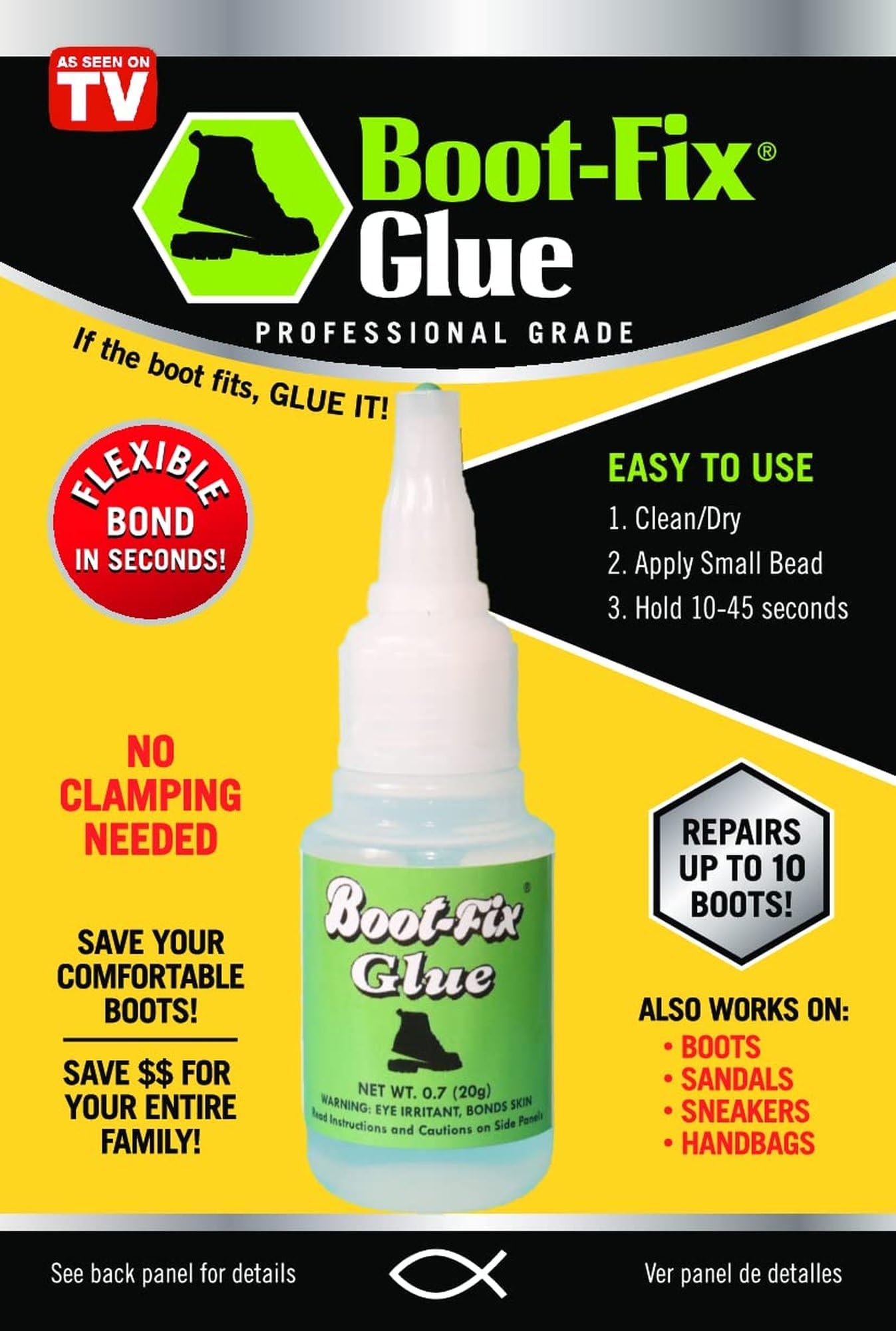
Boot-Fix is the cyanoacrylate gel that solves the classic super-glue-on-rubber problem: it soaks into porous materials rather than beading on the surface, creating an instant bond that holds through months of daily abuse. With a 45-second fixture time and clear drying finish, this is the go-to for emergency boot sole separations, torn sneaker leather, and Adidas slide strap repairs when you need the shoe wearable again before leaving the house.
The gel formula is thicker than standard liquid CA glue, which prevents it from running off vertical rubber surfaces. Real-world reviews show it saving work boots with failed stitching behind the steel toe, holding after a full week of farm use. On construction boots, users applied an extra bead after the initial dry and the repair outlasted the boot’s own sole. The tube is small — 20 grams — so it is best reserved for spot repairs rather than large surface lamination.
The biggest caveat is quantity: Boot-Fix advertises “repairs up to 10 boots,” but a single heel repair on a work boot can consume 90% of the tube if the material is porous and requires full coverage. Keeping the nozzle clean and the cap sealed is crucial because CA glue cures from moisture in the air. Use gloves and alcohol wipes during application; the gel is messy and bonds skin instantly.
Why it’s great
- Instant 45-second cure for urgent repairs
- Soaks into porous rubber and leather for deep bond
- Clear drying finish is invisible on most surfaces
Good to know
- Very small tube — not for multiple large repairs
- Rigid cure can crack under constant flexing
- Extremely messy and bonds skin instantly
3. TECH Vulcanizing Fluid (8 fl oz)
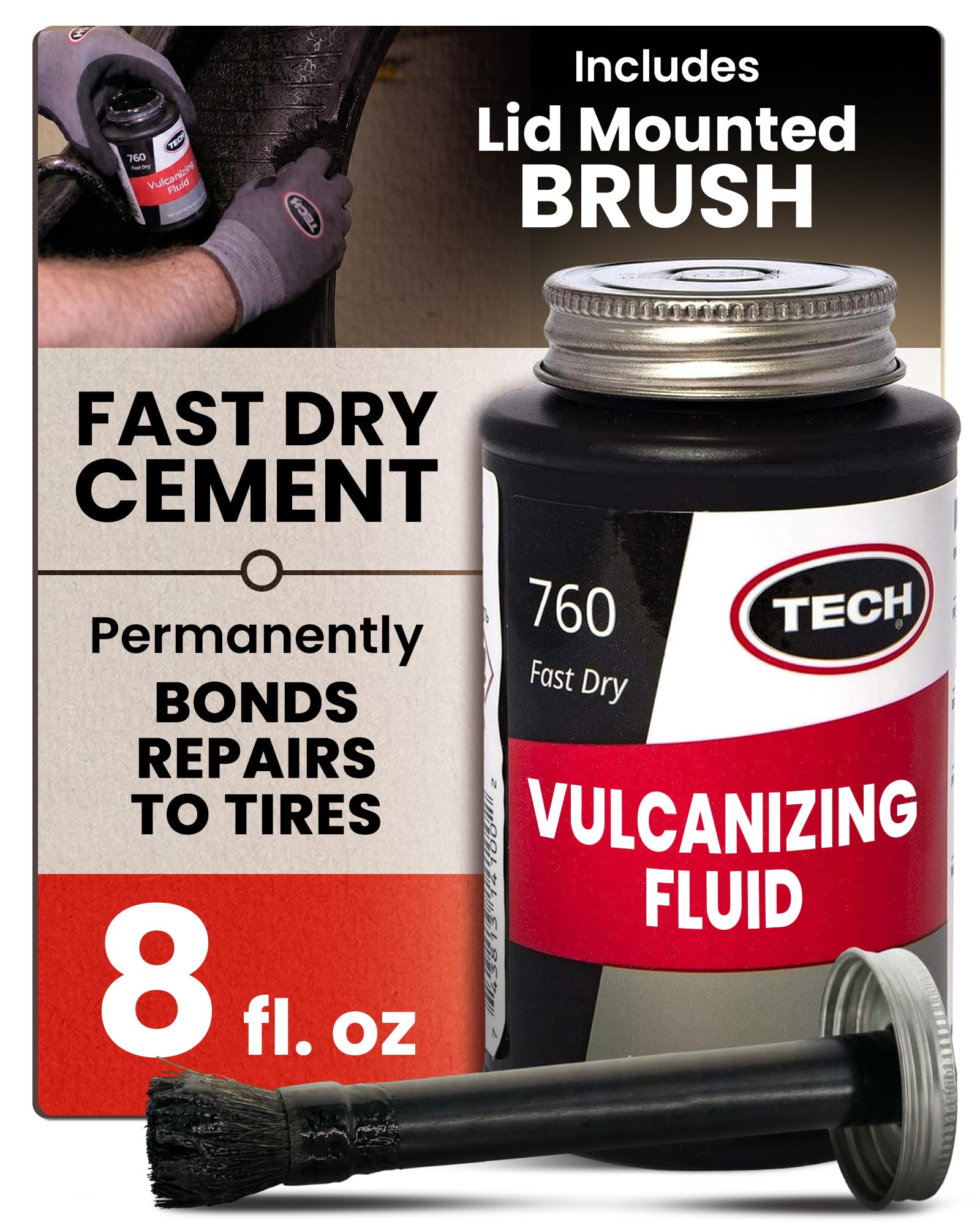
TECH Tire’s Vulcanizing Fluid is not an adhesive in the typical sense — it is a chemical catalyst that cross-links with the rubber molecules themselves, turning the repair area into a single continuous material. This is the professional-grade standard for tire plug and patch repairs, creating a permanent air-tight seal that keeps moisture and contaminants out of the carcass. The fluid sets in 3 to 5 minutes, fast enough for shop throughput yet slow enough for careful positioning.
The 8 oz can is a generous size for the price, and the lid seals tightly to prevent solvent evaporation between uses. Experienced mechanics use it with rope plugs, mushroom plugs, and screw punctures for tires of all sizes. It also works on bicycle tubes and internal rubber boots. The chemical bond survives the heat and flexing of highway driving — a quality that surface-level contact cements cannot match.
One drawback is that the formula is quite watery compared to gel adhesives, so it can run off vertical sidewalls if applied too liberally. Beginners may overtighten the patch and create a gap. The product is colorless, not black, which surprises some users expecting the same hue as tire rubber. For non-tire rubber repairs (boots, mats, gaskets), a neoprene contact cement is more suitable because vulcanizing fluid specifically targets tire rubber chemistry.
Why it’s great
- Chemically welds tire rubber for permanent air-tight seal
- Fast 3-5 minute set time for shop efficiency
- Large can with tight-sealing lid prevents drying out
Good to know
- Watery consistency can run on vertical surfaces
- Best for tire rubber — less effective on general-purpose rubber goods
- Requires experience with tire repair for best results
4. WEICON GMK 2410 Rubber Metal Adhesive

WEICON GMK 2410 is a German-engineered contact cement specifically formulated to stay flexible while resisting vibration — a combination that matters when bonding rubber components to automotive body panels, door seals, or machinery housings. This one-component synthetic rubber adhesive requires no mixing: apply a thin coat to both surfaces, let the solvent flash off until tacky, then press together. The bond reaches full strength after 24 hours but holds enough for immediate handling.
The formula excels in environments where constant movement and temperature swings would crack cyanoacrylate or rigid epoxies. Users report successful adhesion of rubber chair bottoms and EPDM foam strips to metal on car doors, with repairs holding through all weather conditions. The brownish color blends well with rubber and metal substrates, and the 185g can provides enough adhesive for multiple automotive gaskets or insulation panels.
The main limitation is surface sensitivity: the manufacturer explicitly states it will not bond to PE, PP, polystyrene foam, soft PVC, or artificial leather. One review reported failure bonding rubber to aluminum even after scoring and cleaning, indicating that rough or oily metals may still defeat this formula. Proper application technique — two coats, adequate flash-off time, and sufficient clamping pressure — is non-negotiable for success.
Why it’s great
- Flexible bond designed to resist vibration and movement
- Pre-mixed one-component saves time and cleanup
- Proven on automotive door seals, rubber mats, and insulation
Good to know
- Does not bond to certain plastics (PE, PP, soft PVC)
- Aluminum may require extra surface preparation
- 24-hour full cure requires patience and clamping
5. 3M Hi-Strength 94 ET Spray Adhesive
When your project involves bonding rubber sheets to large surfaces — foam insulation to metal van walls, rubber carpet to flooring, or laminated panels — brush-on contact cement becomes impractical. 3M Hi-Strength 94 ET solves that with an aerosol spray that delivers aggressive tack and an open time of up to 60 minutes, giving you room to reposition large substrates before the final bond sets. The spray pattern is consistent and the full cure at 24 hours produces a tenacious, flexible bond.
This adhesive stands apart for its environmental certifications: GREENGUARD certified for low VOC emissions and compliant with CARB and SCAQMD rules, meaning it contributes to LEED credits on commercial jobs. In practice, users report it sticking foam soundproofing to plastic panels in freezing temperatures, holding rubber mats to garage floors, and laminating fabric to rubber without delaminating after months of use. The 19.75 oz can covers significant surface area, making it cost-efficient for whole-room or whole-vehicle projects.
The trade-off is the strong solvent odor — users describe it as “airplane glue” and strongly recommend a respirator mask and cross-ventilation during application. The spray also requires a knuckle test to check tack readiness before pressing surfaces together. If you only need a dot of glue for one small rubber repair, the aerosol format wastes material compared to a tube or can brush.
Why it’s great
- 60-minute open time allows repositioning of large rubber sheets
- Low VOC, GREENGUARD certified for indoor use
- Aggressive tack bonds even in cold temperatures
Good to know
- Strong solvent fumes require respirator and ventilation
- Aerosol format wasteful for small spot repairs
- Needs knuckle test and 30-minute drying time before pressing
FAQ
Can I use super glue for flexible rubber repairs?
How do I prep rubber for adhesive bonding?
Why does my rubber glue keep peeling off after a week?
Is spray adhesive strong enough for rubber flooring or mats?
Final Thoughts: The Verdict
For most users, the best adhesive for rubber winner is the S-18 All-Purpose Adhesive because its neoprene base provides the ideal balance of peel strength, flexibility, and water resistance for the widest range of rubber repairs — from automotive gaskets to DIY boot fixes. If you need an instant cure for emergency shoe repair, grab the Boot-Fix Shoe Glue. And for professional-grade tire repairs that demand a chemical weld rather than a surface bond, nothing beats the TECH Vulcanizing Fluid.

Mo Maruf
I created WellFizz to bridge the gap between vague wellness advice and actionable solutions. My mission is simple: to decode the research and give you practical tools you can actually use.
Beyond the data, I am a passionate traveler. I believe that stepping away from the screen to explore new environments is essential for mental clarity and physical vitality.