Our readers keep the lights on and my smoothie glass nicely filled. As an Amazon Associate, I earn from qualifying purchases.
Finding a glue that actually bonds acrylic without leaving a white, cloudy haze is the single most frustrating part of any project. Standard super glues and epoxies often fog transparent surfaces, ruin the clean look of laser-cut parts, or simply don’t create a chemical weld strong enough to hold up over time. The right solvent cement, however, fuses the material at a molecular level, creating joints that are often stronger than the acrylic itself.
I’m Mohammad Maruf — the founder and writer behind WellFizz. I’ve spent years analyzing adhesive formulations, solvent evaporation rates, and real-world application feedback to separate hobby-grade fixes from professional-grade bonds.
Whether you are assembling a display case, repairing a cracked PLA 3D print, or building a custom fish tank lid, understanding the difference between a surface-adhering glue and a true solvent weld is critical. This guide breaks down the five best options to help you pick the right acrylic glue for your specific project.
How To Choose The Best Acrylic Glue
Not all acrylic adhesives are created equal. A product that works perfectly for bonding a loose PVC pipe may ruin a clear acrylic sheet by leaving a permanent white fingerprint. Understanding a few key specs will steer you to the right formula.
Solvent Weld vs. Surface Adhesion: The Core Difference
Standard cyanoacrylate glue (super glue) creates a thin surface bond. It works well for non-porous materials but often leaves a chalky residue or fog. Solvent-weld cement, on the other hand, chemically dissolves the surface of the acrylic so the parts fuse into a single piece of plastic. This is the only method that produces a joint stronger than the material itself, making it the professional standard for acrylic fabrication.
Body Thickness: Thin, Medium, or Thick
The viscosity of the glue determines how it handles. A water-thin formula flows via capillary action into tight seams and is perfect for flush joints. A medium-bodied glue offers a bit more working time and can fill minor gaps without dripping. A thick, gel-like cement is best for porous surfaces or when you need to fill a larger void. The wrong body type for your joint will result in a weak bond or a messy application.
Drying Clear and Fog-Free
For transparent or colored acrylic projects, the number one enemy is fogging. Cyanoacrylate and some epoxies release fumes that chemically etch the surface. A dedicated acrylic cement is formulated to evaporate without attacking the surrounding plastic, so the joint line remains invisible. Always look for a product explicitly labeled “non-fogging” for clear material work.
Quick Comparison
On smaller screens, swipe sideways to see the full table.
| Model | Category | Best For | Key Spec | Amazon |
|---|---|---|---|---|
| WELD-ON #16 | Premium Solvent | Professional fabrications & signage | Medium-bodied; 5-6 min work time | Amazon |
| LITKO Craftics #33 | Premium Solvent | Fog-free bonding of clear acrylic | Medium-bodied; fills small gaps | Amazon |
| Berkland Acrylic Cement | Premium Solvent | Capillary action on tight seams | Water-thin; 4 oz applicator bottle | Amazon |
| Clennaner All Purpose | Budget Surface Adhesive | General multi-material household repairs | 130ml brush-on; 24h full cure | Amazon |
| UHU All Purpose | Budget Surface Adhesive | Crafts, modeling, and school projects | Solvent-free; 3-pack tubes | Amazon |
In‑Depth Reviews
1. WELD-ON #16 Acrylic Plastic Cement

WELD-ON #16 is widely recognized as the industrial benchmark for bonding acrylic to itself and to materials like rigid PVC, ABS, and styrene. Its medium-bodied formula strikes a rare balance: it is thick enough to stay where you put it on vertical surfaces, yet flows just enough to wet the joint. The 5 to 6-minute working window gives you time to align parts before the solvent sets, a critical advantage over water-thin cements that grab almost instantly.
The low-VOC formulation makes it safer for indoor workshops compared to older solvent cements, though you should still work in a ventilated area. Users consistently report that the bond chemically fuses parts so effectively that material failure occurs outside the joint line, not along it. This makes it the go-to choice for display cases, signage, and industrial fabrications where structural integrity is non-negotiable.
The only practical drawback is the tube design. The glue pours rather than drips, which can lead to accidental spills if you don’t exercise caution. Some users recommend transferring it to a dropper bottle for better control. Despite this packaging quirk, the adhesive performance is top-tier for serious acrylic work.
Why it’s great
- Industry-standard solvent cement for strong chemical welds.
- Low-VOC formula is safer for workshop use.
- Medium viscosity provides control on vertical joints.
Good to know
- Tube design makes it easy to over-apply; use with a separate applicator for precision.
- Strong fumes require a well-ventilated workspace.
- Small tube may not be enough for large-scale projects.
2. LITKO Craftics #33 Thick Acrylic Cement
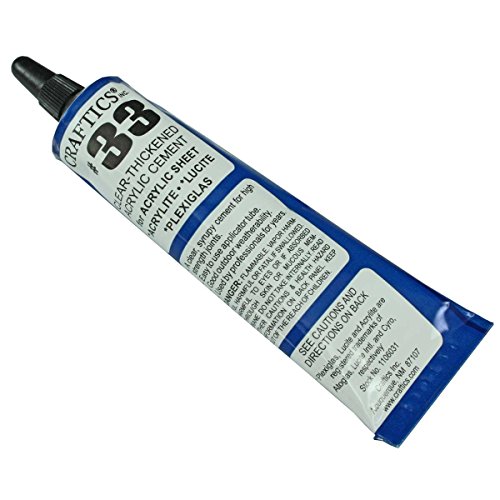
LITKO Craftics #33 was formulated specifically to solve the fogging problem that plagues cyanoacrylate users. It is a medium-bodied, fast-setting solvent cement designed for acrylic, rigid PVC, and styrene. The formula dries completely clear without clouding or whitening the surface, making it the top pick for transparent projects like fish tank lids, display stands, and laser-cut acrylic hobby models.
The thickened consistency is a welcome feature for gap-filling. If your joint has minor irregularities or rough laser-cut edges, the formula fills them in, resulting in a seamless bond. Users report full strength in 24 hours, but the fast-setting nature allows for handling within minutes. The shelf life of up to 24 months means you can keep a tube in your kit without worrying it will harden before your next project.
Some users note that the formula is somewhat runny despite being “medium-bodied,” so you have one chance to position parts correctly. Once applied, the bond is irreversible. Follow the safety guidelines—this is industrial-grade chemistry that requires gloves and ventilation. For anyone building clear acrylic components, this is the safe bet for a clean, invisible joint.
Why it’s great
- Dries completely clear with zero fogging on transparent acrylic.
- Medium-thick formula fills small surface gaps for a seamless finish.
- Fast setting with reliable 24-month shelf life.
Good to know
- Single attempt application—no repositioning once the bond starts.
- Strong chemical odor; adequate ventilation is mandatory.
- 1.5 oz tube is best suited for hobby-scale projects.
3. Berkland Acrylic Bonding Cement
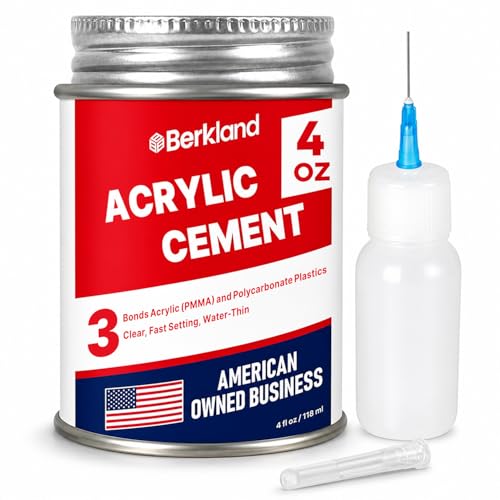
Berkland’s offering is a water-thin solvent that relies on capillary action to wick into incredibly tight joints. It is equivalent to a Weld-On #3 formula, designed for flush-fitting seams where you cannot physically spread glue inside the gap. The 4-ounce applicator bottle with a needle tip allows for clean, controlled delivery, making it a favorite for 3D-printed PLA parts and thin-gauge acrylic sheets.
The fast-setting nature is a double-edged sword. The bond sets in seconds, so you must have your parts perfectly positioned before applying. The reward is a crystal-clear finish with a joint that often exceeds the strength of the parent material. Users repairing a cracked Lexan windshield or building an acrylic box report that the material fails elsewhere before the glue line breaks.
The biggest challenge is the learning curve. The formula is so thin that it can run off vertical surfaces or spread underneath a part if you are not careful. A slight whitening can occur in high-humidity conditions, so a dry workspace is essential. For those who need to join perfectly mated parts with an invisible seam, this precision cement delivers unmatched results.
Why it’s great
- Capillary action creates seamless, invisible bonds on tight joints.
- Precision applicator bottle with needle tip for controlled use.
- Bonds PLA and other thermoplastics exceptionally well.
Good to know
- Water-thin consistency can drip and spread unpredictably.
- Requires perfect part alignment before setting.
- May cause slight whitening in high-humidity environments.
4. Clennaner Super Glue All Purpose
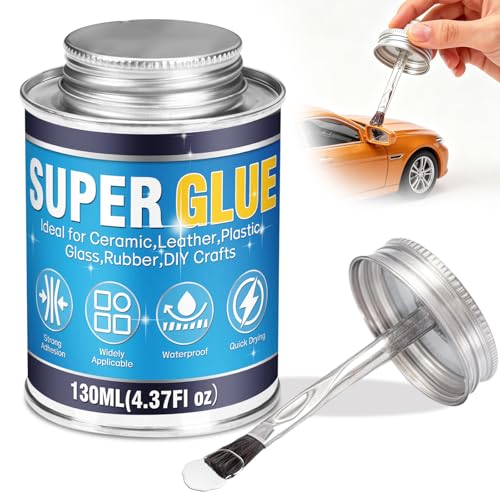
The Clennaner All Purpose glue is a cyanoacrylate-based adhesive, not a solvent cement. This is an important distinction: it bonds by surface adhesion rather than chemical fusion. It will work on acrylic, but it will not create a solvent weld. However, for users who need a single glue for multiple materials—cotton, denim, leather, wood, metal, and ceramics—this 130ml brush-on bottle offers tremendous versatility at a budget-friendly cost.
The brush-on applicator is a standout design feature. It allows for even, drip-free coverage across large areas, and the threaded cap seals tightly to prevent the glue from hardening between uses. Many users report that this is the first multi-purpose glue they haven’t had to throw away after a single project because of drying out. It is especially strong on fabric repairs and bonding 3D-printed PLA to painted wood.
The main drawback is the lack of clarity regarding usage instructions. A few customers found the manual confusing, and the QR code for more information was non-functional. Also, as a cyanoacrylate, it will likely fog clear acrylic surfaces. Keep this glue in your drawer for general household fixes, but reach for a dedicated solvent cement if your project involves transparent acrylic.
Why it’s great
- Large 130ml capacity with a brush-on applicator for easy use.
- Bonds to a huge range of materials beyond just plastic.
- Waterproof, heat-resistant, and impact-resistant bond.
Good to know
- Cyanoacrylate-based—will likely fog clear acrylic surfaces.
- Packaging and instructions could be improved for clarity.
- Not ideal for structural loads on pure acrylic parts.
5. UHU All Purpose Adhesive

The UHU All Purpose Adhesive is a solvent-free acrylic gel, making it a completely different animal from the solvent-weld cements above. It is designed for crafting, school projects, and general household use where flexibility and safety matter more than raw structural strength. The gel dries clear, remains temporarily correctable, and does not wrinkle paper, making it a fantastic choice for scrapbooking, model making, and book nook assembly.
Longtime crafters swear by UHU as a one-bottle replacement for multiple specialized glues. It bonds cardboard, felt, leather, cork, fabrics, and many plastics, including Styrofoam. The solvent-free formula means there is no harsh chemical odor, so it is suitable for use in classrooms and indoor spaces without special ventilation. It also has an impressive shelf life, remaining usable long after a tube is opened.
The trade-off is that this is not a structural adhesive for heavy-duty acrylic loads. A few customers reported that the solvent-free formula feels “too liquid” and may not grab instantly for demanding jobs. It is not a solvent-weld, so it won’t fuse acrylic parts at a molecular level. For lightweight crafts and temporary positioning, this is a reliable, pleasant-to-use adhesive, but it cannot replace the chemical bonding power of a dedicated acrylic cement.
Why it’s great
- Solvent-free and low-odor, perfect for indoor crafting.
- Dries clear and allows temporary repositioning before setting.
- Versatile across many materials, including Styrofoam without dissolving it.
Good to know
- Not a solvent weld—bond strength is lower than dedicated acrylic cements.
- Some users find the formula too thin for robust hold.
- Packaging inconsistency may mean quality varies between batches.
FAQ
What is the difference between acrylic cement and super glue?
Will water-thin acrylic cement work on vertical surfaces?
Why does my acrylic glue turn white after drying?
Can I use acrylic cement on 3D-printed PLA parts?
Final Thoughts: The Verdict
For most users, the acrylic glue winner is the WELD-ON #16 because it offers the professional-grade solvent weld that serious fabrication requires, with a forgiving medium body that balances control and strong adhesion. If you need a fog-free, crystal-clear bond for transparent projects, grab the LITKO Craftics #33. And for precision capillary action on tight seams or 3D-printed parts, nothing beats the Berkland Acrylic Cement.

Mo Maruf
I created WellFizz to bridge the gap between vague wellness advice and actionable solutions. My mission is simple: to decode the research and give you practical tools you can actually use.
Beyond the data, I am a passionate traveler. I believe that stepping away from the screen to explore new environments is essential for mental clarity and physical vitality.