Our readers keep the lights on and my smoothie glass nicely filled. As an Amazon Associate, I earn from qualifying purchases.
ABS printing without the usual headache of fumes and warped corners is now a real option thanks to re-formulated alloys and tighter manufacturing standards. The shift from basic ABS to advanced low-odor, low-warp versions means you can build durable functional parts at home without dedicating a separate ventilated workshop. Every spool in this lineup was engineered to solve the specific cracking, layer separation, and odor problems that have historically kept ABS out of casual printing rooms.
I’m Mohammad Maruf — the founder and writer behind WellFizz. I analyze polymer specifications, thermal properties, and diameter consistency data to separate reliable filament from spools that waste your time and material.
After reviewing dozens of formulations, I have narrowed the selection to five spools that deliver genuine engineering-grade performance. This guide reveals the best abs filament for print quality, low odor, and mechanical strength.
How To Choose The Best ABS Filament
ABS (Acrylonitrile Butadiene Styrene) differs from PLA in three critical ways: it requires a heated chamber to reduce warping, it produces styrene fumes during printing, and it delivers far better impact and heat resistance. Choosing the right spool means balancing odor control, print speed compatibility, and diameter consistency.
Low-Odor vs. Standard ABS
Formulations like ABS+ and ABS Pro use lower residual monomer content to cut down the sharp plastic smell during printing. This does not eliminate the need for ventilation, but it makes indoor printing significantly more tolerable. If you print in a living space, low-odor ABS is not optional—it is essential.
Diameter Tolerance and Winding Quality
A tolerance of ±0.02 mm to ±0.05 mm defines how smoothly the filament extrudes over long prints. Tighter tolerance reduces clogs and under-extrusion. Equally important is spool winding: a poorly wound spool causes tangles that ruin multi-hour prints.
Impact Strength and Heat Deflection
Impact strength (measured in kJ/m²) determines whether a printed part cracks under mechanical load. Heat deflection temperature (HDT) shows at what temperature the part softens. For functional parts like fan ducts, tool holders, or automotive brackets, look for an HDT of at least 80°C and impact strength above 15 kJ/m².
Quick Comparison
On smaller screens, swipe sideways to see the full table.
| Model | Category | Best For | Key Spec | Amazon |
|---|---|---|---|---|
| Creality Hyper ABS | High Speed | Fast prototyping, high-strength parts | Impact strength 19 kJ/m² | Amazon |
| FLASHFORGE ABS Pro | Low Odor | Indoor printing, detailed models | Diameter tolerance ±0.02 mm | Amazon |
| Bambu Lab ABS | Engineered | Bambu Lab printers, AMS integration | RFID auto-configuration | Amazon |
| yxpolyer ABS+ | Budget | Entry-level ABS, large prints | Print temp as low as 220°C | Amazon |
| Creality 2 kg Black & White | Value | Multi-color projects, stockpiling | 2 spools in bundle | Amazon |
In‑Depth Reviews
1. Creality Hyper ABS Filament

Creality Hyper ABS pushes print speeds up to 350 mm/s without sacrificing layer adhesion, a feat achieved through a low-residue monomer formulation that reduces volatile release at high flow rates. The impact strength of 19 kJ/m² is nearly double standard PLA, making it a strong candidate for functional parts like drone frames or tool holders that endure mechanical stress.
The heat deflection temperature of 80°C ensures printed parts remain dimensionally stable under hot enclosures or near motor housings. Users running the K1C and Bambu Lab printers report excellent results with minimal stringing when dialing in the recommended nozzle temperature of 250–260°C and a bed temperature of 100°C.
This spool works well in both standard and high-speed printers, though the best results come from an enclosed chamber to manage warping on large flat surfaces. The winding is consistently tangle-free, and the vacuum seal with desiccant keeps the filament dry straight out of the box.
Why it’s great
- High impact strength (19 kJ/m²) for durable engineering parts
- Low residual monomer reduces fume output during printing
Good to know
- Requires an enclosed printer chamber to prevent warping on large models
- Best results at higher nozzle temperatures above 250°C
2. FLASHFORGE ABS Pro Filament
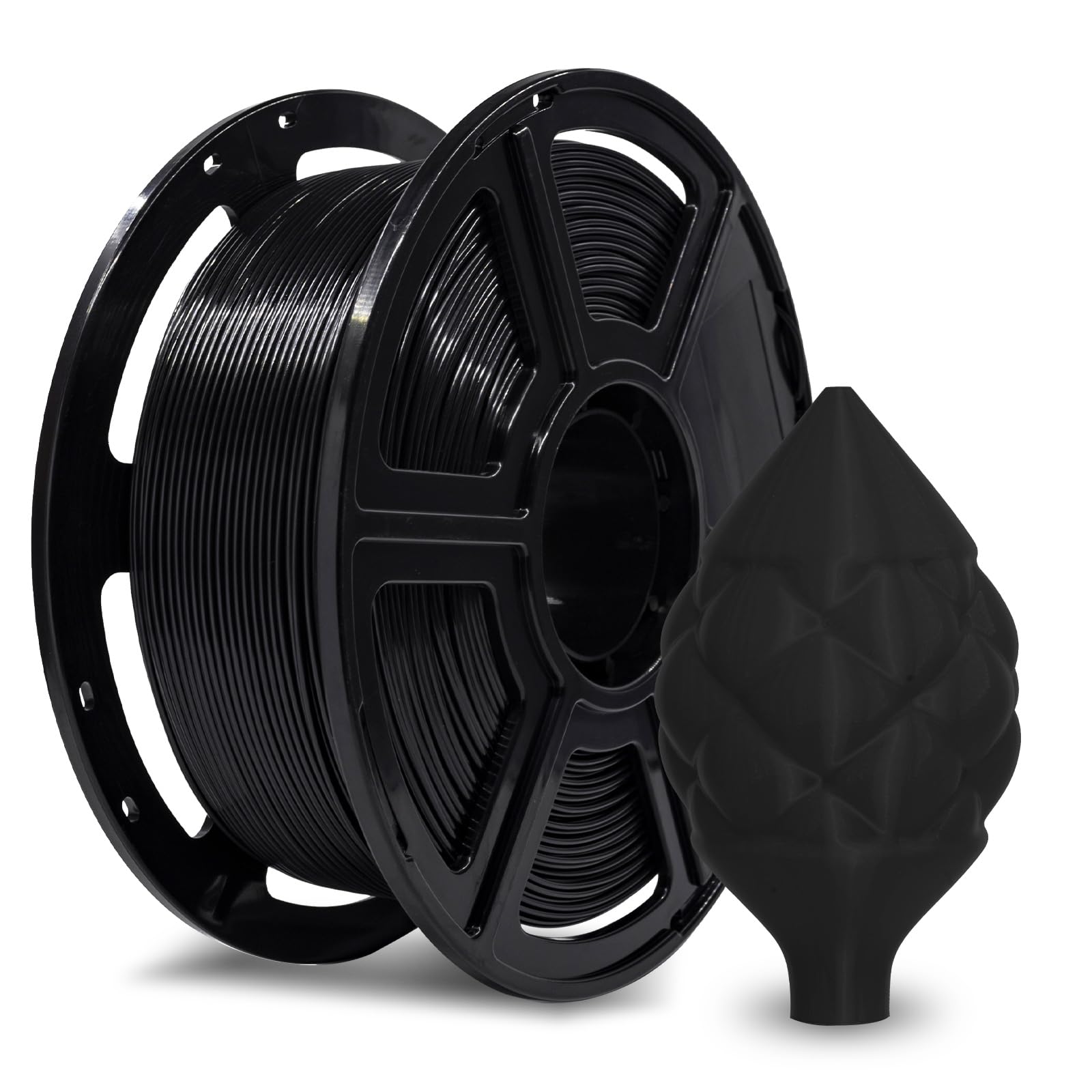
FLASHFORGE ABS Pro stands apart for its exceptionally tight diameter tolerance of ±0.02 mm, which translates to consistent extrusion across long prints with virtually no surface artifacts. The reduced shrinkage formula minimizes corner lifting on medium-sized models, making it a forgiving choice for printers without active chamber heating.
Users report that the low-odor formulation is noticeably less irritating than standard ABS, allowing for indoor printing with minimal ventilation. The spool printed well at 230°C nozzle and 90°C bed on a Bambu Lab P1S, producing clean bridges and strong layer bonds even at moderate print speeds.
One limitation is its hygroscopic nature—unlike standard ABS, this Pro variant absorbs moisture if left exposed, requiring drying after about a week of use to restore optimal surface finish. The complete packaging with a vacuum seal ensures it arrives dry, but long-term storage in a dry box is recommended.
Why it’s great
- Extremely tight ±0.02 mm diameter consistency for smooth extrusion
- Low-odor formulation suitable for indoor printing environments
Good to know
- More hydroscopic than standard ABS; requires dry storage
- Can be slightly more brittle than standard ABS formulations
3. Bambu Lab ABS Filament (Refill)

Bambu Lab ABS is the only spool on this list built around the AMS ecosystem, with an RFID tag that lets the printer automatically select the correct print profile. This removes guesswork for Bambu Lab users: load the spool, and the printer sets nozzle temperature, bed temperature, and chamber fan speed for optimal ABS results.
The ±0.03 mm diameter tolerance is slightly looser than FLASHFORGE ABS Pro, but real-world prints show consistent layer quality and no clogs across a full 1 kg spool. The silver color is a warm metallic finish that sands well and responds predictably to acetone vapor smoothing for a polished surface.
Because this is a refill spool (no plastic spool core), it saves waste and works directly with the AMS unit. Users outside the Bambu Lab ecosystem can still run it on standard FDM printers, but the RFID convenience is lost. The filament is vacuum-sealed with desiccant and arrives ready to print.
Why it’s great
- RFID auto-configuration for seamless Bambu Lab printer setup
- Refill spool reduces plastic waste and fits AMS system
Good to know
- RFID benefit only works with Bambu Lab printers
- Refill requires a reusable spool holder in non-AMS setups
4. yxpolyer ABS+ Low-Odor Filament
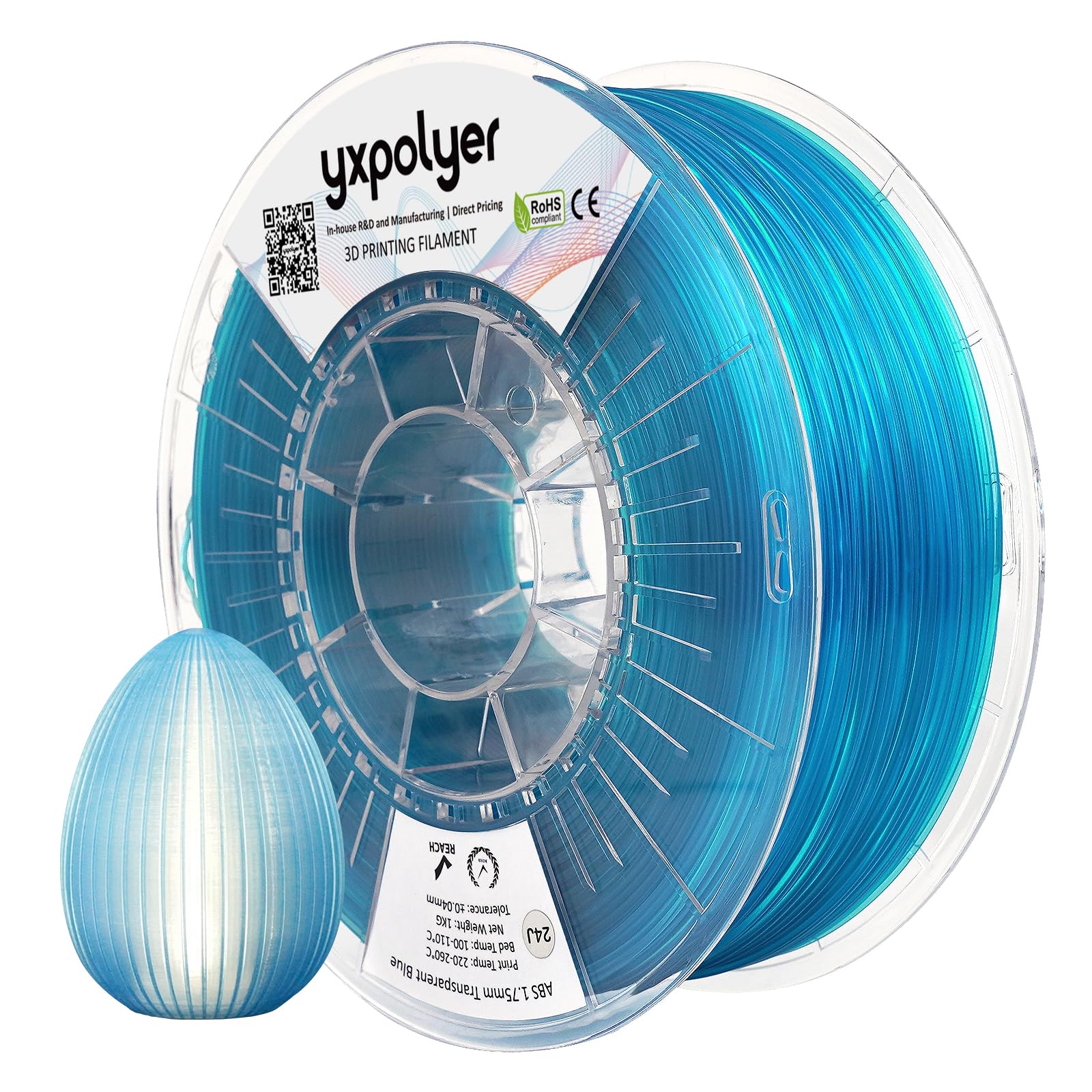
yxpolyer ABS+ targets beginners and budget-conscious users with a remarkably low print temperature floor of 220°C, making it compatible with printers that lack all-metal hotends. The self-supporting claim holds true for simple geometries—overhangs up to about 45 degrees print cleanly without dedicated support material.
The transparent blue color has a striking translucent quality that showcases internal lattice structures and wall thickness variations, giving functional prototypes a refined aesthetic. Users report successful 17-hour prints with no tangles, thanks to manually inspected winding and a well-sealed vacuum bag with a resealable strip.
The major caveat is spool compatibility: the plastic spool rim is narrower than standard, which means it does not contact the rollers on Bambu Lab AMS units. It will feed into the machine but cannot retract, so manual loading is required. For direct-drive and Bowden printers without AMS, this limitation is irrelevant.
Why it’s great
- Low print temperature (220°C) works with basic hotends
- Transparent finish with self-supporting properties for simple models
Good to know
- Spool rim is too narrow for Bambu Lab AMS rollers
- Not designed for high-speed printing above 200 mm/s
5. Creality 2 kg Black & White ABS Bundle
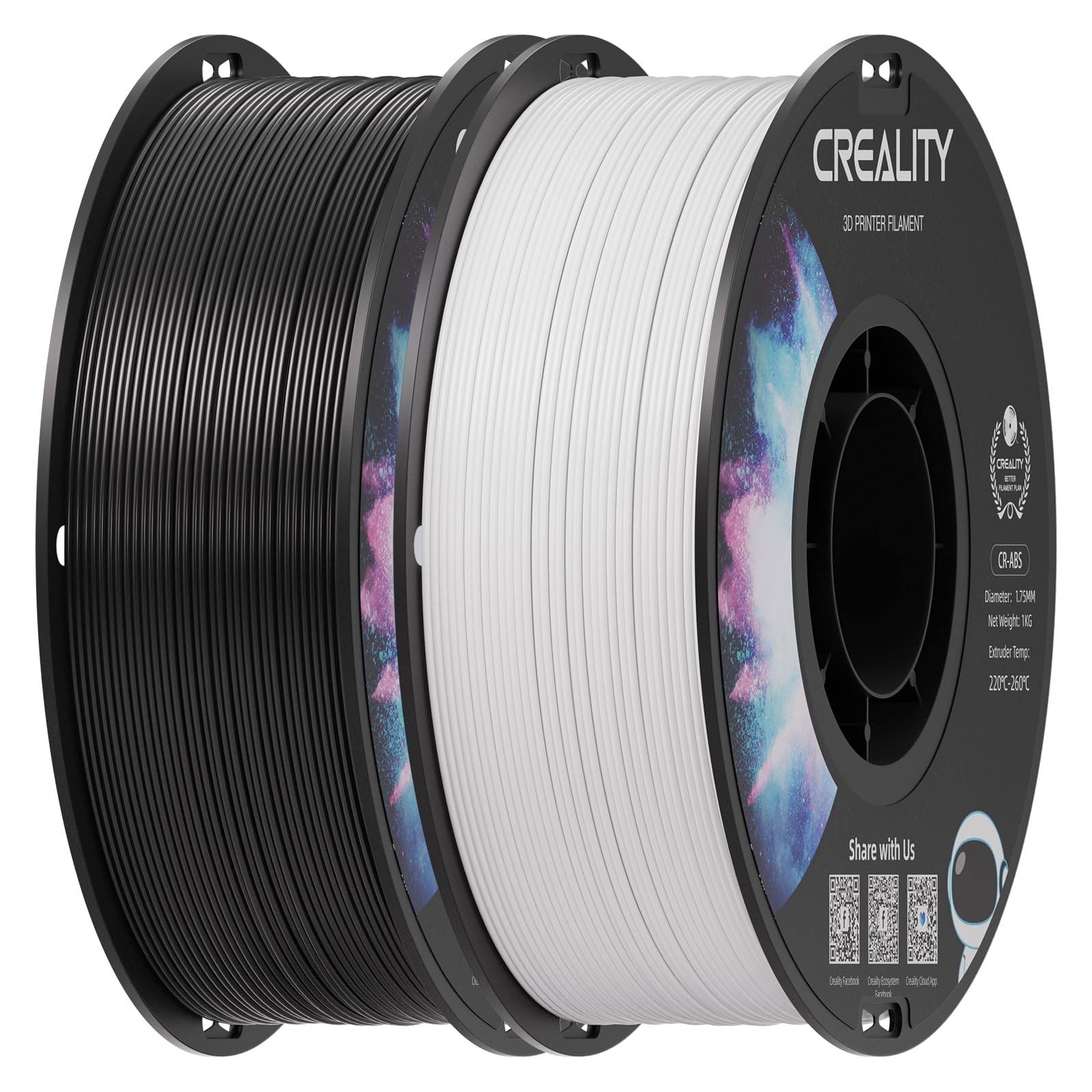
Creality’s 2 kg bundle gives you black and white spools at a combined price that undercuts buying individual rolls, making it the most economical entry point for users who need both colors for functional prototypes. The CR-ABS formulation focuses on reducing layer separation and edge warping on large models with pronounced corners.
Users report that this filament has a slight flexibility compared to standard ABS, which prevents brittle cracking in snap-fit joints and parts that experience vibration. Prints at 240°C nozzle and 80°C bed produce strong layers with no visible delamination across 12-hour builds. The material handles 300°C printing of PPA-CF without deforming, confirming its thermal stability.
While Creality markets this as odorless, user feedback indicates a faint ABS smell remains during printing—typical of standard ABS formulations. Running an enclosed printer with filtration is still recommended. The bundle is backed by a 12-month warranty and 24-hour support from Creality.
Why it’s great
- Two 1 kg spools for the price of one high-end spool
- Slight flexibility prevents cracking in snap-fit joints
Good to know
- Produces a faint ABS smell despite non-toxic labeling
- Requires enclosed chamber to minimize warping on large prints
FAQ
Does low-odor ABS still require ventilation?
Can I print ABS without an enclosed chamber?
What happens if I use ABS in a printer with a PTFE-lined hotend?
Final Thoughts: The Verdict
For most users, the best abs filament winner is the Creality Hyper ABS because it combines the highest impact strength (19 kJ/m²) with high-speed print capability and a low-odor formula at a mid-range price. If you prioritize indoor print environment and dimensional precision, grab the FLASHFORGE ABS Pro. And for a seamless AMS experience with zero profile tweaking, nothing beats the Bambu Lab ABS refill.

Mo Maruf
I created WellFizz to bridge the gap between vague wellness advice and actionable solutions. My mission is simple: to decode the research and give you practical tools you can actually use.
Beyond the data, I am a passionate traveler. I believe that stepping away from the screen to explore new environments is essential for mental clarity and physical vitality.