Our readers keep the lights on and my smoothie glass nicely filled. As an Amazon Associate, I earn from qualifying purchases.
A home office monitor lives or dies by two things: text clarity and all-day viewing comfort. A 4K panel at the right size gives you razor-sharp fonts and enough desktop space to keep reference docs, email, and your main app visible without constant alt-tabbing. But the wrong panel — poor contrast, no ergonomic stand, or weak connectivity — turns your desk into a source of frustration rather than a productivity hub.
I’m Mohammad Maruf — the founder and writer behind WellFizz. I’ve spent years analyzing panel specifications, connectivity standards, and ergonomic design trade-offs to help remote workers, freelancers, and professionals choose monitors that genuinely support their workflow rather than just looking good on paper.
This guide breaks down the key features, specs, and real-world performance factors that define a great 4k monitor for work from home. You will learn exactly what to look for in panel technology, color accuracy, and connectivity so you can make a confident buying decision.
How To Choose The Best 4K Monitor For Work From Home
Choosing a monitor for your home office is about matching the panel specs to your working habits. Start with resolution and size, then evaluate panel type, color accuracy, and the connection ports you actually need.
Size and Resolution Balance
At 27 inches, 4K (3840 x 2160) delivers a pixel density around 163 PPI — sharp enough for crisp text without needing scaling that eats up usable screen space. A 32-inch 4K panel offers a lower PPI (around 140) but gives you more physical real estate for timeline-based work in video editing or complex spreadsheets. Avoid pairing 4K resolution with anything under 24 inches — the interface elements become too small to read comfortably without high scaling percentages.
Panel Technology and Color Accuracy
IPS panels are the standard for productivity monitors because they maintain consistent brightness and color across wide viewing angles — essential when you share your screen with a colleague or move between tasks. Look for sRGB coverage above 98% if you handle any color-sensitive work like photo editing or design. For professional creative work, DCI-P3 or Adobe RGB coverage above 90% and factory calibration with Delta E < 2 will save you from buying a separate calibrator.
Connectivity and USB-C Power Delivery
USB-C with DP Alt Mode and power delivery (65W or higher) lets you connect your laptop with a single cable — it carries video signal, data, and charging all at once. This eliminates the classic home-office rat’s nest of separate power adapters and video cables. If your setup uses a desktop PC, DisplayPort remains the most reliable connection for full 4K at 60 Hz or higher. Two HDMI ports give you flexibility to switch between your work computer and a personal device without unplugging cables.
Ergonomics and Eye Comfort
A fixed-height stand forces you to stack books or buy a separate arm. Prioritize stands with height adjustment (at least 4 inches of travel), tilt, swivel, and pivot to portrait mode. VESA compatibility (75×75 mm or 100×100 mm) future-proofs you for monitor arms. Flicker-free backlighting and a low-blue-light mode reduce fatigue during 8+ hour work sessions. These features are not luxuries — they directly affect how long you can work before feeling eye strain or neck tension.
Quick Comparison
On smaller screens, swipe sideways to see the full table.
| Model | Category | Best For | Key Spec | Amazon |
|---|---|---|---|---|
| Dell UltraSharp U4025QW | Ultrawide | Maximum productivity | 39.7″ 5K2K 120Hz IPS-Black | Amazon |
| MSI PRO MAX 271UPXW12G | QD-OLED | Premium color work | 27″ 4K 120Hz QD-OLED | Amazon |
| ASUS ROG Strix XG32UCG | Fast IPS | Work & competitive gaming | 32″ 4K 160Hz 0.3ms | Amazon |
| ASUS ProArt PA279CRV | Professional | Photo/video editing | 27″ 4K 99% DCI-P3 ΔE<2 | Amazon |
| LG 27UP850K-W | USB-C Hub | Mac all-in-one setup | 27″ 4K 95% DCI-P3 90W PD | Amazon |
| Dell S2725QS | High Refresh | Smooth daily workflow | 27″ 4K 120Hz 1500:1 contrast | Amazon |
| Samsung ViewFinity S7 S70D | Tool-less Stand | Easy setup and eye care | 27″ 4K 350 nits HDR10 | Amazon |
| LG 27UL550-W | Ergonomic IPS | Budget with full stand | 27″ 4K IPS HDR10 | Amazon |
| INNOCN 27C1U-D | USB-C Budget | Mac compatibility on a budget | 27″ 4K IPS 65W PD | Amazon |
| ViewSonic VX3276-4K-MHD | MVA Panel | Deep contrast for media | 32″ 4K MVA 2500:1 contrast | Amazon |
In‑Depth Reviews
1. Dell UltraSharp U4025QW

The Dell UltraSharp U4025QW is the definitive productivity powerhouse — a 39.7-inch 5K2K ultrawide (5120 x 2160) that effectively replaces two 27-inch monitors with a single seamless curved surface. The IPS-Black panel technology delivers a measured 2000:1 contrast ratio, giving dark UI elements real depth without the glow typical of standard IPS screens. At 120 Hz, scrolling through long documents feels noticeably smoother, and the 600-nit peak brightness keeps the image punchy even in bright rooms.
The built-in Thunderbolt 4 hub is the real hero for home office setups: it provides 140W charging, a 2.5 Gbps Ethernet port, multiple USB-A/USB-C downstream ports, and a KVM that lets you control two computers with one keyboard and mouse. This eliminates the need for a separate docking station and keeps your desk clean. The stand offers full height, tilt, swivel, and pivot adjustment — critical for dialing in comfortable viewing posture over a long day.
Color coverage is outstanding out of the box with 99% DCI-P3 and factory calibration, making it suitable for color-critical video editing and graphic design. The response time is not aimed at competitive gaming, but the high refresh rate and IPS-Black quality are excellent for media consumption and fluid productivity. The price is high, but the combination of real estate, connectivity, and panel quality makes it the ultimate investment for professionals who live at their desk.
Why it’s great
- Massive 5K2K resolution eliminates the need for dual monitors
- Built-in Thunderbolt 4 hub with KVM and 140W charging simplifies cable management
- IPS-Black panel delivers deep contrast with wide viewing angles
Good to know
- Premium price point puts it out of reach for budget-conscious buyers
- Plastic housing feels less premium than the price suggests
- 120 Hz not enough for serious competitive gaming
2. MSI PRO MAX 271UPXW12G
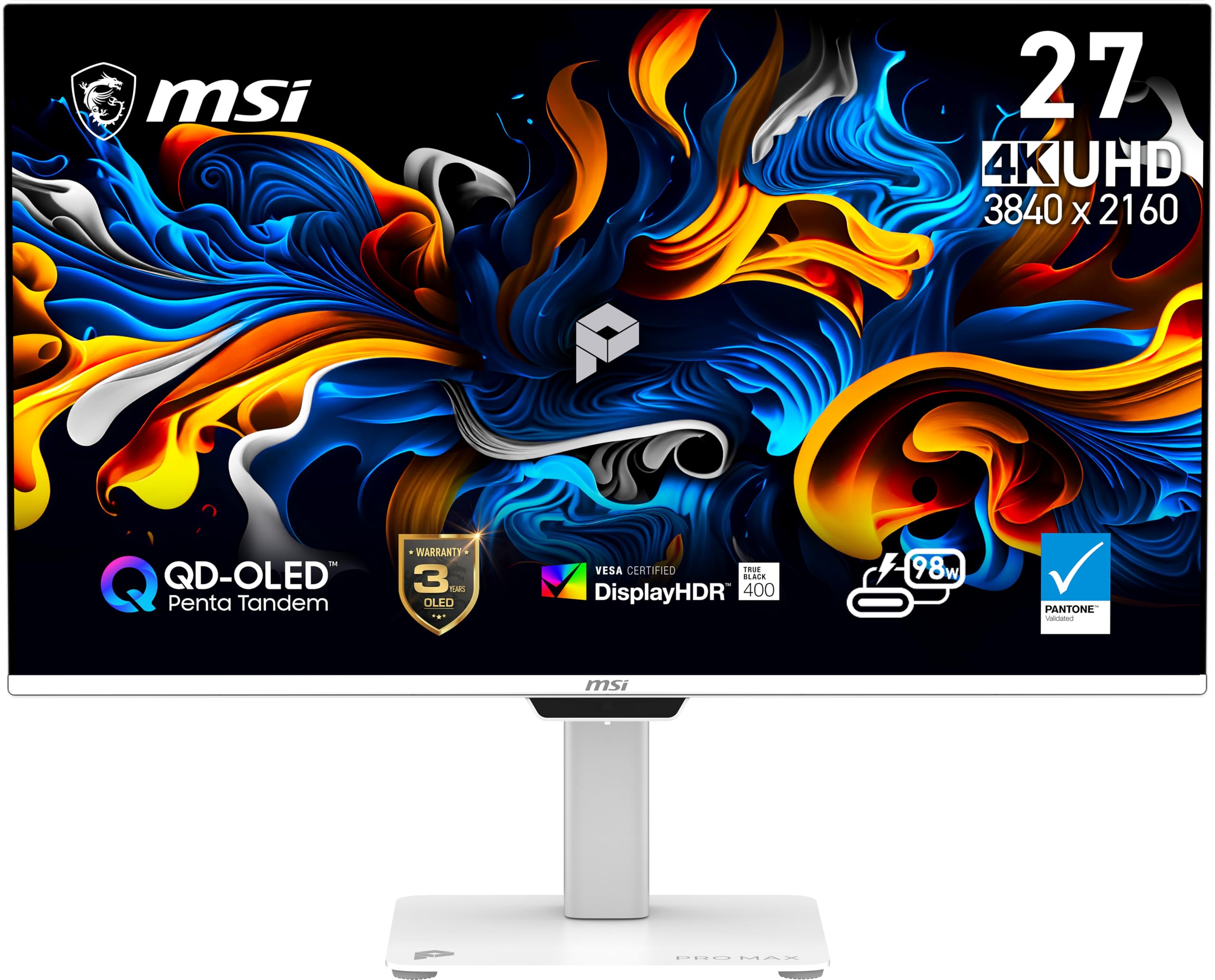
This 27-inch QD-OLED monitor brings infinite contrast and vibrant color to your home office without the burn-in anxiety that older OLED tech carried. The 4K UHD resolution (3840 x 2160) at 120 Hz provides smooth mouse movement and fluid window animations that make daily navigation feel instant. VESA DisplayHDR True Black 400 certification means black levels are truly black — a major advantage over IPS panels when editing dark-mode UI or watching HDR content.
Color accuracy is factory-calibrated to Delta E < 2, covering the full DCI-P3 gamut with the kind of saturation and depth that photo editors and video colorists will appreciate immediately. The dual USB-C ports deliver up to 98W PD, so you can charge a high-powered laptop and connect a second monitor or peripheral through the built-in hub. MSI’s Mac Optimization Software syncs macOS color profiles and shortcut keys, making this a natural partner for Apple Silicon MacBooks.
The all-white design is a refreshing look for minimalist desks, and the ergonomic stand supports height, tilt, and pivot adjustments. The anti-glare coating on the QD-OLED panel is better than older glossy OLEDs at handling ambient light. Note that users running dual Mac monitors may need to disable DSC and lock to DisplayPort for stable 120 Hz operation, but once configured, the image quality is peerless in this class.
Why it’s great
- QD-OLED delivers infinite contrast and vibrant, accurate colors for creative work
- USB-C with 98W PD powers a laptop via single cable
- Mac-focused software integration simplifies color matching
Good to know
- Dual Mac monitor setup requires manual DSC configuration
- Higher cost than equivalent IPS productivity monitors
- Text clarity is excellent but not quite as sharp as high-PPI LCDs
3. ASUS ROG Strix XG32UCG
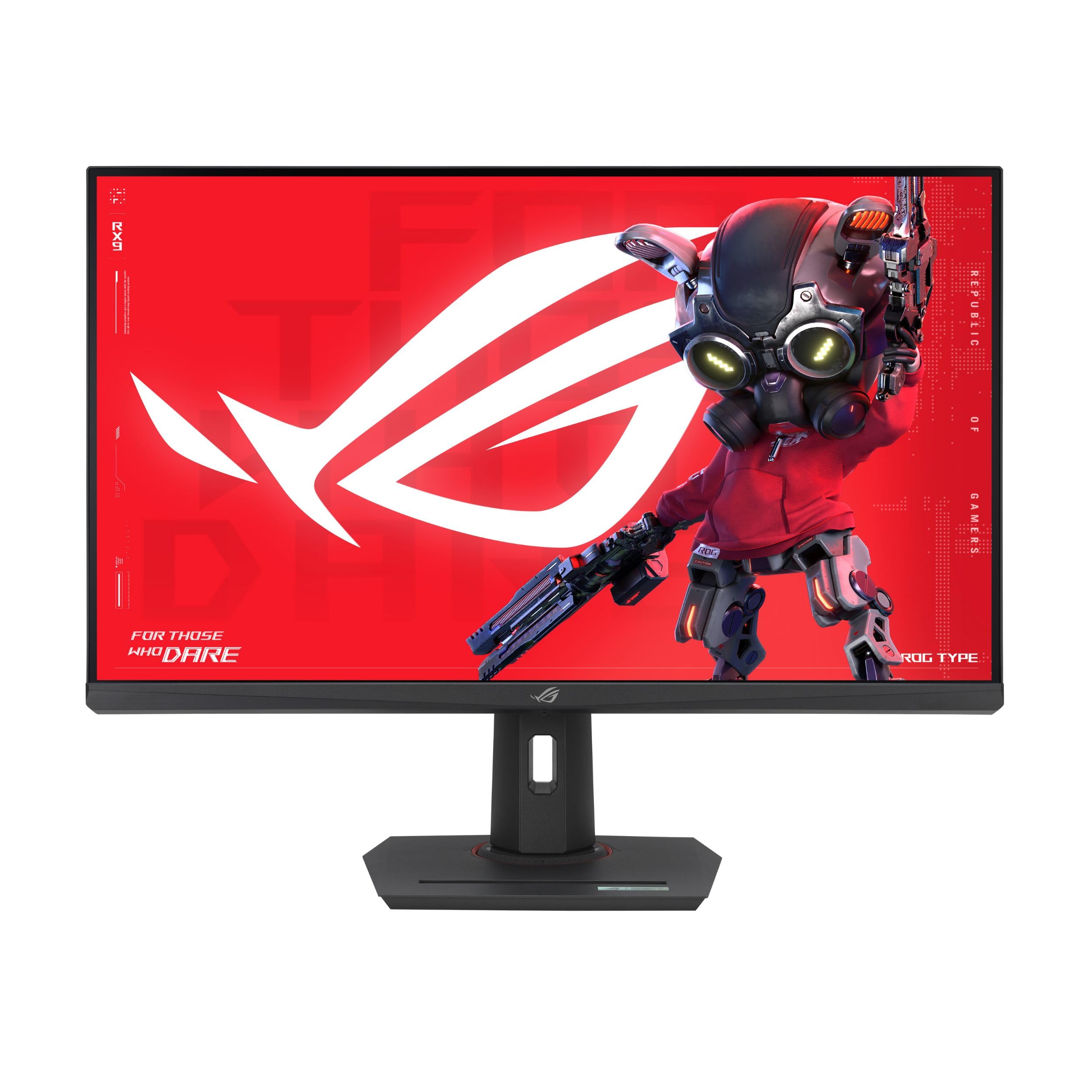
Do you need one monitor for both 8-hour workdays and competitive gaming sessions? The ASUS ROG Strix XG32UCG solves that dilemma with its dual-mode feature: run at native 4K 160 Hz for razor-sharp productivity and cinematic gaming, then switch to FHD 320 Hz for esports titles where raw frame rate matters more than resolution. The Fast IPS panel achieves a 0.3 ms response time, so motion blur is non-existent whether you are scrolling code or flick-shotting in an arena shooter.
Color reproduction is strong with 95% DCI-P3 coverage, and the semi-gloss screen finish makes colors pop more than typical matte panels while still managing reflections decently. The stand offers full ergonomic adjustment including height, swivel, and tilt, and the 32-inch size gives you generous screen real estate without needing a monitor arm. The included tripod socket on top is a quirky bonus for mounting a webcam or microphone directly to the monitor.
USB-C with DP Alt mode supports video and data with up to 15W charging, though power delivery is lower than dedicated productivity monitors. The G-Sync Compatible certification and ELMB Sync technology ensure tear-free gameplay without sacrificing brightness. For the home office worker who also games after hours, this monitor delivers an uncommon blend of high refresh productivity and competitive gaming performance in a single panel.
Why it’s great
- Dual mode toggles between 4K 160 Hz and FHD 320 Hz for work and gaming
- Fast IPS with 0.3 ms response virtually eliminates motion blur
- Full ergonomic stand with tripod socket for webcam mounting
Good to know
- USB-C power delivery limited to 15W, not enough for laptop charging
- Premium price but offers dual-monitor versatility in one panel
- Gaming-focused OSD may be overwhelming for productivity-only users
4. ASUS ProArt PA279CRV

If your home office revolves around color-accurate work — photo editing, video color grading, or graphic design — the ASUS ProArt PA279CRV is the calibrated reference monitor you need without paying five-figure studio monitor prices. The 27-inch IPS panel covers 99% of both DCI-P3 and Adobe RGB, factory-calibrated to Delta E < 2, and comes with a Calman Verification report in the box that confirms each unit’s color accuracy before it ships.
The USB-C port delivers 96W Power Delivery, which charges most 14-inch and 16-inch laptops at full speed while carrying the 4K video signal on the same cable. The stand provides full ergonomic adjustment including height, pivot, swivel, and tilt, plus built-in cable management channels. Daisy-chain support via DisplayPort out lets you connect a second ProArt monitor without using another cable run back to your PC — a clean solution for dual-monitor workstations.
Brightness peaks around 400 nits in standard mode and goes higher for HDR content, though the HDR experience is more about expanded color volume than specular highlights. The matte anti-glare coating preserves contrast in brightly lit rooms. Note that the 60 Hz refresh rate is standard for productivity and not ideal for gaming, but the color accuracy and connectivity make this the top choice for creative professionals who spend their day in Adobe apps.
Why it’s great
- Factory-calibrated Delta E < 2 with Calman Verification for reliable color
- 99% DCI-P3 and Adobe RGB coverage covers professional color spaces
- 96W USB-C PD charges laptops at full speed while transmitting video
Good to know
- 60 Hz refresh rate limits gaming and smooth scrolling
- No built-in KVM for switching between multiple computers
- HDR performance is decent but not displayHDR-level brightness
5. LG 27UP850K-W
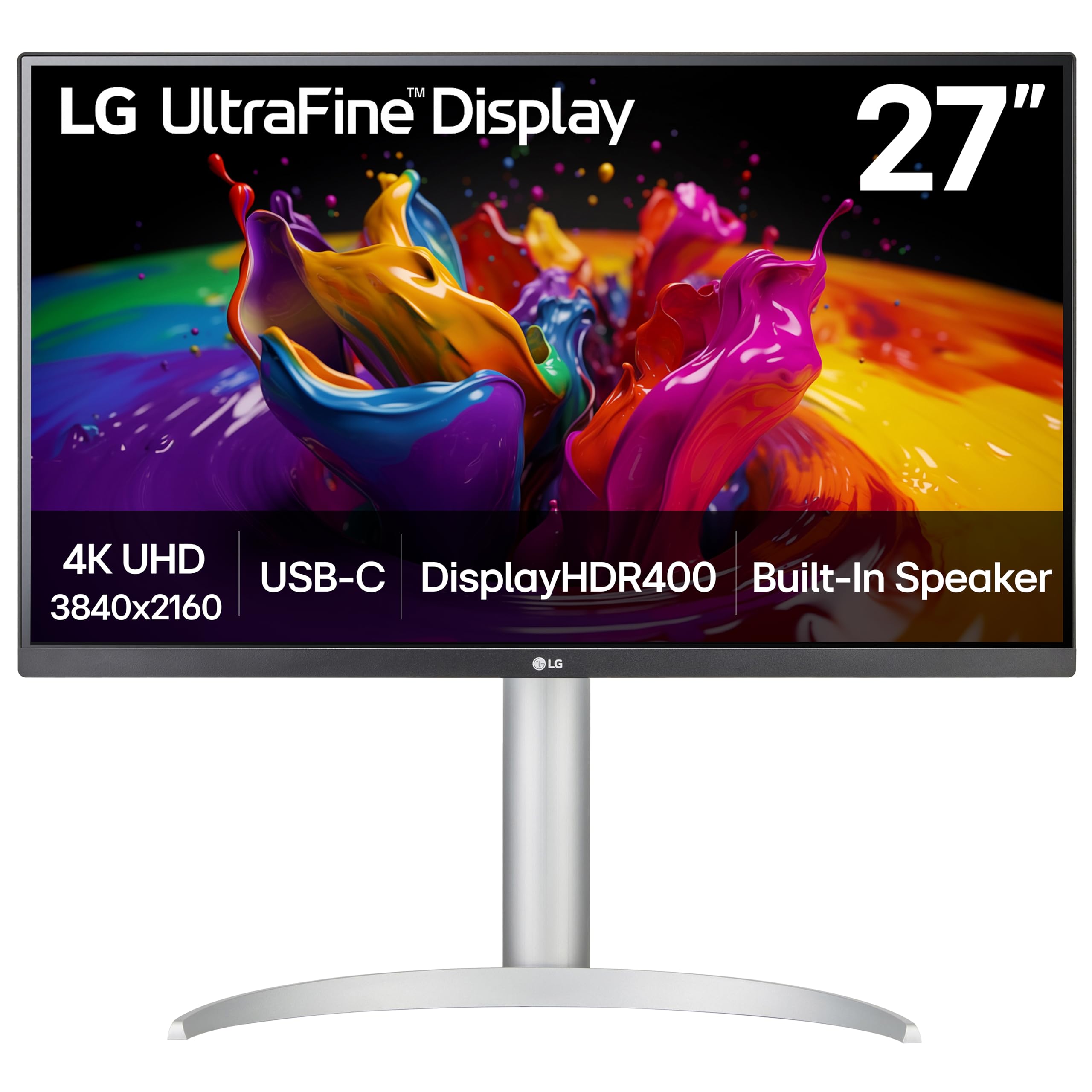
The LG 27UP850K-W has become a go-to recommendation for MacBook users because it nails the essentials: a sharp 27-inch 4K IPS panel with 95% DCI-P3 coverage, USB-C with 90W Power Delivery, and displayHDR 400 certification. One USB-C cable connects your MacBook, charges it, and drives the 4K display at 60 Hz — exactly the minimal-desk setup most remote workers want. The 178-degree viewing angle means color and brightness stay consistent whether you are centered or leaning back.
Built-in stereo speakers with Waves MaxxAudio are a welcome addition for video calls, though external speakers or headphones will still sound better for music or editing. The ergonomic stand offers full height, tilt, swivel, and pivot adjustment, including portrait mode rotation for coding or reading long documents. Two USB 3.0 ports on the rear are handy for connecting a webcam or a wireless dongle without reaching for your laptop.
The white finish matches the aesthetic of Apple’s silver and white lineup, and the slim bezels make it feel modern on any desk. The interface menu is controlled via LG’s intuitive joystick button, and the OnScreen Control software works well for splitting the display into multiple sections. While the 60 Hz refresh rate won’t satisfy gamers, the color quality, connectivity, and build make this a refined all-around productivity monitor for creative generalists.
Why it’s great
- USB-C single-cable solution with 90W PD charges MacBooks at full speed
- 95% DCI-P3 coverage and displayHDR 400 for vivid color
- Full ergonomic stand with height, pivot, and swivel adjustment
Good to know
- Built-in speakers are adequate for calls but not music playback
- 60 Hz refresh rate, not suitable for high-frame-rate gaming
- USB hub lacks a USB-C downstream port for daisy-chaining
6. Dell S2725QS

The Dell S2725QS brings a 120 Hz refresh rate to the home office segment without sacrificing color quality or breaking the bank. The 27-inch IPS panel delivers a 1500:1 contrast ratio — noticeably deeper than the standard 1000:1 found on many IPS monitors — making text pop against dark backgrounds. The 350-nit brightness is sufficient for most indoor environments, and the ComfortView Plus feature reduces blue light emissions to ≤35% while keeping colors accurate, not yellowed.
Dell’s three-year warranty and the inclusion of HDMI 2.1 cable in the box are reassuring touches for long-term ownership. The stand provides full height, swivel, tilt, and pivot adjustment — the kind of ergonomic flexibility that usually costs extra at this price tier. The 0.03 ms response time combined with AMD FreeSync Premium makes scrolling through web pages and office documents feel exceptionally fluid, and casual gaming benefits from the tear-free adaptive sync.
The ash white finish and ultra-thin bezels give it a clean, minimalist appearance that fits modern home offices. The built-in speakers have been improved over the previous generation with higher output and wider frequency response, making them genuinely usable for video calls. The main trade-off is that the HDMI 2.1 bandwidth supports 4K 120 Hz with 8-bit color; for 10-bit color you need to drop to 60 Hz. Still, for general productivity and light gaming, this is a smart balanced choice.
Why it’s great
- 120 Hz refresh rate makes productivity feel smoother than standard 60 Hz
- 1500:1 contrast ratio provides deeper blacks for better text readability
- Full ergonomic stand and three-year warranty at a mid-range price
Good to know
- No USB-C connectivity; relies on HDMI and DisplayPort
- Some units may show slight vignetting on the right side
- Not suitable for competitive gaming due to noticeable ghosting in fast scenes
7. Samsung ViewFinity S7 S70D

Samsung’s ViewFinity S7 S70D targets the remote worker who values setup convenience and eye comfort above all else. The 27-inch 4K panel uses an LED-backlit IPS-type screen with a 350-nit brightness and HDR10 support, delivering a clear, color-accurate image suitable for office tasks, spreadsheets, and video conferencing. The tool-less stand snaps together in seconds without a single screw — a small but genuine relief for anyone who dreads monitor assembly.
TÜV-certified intelligent eye care adjusts brightness and color temperature based on ambient lighting conditions, and the Eye Saver Mode reduces blue light exposure without washing out the display. The connectivity suite is practical: HDMI, DisplayPort, USB-A ports, and USB-B upstream for connecting peripherals directly to the monitor. The 99% sRGB coverage is fine for standard office work but falls short of the wide gamuts needed for advanced photo editing.
The slim profile and thin bezels make it a tidy addition to a desk, and the stand includes tilt, swivel, height, and pivot adjustments — impressive given the price. Some users report that HDR mode distorts colors in SDR content, so leaving HDR off for daily use is the better strategy. The built-in speakers are present but mediocre, so a dedicated headset or external speakers are recommended. Overall, this is a solid entry-level 4K monitor with excellent eye care features for long workdays.
Why it’s great
- Tool-less stand assembles in seconds, no screwdriver required
- Intelligent eye care with ambient light sensor reduces fatigue
- Full ergonomic stand with height, pivot, and swivel at a competitive price
Good to know
- HDR mode can cause color distortion in standard desktop use
- Speakers are quiet and lack bass for any media consumption
- sRGB coverage is fine for office work but not for color-critical editing
8. LG 27UL550-W

LG’s 27UL550-W proves you do not need to spend heavily to get a proper ergonomic 4K monitor for your home office. The 27-inch IPS panel delivers the standard 1000:1 contrast ratio and 400-nit peak brightness, with 98% sRGB coverage that keeps colors accurate for day-to-day work. The key feature that separates it from bargain-bin 4K screens is the fully adjustable stand with height, tilt, pivot, and swivel — including portrait mode rotation for coding or document review.
The connectivity is basic but functional: one HDMI port, one DisplayPort, and a headphone jack. No USB-C or USB hub, so you will need to connect peripherals directly to your laptop or PC. The OnScreen Control software lets you split the screen into multiple zones, which is useful for window management on a single display. AMD FreeSync support reduces tearing if you do any light gaming, and the 60 Hz refresh rate is standard for this tier.
The silver stand and slim bezels give it a modern look, and the 178-degree viewing angle ensures color consistency when sharing your screen. The wide base takes up more desk space than some competitors, so measure your desk depth before buying. One minor annoyance: the monitor does not automatically detect input changes when waking from sleep on some systems. Still, for a budget-friendly 4K IPS monitor with a truly useful stand, this remains a reliable choice that has been on the market for years with consistent quality.
Why it’s great
- Full ergonomic stand with height, pivot, and swivel at a budget price
- IPS panel with 98% sRGB and 400 nits brightness for clear, accurate imagery
- AMD FreeSync support reduces tearing during casual gaming
Good to know
- No USB-C connectivity; relies on HDMI and DisplayPort only
- Wide stand base may not fit on smaller desks
- Automatic input detection can be inconsistent when waking from sleep
9. INNOCN 27C1U-D

The INNOCN 27C1U-D is the budget portal to a single-cable USB-C workflow for MacBook and Windows laptop users. At its price point, it delivers a 27-inch 4K IPS panel with 65W USB-C Power Delivery, HDR400 certification, and a fully adjustable stand with height, swivel, tilt, and pivot. One cable connects to your laptop, charges it, and drives 4K at 60 Hz — exactly the convenience that costs significantly more from bigger brands.
Color accuracy is better than expected for the tier: the panel covers 1.07 billion colors via 8-bit+FRC and maintains a Delta E < 2 factory calibration, making it usable for photo editing and graphic design tasks. The HDMI 2.1 port is a nice inclusion, though it operates at 4K 60 Hz rather than higher refresh rates. The slim bezel design and matte screen finish give it a clean, professional appearance that punches above its price class.
There are trade-offs to keep in mind. The built-in speakers are very weak — barely loud enough for YouTube, let alone video calls. The OSD menu buttons are located on the rear and are not particularly intuitive to navigate. Some Mac users report a slightly slow wake-from-sleep delay compared to first-party displays. But if your priority is USB-C single-cable simplicity with good 4K image quality and an adjustable stand, this is the best value proposition in this guide.
Why it’s great
- USB-C with 65W PD enables single-cable laptop setup on a budget
- IPS panel with Delta E < 2 factory calibration for acceptable color accuracy
- Fully adjustable ergonomic stand with pivot for portrait mode
Good to know
- Built-in speakers are very weak, plan to use external audio
- OSD buttons on the rear are frustrating to reach and navigate
- Wake-from-sleep delay is slightly longer than premium monitors
10. ViewSonic VX3276-4K-MHD
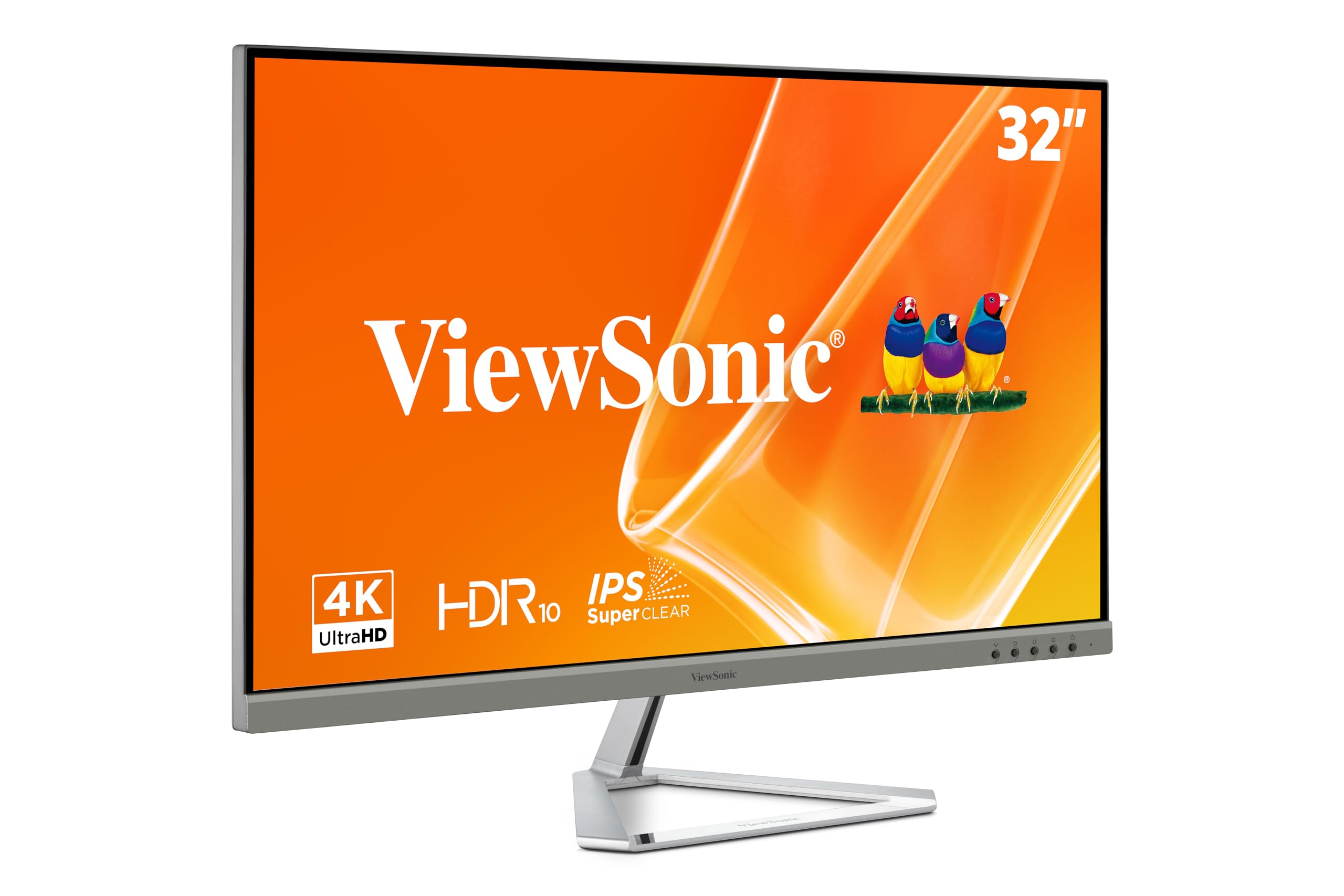
The ViewSonic VX3276-4K-MHD offers a larger 32-inch screen at a budget-friendly price, using an MVA panel that delivers a 2500:1 static contrast ratio — significantly deeper blacks than the typical 1000:1 IPS panel. For home office users who work with dark-mode applications or watch media during breaks, the improved contrast makes a noticeable difference in perceived image depth. The 4K resolution on 32 inches provides a comfortable pixel density (around 140 PPI) that shows sharp text without requiring scaling.
Connectivity is flexible with two HDMI ports, one DisplayPort, and a Mini DisplayPort, giving you options to connect multiple devices or a laptop via an adapter. The thin bezel design and silver metallic finish give it an upscale look that belies the price tag. The built-in Eye Care technology includes flicker-free backlighting and a blue light filter, reducing eye strain during long work sessions.
The trade-off for the MVA panel is that off-axis viewing angles are narrower than IPS — colors fade and contrast drops when viewed from more than 30 degrees off-center. The stand is fixed-height with no ergonomic adjustment, so you will need a monitor arm or a stack of books to get the screen to eye level. The 60 Hz refresh rate is standard for the price, and the built-in 2-watt speakers are barely usable. This monitor is best suited for users who prioritize a large high-contrast 4K screen and are comfortable adding a VESA arm for proper ergonomics.
Why it’s great
- 32-inch size gives generous screen real estate for multitasking
- MVA panel with 2500:1 contrast delivers deep blacks and rich colors
- Multiple HDMI and DisplayPort inputs support several devices
Good to know
- Fixed stand offers no height or tilt adjustment out of the box
- Narrow viewing angles compared to IPS panels
- Built-in speakers are very low quality for any audio use
FAQ
What is the best monitor size for working from home?
Do I need a high refresh rate monitor for office work?
Is a curved monitor good for a home office?
How much color accuracy do I realistically need for home office work?
Can I use a gaming monitor for working from home?
Final Thoughts: The Verdict
For most users, the 4k monitor for work from home winner is the LG 27UP850K-W because it delivers excellent color accuracy, a fully ergonomic stand, and USB-C 90W power delivery at a mid-range price — the ideal balance for Mac and PC users alike. If you want a single-cable ultrawide productivity hub with Thunderbolt 4, grab the Dell UltraSharp U4025QW. And for creative professionals who need reference-grade color and wide gamut coverage, nothing beats the ASUS ProArt PA279CRV.

Mo Maruf
I created WellFizz to bridge the gap between vague wellness advice and actionable solutions. My mission is simple: to decode the research and give you practical tools you can actually use.
Beyond the data, I am a passionate traveler. I believe that stepping away from the screen to explore new environments is essential for mental clarity and physical vitality.