Our readers keep the lights on and my smoothie glass nicely filled. As an Amazon Associate, I earn from qualifying purchases.
The challenge with choosing a 200-watt solar panel isn’t lack of options — it’s separating the panels that actually deliver near their rated power from those that fall short under real sunlight. Between cell technology, connector compatibility, and portable versus rigid formats, the wrong choice means your battery bank stays half-empty when you need it most.
I’m Mohammad Maruf — the founder and writer behind WellFizz. I’ve spent hundreds of hours analyzing solar panel specifications, reading through customer data on real-world wattage output, and comparing the efficiency claims versus verified field results across dozens of models in this specific power class.
This guide breaks down the top options and explains exactly what makes each one worth considering if you’re shopping for the best 200 watt solar panel for your RV, off-grid setup, or emergency backup system.
How To Choose The Best 200 Watt Solar Panel
Not all 200-watt panels share the same DNA. The quiet details — cell type, busbar count, voltage curve, and bypass diode layout — determine whether you actually see 180W on your charge controller or just 120W on a partly cloudy afternoon. Here are the three factors that matter most.
Cell Architecture: N-Type vs. P-Type
Traditional P-Type cells suffer from light-induced degradation (LID) that can shave off 2-3% of output in the first few hours of sun exposure. N-Type cells, increasingly common on the best current models, resist LID almost entirely and offer a lower temperature coefficient. This means they hold voltage better as the panel heats up under summer sun — a critical advantage for sustained power generation in rooftop installations or open fields.
Voltage Matching & Connector Compatibility
A 200W panel typically outputs between 18V and 40V, depending on its internal wiring. If your power station or charge controller has a maximum input voltage limit — many portable units cap at 28V — feeding it 40V will trigger overvoltage protection and zero charging. Always check the open-circuit voltage (Voc) of the panel and compare it against your device’s spec sheet. Also verify the connector type: MC4 is the universal standard, but many portable panels now bundle XT60 and Anderson adapters for direct plug-and-play with brands like Jackery, EcoFlow, and Bluetti.
Rigid vs. Portable: Mounting Context
Rigid aluminum-framed panels (typically 50-60 inches long) offer higher durability and better thermal dissipation, making them the default choice for permanent RV roof mounts or ground arrays. Portable folding panels sacrifice a few percentage points of efficiency in exchange for convenience — they pack down to suitcase size and can be angled toward the sun throughout the day. Your decision hinges on whether you need a set-and-forget installation or a flexible panel you reposition with the changing light.
Quick Comparison
On smaller screens, swipe sideways to see the full table.
| Model | Category | Best For | Key Spec | Amazon |
|---|---|---|---|---|
| BLUETTI 200W | Portable | Ecosystem pairing | 23.4% efficiency / ETFE coating | Amazon |
| Renogy E.Flex 200W | Portable | Lightweight travel | 13.89 lbs / 25% efficiency | Amazon |
| Twelseavan 200W | Portable | Multi-device USB charging | 60W USB-C / 24% efficiency | Amazon |
| Callsun Bifacial 200W | Rigid | Max output per panel | 25% N-Type / Bifacial 30% gain | Amazon |
| BougeRV N-Type 200W | Rigid | 24V battery systems | 36.4V Voc / 25% efficiency | Amazon |
| RICH SOLAR 200W | Rigid | Permanent RV roof install | 18BB N-Type / 10.9 Amps | Amazon |
| SOLUPUP 200W | Portable | Universal power station compatibility | 24% efficiency / 10.1 Amps | Amazon |
| SOKIOVOLA 200W | Portable | Budget-friendly foldable | 25% N-Type / IP68 waterproof | Amazon |
| MHPOWOS 220W | Portable | Higher voltage input (40V) | 23.5% / IP67 rated | Amazon |
In‑Depth Reviews
1. BLUETTI 200W Solar Panel

The BLUETTI 200W panel is the top choice for anyone deep inside the BLUETTI power station ecosystem. Its monocrystalline cells, wrapped in a durable ETFE laminate, deliver consistent charging across the lineup — from the compact EB3A to the massive AC500. Users report steady 150-178W real-world output, which is excellent for a portable folding panel. The solar connector integrates directly with BLUETTI units, eliminating the need for dongles or adapters.
At 16.1 pounds with a folded size of 22.5 x 23.6 inches, this panel is moderately heavy for hiking but perfectly suited for car camping, RV trips, and emergency home backup. The adjustable kickstands provide three angle positions, allowing you to tilt toward the sun. The ETFE coating resists scratches and water splashes, though the manual explicitly warns against leaving it in sustained rain — this is a semi-weatherized unit, not a fully waterproof one.
Where this panel excels is in build quality and cable management: each panel ships with built-in zippered pouches for the MC4-style connector cables, keeping them safe during transport. The dual-panel parallel wiring inside helps maintain partial output if one section gets shaded. For owners of Bluetti power stations who want a seamless, no-guesswork pairing, this is the most reliable match.
Why it’s great
- Seamless compatibility with BLUETTI power stations via direct solar connector
- Real-world output of 150-178W from a portable format — near rated spec
- ETFE coating resists scratches and sheds water during light rain
- Integrated cable pouch prevents connector damage during transport
Good to know
- Not waterproof — manual advises against use in sustained rain
- Heavier than some competitors at 16.1 lbs
- Regular retail price is noticeably higher than comparable 200W panels
2. Renogy E.Flex 200W Portable Solar Panel
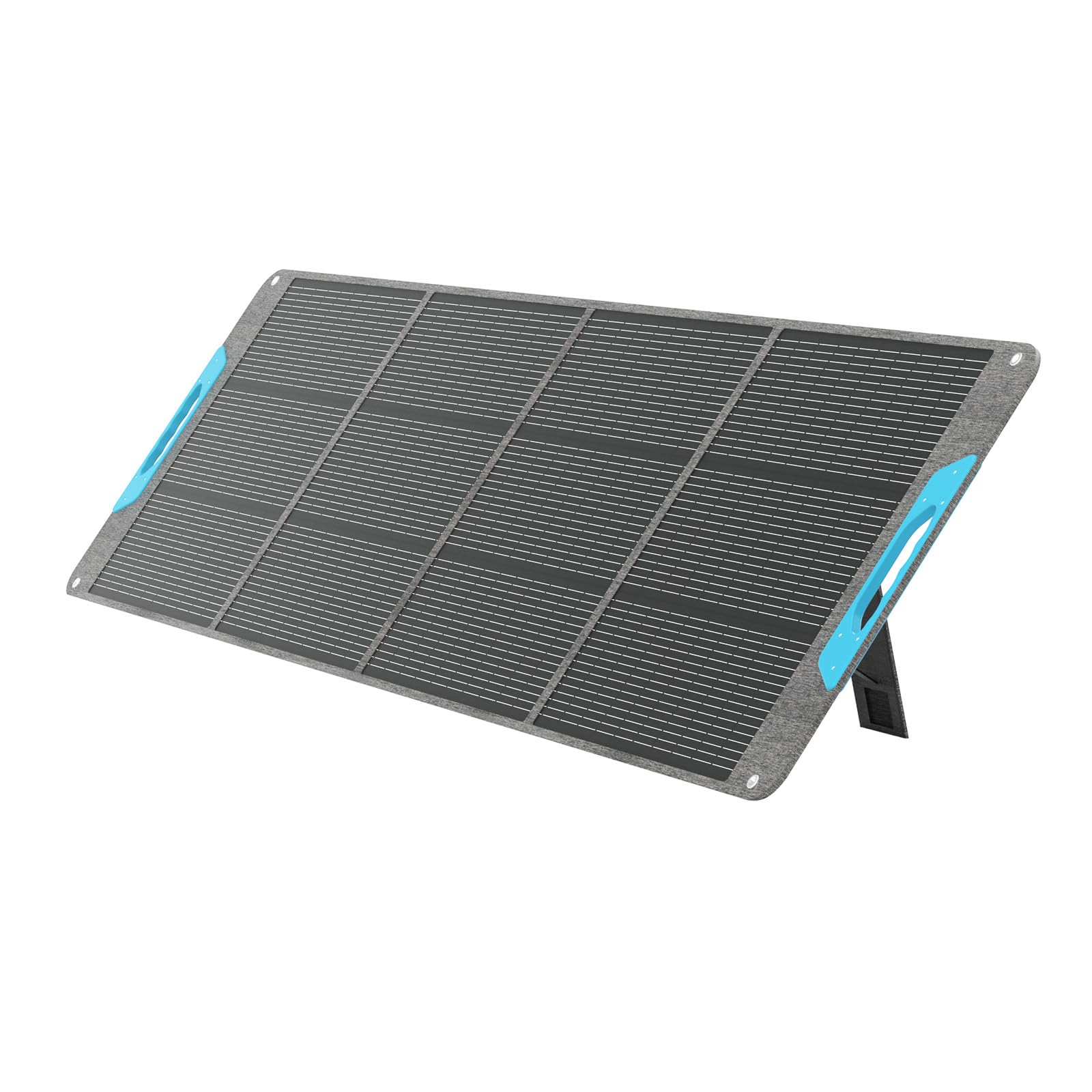
Renogy’s E.Flex 200W is the lightest portable panel in this class at just 13.89 pounds, making it a serious consideration for overlanders and truck campers who count every pound. The 16BB N-Type cell architecture delivers up to 25% efficiency, which is among the highest available in a folding panel. Real-world reports routinely show the panel exceeding its 200W rating in strong sun — one user measured 469W running two in parallel in Florida sun.
This panel features a magnetic closure system instead of traditional snaps or Velcro, making it notably easier to fold and store in tight camper spaces. The quad-fold design with four adjustable kickstands offers three tilt angles (40, 50, and 60 degrees), and the “small ear” design plus ground studs provide stability in windy conditions. The built-in accessory pouch stores the MC4 cables, while the 45W USB-C PD port and two USB-A ports let you charge devices directly from the panel without a power station in between.
One limitation worth noting: the included cables are functional but basic, and some users found the kickstands a bit janky in gusty winds. The IP65 rating handles dust and splashes, but this isn’t a panel you’d leave out in a downpour. It ships with a 2-year warranty and UL 61730 certification, which adds a layer of safety verification that budget panels often skip.
Why it’s great
- Heaviest portable panel at 13.89 lbs — genuine carry-anywhere convenience
- 25% efficiency with 16BB N-Type cells — best in class for a folder
- Magnetic closure is faster and more durable than Velcro alternatives
- 45W USB-C PD port for direct device charging without a power station
Good to know
- Kickstands can feel unstable in moderate wind without ground studs
- IP65 rating means no heavy rain exposure
- No charging cord included in the box
3. Twelseavan 200W Portable Solar Panel

The Twelseavan 200W stands out for its 60W USB-C PD port — the highest direct charging output on any panel in this comparison. If your goal is to charge a laptop or tablet directly from the panel without a power station, this is the most capable option. The panel also includes an 18W QC3.0 USB port and a standard 5V/3A USB port, letting you charge three devices simultaneously.
At 15.7 pounds with a folded size of 23 x 22 inches and a magnetic handle, this panel is portable enough for RV camping and tailgate use. The 24% efficient A+ grade monocrystalline cells sit under an ETFE laminate with over 95% light transmission. Users in winter conditions report 177W output on clear days, and one user charged an Anker SOLIX C300 and Bluetti AC180 from 60% to full in a single morning. The 8-in-1 MC4 converter cable includes adapters for XT60, Anderson, DC7909 (8mm), DC8020mm, and DC5521, ensuring compatibility with virtually every major power station brand.
The biggest practical drawback is the fixed-angle stands — the panel lacks a wide-range tilt mechanism, making it harder to optimize angle when the sun is low on the horizon. The IP65 rating handles splashes and dust, and Twelseavan backs this with a 24-month warranty plus 30-day money-back guarantee, which is stronger than the industry standard.
Why it’s great
- 60W USB-C PD port — best for direct laptop charging from the panel
- 8-in-1 cable kit covers XT60, Anderson, 8mm, and DC connector types
- 24% efficiency with A+ grade monocrystalline cells
- 24-month warranty plus 30-day money-back guarantee
Good to know
- Fixed-angle kickstands lack wide-range tilt for low sun conditions
- Not ideal for backpacking at 15.7 lbs
- High-density canvas back is durable but adds weight
4. Callsun N-Type Bifacial 200W Solar Panel

The Callsun 200W delivers the highest theoretical output in this lineup thanks to its bifacial design and N-Type 16BB cells. With a transparent backsheet that captures reflected light from the ground, users consistently report 220-300W real-world output — significantly exceeding the panel’s 200W rating. Measuring 51.3 x 30.3 x 1.4 inches and weighing 23.8 pounds, this is a rigid panel intended for permanent rooftop mounting on Class B vans or ground arrays.
The TwinCell anti-shade technology splits the panel into two independent halves, so if a tree branch shadows one section, the other continues producing at full voltage. This is a concrete advantage over standard panels that can lose 50% or more output from a single shading event. The low temperature coefficient of -0.3%/K means the panel holds voltage much better in hot weather than typical P-Type designs, making it a strong candidate for rooftop installations in southern climates.
Callsun backs this panel with a 10-year technical support window and a 25-year performance commitment — they guarantee at least 84.5% output after 25 years. The IP68 waterproof rating is the highest in this comparison, and the 3.8mm tempered glass plus corrosion-resistant aluminum frame provide serious durability against hail and debris.
Why it’s great
- Bifacial design captures reflected light from ground — net output often exceeds 220W
- 25% efficiency with N-Type 16BB cells reduces LID and improves heat tolerance
- IP68 rating means full submersion protection and decades of weather exposure
- 25-year performance guarantee with 84.5% output retention
Good to know
- Requires permanent mounting — not portable or foldable
- 23.8 lbs: heavier than portable alternatives
- Bifacial output gain depends on ground surface reflectivity (concrete better than grass)
5. BougeRV N-Type 16BB 200W Bifacial Solar Panel

The BougeRV 200W is engineered specifically for 24V battery systems. With an open-circuit voltage of 36.4V, a single panel can charge a 24V lithium battery directly without needing to wire two panels in series — this eliminates the current loss inherent in series connections and simplifies your wiring. The N-Type 16BB cell design with industrial tunnel oxide passivated contact technology achieves 25% efficiency, and the bifacial transparent backsheet adds up to 80% bifacial gain.
At 50.7 x 30.2 x 1.4 inches and just over 23 pounds, this rigid panel fits standard roof racks and features an anti-shade parallel design: if one half of the panel is shaded, the other half keeps producing at full power. The tempered glass and corrosion-resistant aluminum frame are built to withstand harsh outdoor conditions, and users praise the panel’s real-world output — typically around 170W on clear days, with bifacial gain pushing it higher depending on mounting surface.
The practical catch is that some units have shipped with reversed polarity on the MC4 connectors, and customer service experiences have been mixed. However, BougeRV offers a 10-year product tech support window, and the panel’s ability to charge a 24V battery without series wiring is a genuine convenience for anyone running a 24V electrical system in an RV or marine application.
Why it’s great
- 36.4V Voc charges 24V batteries directly — no series wiring needed
- N-Type 16BB cells with 25% efficiency and low temperature coefficient
- Bifacial design captures reflected light for up to 30% output gain
- Parallel anti-shade design keeps half the panel active under partial shade
Good to know
- Some units reported reversed MC4 polarity from factory
- Customer service response can be inconsistent
- Condensation inside panels observed after months of use in some cases
6. RICH SOLAR 200 Watt 12 Volt Monocrystalline Solar Panel

RICH SOLAR’s 200W panel is a benchmark for permanent 12V installations. It generates 10.9 amps at maximum power — the highest current rating in this group — which makes it particularly efficient at charging 12V battery banks in the morning and late afternoon when the sun angle is low. The 18BB N-Type cells deliver stable performance with minimal LID, and users consistently report 188-220W real-world output depending on cloud enhancement.
Measuring 58.7 x 26.8 x 1.2 inches and weighing 24 pounds, this panel is built around a heavy-duty 1.3mm anodized aluminum frame with tempered glass and an anti-reflective coating. It includes 14 pre-drilled holes compatible with standard Z-brackets, ground mounts, side pole mounts, and tilt mounts — making installation straightforward on RV roofs or ground arrays. The 3-foot quick-connect cables with MC4 connectors are ready for series or parallel wiring out of the box.
The 25-year limited warranty on power output (maintaining above 84% after 25 years) and 5-year material warranty provide long-term confidence. Multiple users have reported running arrays of 7 panels for years without a single failure, and one user reported the panel surviving a 95+ mph storm with hail and debris without damage. This is the panel to buy if you want to mount it once and forget it.
Why it’s great
- 10.9 amp output — highest current in this comparison, ideal for 12V charging
- 18BB N-Type cells with low LID for stable long-term output
- 1.3mm anodized aluminum frame survived 95+ mph storm with hail
- 25-year power output warranty with 14 pre-drilled mounting holes
Good to know
- Largest physical footprint in the group (58.7 inches long)
- Not portable — permanent mount only
- Some units have used different cell batches that affect consistency
7. SOLUPUP 200 Watt Portable Solar Panel
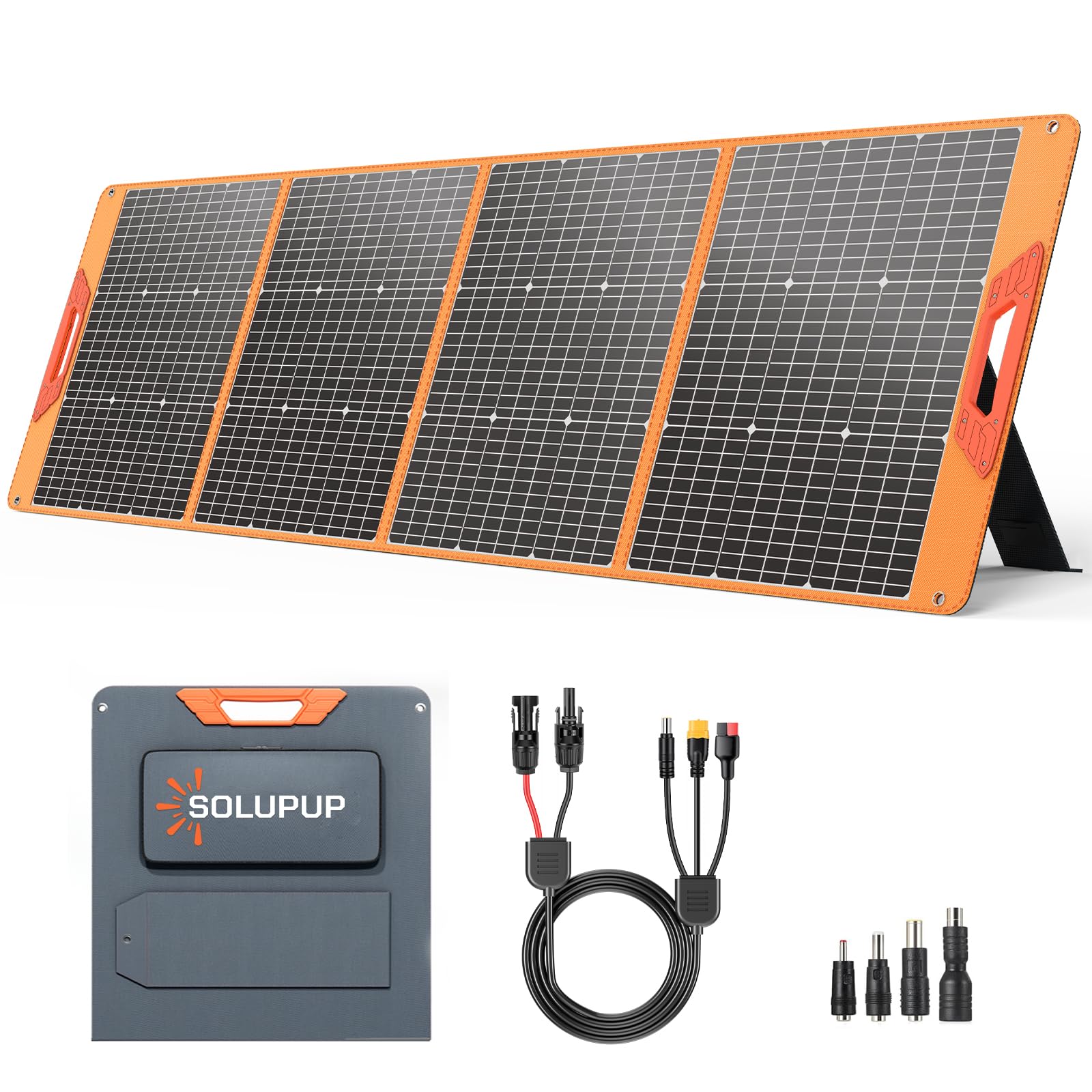
SOLUPUP’s 200W panel is designed around maximum power station compatibility. It ships with MC4-to-DC5521, Anderson, and XT60 adapter cables plus 4 DC conversion ports, covering Jackery, EcoFlow, Bluetti, Anker, Paxcess, Suaoki, and FlashFish. The included power box adds 1 SAE, 2 Type-C, and 2 USB-A fast-charging ports, letting you charge phones, tablets, and laptops directly from the panel without a separate power station in the loop.
The panel achieves 24% conversion efficiency using high-quality monocrystalline cells, and users consistently report 180-192W real-world output in full sun, with 45-120W on overcast days. At 18.5 pounds with folded dimensions of 24.4 x 20.8 x 1.9 inches, it’s on the heavier side for portable panels, but the magnetic handle and adjustable kickstands make it easy to carry and position. The IP66 rating means it can handle sudden downpours and dusty environments without issue.
The ETFE coating provides good scratch resistance, and the panel includes hanging holes for wall mounting when you want to keep it off the ground. Multiple users have tested this panel in heavy tree cover during multi-day camping trips and reported consistent charging of speakers, phones, TV, and battery backups. For the price, it outperforms more established brands like EcoWorthy and Renogy in side-by-side comparisons.
Why it’s great
- MC4-to-Anderson, XT60, and DC5521 cables included — covers every major brand
- Power box with 2 Type-C and 2 USB-A ports for direct device charging
- Consistent 180-192W real-world output in full sunlight
- IP66 rating handles heavy rain and dusty environments
Good to know
- Heavier than average at 18.5 lbs
- Kickstands are limited to high and low angle positions only
- Setup can feel slightly floppy before stands lock in
8. SOKIOVOLA 200W Portable Solar Panel
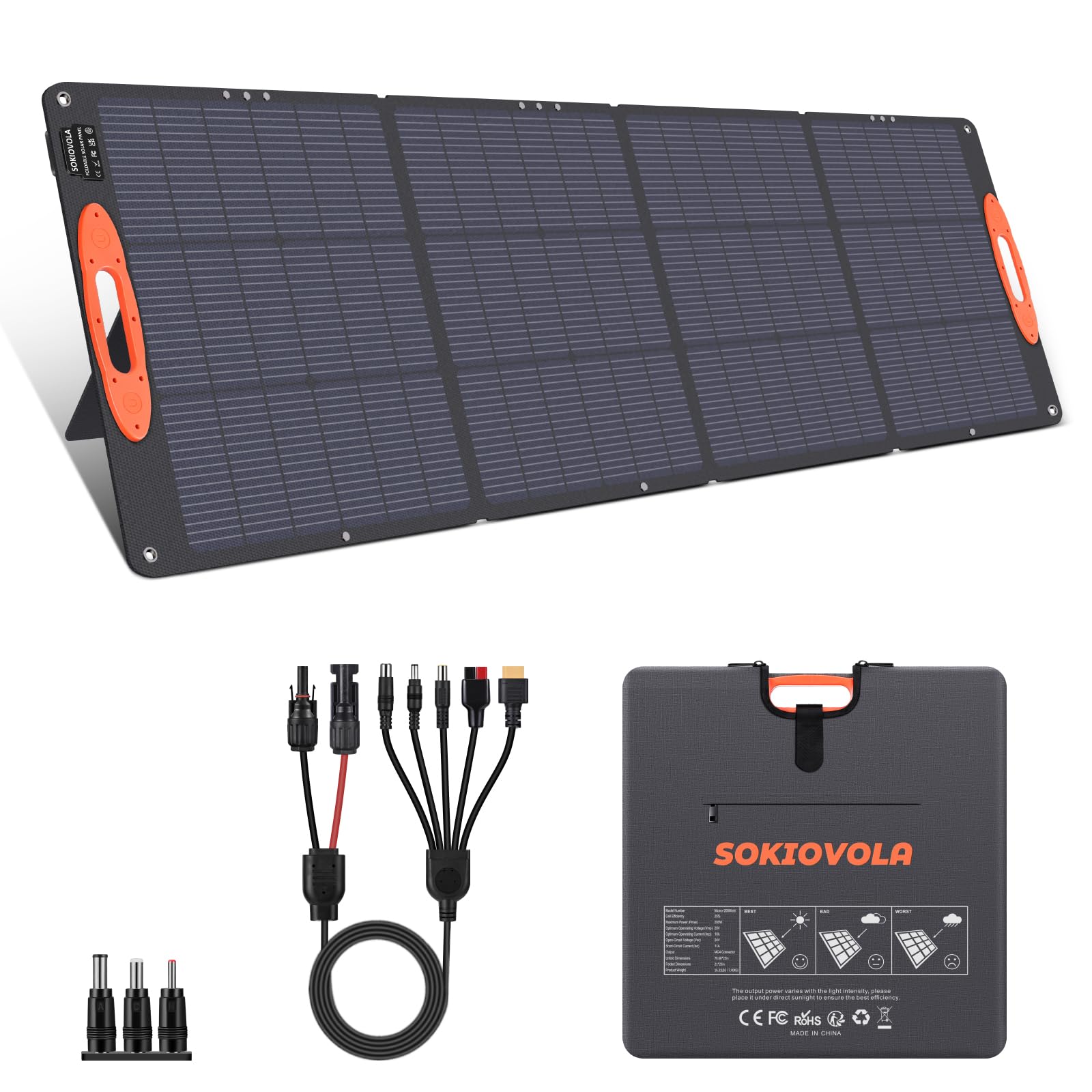
The SOKIOVOLA 200W packs N-Type 16BB cell technology into a portable folding format with an IP68 waterproof rating — the highest weather protection available in a foldable panel. The monocrystalline silicon cells achieve 25% conversion efficiency, and the ETFE coating ensures long-term durability. Users consistently measure 170-180W real-world output in peak summer sun (88-90% of rated spec), which is excellent for a portable panel.
At 16.31 pounds with a folded size of 21 x 23 inches and a magnetic handle, this panel is manageable for RV and car camping use, though it’s too heavy for backpacking. The 5-in-1 MC4 extension cable includes adapters for XT60, DC5521mm, Anderson, DC7909 (8mm), and DC8020mm, making it compatible with Jackery, EcoFlow, Bluetti, Goal Zero, and Anker power stations. The included carrying bag is spacious enough to hold the panel plus all cables and adapters.
Some users note that the panel material feels thin and the kickstands have a strong retraction force that can cause alignment issues during setup. A few cables, particularly the XT60 connector, have been reported as flimsy. However, at this price point, the combination of N-Type cells, IP68 waterproofing, and broad adapter support makes it a compelling value for buyers who want foldability without sacrificing cell technology.
Why it’s great
- 25% N-Type cells in a foldable format — rare at this price tier
- IP68 waterproof rating outperforms most portable panels
- 5-in-1 adapter cable covers XT60, Anderson, and DC connector types
- Roomy carrying bag stores panel and all cables
Good to know
- Thin panel material may affect long-term UV durability
- Kickstand retraction is aggressive and can misalign folds
- Some connectors feel flimsy out of the box
9. MHPOWOS Portable Solar Panel 220W 40V

The MHPOWOS 220W operates at a unique 40V output voltage, which is notably higher than the standard 18-24V range of most portable panels. This makes it a specialized option for power stations that accept higher solar input voltages — the Pecron E600LFP and EcoFlow Delta 2 are common pairings. Users report 185-207W real-world output depending on season and sun angle, with one tester measuring 205W in clear spring conditions at a 17-degree tilt.
Weighing 17.8 pounds with a folded size of 23.5 x 21.25 x 2.3 inches and an IP67 waterproof rating, this panel is built to handle dusty trails and sudden rain. The 7-in-1 solar connector bundle includes adapters for most power stations, and the four kickstands allow for angle adjustment to maximize sun exposure. The thickened handles and reinforced grommets add durability for frequent setup and takedown.
The critical catch is compatibility: many portable power stations have a maximum input voltage limit below 40V, and feeding 40V into a 28V-limited unit will trigger overvoltage protection and halt charging entirely. Always verify your power station’s maximum input voltage before buying. For those whose equipment can handle it, this panel delivers near-rated wattage reliably and is a strong value for its build quality.
Why it’s great
- 40V output enables efficient charging for compatible high-voltage power stations
- Real-world output of 185-207W in field conditions
- IP67 rating excels in dusty and wet outdoor environments
- 7-in-1 connector kit covers most power station brands
Good to know
- 40V output is incompatible with many portable power stations (check Voc limit)
- Kickstands have limited angle adjustment range
- Strong Velcro straps on kickstands risk tearing over time
FAQ
Can I use a 200W solar panel with a 12V battery without a charge controller?
Why does my 200W panel only show 150W on the display?
Is a rigid panel always better than a portable folding panel?
What does the MC4 connector do on a solar panel?
Final Thoughts: The Verdict
For most users, the best 200 watt solar panel winner is the RICH SOLAR 200W because it combines the highest current output for 12V charging with proven storm survival and a 25-year warranty. If you want a portable panel with premium cell technology, grab the Renogy E.Flex 200W. And for maximizing output from a small rooftop footprint, nothing beats the bifacial Callsun 200W.

Mo Maruf
I created WellFizz to bridge the gap between vague wellness advice and actionable solutions. My mission is simple: to decode the research and give you practical tools you can actually use.
Beyond the data, I am a passionate traveler. I believe that stepping away from the screen to explore new environments is essential for mental clarity and physical vitality.