Our readers keep the lights on and my smoothie glass nicely filled. As an Amazon Associate, I earn from qualifying purchases.
Specs are compiled from manufacturer listings and verified buyer reviews and can change over time — please confirm the key details on the product page before buying.
A cold tile floor after a hot shower is a shock that electric underfloor heating eliminates. The right electric underfloor heating cable delivers gentle, consistent warmth directly beneath your feet. But with different cable lengths, thermostat types, and coverage areas to pick from, choosing the wrong kit can mean a cold bathroom or a frustrating install. This guide breaks down the top-rated kits to match your room size and skill level.
I’m Mohammad Maruf — the founder and writer behind WellFizz. This guide is built by comparing the manufacturers’ published specifications and the patterns across verified customer reviews, so you get each pick’s real strengths and trade-offs instead of marketing spin.
Whether you are heating a small powder room or a master bath, the right electric underfloor heating cable makes all the difference between a toasty morning and a disappointing project you wish you’d planned better.
Our Picks at a Glance
How To Choose The Best Electric Underfloor Heating Cable
Match the kit to your room size, subfloor, and technical comfort level.
Coverage Area and Cable Length
The most important spec is the square footage the cable can heat. Kits are rated for a specific coverage at a specific spacing — typically 3 inches apart. If your room is 20 square feet, a 15-square-foot kit will leave cold patches. Measure your open floor area carefully (subtract toilets, vanities, and tubs), then choose a kit that matches or slightly exceeds that number. Remember: you cannot cut the heating wire to make it shorter, so a larger room needs a longer cable.
Thermostat Type and Safety Features
The thermostat controls your floor’s temperature and energy use. Basic models are simple dials, while programmable thermostats let you set different temperatures for different times of day, saving energy. Look for a thermostat with a built-in floor sensor (it reads the actual tile temperature) and GFCI protection (a safety device that shuts off power if it detects a ground fault, which is mandatory for wet locations like bathrooms). A touchscreen or Wi-Fi model adds convenience but isn’t essential.
Installation Monitoring and Warranty
Heating cables are fragile before they are covered in thinset (the cement glue that holds your tile down). A damage alarm — sometimes called a “screamer” — plugs into the cable and beeps if you nick or cut the wire during installation. This simple tool can save you from tiling over a dead cable. A 25-year warranty on the cable itself signals confidence from the manufacturer, which is worth looking for.
Quick Comparison
| Model | Best For | Coverage Area | Cable Length | Max Wattage | Amazon |
|---|---|---|---|---|---|
| Warming Systems 15 sqft★ Best Overall | Best Overall | 15 sq ft | 60 ft | 180W | Amazon |
| LuxHeat 20 sqftMore Coverage per Dollar | More Coverage per Dollar | 20 sq ft | 80 ft | 240W | Amazon |
| LuxHeat 15 sqft Touchscreen | Premium Thermostat | 15 sq ft | 60 ft | 180W | Amazon |
| HeatTech 30 sqft | Mid-Size Rooms | 30 sq ft | 120 ft | 360W | Amazon |
| HEATWAVE 64-120 sqft | Large Open Spaces | 64-120 sq ft | 362 ft | 960W | Amazon |
In‑Depth Reviews
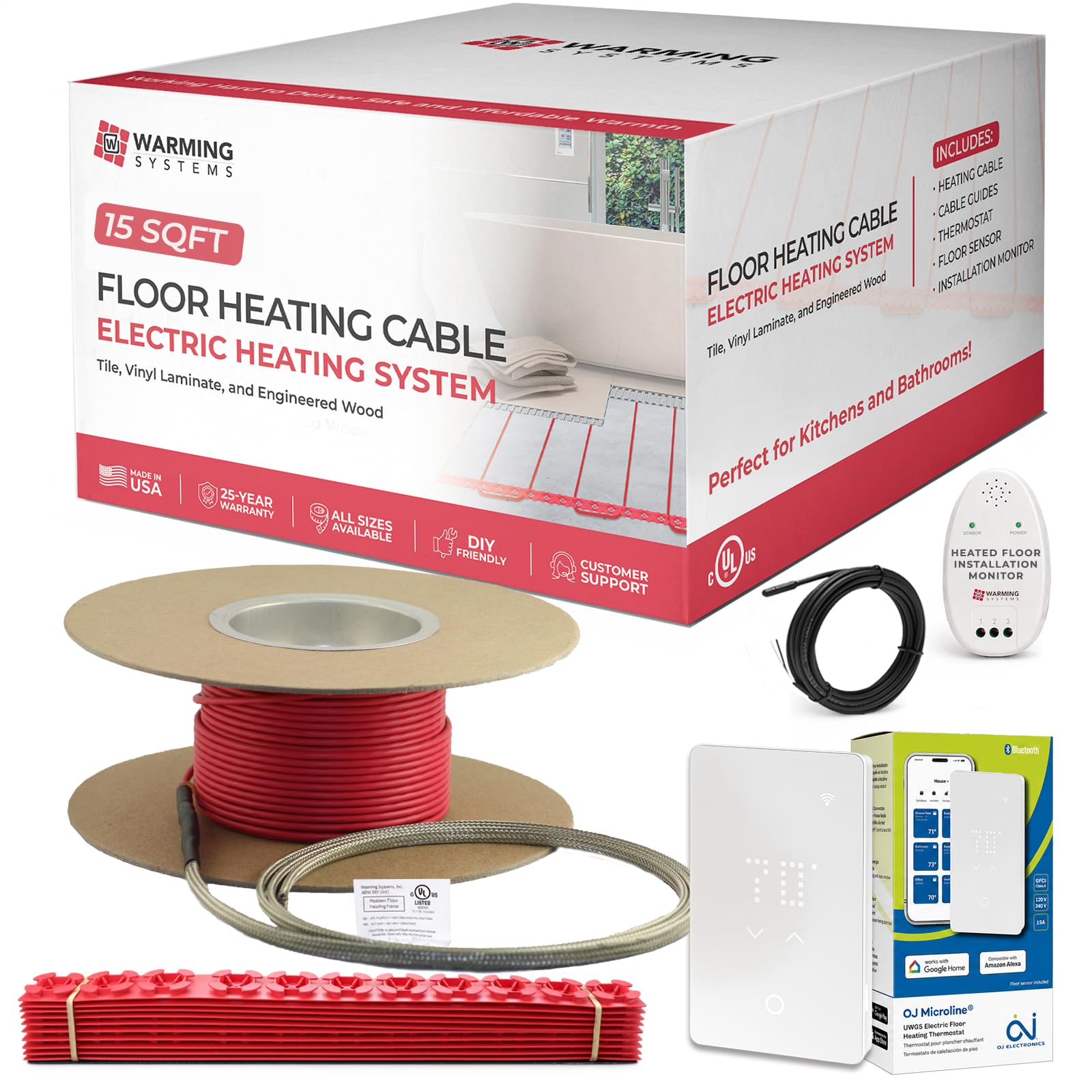
1. Warming Systems 15 Sqft Electric Radiant Floor Heating Cable Kit
Our pick — 4.5★ from 400+ verified ratings; the strongest balance of quality and price.
The 60-foot, 180-watt kit with the best thermostat and the most positive owner feedback of any small-bathroom option.
You get a 60-foot cable that heats 15 square feet at 12 watts per square foot — enough to make tile comfortably warm without feeling hot underfoot. The included programmable thermostat has Wi-Fi and Bluetooth, works with voice control, and uses a floor sensor (a small probe that sits between the cable loops) to keep the tile at a steady temperature. The kit also has a built-in damage alarm that beeps if you nick the cable during tiling, a lifesaver for DIY installs. Buyers report that 61 people specifically praised the ease of installation, calling it a weekend project. Compared to the LuxHeat 20 sqft kit, this one covers 5 fewer square feet but gives you a thicker cable and a smarter thermostat that the other does not match.
The trade-off: you need a precise layout. A few owners mention it took a couple of tries to arrange the loops. The 25-year warranty and US-based manufacturing add confidence that the Warming Systems name carries. For a 15 sqft bathroom, this is the most-trusted package — over 215 shop owners rated it above 4.5 stars collectively, according to the product listings.
Smart-start thermostat: The best all-around pick for a 15 sqft bathroom renovation — it bundles the cable, alarm, and a modern thermostat in one box with a track record of happy owners.
Check fit first: If your room is a tight 13 sqft, you may end up with too much cable and have to tighten spacing. Measure twice, buy the kit that matches your exact floor area.
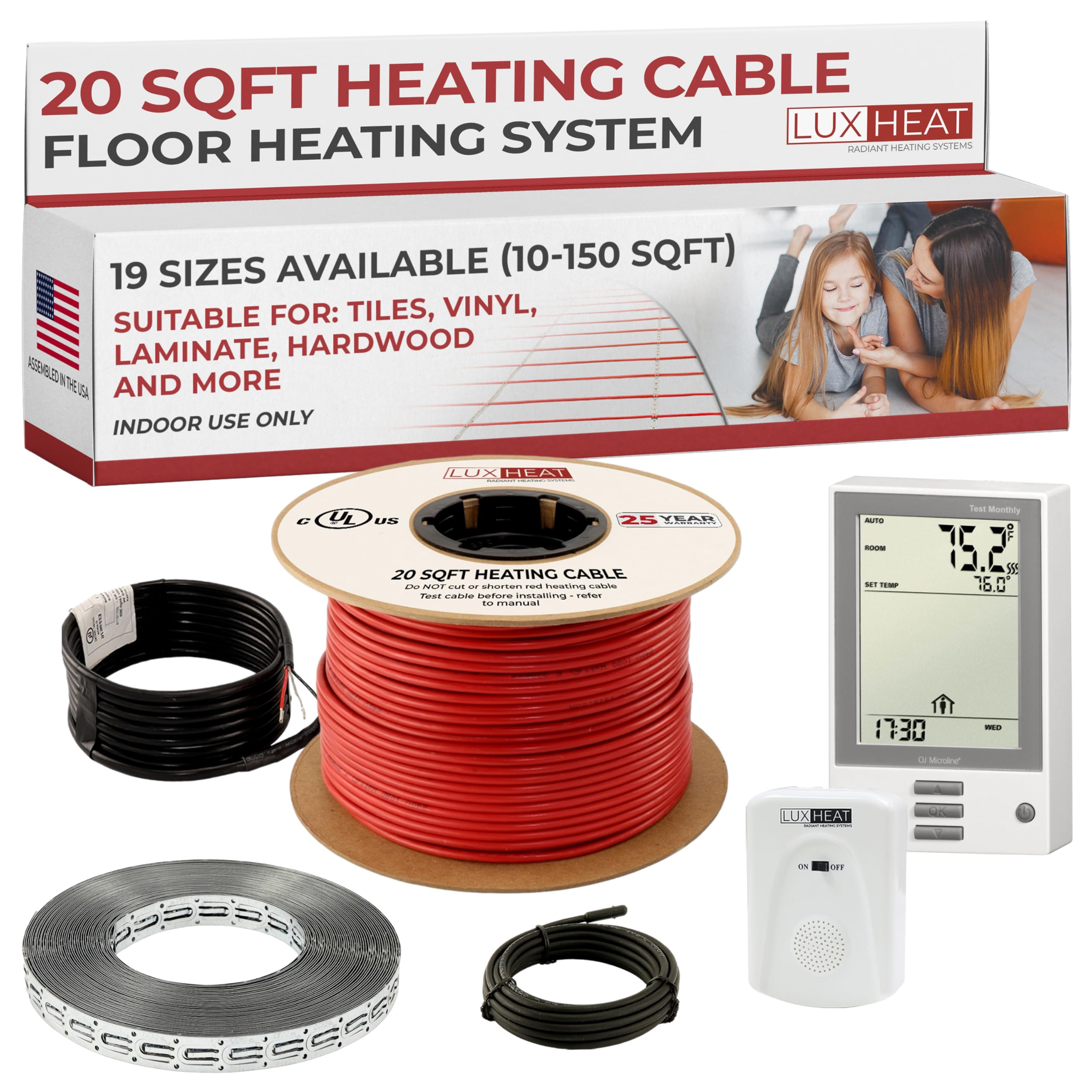
2. LuxHeat 20sqft Floor Heating Cable Kit
The 80-foot, 240-watt kit that covers 33% more floor area than the 15 sqft standard, for a small step up in investment.
If your bathroom is pushing past a tight powder room size, this 20-square-foot kit is the natural next step. An 80-foot cable delivers the same 12 watts per square foot heat density as the Warming Systems pick, but over 5 more square feet. Included metal strapping and cable guides make securing the loops straightforward. The UDG-4999 programmable thermostat includes a built-in Class A GFCI (the safety shutoff for wet areas) and dual air/floor sensing with 7-day scheduling. One reviewer noted it “keeps my toes warm” after over a year of daily use. The cable uses dual-wire technology with an aluminum shield to reduce electromagnetic fields (EMF) to low levels, a detail that matters to sensitive buyers.
The honest downside: the thermostat is a step behind the touchscreen model you get with the other LuxHeat kit or the Wi-Fi model from Warming Systems. A few owners note the interface is functional but plain. But if your priority is covering a larger floor area without jumping up a price bracket, this kit delivers that extra 5 square feet directly.
Big rooms: your open floor measures between 15 and 20 sqft and you want the most direct route to full coverage without moving up to a 30 sqft kit.
Needs extra parts: you strongly prefer a touchscreen thermostat with Wi-Fi — the standard programmable model here is competent but basic.
3. LuxHeat 15sqft Floor Heating Cable Kit with Touchscreen Thermostat
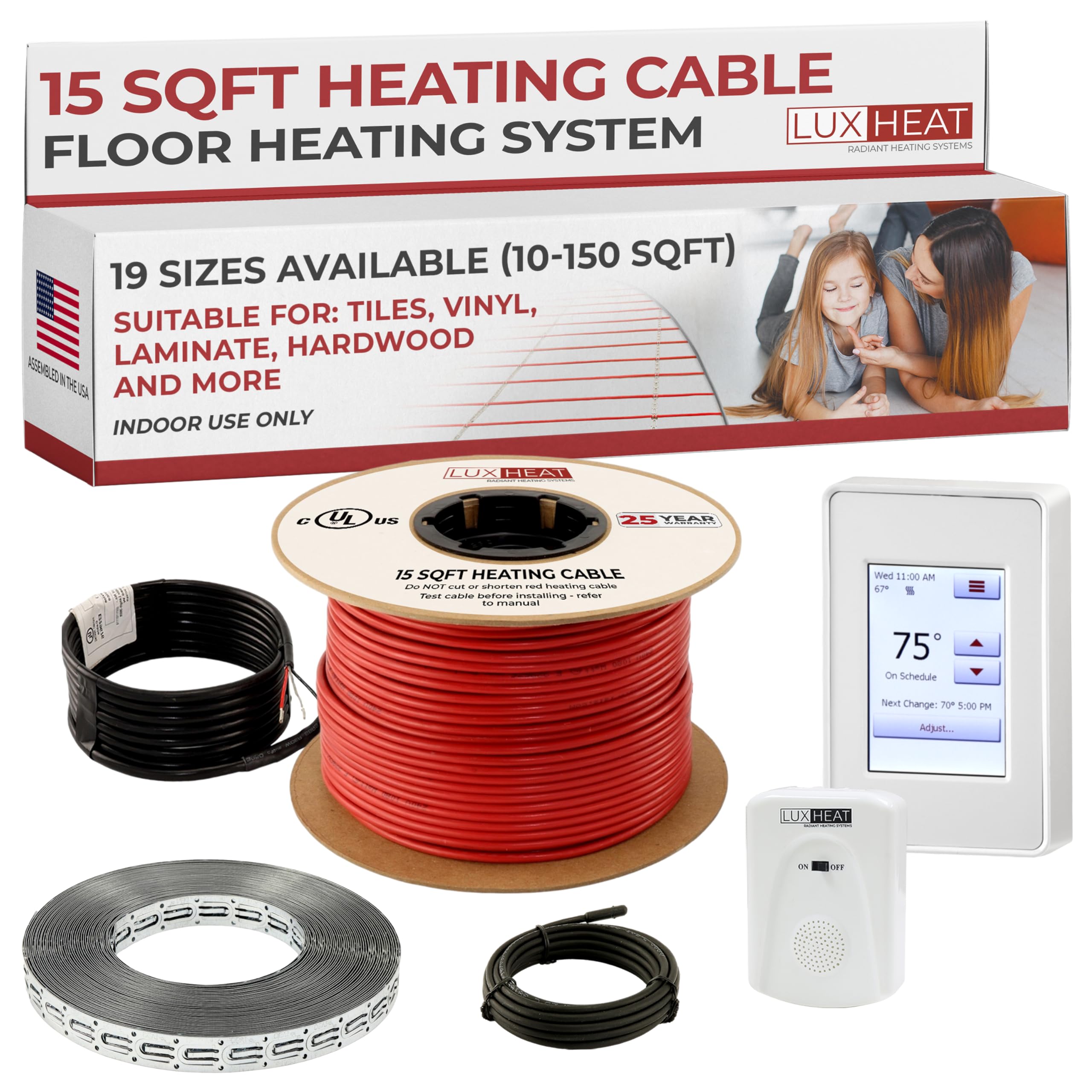
A 60-foot, 180-watt kit that upgrades the everyday control experience with a modern touchscreen and self-learning schedule.
This kit shares the same cable as the Warming Systems pick, but the big difference is the UDG4-4999 touchscreen thermostat. Instead of pushing buttons, you tap the screen to set your schedule. The thermostat includes a “self-learning” feature that the brand claims studies your habits and adjusts the heating pattern, plus a child lock and power logging to track energy use. It also has a built-in Class A GFCI, which means you do not need a separate GFCI breaker in your panel — a real convenience for DIY wiring. Owners say the cable reaches warmth quickly and spreads it evenly across the tile. The 25-year warranty on the cable and the 3-year warranty on the thermostat match the other LuxHeat kits.
The catch: the programming instructions are sparse. A few owners mention you have to experiment with the settings because the manual does not walk you through every step. If you prefer a dead-simple dial or a thermostat with a detailed guide, the non-touchscreen LuxHeat or the Warming Systems kit with Wi-Fi may be a better fit.
Compact spaces: you want the nicer daily interaction of a touchscreen thermostat and the safety of built-in GFCI in one package.
Limited square footage: you dislike figuring out electronics without clear instructions — the benefits here are real but the learning curve is yours to climb.
4. HeatTech 30 sqft Floor Heating Cable Set with Aube Thermostat

A 120-foot, 360-watt cable that adapts to three different coverage sizes by changing the spacing between loops.
When your room is too big for a 15 or 20 sqft kit, this 30-square-foot set fills the gap. The 120-foot cable runs at 360 watts (3 watts per foot) at the standard 3-inch spacing. You can also run it tighter at 2-inch spacing to cover 20 sqft with denser heat, or looser at 4-inch spacing for 40 sqft with a milder warmth. That flexibility is the big selling point — the same cable adapts to different projects. The Aube TH115-AF-120S thermostat from Honeywell is a 7-day programmable model with a backlit LCD display and floor sensor. It is reliable and quiet, but it does not include a built-in GFCI, so you will need a GFCI breaker or a separate device to meet code for wet locations. The cable uses a zero-EMF design, which means the twin conductors cancel out electromagnetic fields — a feature buyers looking to minimize EMF exposure specifically seek out. Cable is described as thick and durable by owners; one noted it even survived a tile removal session without damage. It warms from 55°F to 70°F in about 45 minutes, quick enough for morning schedules.
The main trade-off: no installation alarm monitor is in the box. You will need to be extra careful during tiling or buy a separate continuity tester to confirm the cable is intact before you cover it.
Aube thermostat included
- Flexible 2-to-4-inch spacing gives three coverage options from one cable
- Zero-EMF design reduces electromagnetic fields for sensitive buyers
- Rugged cable that owners praise for surviving rough handling
Higher price point
- No built-in GFCI on the thermostat — you need a GFCI breaker or device
- No damage alarm monitor included during installation
Complete package: a larger bathroom or small kitchen where you need 30 sqft of coverage and want the flexibility to adjust heat density by spacing.
Budget alternative: budget for a GFCI breaker if your panel doesn’t have one, and be extra careful tiling without an alarm to warn you of nicks.
5. HEATWAVE 64-120 Sqft In-Floor Heat Cable Kit with Thermostat & Sensor
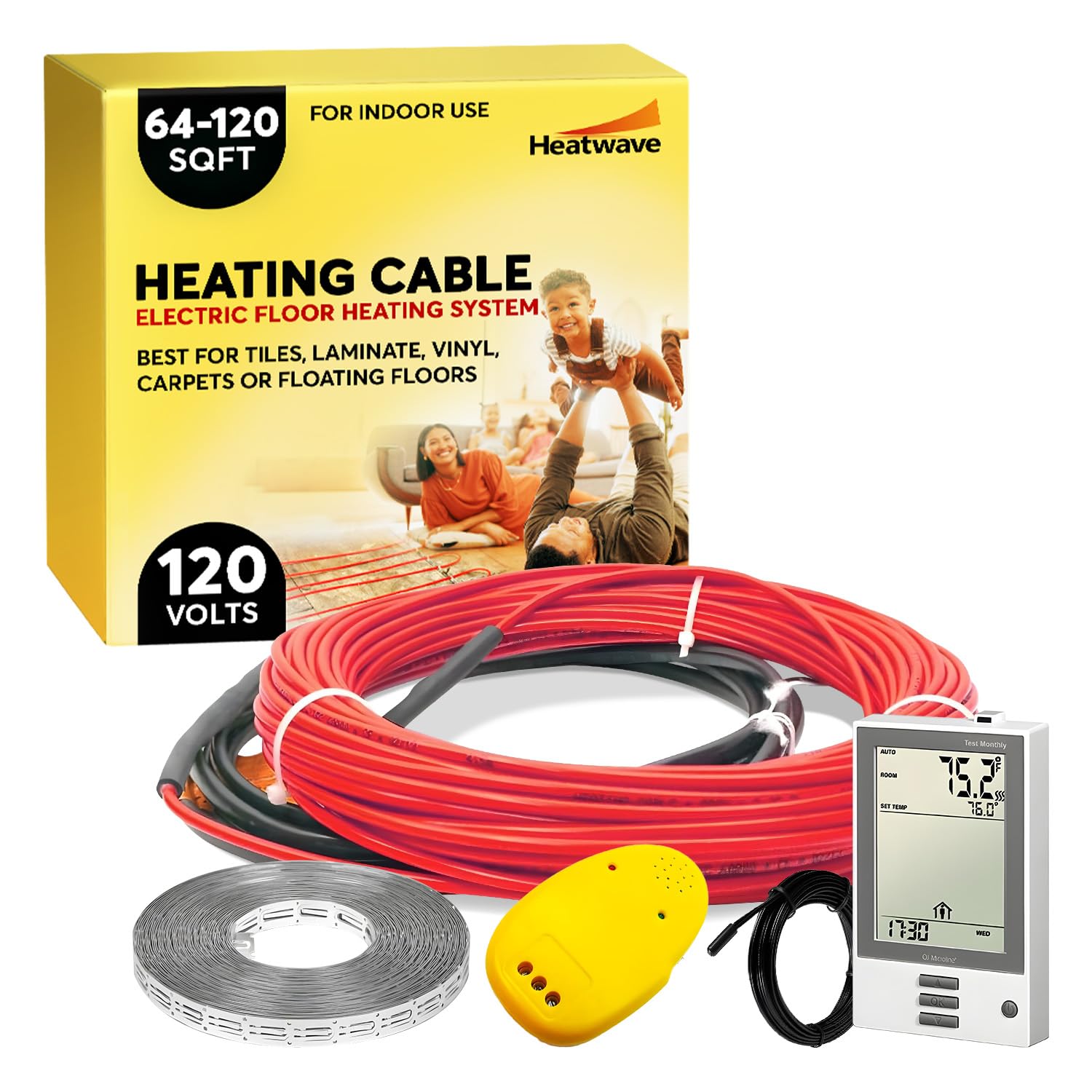
A 362-foot, 960-watt cable that covers between 64 and 120 square feet — the only kit here designed for an entire room, not just a bathroom.
This is the big one. The 362-foot cable pulls 960 watts at 8 amps and covers 64 to 120 square feet depending on spacing. At tight 2-inch spacing, you get a dense 15 watts per square foot — noticeably warmer than the standard 12 watts. At 4-inch spacing, coverage stretches to 120 square feet at a gentler 8 watts per sqft. The included thermostat is a 7-day, 4-event programmable model with built-in GFCI protection, which is essential for a system drawing this much power. The kit also includes a damage alarm and monitor, a welcome feature given the cost of replacing a 362-foot run. Owners who installed it under porcelain tile in a kitchen report it keeps the whole room warm during winter, cutting out the need for a space heater. The value: covering 96 sqft at 10 watts per sqft works out to a cost per square foot that beats buying multiple smaller kits.
The main complaint: the thermostat is functional but not intuitive. The display is small and the programming can be tedious. A touchscreen upgrade is available from the vendor, and several owners took that route. If you plan your thermostat programming before install, this is manageable. But if you want a premium control interface from the start, budget for the upgrade or spend time learning the button sequences.
Big projects: a large kitchen, family room, or any open-plan area between 64 and 120 sqft where you want one continuous cable run instead of multiple mats.
Tricky to handle: the thermostat interface is dated — budget an extra for the touchscreen upgrade if you want a modern control experience.
Understanding the Specs
Watt Density (Watts per Square Foot)
Watt density tells you how much heat the cable puts out for every square foot of floor. Most kits run at 12 watts per square foot, which is enough to make tile comfortably warm to the touch — think a gentle heat, not a hot surface. A kit with 15 watts per square foot (like the HEATWAVE at 2-inch spacing) will feel noticeably warmer and heat up faster, but it also draws more power. Higher watt density is great for large rooms or very cold climates, but for a standard bathroom, 12 watts per square foot is the typical balance that balances comfort with energy use.
Cable Spacing and Coverage Flexibility
Cable spacing is the distance between each loop of wire as you lay it across the floor. Tighter spacing (2 inches apart) puts more wire in the same area, creating a denser heat pattern and a warmer floor. Wider spacing (3 or 4 inches apart) uses less wire to cover a larger area but produces a milder heat. Some kits let you adjust the spacing to fine-tune the heat output, which is useful if your room is an odd shape or if you want more warmth in a specific zone. The standard recommendation for most bathrooms is 3-inch spacing.
FAQ
Can I cut the heating cable to make it fit my room?
What happens if I damage the cable during tile installation?
Do I need a special thermostat for an electric underfloor heating system?
Do I need GFCI protection for a bathroom floor heating system?
Can I install the heating cable under carpet or vinyl plank flooring?
How long does it take for an electric underfloor heating cable to warm up?
Can I install an electric floor heating cable myself, or do I need a professional?
What is the difference between a loose-lay cable and a heating mat?
How much will it cost to run an electric underfloor heating system monthly?
What is the cold lead on an underfloor heating cable?
Final Thoughts: The Verdict
Across the board, the clear winner among the electric underfloor heating cable kits is the Warming Systems 15 Sqft Kit because it bundles the most trusted cable design with a Wi-Fi/Bluetooth programmable thermostat and a 25-year warranty, all wrapped in a package that the largest group of owners found easy to install. If you need to heat a larger space (20 sqft), the LuxHeat 20 Sqft Kit delivers 33% more coverage with a solid GFCI thermostat. And for those tackling a big room between 64 and 120 sqft, the HEATWAVE 64-120 Sqft Kit is the one to reach for — a single 362-foot cable run that keeps a whole kitchen warm without needing multiple separate kits.
How We Picked
We do not accept paid placement. Every pick is matched to a real buyer and a real use-case; we do not hands-on test units.
Sources & Methodology
Specifications: manufacturer listings and product documentation. Review insights: verified customer reviews, as of July 2026. Pricing: not shown on this page (it changes often); check the current price via the retailer link.
As an Amazon Associate, WellFizz earns from qualifying purchases. This does not affect which products we feature.
Related Guides

Mo Maruf
I created WellFizz to bridge the gap between vague wellness advice and actionable solutions. My mission is simple: to decode the research and give you practical tools you can actually use.
Beyond the data, I am a passionate traveler. I believe that stepping away from the screen to explore new environments is essential for mental clarity and physical vitality.