Our readers keep the lights on and my smoothie glass nicely filled. As an Amazon Associate, I earn from qualifying purchases.
Specs are compiled from manufacturer listings and verified buyer reviews and can change over time — please confirm the key details on the product page before buying.
In the back of a speeding rig or a chaotic ER bay, the difference between a clear lung sound and a muddy guess can change a call. An EMT stethoscope needs to be louder, tougher, and more forgiving of noise than a ward scope — it is a piece of rescue gear as much as a diagnostic tool. This guide cuts through the marketing and lines up the six models that genuinely earn their keep in emergency medicine.
I’m Mohammad Maruf — the founder and writer behind WellFizz. This guide is built by comparing the manufacturers’ published specifications and the patterns across verified customer reviews, so you get each pick’s real strengths and trade-offs instead of marketing spin.
Whether you are a field paramedic needing reliable acoustics or a student building a kit, these are the models that deliver where it counts: the best emt stethoscope is the one you can trust when every second matters and the noise level rises.
Our Picks at a Glance


How To Choose The Best EMT Stethoscope
Picking a stethoscope for emergency work is different from choosing one for a quiet exam room. You need acoustics that can punch through background noise, a build that survives being thrown in a jump bag, and a fit that stays comfortable for a 12-hour shift. Here is what to focus on.
Acoustic Output and Clarity
The single biggest factor is how much sound reaches your ears. An EMT scope must amplify faint heart and lung sounds above the noise of a diesel engine, a radio, or a busy trauma bay. Look for models that claim significantly higher acoustic output — some are rated at more than twice the loudness of standard scopes. That spec translates to fewer missed lung crackles or weak heart tones when it matters.
Chestpiece Design: Tunable vs. Convertible
A tunable diaphragm lets you hear different frequencies by changing pressure — light pressure for low-frequency sounds, firm pressure for high frequencies. This is convenient in fast field assessments because you do not have to flip the chestpiece. A convertible chestpiece, on the other hand, lets you physically swap between a bell and a diaphragm, which some prefer for pinpointing very low-frequency heart sounds. Your choice depends on whether speed or fine diagnostic control matters more.
Weight, Tubing, and Portability
You will carry this scope around your neck for hours. Every ounce adds up, so a lighter instrument — around 3.5 ounces for the lightest options versus over 11 ounces for heavier ones — makes a real difference in neck fatigue over a shift. Tubing length affects reach: 27 inches is standard, but a 28-inch tube can give you a bit more stretch when leaning over a gurney. Dual-lumen tubing (two sound channels inside one tube) reduces noise from tubes rubbing together, which is a genuine problem in a moving ambulance.
Warranty and Parts Support
An EMT stethoscope takes abuse — dropped on concrete, crushed in a bag, exposed to sanitizers. A strong warranty (5 years is common on premium models, some go to 20 years on calibration) and a free lifetime parts program for ear tips and diaphragms can save you real money. If you are buying for the long haul, check whether the manufacturer will replace the parts that wear out fastest.
Quick Comparison
| Model | Best For | Acoustic Output | Weight | Chestpiece Type | Amazon |
|---|---|---|---|---|---|
| 3M Littmann Classic III (5809)★ Best Overall | Best Overall / Loudest Acoustics | More than 2x louder | 3.53 oz | Tunable Dual-Sided | Amazon |
| Greater Goods Dual-HeadBudget Champion | Budget-Friendly Value Pick | High-Precision | 11.7 oz | Dual-Head Tunable | Amazon |
| 3M Littmann Classic III (5623) | EMT Field Reliability | More than 2x louder | 0.15 kg | Tunable Dual-Sided | Amazon |
| ADC Adscope 601 Convertible | Cardiology-Level Detail on a Budget | Superior (AFD Tech) | 7.6 oz | Convertible Bell/Diaphragm | Amazon |
| Welch Allyn Harvey DLX (Navy) | Modular Long-Term Workhorse | Full-Range Cardiology | 1.12 lb | Double-Head Bell & Diaphragm | Amazon |
| Welch Allyn Harvey DLX Triple Head | Extra Acoustic Versatility | Superior Clarity | 1.26 lb | Triple-Head | Amazon |
In‑Depth Reviews
1. 3M Littmann Classic III Monitoring Stethoscope (5809) — Copper Finish
Our pick — over 4.5★ from 81,000+ verified ratings; the strongest balance of quality and price.
The loudest acoustic tool in the rig, trusted by over 80,000 owners for its clarity and featherweight feel.
Your neck will thank you after a long shift. At just 3.53 ounces, this is far lighter than many competitors — a difference that disappears around your neck after hour six. But the real headline here is the acoustic output: the manufacturer tests show it is more than twice as loud as comparable stethoscopes, and the crowd consensus backs that up. It is designed to help you hear low-frequency sounds below 120 Hz — the range of Korotkoff sounds and certain heart gallops — more reliably than other leading scopes. That is the difference between catching a subtle change in a patient’s condition and missing it entirely.
The tunable, dual-sided stainless steel chestpiece gives you both an open and closed bell, with a non-chill bell sleeve for patient comfort. The soft-sealing ear tips block out ambient noise, and the 5-year warranty covers the build. The visual appeal — chocolate tubing with a copper chestpiece — is a bonus that buyers consistently mention as a bright spot in their kit. One owner summed it up plainly: “Great for hearing issues: loud, clear sound.”
What Rises Above
- More than 2x louder than the next leading competitor — critical for noisy back-of-rig assessments.
- Weighs just 3.53 oz, making it the lightest pick here by a wide margin.
- Tunable dual-sided chestpiece adapts quickly between adult and pediatric patients.
- Designed and manufactured in the USA with a full 5-year warranty.
What to Know
- Premium-tier investment — not the cheapest option for a student on a tight budget.
- Some buyers prefer a true bell instead of a tunable diaphragm for certain very-low-frequency heart sounds.
Reach for it if: you want the loudest, lightest, and most universally trusted field scope — the one that makes hearing in a chaotic environment feel easy.
Look elsewhere if: your budget cannot stretch to this level and you still need solid acoustics for daily training or basic assessments.
2. Greater Goods Dual-Head Stethoscope — Black & Stainless Steel
A clinical-grade scope that delivers clear sound and a no-worry parts program at a third of the premium price.
The most-discussed feature here, by a wide margin, is the build quality — and that is rare for a scope at this price tier. The precision-machined stainless steel chestpiece and headset run a 29-inch overall length with insulated tubing that supports accurate auscultation (listening to internal body sounds). The tunable, 360-degree rotating dual-head chestpiece handles both high and low frequencies and works with manual blood pressure cuffs for accurate systolic (pressure when the heart beats) and diastolic (pressure between beats) readings. The catch, and it is a real one: at 11.7 ounces, it is the heaviest single-chestpiece scope in this lineup — a full 3.3x the weight of the Littmann Classic III — and you will feel that difference during a 12-hour shift.
The standout value is the Free Lifetime Parts Program. Replacement ear tips and diaphragms are provided at no charge for as long as you own the instrument. That alone can save you money over the life of the scope. The factory-tested acoustics are clear enough for breathing and heart sounds, and the internal tension spring keeps the headset balanced for a secure fit. As one buyer put it, “For the price really wasn’t bad” — a fair summary that acknowledges the weight tradeoff while affirming the core performance.
What Stands Out
- Free lifetime replacement ear tips and diaphragms — zero cost for wearable parts.
- Precision-machined stainless steel chestpiece feels solid and durable for daily use.
- Factory-tested acoustics deliver clear sound for basic cardiac and respiratory assessments.
- Compatible with manual BP cuffs for combined assessment.
The Fair Warning
- At 11.7 oz, it is significantly heavier than premium options — neck fatigue is a real possibility on long shifts.
- Sound quality is good for the price but buyers report a clear difference versus high-end scopes for subtle auscultation.
Best for a student or early-career clinician. You get a reliable, durable scope without a massive upfront cost, and the free lifetime parts support saves you money for years.
3. 3M Littmann Classic III Monitoring Stethoscope (5623) — Caribbean Blue
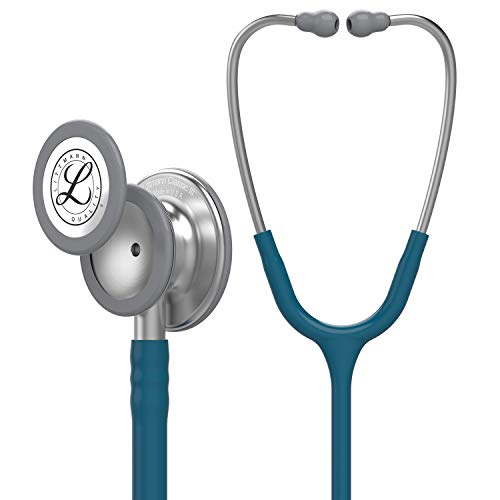
The same legendary acoustic engine in a classic stainless finish that EMTs and paramedics trust in the field.
This is the same core instrument as the copper-finish Classic III, just with a stainless steel chestpiece and Caribbean blue tubing — a color that stands out in a black-and-white medical world. The acoustic performance is identical: more than twice as loud as the next leading stethoscope, with a tunable dual-sided chestpiece that handles both adult and pediatric assessments. The 27-inch length is standard, and the soft-sealing ear tips provide the same excellent sound occlusion (blocking out background noise) that owners rave about for noisy environments.
Where this model earns its place is in the field-specific praise. Buyers repeatedly describe “excellent acoustic clarity for breath, heart, and lung sounds in noisy EMS environments” and call it “dependable for students and experienced nurses.” The dual-sided chestpiece has a tunable diaphragm — light pressure for low frequencies, firm for high — which is faster in an emergency than flipping to a bell. The 5-year warranty and US-based manufacturing are the same as the 5809 model. The core difference is aesthetic and price: the stainless steel finish brings the cost down while keeping all the same internals.
The Verdict: If you want the proven Littmann Classic III acoustics — louder than the competition, reliable for EMT field work — but prefer a classic stainless look and a slightly lower entry point, this is your pick. The trade-off is zero; it is the same scope in a different color and chestpiece finish.
Who it fits: any EMT, paramedic, or nurse who needs the gold-standard acoustic output at a better price than the premium-finish version. The performance is identical.
Who might pass: those who specifically want the copper chestpiece for its corrosion resistance or visual distinction.
4. ADC Adscope 601 Convertible Cardiology Stethoscope — Tactical Black

Cardiology-grade acoustics with a convertible chestpiece that lets you switch bell to diaphragm in seconds.
The ADC Adscope 601 offers an alternative philosophy to the tunable-diaphragm Littmann. Instead of varying pressure, you physically convert the chestpiece: the stainless steel body comes with a fixed adult diaphragm and a threaded pediatric diaphragm. Unscrew the pediatric piece, and you have an open bell for deep low-frequency sounds. Owners consistently report sound quality that is “virtually indistinguishable from Littmann Cardiology III” and praise its performance in noisy settings — one buyer described hearing “all murmurs and every little detail.” The proprietary Adjustable Frequency Design (AFD) tech uses light pressure for low frequencies and firm pressure for high, giving you that tunable convenience on the adult side.
At 7.6 ounces, it sits between the ultra-light Littmann and the heavier Greater Goods and Welch Allyn models. It is not featherweight, but it is manageable for a full shift. The dual-channel phthalate-free tubing cuts down on tube-rub noise, and the Adsoft Plus snap-on silicone ear tips provide a comfortable seal. The real head-turner is the warranty: a 20-year calibration warranty and a 3-year system warranty — far longer than most competitors. The major caveat is weight: several owners flag it as a notable heft, and the convertible design means you need to unscrew the pediatric portion to access the cardiology bell, which is a small extra step in a fast-paced assessment.
Highlights
- Superior sound quality that owners compare directly to Littmann Cardiology III — at a lower cost.
- Convertible chestpiece offers true bell and diaphragm for maximal acoustic flexibility.
- 20-year calibration warranty is the longest in this group by far.
- Includes extra ear tips, storage case, and scope ID tag right from the start.
Trade-offs
- Heavier than the Littmann Classic III (7.6 oz vs 3.53 oz) — noticeable on long shifts.
- Converting between pediatric diaphragm and bell requires unscrewing; not instant during a rapid assessment.
Choose this for: a clinician who wants cardiology-level acoustic detail — including a true bell for low-frequency heart sounds — without paying Littmann Cardiology pricing.
Pass if: you prioritize a featherweight scope and want one smooth tunable chestpiece, not a convertible one.
5. Welch Allyn 5079-327 Harvey DLX Adult Cardiology Stethoscope — Navy
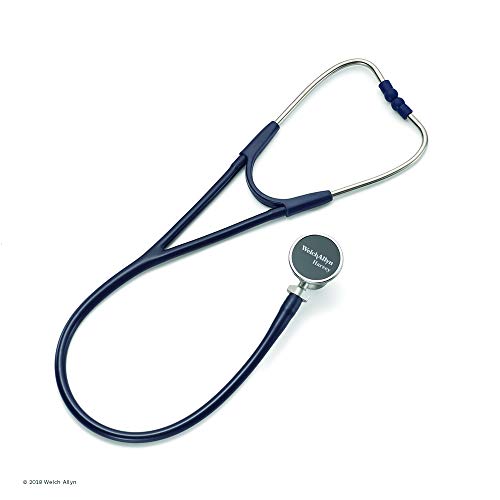
A modular, mechanically brilliant scope built to last a decade — and to be repaired, not replaced.
Welch Allyn is one of the great medical instrument manufacturers, and the Harvey DLX is a different breed from the tunable-diaphragm models. It uses a true bell and a corrugated diaphragm — the corrugated design has ridges that help it pick up midrange frequencies better than flat diaphragms. The chrome-plated brass chestpiece and rotatable binaural (the part that splits into your ears) are heavy and precise. At 1.12 pounds, it is the second-heaviest scope here, and that heft is by design: the mass helps it stay stable on the patient’s chest and filters out handling noise. Buyers describe the “masterful headpiece” and note it “lasts about 10 years” before tubing typically fails — and because the scope is fully modular, you can replace parts individually rather than tossing the whole instrument.
The double-head chestpiece gives you a bell and a flat diaphragm, which some clinicians strongly prefer over a tunable design. The interchangeable comfort-sealing ear tips provide a good seal. The caveat is intuitive: you need to get used to it. Owners mention that the ear tubes are snug and the chest pieces may loosen over time, though neither is a dealbreaker. The 28-inch tubing is slightly longer than standard, which is helpful when you need extra reach over a gurney.
The Verdict: This is the pick for a clinician who appreciates mechanical elegance, modular repairability, and a true bell for classic auscultation.
Best for: a career EMT or medic who wants a scope that can be maintained and repaired over a decade, with a corrugated diaphragm that excels at midrange sounds.
Skip if: you need the absolute lightest field scope or prefer a tunable diaphragm over a true bell.
6. Welch Allyn 5079-321 Harvey DLX Stethoscope — Triple Head, 28″ Black

The triple-head design delivers a corrugated diaphragm, flat diaphragm, and a brass bell — all on one scope.
This is the most acoustically versatile scope in the lineup. The rotatable triple-head chestpiece gives you three distinct listening modes: a brass bell for low-frequency heart sounds, a corrugated diaphragm for midrange clarity, and a flat diaphragm for general assessment. Owners consistently report it is “louder than Littmann Cardio III with less noise” and note the corrugated diaphragm “excels at low/medium frequencies.” The chrome-plated brass chestpiece and binaural are built to last, and the 28-inch length is the longest here — useful for reaching across a stretcher without straining.
The cost of that versatility is weight: at 1.26 pounds, it is the heaviest scope in this comparison. That is a serious consideration for a 12-hour shift, though some owners point out the mass actually helps the chestpiece stay stable and filter out handling noise. The interchangeable comfort-sealing ear tips are the same quality as the double-head model. The common owner observations are that the binaural spring can be a weak point (expensive to replace) and the bell component may need periodic tightening. A buyer noted it is “very heavy” but also “solid and dependable” and “would not do without it.”
Why It Wins
- Triple-head design gives you three distinct acoustic tools in one scope — brass bell, corrugated diaphragm, flat diaphragm.
- Excellent sound clarity and amplification, often described as louder than the Littmann Cardio III with less background noise.
- 28-inch length is the longest in the group, offering extra reach in the field.
- Chrome-plated brass construction is sturdy and optically distinctive.
The Heavy Cost
- At 1.26 lb, this is the heaviest pick here — expect neck fatigue over long shifts.
- Binaural spring is a known weak point and is costly to replace.
- Bell component may loosen and require periodic tightening.
Reach for it when: you need the ultimate acoustic versatility — the ability to switch between a bell and both diaphragm types — and you are willing to carry the weight for the range.
Pass if: you prioritize a lightweight, neck-friendly tool for rapid field assessments over having a specialized head for every sound frequency.
Understanding the Specs
Acoustic Output & Loudness
This is the most critical spec for an EMT stethoscope. A scope that is “more than 2x louder” than a standard model means you can hear subtle breath sounds and heart tones above the ambient noise of a running ambulance, a busy ER, or a chaotic scene. In practice, higher acoustic output gives you more confidence in your assessment and reduces the chance of missing something. Look for models that explicitly test and publish their output relative to comparable scopes.
Tunable Diaphragm vs. True Bell
A tunable diaphragm lets you hear different frequencies by changing how firmly you press the chestpiece against the patient. Light pressure filters out high frequencies (for low-frequency sounds like heart murmurs), while firm pressure lets high frequencies through (for lung sounds). A true bell — found on the ADC Adscope and both Welch Allyn Harvey models — is a physically open chamber that naturally amplifies low frequencies. There is no wrong choice; it is about whether you prefer instant frequency switching (tunable) or dedicated acoustic chambers (true bell).
Weight and Neck Fatigue
You will wear a stethoscope around your neck for the majority of a 12-hour shift. The difference between a 3.5-ounce scope and an 11-ounce scope is massive over time. Lighter scopes are more comfortable and less likely to cause neck strain. Heavier scopes, however, often have more metal and mass, which can help stabilize the chestpiece on the patient and reduce handling noise. Your call is a trade-off: lightweight comfort vs. mass-based stability.
Tubing: Single-Lumen vs. Dual-Lumen
Single-lumen tubing uses one tube for both sound channels. Dual-lumen tubing puts both channels inside a single outer tube, which dramatically reduces the “rub” noise that happens when two separate tubes slide against each other. In a moving ambulance, that rub noise can be distracting. Dual-lumen is generally preferred for EMT work because of the noise reduction, though it can sometimes make the tubing feel slightly stiffer.
FAQ
Which is better for an EMT: a tunable diaphragm or a convertible bell-and-diaphragm chestpiece?
Will a lighter stethoscope like the Littmann Classic III hold up to daily abuse in an ambulance?
Why does the Welch Allyn Harvey DLX weigh so much more than the Littmann Classic III?
Can I use an adult cardiology stethoscope on pediatric or infant patients?
What does “more than 2x louder” actually mean in a real ambulance setting?
How important is a 5-year or 20-year warranty for an EMT stethoscope?
What is the difference between dual-lumen and single-lumen tubing on a stethoscope?
Should I buy a stethoscope with a heavier chestpiece to get better noise isolation?
Final Thoughts: The Verdict
For most EMTs and paramedics, the best emt stethoscope winner is the 3M Littmann Classic III (5809) because it offers the best balance of extreme lightweight design (3.53 oz), proven acoustic output that is more than 2x louder than competitors, and a tunable chestpiece that adapts instantly between adult and pediatric patients. If you need cardiology-level acoustic detail with a true bell at a mid-range cost, grab the ADC Adscope 601. And for the budget-conscious buyer who needs a reliable daily driver with zero-cost lifetime parts, the Greater Goods Dual-Head is the one to reach for.
How We Picked
We do not accept paid placement. Every pick is matched to a real buyer and a real use-case; we do not hands-on test units.
Sources & Methodology
Specifications: manufacturer listings and product documentation. Review insights: verified customer reviews, as of July 2026. Pricing: not shown on this page (it changes often); check the current price via the retailer link.
As an Amazon Associate, WellFizz earns from qualifying purchases. This does not affect which products we feature.
Related Guides

Mo Maruf
I created WellFizz to bridge the gap between vague wellness advice and actionable solutions. My mission is simple: to decode the research and give you practical tools you can actually use.
Beyond the data, I am a passionate traveler. I believe that stepping away from the screen to explore new environments is essential for mental clarity and physical vitality.