Our readers keep the lights on and my smoothie glass nicely filled. As an Amazon Associate, I earn from qualifying purchases.
Specs are compiled from manufacturer listings and verified buyer reviews and can change over time — please confirm the key details on the product page before buying.
You want a concrete floor in your garage, shop, or driveway that stops kicking up dust every time you walk over it. A concrete densifier (a liquid you pour onto the slab) seeps into the pores and turns loose particles into a hard, solid mass from the inside out. The real trick is picking the right chemistry — lithium silicate or sodium silicate — at the right coverage rate so you do not waste money or end up with a sticky, stained surface. This guide compares three proven picks by their published specs and the experiences real buyers share in their reviews, so you know exactly which concrete densifier solves your dusting problem without any guesswork.
I’m Mohammad Maruf — the founder and writer behind WellFizz. This guide is built by comparing the manufacturers’ published specifications and the patterns across verified customer reviews, so you get each pick’s real strengths and trade-offs instead of marketing spin.
The right choice hinges on if you need a one-and-done penetrating hardener for a new pour or a tougher fix for an older, dusty slab. We will walk through three top-performing formulas so you know exactly which concrete densifier fits your project before you pull the trigger.
Quick Picks
- Ghostshield 1 gal. Invisible Penetrating Concrete Sealer Plus Densifier and Hardener 4500 — Best Overall
- Foundation Armor 1-Gal. L3000 Ready to Use Water-Based Lithium Silicate Densifier — Polished Floor Pro
- Armor S2000 Sodium Silicate Concrete Densifier and Surface Hardener – 1 Gallon — Budget Champion
How To Choose The Best Concrete Densifier
A concrete densifier is a liquid treatment that soaks into your slab and triggers a chemical reaction. It turns free lime and calcium inside the concrete into permanent calcium silicate hydrate (CSH) crystals — basically filling microscopic pores with rock-hard binder. The result is a dense surface that resists dusting, abrasion, and water penetration. Two main chemistries do the job: lithium silicate and sodium silicate. Lithium-based formulas generally penetrate deeper (up to 2 inches) and react faster, making them a favorite for polished floors and garage slabs. Sodium silicate is older, cheaper, and works very well on existing concrete that just needs a dust-control fix — but it sometimes leaves a temporary white haze if over-applied.
Look at the coverage number first
Every densifier states how many square feet one gallon covers. Smooth, dense concrete might take 300-400 square feet per gallon, while a rough or porous surface can drop that to 175-200 square feet. Work out your slab’s square footage, then buy enough for two thin coats (the second coat always covers less because the first already filled some pores). If the packaging says “up to 400 sq ft,” plan for the lower end on any surface that looks sandy or pitted — you will need more.
Decide between a stand-alone treatment and a primer
Some densifiers are designed as a final treatment — you apply them, let them cure, and you are done. Others work better as a primer under a separate topical sealer or coating. If you plan to paint or epoxy your garage floor later, pick a penetrating densifier that leaves no film (like a lithium silicate). If you just want to stop dusting on a basement floor and never touch it again, a sodium silicate formula at the right concentration will do the job alone.
Check for low odor and easy clean-up
Most densifiers are water-based with low or no VOCs (volatile organic compounds — the stuff that makes paint fumes). That means you can use them in an attached garage or basement without gas masks. Clean-up is typically soap and water while the product is still wet. If a formula says “ready to use,” you do not need to dilute it; if it recommends dilution, follow it to the letter to avoid white residue. Buyers report that the tiniest puddle left to pool on the surface will leave a whitish stain that requires grinding to remove.
Quick Comparison
| Model | Best For | Chemistry | Coverage (per gal) | Item Weight | Amazon |
|---|---|---|---|---|---|
| Ghostshield 4500 | Long-term outdoor & garage use | Lithium Silicate | Up to 400 sq ft (dense) | 9.5 lbs | Amazon |
| Foundation Armor L3000 | Polishing & high-traffic floors | Lithium Silicate | 175-400 sq ft | 10 Pounds | Amazon |
| Armor S2000 | Large budget-driven projects | Sodium Silicate | 200-400 sq ft | 9 Pounds | Amazon |
In‑Depth Reviews
1. Ghostshield 1 gal. Invisible Penetrating Concrete Sealer Plus Densifier and Hardener 4500
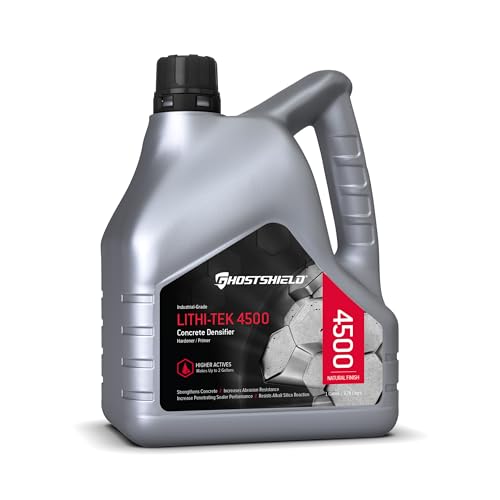
A lithium-based penetrator that takes on the toughest weather and still keeps your slab dust-free.
If you want your driveway, garage floor, or pool deck to stop dusting and resist winter salt, the Ghostshield 4500 is the deepest bet of the three. It uses a proprietary lithium silicate formula that bonds below the surface to increase abrasion resistance by up to 50% — no film, no change in appearance, just a harder slab. One reviewer noted that it “survived harsh Nebraska winter with salt” and actually prevented an ice sheet from forming on an inclined driveway, while an untreated sidewalk nearby flaked and chipped.
The coverage is generous — on dense surfaces you get up to 400 square feet per gallon, though on 30-day-old concrete one reviewer found they underestimated coverage at a 1:1 dilution and still got great results. Another buyer applied it as a primer before a Siloxa 8510 topcoat and reported water still beaded up without any glossy look. The formula is 100% VOCs (volatile organic compounds), so there is no chemical odor during application, and clean-up is just soap and water while it is wet. The only temporary side effect some buyers see is a light veiny appearance while the material cures, which fades completely with no final color change.
Unlike the Armor S2000 sodium silicate option below, the Ghostshield uses smaller lithium molecules that can penetrate deeper (the competing Foundation Armor L3000 below claims 2 inches of penetration with the same chemistry). One reviewer on a pool deck noticed waterproofing effects soon after application, and multiple buyers confirm the treatment saved them significant sealer cost — one cut his sealant use from 2.5 gallons down to 1.25 gallons after densifying first. The main tradeoff: if you pour it on too thick in one spot, you will see whitish residue that only comes off with mechanical grinding, so keep that sprayer moving in even passes.
Where it leads
- Li-ion penetrates 2″ deep — densifies all the way through the surface layer.
- Rated to increase abrasion resistance by 50% — tougher than any sodium-silicate here.
- Zero VOCs means no fumes in attached garages or basements.
Watchpoints
- Pooled liquid leaves a temporary whitish stain that requires grinding to remove.
- More expensive per gallon than the Armor S2000 sodium silicate.
The long-haul player: This is for the buyer who needs one permanent application on an outdoor slab that faces freeze-thaw cycles and salt. The cold-weather proofing alone makes it worth the step up in cost.
Not for tight budgets: If you have a massive 1,500-sq-ft project and just need a one-season dust fix before a coating, the premium price tag hits harder than the sodium-silicate alternative.
2. Foundation Armor 1-Gal. L3000 Ready to Use Water-Based Lithium Silicate Densifier

A ready-to-use lithium that erases concrete dust on the first coat for garage slabs and countertops.
Foundation Armor’s L3000 is the go-to for a specific pain: you poured a concrete countertop or a garage slab, and every time you wipe it, your rag turns gray. The data says it increases concrete strength up to 45% by penetrating as deep as 2 inches and forming calcium silicate hydrate crystals inside the pores. Owners mention it works fast — one user diluted it 1:3 with water for a dusty Portland cement countertop and a single application eliminated the dust completely, with the crystallized excess vacuuming off cleanly.
Like the Ghostshield 4500, the L3000 is lithium-based, meaning its smaller molecules slip deeper into the concrete matrix than the sodium silicate alternative (the Armor S2000 weighs 9 pounds and this unit weighs 10 pounds). You get 175-200 square feet of coverage per gallon on a porous surface, or up to 300-400 square feet on a dense surface. That is slightly tighter than the Ghostshield’s top-end estimate, so check your slab’s condition before buying. One reviewer used it on a ground concrete slab under a future glue-down wood floor and noted that the dust stopped completely without affecting adhesion — no film was left behind.
The catch is the residue management. Several buyers describe white buildup in areas where the liquid pooled, especially when applied with a roller instead of a sprayer. A second coat in pitted areas made the whitish look worse. The formula is ready to use right out of the bottle, so do not be tempted to let it sit in puddles. One buyer on a patio reported that his dog’s nails could no longer scratch the surface after treatment — a durable outcome but a messy application if you are not careful.
The strengths
- Penetrates up to 2″ deep — deeper than any sodium-silicate formula in this class.
- Increases concrete strength by up to 45% — verified by the maker’s published spec.
- One reviewer says it “cut sealer needed by half” on a garage floor — real money saved.
The downside
- Whitish residue appears wherever liquid pools; requires a sprayer, not a roller.
- More expensive per square foot than the S2000, especially on porous surfaces.
Dust-killer for precision projects: The L3000 is the pick for countertops, polished floors, and garage slabs where you want the deepest densification and the highest strength gain. It is also the heaviest can in the list at 10 pounds, reflecting more active solids.
Application-sensitive: skip it if you want a sloppy, fast application — the whitish residue is a real problem if you do not spray in thin, even coats and immediately broom or mop out any puddles.
3. Armor S2000 Sodium Silicate Concrete Densifier and Surface Hardener – 1 Gallon
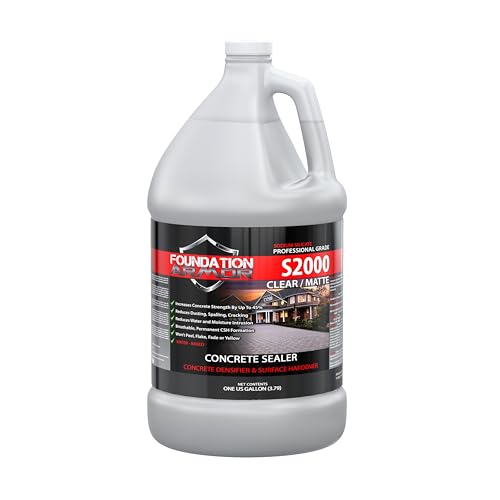
A sodium-silicate workhorse that stretches your dollar across a big driveway without sacrificing strength.
The Armor S2000 is your straightforward, no-nonsense densifier for big square footage. One buyer mentioned covering a 702 square foot driveway and sidewalk with 4 gallons using a pump sprayer. That works out to about 175 square feet per gallon on a porous surface — right in the expected range. The sodium silicate formula increases concrete strength up to 45% (matching the L3000’s claim) by forming permanent CSH crystals within the pores. It works entirely below the surface, so it won’t change the look or color of your concrete. Multiple buyers confirmed it eliminated concrete dusting and erosion on garage floors with a simple garden-sprayer application.
There are a couple real-world trade-offs compared to the lithium-based alternatives above. First, the S2000 weighs 9 pounds per gallon, while the L3000 weighs 10 pounds, so it may require a second coat to match the densification depth of the lithium picks. Second, one owner reported that the sealer applied evenly but overlapped areas dried darker with a wave-like appearance that required a second coat to correct. On the plus side, the maker says one gallon covers up to 200 square feet per gallon on standard surfaces, or up to 400 square feet per gallon on smooth, absorbent concrete. The manufacturer claims no maintenance is ever needed once applied — no re-application unless you want an even stronger surface. It is also ready to use with no mixing required.
Compared directly with the Ghostshield 4500, the S2000 is more affordable per gallon but lacks the lithium chemistry’s deeper penetration and the reported winter-salt protection. For a driveway in a mild climate or a garage floor that you plan to coat with epoxy later, this is the efficient choice. One buyer rated it 3/5 and called it “acceptable for the price” — the best description of its value position: it does the job without the premium price tag and without the risk of white residue from lithium formulas.
The appeal
- Costs less per gallon than either lithium pick — ideal for large areas on a budget.
- Increases concrete strength up to 45% with a permanent chemical bond.
- No maintenance once applied — low-maintenance.
The caution
- Overlapped applications can dry darker, leaving uneven appearance.
- It weighs 9 lbs, while the L3000 weighs 10 lbs.
The budget-friendly fix: Reach for the S2000 when you have a big driveway or sidewalk to cover and you need a proven dust stopper without the lithium price. Buyers with a 700+ sq ft project find it tough to top for square-foot cost.
Not for salt zones: If your slab faces harsh winter de-icers, the Ghostshield lithium above handled that scenario better according to real reviews. Skip the S2000 for outdoor freeze-thaw regions.
Understanding the Specs
Lithium Silicate vs Sodium Silicate
These are the two active chemistries inside a densifier. Lithium silicate uses smaller molecules that penetrate deeper (up to 2 inches) and react faster, making it the standard for polished concrete and garage floors where maximum hardness matters. Sodium silicate is an older, less expensive formula that also forms CSH crystals but may not reach as deep; it is a solid choice for existing concrete where the main goal is dust reduction.
Coverage in Square Feet per Gallon
Every densifier label shows a coverage range (for example 175-400 sq ft). The lower number is for porous, sandy, or rough concrete that soaks up liquid fast; the higher number is for smooth, dense, already-seasoned concrete. Always plan for the lower end of your surface type, then buy a second gallon for the second coat — the first coat fills pores, so the second coat always covers less area.
FAQ
How long does a concrete densifier take to cure before I can walk or drive on it?
Will a concrete densifier make my floor shiny or slippery?
Can I apply a densifier over old, painted, or sealed concrete?
How many coats of densifier do I really need?
What is the white residue I see after applying densifier, and how do I fix it?
Can I use a concrete densifier outdoors in rain or below freezing?
Which densifier works best for a dusty garage floor that I plan to coat with epoxy later?
How long does one gallon of densifier actually last in storage?
Final Thoughts: The Verdict
For most users looking for a concrete densifier, the winner is the Ghostshield 4500 because it combines deep lithium penetration with proven winter-salt resilience that no sodium-silicate product in this price tier matches. If you need the deepest possible densification for a polished floor or dusty countertop, the Foundation Armor L3000 delivers a 2-inch penetration depth and 45% strength increase with the highest solids weight in the group. And for budget-conscious projects covering a large driveway or sidewalk, the Armor S2000 offers concrete-hardening chemistry at a lower per-square-foot cost that buyers with 700+ sq ft projects find hard to pass up.
How We Picked
We do not accept paid placement. Every pick is matched to a real buyer and a real use-case; we do not hands-on test units.
Sources & Methodology
Specifications: manufacturer listings and product documentation. Review insights: verified customer reviews, as of July 2026. Pricing: not shown on this page (it changes often); check the current price via the retailer link.
As an Amazon Associate, WellFizz earns from qualifying purchases. This does not affect which products we feature.

Mo Maruf
I created WellFizz to bridge the gap between vague wellness advice and actionable solutions. My mission is simple: to decode the research and give you practical tools you can actually use.
Beyond the data, I am a passionate traveler. I believe that stepping away from the screen to explore new environments is essential for mental clarity and physical vitality.