Our readers keep the lights on and my smoothie glass nicely filled. As an Amazon Associate, I earn from qualifying purchases.
Specs are compiled from manufacturer listings and verified buyer reviews and can change over time — please confirm the key details on the product page before buying.
If you are picking up a paddle for the first time, or you want a spare that does not hurt your wallet, the biggest question is simple: which cheap option actually plays well, and which one leaves you frustrated at the net? A low price tag can mean a hollow feel, dead spots on the face, or a grip that slips after one game — but a few budget paddles get the fundamentals right. This guide lines up four affordable models and breaks down what each one really delivers during a rally.
I’m Mohammad Maruf — the founder and writer behind WellFizz. This guide is built by comparing the manufacturers’ published specifications and the patterns across verified customer reviews, so you get each pick’s real strengths and trade-offs instead of marketing spin.
if you need a durable practice racket, a lightweight paddle for long sessions, or a spin-friendly carbon fiber face, these reviews help you choose the right cheap pickleball paddle without guessing.
Quick Picks
- CZRR 3K Raw Carbon Fiber Pickleball Paddle — Best Value
- Ivecado Carbon Fiber Pickleball Paddle — Best Reach
- ELKCIP Composite Graphite Pickleball Paddle — Best for Beginners
- GoSports GS1 Fiberglass Pickleball Paddle — Budget Champion
How To Choose The Best Cheap Pickleball Paddle
A low price does not automatically mean a bad paddle — but you have to know which specs actually affect your game and which ones are just marketing. Here are the three things to check before you add a paddle to your cart.
Surface Material — The Grip That Creates Your Spin
The outer layer of the paddle is what grabs the ball. At this price level, you will mostly find fiberglass, graphite, and occasionally raw carbon fiber. Fiberglass is the cheapest and it produces decent power, but it gives you less bite for topspin and slicing. Graphite offers a crisper feel and better spin for the same weight, which is why many beginners prefer it. Raw carbon fiber is the most aggressive at creating spin, though it often costs a few dollars more. If you like to add spin to your serves and dinks, prioritize a graphite or carbon fiber face over fiberglass.
Core Thickness — Control Comes From the Middle
The honeycomb core inside the paddle soaks up vibration and controls where the ball goes. In this roundup, the GoSports uses a 13 mm construction, while the Ivecado and CZRR use 16 mm cores. In general, thicker cores tend to feel softer and more forgiving, while thinner ones tend to feel a bit poppier. For a beginner on a budget, a 16 mm polypropylene core can be a good choice if you want more control without losing all your power.
Weight and Handle Length — How It Feels in Your Hand
A lightweight paddle, around 7 ounces, lets you react faster at the net and keeps your arm fresh during long sessions. Heavier paddles, around 8 ounces, add power to your drives but can tire you out quicker. The handle length matters too — a 4.5-inch grip fits a one-handed backhand well, while a 5.5-inch grip gives you room for a two-handed backhand. If you play with two hands on the paddle, look for a longer handle so you can maintain leverage on your groundstrokes.
Quick Comparison
| Model | Best For | Face Material | Core Thickness | Weight | Amazon |
|---|---|---|---|---|---|
| CZRR 3K Raw Carbon Fiber | Spin & control on a budget | 3K Raw Carbon Fiber | 16 mm | 8.0-8.5 oz | Amazon |
| Ivecado Carbon Fiber | Reach & edgeless design | Japanese Toray Carbon Fiber | 16 mm | 7.6 oz | Amazon |
| ELKCIP Graphite Composite | Lightweight casual play | Graphite | Polypropylene Honeycomb | 7.9 oz | Amazon |
| GoSports GS1 Fiberglass | Entry-level value | Fiberglass | 13 mm | 7 oz | Amazon |
In‑Depth Reviews
1. CZRR 3K Raw Carbon Fiber Pickleball Paddle
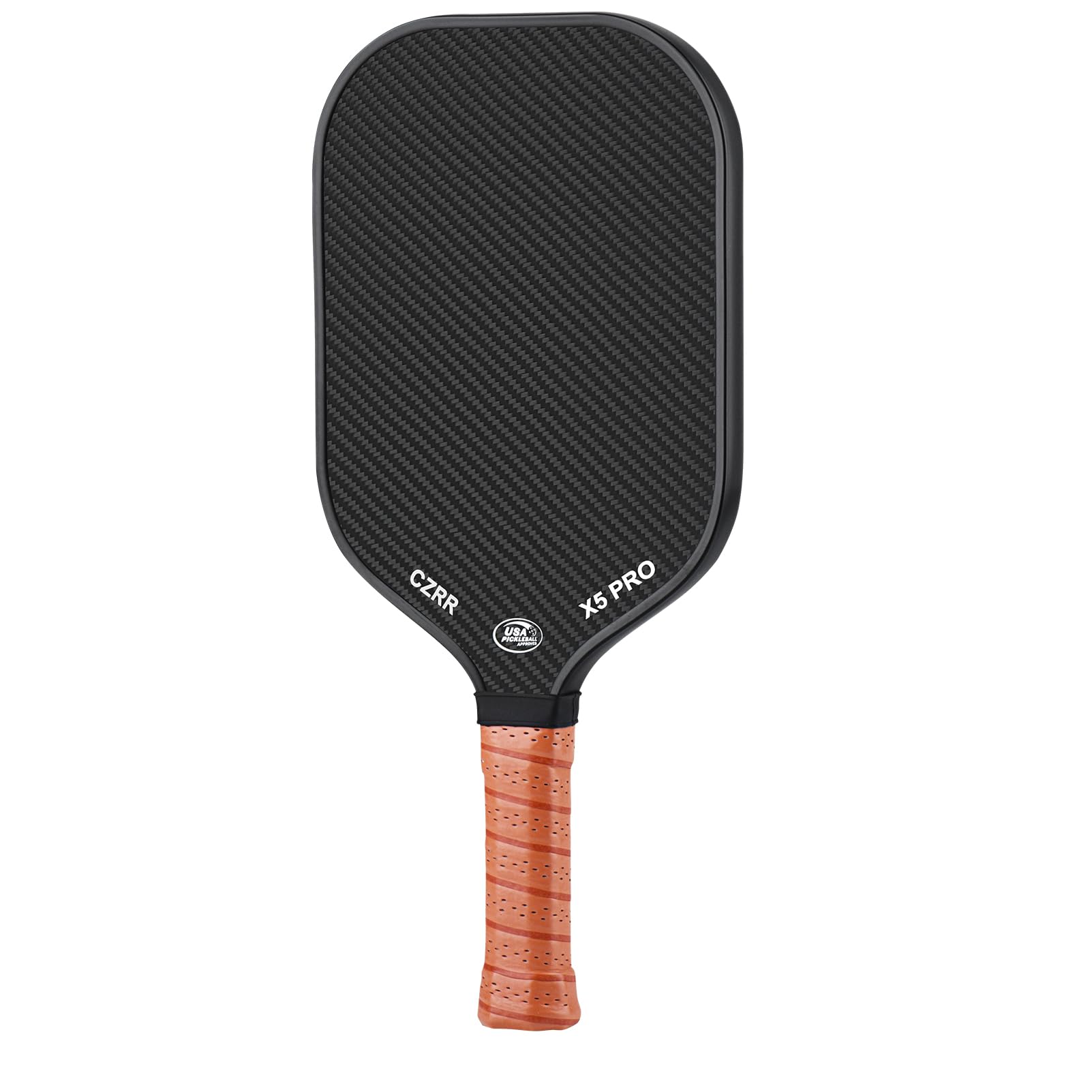
Raw carbon fiber spin at a fraction of what pro paddles cost.
If spin is your weapon at the kitchen line, this is the budget paddle that rivals far more expensive options. The face uses 3K Raw Carbon Fiber Surface (CFS) combined with a Carbon Abrasion Surface (CAS) — a textured face that the brand describes as feeling like very high-grit sandpaper, designed to grab the ball for extreme topspin and slice. Inside, the 16 mm polypropylene honeycomb core (the honeycomb layer inside the paddle that absorbs shock) reduces vibration noticeably, which helps you place soft resets and dinks without the ball popping up.
The trade-off is weight. At 8.0 to 8.5 ounces, this is the heaviest paddle on the list — 13% heavier than the 7 ounce GoSports GS1. That extra heft adds power to your drives, but it can wear out your arm faster if you are playing three or four games in a row. The grip length is 5.5 inches, which gives you plenty of room for a two-handed backhand, though some buyers report the actual grip feels closer to 4.5 inches in circumference. The handle profile is rectangular rather than round, a detail that takes a few swings to get used to. The paddle measures 16.5 inches long and 7.5 inches wide — the largest hitting surface in this roundup, so off-center hits stay in play more often.
Reviewers consistently call this a “sleeper” paddle — one buyer wrote that after adding tungsten tape and foam strips for stability, the paddle performed like one costing triple the price. The rough carbon face can mark up slightly with use, but no one reported performance loss. This is the best bet if you want pro-level spin and control without leaving the budget aisle.
Spin Machine
- Aggressive raw carbon fiber face creates superior spin compared to the fiberglass GoSports GS1
- 16 mm honeycomb core delivers excellent control for dinks and resets
- Large 16.5″ x 7.5″ face forgives off-center hits
Weight Trade-off
- Heaviest option at 8.0-8.5 oz can fatigue your arm during long sessions
- Rectangular handle profile feels different than a standard round grip
Reach for it if: you rely on topspin and want the most aggressive surface you can get for the money — owners mention it plays like a paddle.
Look elsewhere if: you prefer a lightweight paddle under 7.5 oz or you want a round grip profile from the start.
2. Ivecado Carbon Fiber Pickleball Paddle

Japanese carbon fiber with an edgeless face for cleaner swings.
At 16.3 inches long with a 5.6-inch handle, this is the extended-reach option for players who want extra leverage on serves and groundstrokes. The face is made from Japanese Toray carbon fiber and uses Micro-particle Surface Technology (MPS TECH) to create a rough texture for grip and spin — buyers confirm it “really lets you control the spin to the ball.” The 16 mm one-piece polypropylene honeycomb core is the same thickness as the CZRR above, giving you a similar blend of power absorption and control.
Where this paddle stands apart is the edgeless construction. Without a traditional edge guard (the rubber strip around the paddle rim that protects against scrapes), there is less wind resistance during your swing, and the face extends edge-to-edge so you have more usable hitting area. The weight sits at 7.6 ounces (plus or minus 0.2 oz), which is light enough for quick hand battles at the net yet dense enough to feel stable on volleys. The 4.5-inch perforated grip helps with sweat absorption — a real plus in warm outdoor play. The package includes a cover and a cooling towel, which is a nice extra at this price point.
The honest catch, as multiple customers note, is that the paddle face chips easily if you ding it on the court or net post. One reviewer noted “if you ding it on anything it chips easy,” which means you will want to be careful when setting it down or hitting the ground. The edgeless design looks sleek but leaves the face more exposed than a paddle with a protective edge guard. For the weight and the reach, though, this is a strong mid-range contender that punches above its price.
Extended leverage: At 7.6 ounces and a 5.6-inch handle, you get the longest grip in this group for two-handed backhands without feeling heavy — unlike the 8.0+ ounce CZRR.
The fragility reality: the edgeless look comes with a real wear risk; reviewers point out it chips on impact, so it is best treated as a court paddle, not a drop-it-on-concrete spare.
Grab it for: extra reach on serves and a lightweight feel that lasts multiple matches — plus a cooling towel is included.
Think twice if: you tend to scrape your paddle on the court surface or bang it against the net post regularly.
3. ELKCIP Composite Graphite Pickleball Paddle
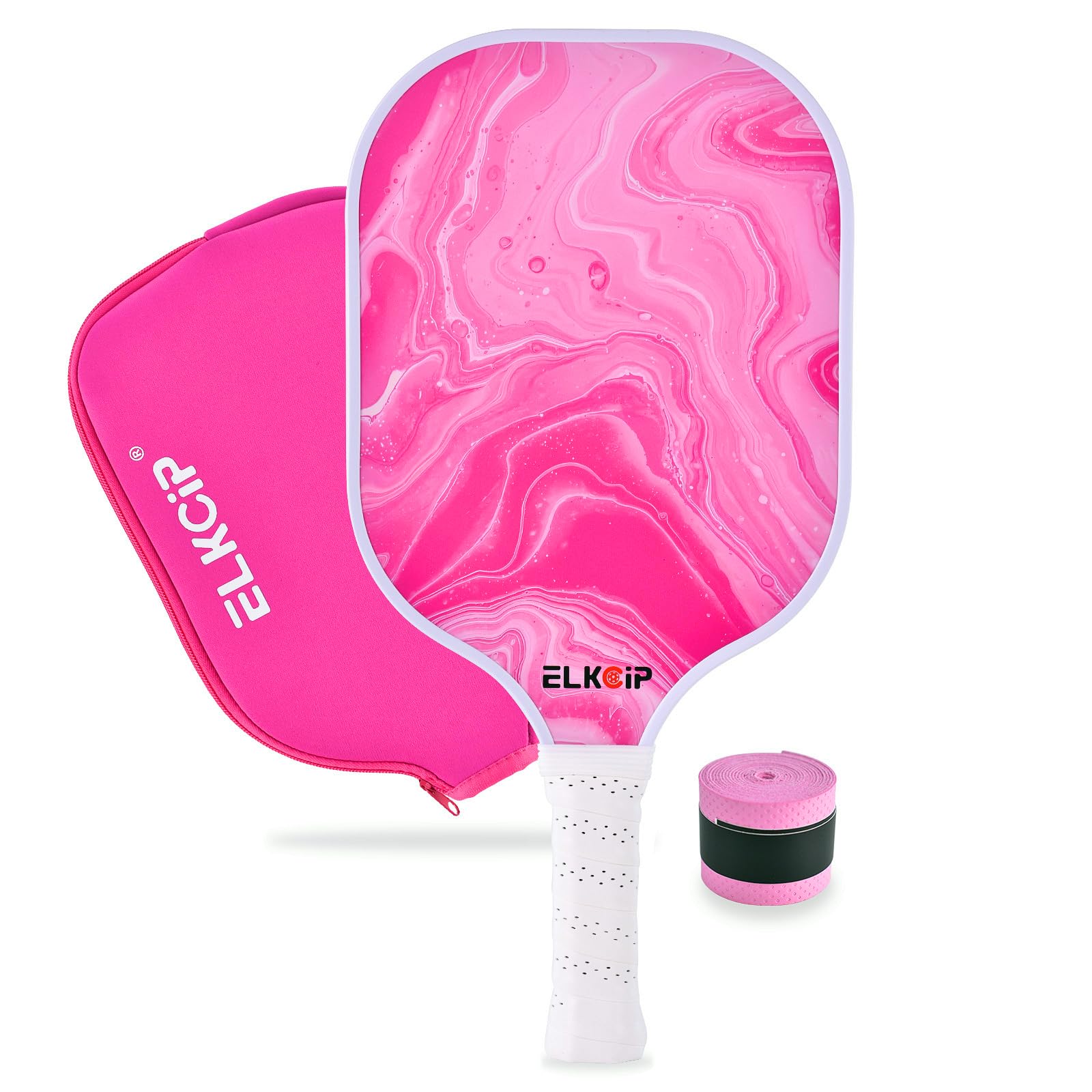
A pretty pink graphite paddle that plays light and quiet.
If the person you are buying for cares about aesthetics as much as the feel at contact, this paddle delivers on both without blowing the budget. The 7.9-ounce frame uses a graphite outer layer over a polypropylene honeycomb core — a combination that strikes a different balance than the raw carbon fiber of the CZRR. It is designed to be quieter than standard fiberglass paddles, according to the maker, which helps keep noise down in community centers. The grainy graphite texture creates tiny friction on the ball, helping beginners generate topspin more naturally than a smooth surface would. It measures 15.35 inches long and 7.67 inches wide, which is slightly shorter than the CZRR and Ivecado but wider than the GoSports.
Reviewers who bought this as a first paddle consistently praise the weight distribution — one buyer mentioned it was “the perfect weight that my son was looking for.” The 4.5-inch handle length supports a two-handed backhand, and the perforated anti-slip grip helps keep your hands from sweating during longer matches. The included zippered neoprene cover adds protection for carrying it in a gym bag or to the community center. The pink marble color pattern is distinctive and shows up well on the court.
Buyers also point out the honest trade-off: “lacks carbon fiber outer layer, so less effective for topspin/slicing.” If you are a developing player who wants to work on aggressive slice shots, this paddle will hit a ceiling faster than the raw carbon fiber options above. It performs beautifully for casual play and community games, but competitive intermediates may outgrow it. The low-profile edge guard protects against ground impact without adding head weight, a smart design choice for a paddle aimed at beginners.
Casual Performer
- Graphite face is more powerful and quieter than the fiberglass GoSports GS1
- Well-balanced 7.9 oz weight suits long sessions without arm fatigue
- Neoprene cover included for storage and travel
Spin Limit
- Graphite surface produces less topspin than the raw carbon fiber of the CZRR or Ivecado
- Not ideal for advanced players who rely on heavy slice
Best suited for: beginners and casual players who want a light, good-looking paddle that plays well right out of the bag — especially if they like pink.
skip it if: you are an intermediate or above who needs carbon-level spin for aggressive shotmaking.
4. GoSports GS1 Fiberglass Pickleball Paddle

The lightest paddle here and the cheapest entry point for new players.
At 7 ounces, the GS1 is the featherweight of the group — it is a full 13% lighter than the 8.0-8.5 ounce CZRR, and you will feel that difference in every fast exchange at the net. The 13 mm textured fiberglass surface sits over a thick honeycomb core, giving you a decent balance and the ability to add some spin. The paddle measures 15.75 inches long and 8 inches wide, making it the widest paddle here — that wider face helps beginners connect with the ball more consistently when they are still developing hand-eye coordination. The 4.5-inch grip is standard and comfortable for one-handed swings.
Shoppers say this is a tremendous value, with one reviewer calling it “great value at for two paddles and balls.” Another mentioned that the textured surface “enables more spin and control than Vulcan paddles.” The construction feels sturdy for the price, and the USAPA approval means it meets regulation standards for tournament play. The edge guard is made from TPE (thermoplastic elastomer, a rubber-like material designed to absorb some impact if you hit the ground).
The honest feedback from reviewers points to two issues: the paddle has some dead spots off-center (one owner reported it “feels like wood” in certain sweet spots), and it is noticeably louder on contact than the graphite or carbon fiber options. The fiberglass face does not grip the ball as aggressively as graphite or raw carbon, so your topspin ceiling is lower. But for a beginner who just wants to get on the court, learn the basics, and have fun for the lowest possible cost, this is the sensible pick — especially if you buy it in a two-pack to keep a spare handy for a friend.
Entry-level value king: at 7 ounces with a wide 8-inch face, it is the lightest and most forgiving paddle on this list for brand-new players.
The trade-off: the fiberglass face produces less spin than graphite or carbon, and some buyers report dead spots off-center that reduce confidence on mis-hits.
Ideal for: complete beginners, community center loaner paddles, and anyone who wants to try pickleball without a real investment.
Not the pick for: players who have outgrown beginner gear or who want carbon-level spin and a consistent feel across the whole face.
Understanding the Specs
Core Thickness (mm)
This is the middle layer of the paddle, usually made of polypropylene honeycomb. In this guide, you will see both 13 mm and 16 mm paddles. Generally, 16 mm cores absorb more vibration and feel softer and more controlled, while 13 mm cores tend to feel poppier on contact. For a budget paddle, many developing players prefer 16 mm if they want to learn touch shots.
Surface Material
The outer layer is what contacts the ball. Fiberglass is cheapest and provides decent power but limited spin. Graphite is lighter and crisper, offering better feel and more spin. Raw carbon fiber is the most aggressive — it feels like sandpaper and grabs the ball for maximum topspin and slice. If you like putting spin on the ball, spend the extra dollar or two for graphite or carbon fiber over fiberglass.
FAQ
Is a cheap pickleball paddle worth buying for a beginner?
Does a cheap pickleball paddle need to be USAPA approved?
What is the best surface material for a budget pickleball paddle?
How much should a cheap pickleball paddle weigh?
Do cheap pickleball paddles have good spin?
What is a 16 mm honeycomb core and why does it matter?
Can I use a cheap pickleball paddle for competitive play?
What handle length do I need for a two-handed backhand?
How long does a cheap pickleball paddle last?
What accessories come with a cheap pickleball paddle?
Final Thoughts: The Verdict
If you want one dependable pick, the cheap pickleball paddle winner is the CZRR 3K Raw Carbon Fiber Paddle because it delivers pro-level spin and control with a 16 mm core, all for around the price of a dinner out. If you want a lightweight paddle that gives you extra reach on serves, grab the Ivecado Carbon Fiber Paddle. And for a beginner who just wants a reliable paddle to get started without any fuss, the standout is the GoSports GS1 Fiberglass Paddle for its combination of low weight and low cost.
How We Picked
We do not accept paid placement. Every pick is matched to a real buyer and a real use-case; we do not hands-on test units.
Sources & Methodology
Specifications: manufacturer listings and product documentation. Review insights: verified customer reviews, as of July 2026. Pricing: not shown on this page (it changes often); check the current price via the retailer link.
As an Amazon Associate, WellFizz earns from qualifying purchases. This does not affect which products we feature.

Mo Maruf
I created WellFizz to bridge the gap between vague wellness advice and actionable solutions. My mission is simple: to decode the research and give you practical tools you can actually use.
Beyond the data, I am a passionate traveler. I believe that stepping away from the screen to explore new environments is essential for mental clarity and physical vitality.