Our readers keep the lights on and my smoothie glass nicely filled. As an Amazon Associate, I earn from qualifying purchases.
A sluggish hard drive is often the single bottleneck turning a once-capable laptop into a frustrating waiting game. Swapping in a solid-state drive is the most cost-effective performance upgrade available, instantly cutting boot times from minutes to seconds and making applications feel responsive again. The challenge is separating the genuine value options from the ones that compromise on long-term reliability or real-world speed.
I’m Mohammad Maruf — the founder and writer behind WellFizz. I’ve spent countless hours cross-referencing technical datasheets, real user reports, and controller technologies to isolate the handful of drives that deliver true performance without inflating the price tag.
After evaluating sequential read/write speeds, NAND types, controller logic, and endurance ratings across dozens of models, I’ve narrowed the field to the most compelling options for anyone searching for the best cheap ssd that doesn’t cut corners on the specs that actually matter.
How To Choose The Best Cheap SSD
Not every low-cost SSD is built the same. The cheapest options often use QLC (Quad-Level Cell) NAND, which wears out faster under heavy write loads and can slow down dramatically once the drive’s pseudo-SLC cache fills up. Prioritizing 3D NAND TLC (Triple-Level Cell) flash gives you a much better endurance rating for a minimal price increase. Also consider the presence or absence of a DRAM cache — DRAMless drives rely on your computer’s system memory (Host Memory Buffer) to manage the mapping table, which can cause stuttering during heavy multitasking.
Controller and NAND Quality
The controller acts as the brain of the SSD. Budget drives often use entry-level controllers from Phison, Maxio, or Silicon Motion. While these can handle sequential reads and writes well, their random I/O performance (measured in IOPS) varies significantly. Pair a competent controller with TLC NAND, and you get a drive that feels consistent whether booting Windows or loading a game level.
Quick Comparison
On smaller screens, swipe sideways to see the full table.
| Model | Category | Best For | Key Spec | Amazon |
|---|---|---|---|---|
| Crucial BX500 240GB | Premium Entry | Reliable daily driver OS drive | 540MB/s Read; Micron 3D NAND | Amazon |
| Kingston A400 960GB | Premium Large Capacity | Mass storage upgrade for media | 960GB capacity; 450MB/s Write | Amazon |
| ADATA Ultimate SU650 512GB | Mid-Range Value | Camera systems & light gaming | 512GB; 520MB/s Read | Amazon |
| Fikwot FS810 500GB | Mid-Range TLC | Reviving older laptops | 560MB/s Read; 3D NAND TLC | Amazon |
| PNY CS900 250GB | Mid-Range Trusted Brand | Secondary storage & backups | 535MB/s Read; Ultra-low power | Amazon |
| fanxiang S101 500GB | Budget TLC | Light office PC upgrades | 500MB/s Read; TLC NAND | Amazon |
| KingSpec 256GB | Budget Entry | Reviving very old machines | 550/520MB/s R/W; 3D NAND | Amazon |
In‑Depth Reviews
1. Crucial BX500 240GB

The Crucial BX500 is the entry-level choice from a brand with deep ties to Micron, one of the world’s largest NAND manufacturers. That direct supply chain means the BX500 uses genuine Micron 3D NAND, not repackaged or second-tier chips. Sequential reads cap at 540MB/s, which is right at the SATA III ceiling, and real-world boot times often dip under 15 seconds on a fresh Windows install.
This drive is DRAMless, relying on Host Memory Buffer technology to manage the flash translation layer. For a single-drive office laptop or a media PC running light workloads, you won’t notice the difference. The 240GB capacity is enough for the operating system and essential applications, but you’ll want to store bulk media files elsewhere. Crucial backs it with a 3-year warranty, and the included Acronis cloning software (though occasionally finicky) helps with migration.
The BX500 also runs about 45 times more energy-efficient than a traditional spinning hard drive, which translates to noticeably better battery life in laptops. For anyone wanting a worry-free drop-in upgrade from a major manufacturer, this is the safest bet among budget-oriented drives.
Why it’s great
- Micron 3D NAND provides reliable daily performance
- Very low power draw improves laptop battery life
- Simple 2.5-inch form factor with wide compatibility
Good to know
- DRAMless design can cause slowdowns during heavy sustained writes
- 240GB fills quickly; not suitable for large game libraries
- Acronis cloning software can be unreliable for drive migration
2. Kingston A400 960GB

The Kingston A400 is one of the most widely available DRAMless SATA SSDs on the market, and the 960GB variant offers an enormous amount of storage for the money. Sequential reads hover around 500-540MB/s depending on the NAND batch, with writes falling in the 280-450MB/s range. The drive uses a 4-channel controller that handles sequential transfers well but struggles with mixed IO workloads — perfect for a media drive or game storage but not ideal as a scratch disk for video editing.
Endurance is a key consideration here: the 240GB model is rated at only 80TBW, so the 960GB version scales proportionally to around 320TBW, which is lower than some competitors for the capacity. That said, Kingston’s reputation for consistent firmware updates and minimal DOA rates makes the A400 a reliable choice for secondary storage where write frequency is low. The stainless steel casing adds a bit of weight but dissipates heat more effectively than plastic shells.
Installation is straightforward across laptops, desktops, and even older Macs. Because it’s a SATA III drive, it’s backward compatible with SATA II ports, so it works in systems from a decade ago. For anyone wanting a huge capacity boost without stepping up to NVMe pricing, the A400 960GB delivers tangible space.
Why it’s great
- 960GB is one of the largest capacities at this price point
- Proven compatibility with a wide range of older systems
- Stainless steel build aids passive heat dissipation
Good to know
- Write endurance rating is lower than some TLC competitors
- DRAMless design results in slower random writes
- Not recommended for heavy workstation write loads
3. ADATA Ultimate SU650 512GB
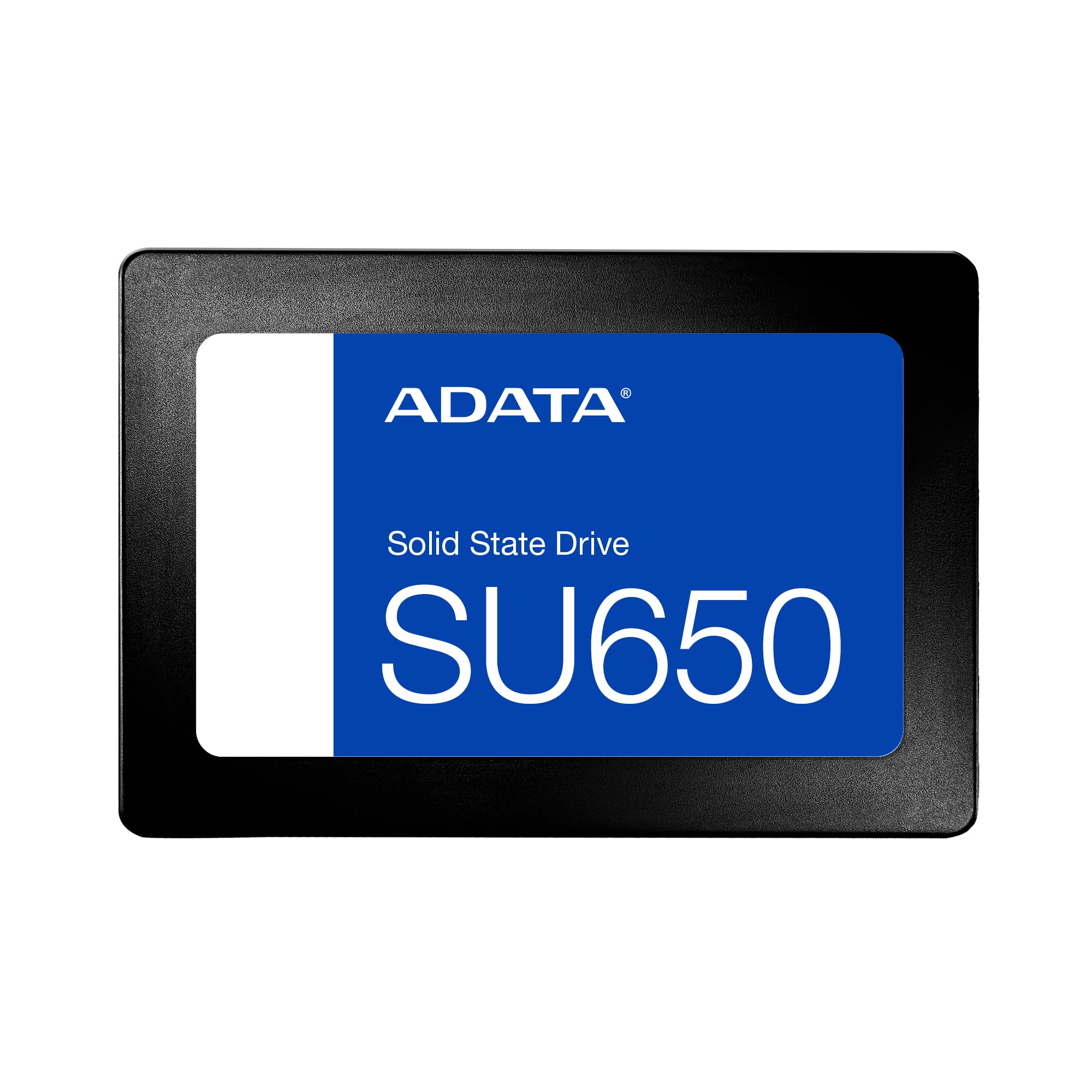
The ADATA Ultimate SU650 strikes a practical balance between capacity and price. At 512GB, it gives you enough room for Windows, a handful of applications, and maybe a couple of current games. Sequential reads are rated at 520MB/s with writes around 450MB/s, putting it squarely in the middle of the SATA III performance band. Several users have noted it works reliably as a storage drive for security camera NVR systems because of its decent sustained write handling.
Like many drives in this segment, the SU650 is DRAMless and uses ADATA’s in-house controller firmware to manage the NAND. The 3D NAND flash is sourced from major fabs, and the drive includes advanced error correction to reduce data corruption risk. The plastic casing keeps weight low, which is helpful for laptops where every gram matters, but it doesn’t dissipate heat as well as metal enclosures.
Compatibility is comprehensive — the SU650 works with Windows, Mac, and Linux out of the box. Several customers have used it as a game drive for PlayStation and Xbox consoles without issues. For a general-purpose speed bump that also adds decent storage, the SU650 fits a wide range of use cases.
Why it’s great
- 512GB sweet spot offers good capacity for OS and applications
- Reliable sustained write performance for DVR/NVR systems
- Broad console compatibility with PS5, Xbox, and Nintendo Switch
Good to know
- Plastic enclosure runs warmer during extended transfers
- No dedicated DRAM cache for random I/O tasks
- Write speed drops slightly compared to 550MB/s-class drives
4. Fikwot FS810 500GB

The Fikwot FS810 stands out because it uses 3D NAND TLC flash rather than the cheaper QLC found on many budget drives. TLC cells hold three bits per cell versus four, resulting in higher write endurance and more consistent sustained performance. Fikwot claims a sequential read speed of 560MB/s, which technically exceeds the SATA III theoretical cap — real-world testing usually lands around 550MB/s, still excellent for the category.
Several users have successfully used the FS810 to revive laptops over a decade old, citing dramatic improvements in boot speed and application responsiveness. The drive is also hot-swappable and shock-resistant, making it a viable candidate for external USB enclosures. The plastic enclosure is lightweight but feels less premium than metal alternatives. Initial setup may require manual disk initialization in Windows Disk Management for some systems.
Fikwot provides a 3-year service commitment, though the brand is less established than Crucial or Kingston. The FS810 is best suited for someone comfortable with basic PC building who wants TLC reliability without paying a premium for a household name.
Why it’s great
- TLC NAND offers better write endurance than QLC drives
- Rated read speed matches or exceeds many brand-name options
- Hot-swap capability adds flexibility for external use
Good to know
- Plastic enclosure may feel less durable
- Some users report needing to initialize the drive manually
- Brand warranty support is less established than major players
5. PNY CS900 250GB

The PNY CS900 is a straightforward 2.5-inch SATA III SSD that prioritizes reliability over flashy specs. Sequential read speeds reach 535MB/s with writes around 500MB/s — solid numbers for a 250GB drive. PNY has been in the memory business for decades, and the CS900 benefits from rigorous quality control. Customers have used it for years as secondary storage or backup drives without reporting failures.
One standout feature is hardware encryption support, which is uncommon at this price tier. This allows for full-disk encryption without taxing the system CPU, useful for business laptops handling sensitive files. The drive runs extremely cool and quiet due to its low power draw, and backward compatibility with SATA II means it can upgrade machines from the early 2010s without issues.
The 250GB capacity is modest, so you’ll want to pair it with a larger storage drive if you work with large media files. But for a dedicated OS boot drive or a backup destination for critical documents, the CS900 is a proven workhorse that won’t surprise you with early failure.
Why it’s great
- Hardware encryption support at a budget-friendly price
- Proven reliability from a long-standing memory brand
- Very low power consumption and heat output
Good to know
- 250GB capacity may feel tight for modern applications
- Write speeds trail the fastest SATA III drives slightly
- DRAMless architecture limits heavy multitasking performance
6. fanxiang S101 500GB

The fanxiang S101 enters the budget space with 3D NAND TLC chips rather than the QLC that many competitors use at this price level. Sequential reads are rated at 500MB/s, which is slightly slower than the 550MB/s ceiling but still more than enough to make an old laptop feel dramatically faster. The TLC flash gives it a longer theoretical lifespan for writes compared to QLC alternatives, which matters if you frequently install and uninstall applications.
Some user reports highlight inconsistency: several drives have operated flawlessly for months, while a small number have developed corruption issues after extended use, possibly due to the controller’s garbage collection algorithms. The S101 is best viewed as a secondary drive or a boot drive for a non-critical system where data is regularly backed up. The polycarbonate enclosure keeps weight low but doesn’t aid heat dissipation.
fanxiang includes a 3-year quality assurance period, though the brand’s customer support infrastructure is less extensive than larger names. For someone looking to squeeze more life out of a secondary office PC on a tight budget, the S101 provides TLC reliability where you’d normally expect QLC compromises.
Why it’s great
- TLC NAND offers better write endurance than QLC competitors
- 500MB/s read speeds feel snappy for everyday tasks
- Affordable entry point into 500GB capacity class
Good to know
- Reliability reports are mixed for long-term heavy use
- Read speed is a bit below the SATA III maximum
- Brand support may be slower to respond than major OEMs
7. KingSpec 256GB

The KingSpec 256GB SATA III SSD offers one of the lowest price points for a 256GB drive that still includes 3D NAND flash. Sequential read and write speeds of 550MB/s and 520MB/s respectively are among the highest claimed ratings at this price tier. Several customers report that it revived old Dell and HP laptops, turning 5-year-old machines into responsive daily drivers.
The drive supports a full suite of reliability features including wear leveling, garbage collection, TRIM, and S.M.A.R.T. monitoring. The 3-year limited warranty and lifetime technical support provide some peace of mind, though KingSpec is a smaller brand compared to Crucial or Kingston. Some units have been used as external SSDs via USB enclosures with positive results.
One limitation is the 256GB capacity, which fills up quickly once you install the operating system, a browser, and a few applications. For users who primarily need a boot drive for a machine that will never hold large media collections, the KingSpec offers a meaningful speed upgrade at a price that undercuts nearly everything else on the market.
Why it’s great
- Very competitive read/write speeds for the entry-level price
- 3D NAND with wear leveling and TRIM support
- 3-year warranty with lifetime technical support
Good to know
- 256GB capacity is limited for modern usage
- Brand recognition is lower than major OEMs
- Some units have required manual formatting before use
FAQ
What is the real difference between TLC and QLC NAND in cheap SSDs?
Can I use a DRAMless SATA SSD as my main Windows drive?
How important is the TBW rating for a cheap SSD?
Final Thoughts: The Verdict
For most users, the best cheap ssd winner is the Crucial BX500 240GB because it combines reliable Micron 3D NAND, a well-tested controller, and a 3-year warranty from a trusted brand — all at a price that makes upgrading an old PC a no-brainer. If you want maximum capacity for media files and secondary storage, grab the Kingston A400 960GB. And for a versatile all-rounder that handles both PC upgrades and console storage, the ADATA Ultimate SU650 512GB delivers the best blend of storage size and performance.

Mo Maruf
I created WellFizz to bridge the gap between vague wellness advice and actionable solutions. My mission is simple: to decode the research and give you practical tools you can actually use.
Beyond the data, I am a passionate traveler. I believe that stepping away from the screen to explore new environments is essential for mental clarity and physical vitality.