Our readers keep the lights on and my smoothie glass nicely filled. As an Amazon Associate, I earn from qualifying purchases.
Moving from a home-grade machine to a true commercial sewing machine is less about a hobby upgrade and more about accepting the reality of production deadlines, material thickness, and the cost of downtime. A machine that stalls on a single layer of upholstery leather or burns out its motor after a second of sustained use isn’t just frustrating—it costs you orders. The difference between a reliable workhorse and a frustrating misstep comes down to the build quality of the frame, the type of feed system, and the sheer stitch-per-minute output.
I’m Mohammad Maruf — the founder and writer behind WellFizz. My approach to evaluating these machines involves cross-referencing over 60 hours of spec analysis with long-term owner reports to separate marketing claims from true production capability.
This guide focuses on finding a dependable commercial sewing machine that can handle consistent, high-volume work across demanding materials like denim, vinyl, and light upholstery without constant tension adjustments or skipped stitches.
How To Choose The Best Commercial Sewing Machine
Choosing a machine for a shop or a serious side business requires looking beyond stitch count. You need to match the feed system, motor torque, and throat space to the specific materials you plan to sew day in and day out. A machine perfect for canvas tarps will be a nightmare for delicate silks, and vice versa.
Feed System: Drop Feed vs. Walking Foot vs. Compound Feed
Drop feed (standard from below) is fine for consistent fabric layers like cotton or polyester blends. A walking foot (top and bottom feed) moves the top layer of fabric at the same rate as the bottom, preventing shifting on slippery fabrics like vinyl or leather. A compound (triple) feed adds a needle that also moves forward, offering the ultimate grip for extremely thick or multi-layer assemblies like automotive upholstery.
Motor Type: Clutch vs. Servo
Traditional clutch motors are loud, run constantly when the machine is on, and offer little speed control at low stitches-per-minute. Modern servo motors are quiet, only spin when you press the pedal, and provide instant low-speed torque for precise cornering and heavy needle penetration without overwhelming the fabric.
Throat Space and Harp Size
This measurement determines how large a project you can fit under the arm. A standard home machine offers about 6 inches; a dedicated quilting machine will have 9 to 13 inches; industrial single-needle machines often have about 13 to 15 inches. For quilting, upholstery, or large bags, a larger throat space is mandatory to avoid bunching the fabric.
Quick Comparison
On smaller screens, swipe sideways to see the full table.
| Model | Category | Best For | Key Spec | Amazon |
|---|---|---|---|---|
| Juki DDL-8100 | Industrial Lockstitch | High-volume garment production | 5,500 SPM, 3/4 HP Servo Motor | Amazon |
| Juki DDL-8700-H | Industrial Lockstitch | Heavy straight-stitch work | Auto-lubrication, 1/2 HP Servo | Amazon |
| Consew 206RB-5 | Walking Foot | Upholstery & leather | 10mm stitch length, 14mm foot lift | Amazon |
| Janome MC6650 | Computerized | Versatile quilting & sewing | 10″ throat space, 1,000 SPM | Amazon |
| Grace Company Little Rebel | Quilting Machine | Frame quilting & free motion | 13″ x 8.5″ throat, stitch regulator | Amazon |
| Smartstitch S-1001 | Multi-Needle Embroidery | Commercial embroidery production | 10 needles, 9.5″x14.2″ area | Amazon |
| BAI The Mirror | Multi-Needle Embroidery | Hat & flat production runs | 15 needles, 1200/850 SPM | Amazon |
| Juki TL-2010Q | Portable Lockstitch | Quilting & tailoring | Auto thread trimmer, knee lifter | Amazon |
| Singer Quantum Stylist 9985 | Computerized | Multi-purpose home business | 1,000+ stitch applications | Amazon |
| Brother SE700 | Combo Sew/Embroidery | Light embroidery & sewing | 4″x4″ embroidery, 135 designs | Amazon |
| Brother PE900 | Dedicated Embroidery | Dedicated embroidery work | 5″x7″ hoop, jump stitch trim | Amazon |
| Janome HD3000 | Mechanical Heavy-Duty | Reliable daily stitching | 23 lbs, all-metal internal frame | Amazon |
| Consew CP206RL | Portable Walking Foot | On-site heavy repairs | 42 lbs, walking foot mechanism | Amazon |
In‑Depth Reviews
1. Juki DDL-8100 Industrial Lockstitch Machine

The Juki DDL-8100 is the direct successor to the legendary DDL-8700 platform, delivering a 5,500 stitches-per-minute top speed with a 550-watt servo motor that provides quiet, controlled power. It comes complete with a heavy-duty table, knee lifter, and thread stand, making it a turnkey solution for any serious garment production or alteration shop. Its single-needle lockstitch design is optimized for consistent straight stitching on woven fabrics from light shirting to canvas.
Assembly is required, and the machine arrives in three boxes (head, table, motor). User reports highlight the QR-code assembly videos as a helpful resource, though some caution that identifying specific screws can be tricky. Once set up, the machine runs remarkably quiet compared to older clutch-motor machines, and the 13mm foot lift via the knee lifter handles bulky seams with ease.
Owners consistently note that the servo motor’s slow-speed torque is a major upgrade, allowing precise stitch-by-stitch control for curving and corners. The DDL-8100 is not a walking foot machine, so it is best suited for two-layer lockstitch applications where you do not need a top feed mechanism. It runs on standard DBx1 needles and uses a large industrial bobbin for fewer thread changes.
Why it’s great
- Extremely quiet and smooth servo motor operation
- Large working area and 13mm knee-lift clearance
- Industry standard lockstitch for easy parts and servicing
Good to know
- Requires assembly and a dedicated table setup
- Not a walking foot—limited to drop feed only
- Only straight stitch; no zigzag capability
2. Juki DDL-8700-H Heavy Straight Stitch Machine
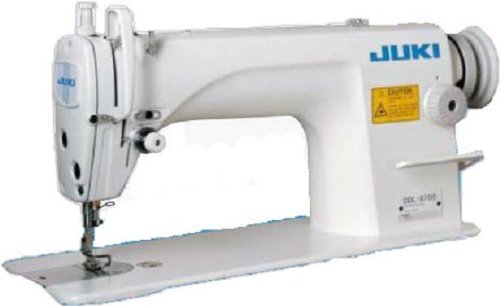
The DDL-8700-H is the heavy material variant of Juki’s most famous straight stitch platform, designed for sewing through thicker stacks without walking foot assistance. It includes a servo motor, table, and an integrated auto-lubrication system for the hook, which reduces maintenance intervals significantly. With a maximum stitch length of 5mm and a presser foot lift of 13mm, it handles multiple layers of denim or canvas reliably.
Users report that the machine lives up to its reputation as a bulletproof straight stitch workhorse. It is worth noting that the 8700-H requires specific Juki bobbins (smaller diameter than standard industrial bobbins) and heavier bonded thread (Tex 45-70) for best results. The included servo motor provides excellent low-speed control and instant start-stop capability.
There have been isolated reports of shipping damage and delivery issues, but the majority of users emphasize that the machine performs flawlessly once properly set up. The heavy model’s stronger feed mechanism and reinforced components make it a clear choice for anyone regularly assembling multiple layers of upholstery fabric or heavy twill.
Why it’s great
- Reinforced for heavy materials without a walking foot
- Auto-lubrication system extends hook life
- Quiet servo motor with smooth speed control
Good to know
- Uses proprietary smaller Juki bobbins
- Requires assembly and a heavy table
- Straight stitch only; not for decorative sewing
3. Consew 206RB-5 Walking Foot Industrial Machine
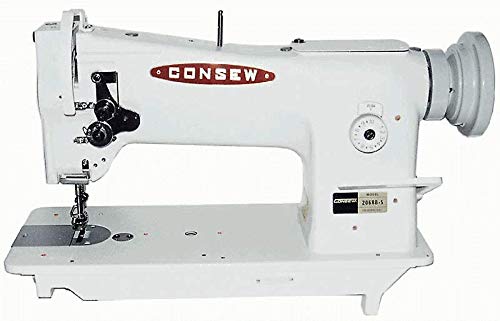
The Consew 206RB-5 is the industry-standard compound-feed walking foot machine, built for furniture upholstery, marine canvas, auto interiors, and heavy leather. Its triple feed mechanism (needle, presser foot, and feed dog all advancing together) eliminates layer shift on slippery or thick materials. It offers a maximum 10mm stitch length and a 14mm foot lift, allowing it to pass through multiple heavy layers at once.
This machine arrives with a table and a servo motor, ready for assembly. Long-term owners report it running trouble-free for years on commercial projects requiring consistent needle penetration and precise seam alignment. The build quality is robust, though some users note that newer units are manufactured in China and may have minor fit-and-finish issues compared to vintage Japanese models.
The servo motor is quiet and provides excellent slow-speed torque, which is critical when stitching curves in leather or vinyl. There is no automatic thread cutter, and the machine lacks any electronic stitch programming—it is purely mechanical. For a full-time auto upholstery or custom canvas shop, the 206RB-5 is considered the standard.
Why it’s great
- Compound feed prevents material shifting
- Huge 14mm foot lift for bulky assemblies
- 10mm stitch length for heavy thread applications
Good to know
- Heavy unit requires a strong table and two-person setup
- Limited to straight stitch and basic reverse
- Some units may need belt or pulley adjustment for optimal control
4. Janome MC6650 Sewing and Quilting Machine
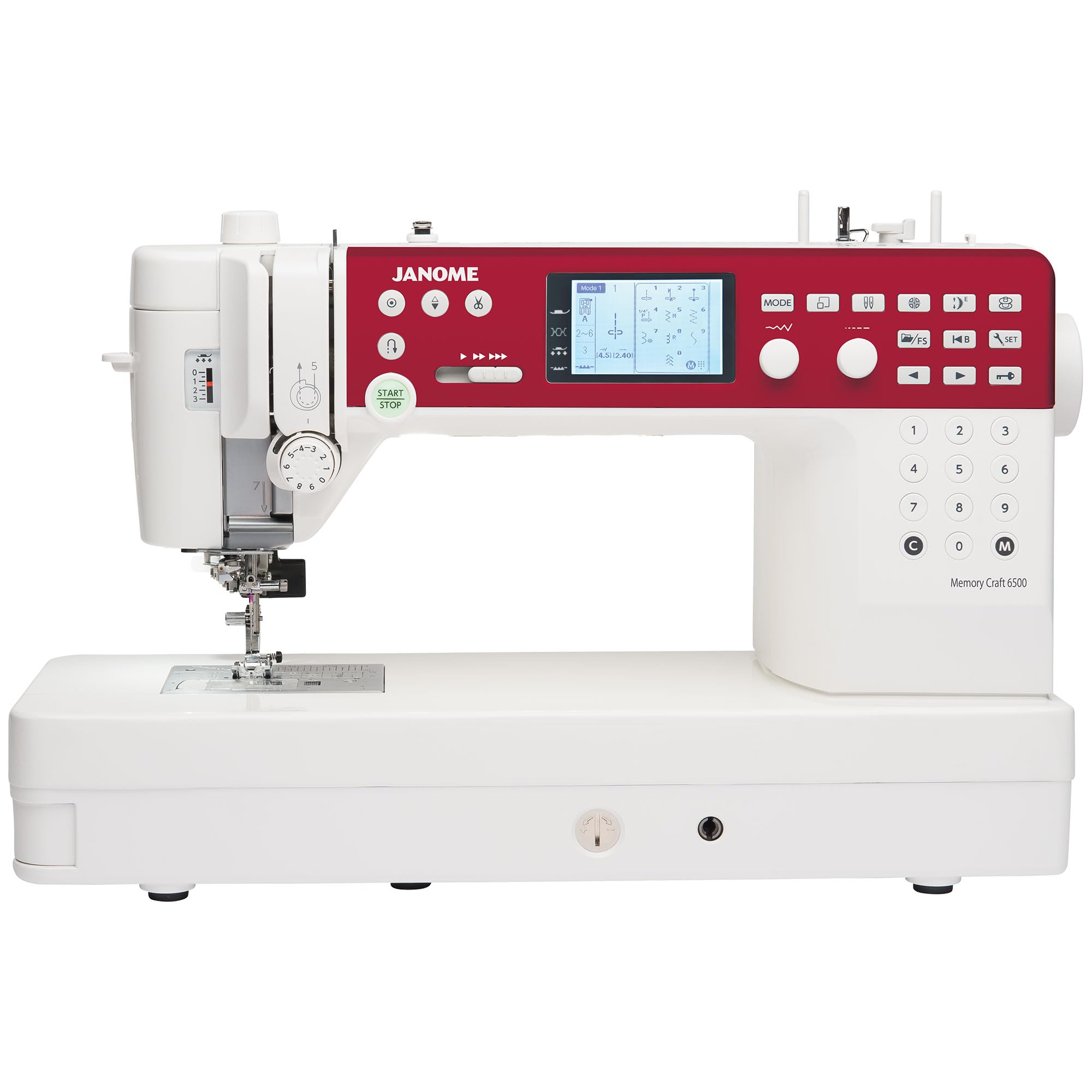
The Janome MC6650 bridges the gap between a heavy home machine and a semi-industrial unit, featuring an all-metal aluminum body frame and a seamless 10-inch flatbed. It delivers up to 1,000 stitches per minute with a computerized system that includes a built-in needle threader, independent bobbin winder, and 12 presser feet. The top-loading rotary hook bobbin system is smooth and jam-resistant.
Users highlight the two-level presser foot lift and the knee lift lever as game-changers for free-motion quilting and heavy bag making. The 10-inch throat space is generous enough for medium-sized quilts and large garment panels. The MC6650 handles thin denim, multiple quilting cotton layers, and light upholstery fabrics without tension issues.
This machine is heavier than a typical home model at 24.3 pounds, and its construction feels solid. The 6 LED lights in 3 locations provide excellent illumination. It does not have an automatic thread cutter on some versions, and the stitch speed may feel limited compared to full industrial units, but the versatility and build quality are outstanding for a mid-range shop.
Why it’s great
- Durable all-metal frame with semi-industrial feel
- Knee lift and two-level presser foot lift
- Versatile stitch range including quilting and decorative patterns
Good to know
- Top speed of 1,000 SPM is slower than dedicated industrial machines
- Throat space is 10 inches—adequate but not for large quilts
- May require specific Janome bobbins for best tension
5. Grace Company Little Rebel Quilting Machine
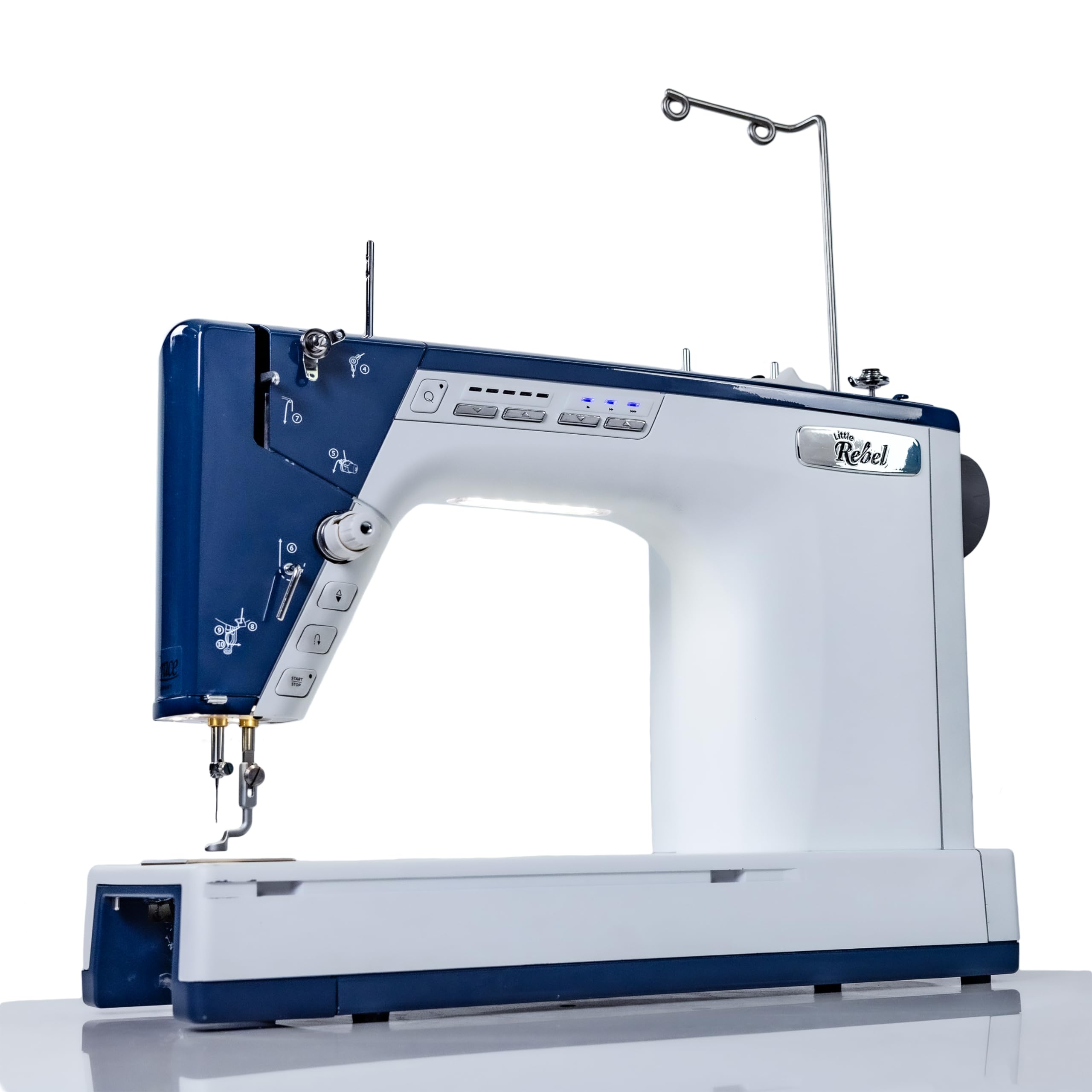
The Grace Company Little Rebel is a purpose-built machine for longarm-style quilting on a frame or table. It features built-in stitch regulation, a high-speed motor reaching 1,600 stitches per minute, and a massive 13-inch by 8.5-inch throat space. The quick-change system allows users to switch between piecing and free-motion quilting in under a minute using snap-on feet and a quilting plate.
Owners consistently praise the machine for its ease of threading and the consistent stitch quality provided by the regulation system. It is designed to fit the Grace QHoop frame, making it an affordable entry point for dedicated quilters who want professional results without the price tag of a full industrial longarm. The machine also includes a generous set of accessories including multiple needle sizes and an M-class bobbin.
The Little Rebel is heavy at 48 pounds, and its design is clearly optimized for frame use. Some users mention that different needle types can be trickier to install, and the foot lever is stiff. It lacks an automatic thread cutter. The built-in stitch regulation, however, makes it one of the most accessible options for achieving perfect stitch length during free-motion work.
Why it’s great
- Built-in stitch regulation ensures even stitch length
- Large 13″ throat for bulky quilts
- Quick-change system for piecing and quilting
Good to know
- Heavy machine best used on a dedicated frame
- No automatic thread cutter
- Foot lever requires deliberate force to operate
6. Smartstitch S-1001 10-Needle Embroidery Machine

The Smartstitch S-1001 is a 10-needle commercial embroidery machine designed for small business owners transitioning from single-needle home machines. It stitches at up to 1,200 SPM on flat goods and features auto thread trimming, auto color changing, and thread break detection. The 7-inch touchscreen interface and physical buttons simplify operation, while the large 9.5-inch by 14.2-inch embroidery field handles jackets, bags, and shirt backs.
Users highlight the included starter pack (threads, stabilizers, bobbins) and the responsive support team as major advantages for beginners. Active Facebook groups and YouTube tutorials provide ongoing training. The machine supports standard DST/DSB files and can connect via USB or Wi-Fi. The laser positioning system aids in accurate design placement.
While the S-1001 is lighter and more compact than full-size industrial machines at 93 pounds, it still requires a dedicated workspace. Some users note that the included software has a learning curve for digitizing. The machine is most at home handling moderate production runs of hats, T-shirts, and patches, and its build quality is solid for the price tier.
Why it’s great
- 10 needles minimize thread color changes
- Compact footprint for a multi-needle machine
- Strong community and training support
Good to know
- Requires a dedicated heavy table or stand
- Beginner digitizing software has a learning curve
- Limited to 9.5″ x 14.2″ field; not for large blankets
7. BAI The Mirror 15-Needle Embroidery Machine
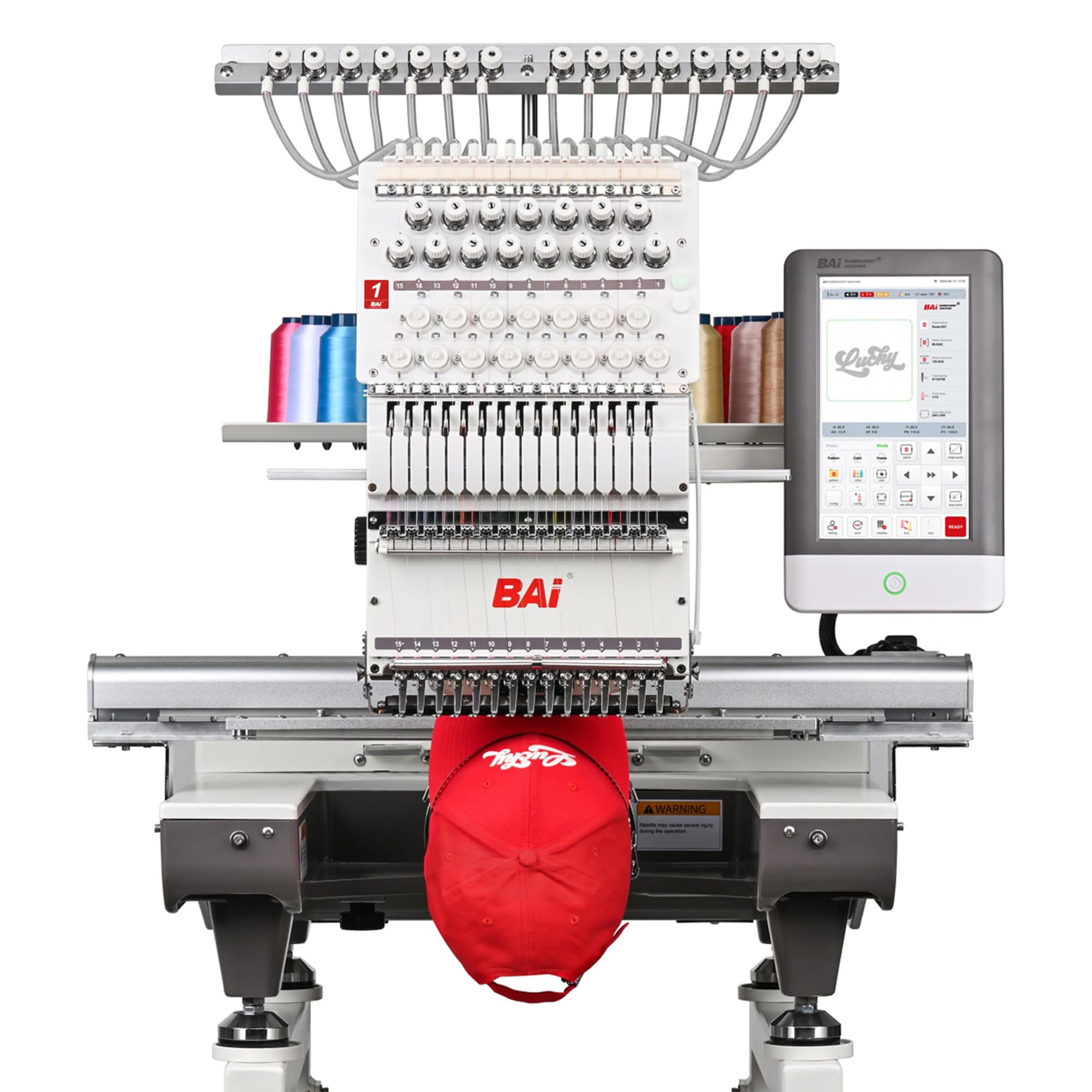
The BAI The Mirror is a 15-needle commercial embroidery machine built for stable production runs on hats, shirts, uniforms, and jackets. It offers dual-speed performance with 1,200 SPM on flat embroidery and 850 SPM on structured caps. The proprietary Institch OS5 touchscreen interface provides guided, multi-lingual workflow, and the machine includes brand-name industrial components designed for a 10-year service life.
Business owners emphasize that the machine handles dense logos and heavy garments like Carhartt jackets without jamming. The 15-needle system dramatically reduces thread change frequency for multi-color jobs. Users report that the included support package—free local tech support, active Facebook community, and detailed video library—makes the transition from single-needle machines smooth.
The Mirror is a heavy floor-standing unit at 391 pounds, requiring two to three people for initial setup. It lacks a bobbin run-out sensor and does not include free digitizing software. However, its reliability, consistent stitch quality, and excellent support network make it a top choice for growing apparel businesses.
Why it’s great
- 15 needles for high-volume multi-color production
- Dedicated hat frame with stable cap stitching
- Excellent tech support and active user community
Good to know
- Very heavy—requires a strong floor and multiple people to install
- No bobbin run-out sensor
- Digitizing software is not included
8. Juki TL-2010Q Portable Lockstitch Machine

The Juki TL-2010Q is a portable single-needle lockstitch machine that delivers industrial-grade straight stitching without requiring a dedicated table. It features an automatic thread trimmer that cuts both needle and bobbin threads at the touch of a button, a knee lifter lever for high presser foot lift (up to 12mm), and an automatic needle threader. The machine is built around an aluminum frame, keeping its weight at 38 pounds for easier transport to workshops or classes.
Users describe the TL-2010Q as incredibly smooth and quiet, with the servo motor providing exceptional speed control for both slow free-motion quilting and high-speed piecing. The throat space is larger than standard home machines, offering ample room for quilting. The machine excels at chain piecing, straight line quilting, and handling heavy fabrics like denim and upholstery.
It is a straight stitch only machine and lacks a zigzag function. The needle threader can be finicky, and the standard lighting has shadowing issues, prompting many users to add an aftermarket LED kit. The walking foot accessory requires some adjustment to the presser foot pressure. For quilters and tailors who prioritize a precise straight stitch, the TL-2010Q is a benchmark portable machine.
Why it’s great
- Automatic thread trimmer for speed
- Knee lifter provides hands-free fabric control
- Portable yet powerful straight stitch performance
Good to know
- Straight stitch only; no decorative stitch options
- Standard lighting has shadow zones
- Needle threader mechanism can be temperamental
9. Singer Quantum Stylist 9985

The Singer Quantum Stylist 9985 is a fully computerized machine offering over 1,000 stitch applications, a large color touchscreen, and 13 one-step buttonhole styles. It includes 15 presser feet in the package and features a full metal frame for durability. The machine provides adjustable stitch width up to 7mm and speed control for both slow detailed work and faster garment assembly.
Users upgrading from basic mechanical machines praise the automatic needle threader, the up/down needle button, and the automatic thread cutter. The touchscreen is intuitive and includes tutorials for threading and bobbin setup. The machine is relatively quiet and handles a wide range of fabrics from delicate silks to heavy denim with good stitch quality.
Some owners note that the machine requires Singer brand size 15 bobbins (not 15J) and that the enclosed top spool area can feel cramped. There is no knee lifter, and the bobbin does not have a low-thread alert. The soft dust cover is included, but there is no hard case. For a home business needing maximum stitch variety, the 9985 is hard to beat.
Why it’s great
- Vast stitch library with memory slots for custom sequences
- Color touchscreen with live stitch previews
- Full metal frame for stability
Good to know
- Uses specific Singer bobbins only
- No knee lifter or bobbin low alert
- Top spool area is small for large cones
10. Brother SE700 Sewing and Embroidery Machine

The Brother SE700 is a sewing and embroidery combo machine featuring a 4-inch by 4-inch embroidery field, a 3.7-inch color touchscreen, and wireless LAN connectivity. It comes with 135 built-in embroidery designs, 103 sewing stitches, and 8 sewing feet. The Artspira mobile app allows for custom design creation and wireless transfer to the machine.
Users appreciate the machine’s beginner-friendly nature, noting that the auto needle threader, thread cutter, and speed control make it easy to learn on. The machine handles mini quilts and general mending well, with impressive stitch quality for its price tier. The wireless transfer capability is a standout feature for uploading designs from a mobile device.
The 4-inch by 4-inch embroidery field is limited for larger projects, and the throat space is small for quilting large quilts. Some users experienced initial bobbin thread pulling issues that resolved with correct rethreading. It is not intended for heavy commercial use, but it is an excellent contender for a light production shop offering custom patches and small apparel decoration.
Why it’s great
- Combines sewing and embroidery in one machine
- Wireless design transfer via Artspira app
- Beginner-friendly with excellent stitch quality
Good to know
- Small 4″x4″ embroidery field limits project size
- Not built for high-volume industrial use
- Small throat space restricts large quilting
11. Brother PE900 Dedicated Embroidery Machine

The Brother PE900 is a dedicated embroidery machine with a 5-inch by 7-inch embroidery field, jump stitch trimming, and advanced color sorting to reduce thread changes. It features 193 built-in designs, 13 lettering fonts (English, Japanese, and Cyrillic), and wireless LAN connectivity. The large 3.7-inch LCD touchscreen allows for precise on-screen editing, including resizing, rotating, and combining designs.
Users highlight the jump stitch cut feature as a significant upgrade for creating clean, professional embroidery without trimming threads manually. The Artspira app provides access to 50 free designs and the ability to digitize drawings. The machine is relatively quiet compared to older dedicated machines and handles detailed designs with excellent stitch quality.
This machine is embroidery-only and does not function as a regular sewing machine. The built-in designs are considered somewhat dated by some users. The 5-inch by 7-inch hoop is generous for home business use but may still be restrictive for large back-of-jacket designs. For a dedicated embroidery setup, the PE900 offers great value and ease of use.
Why it’s great
- Automatic jump stitch trimming saves time
- Wireless design transfer and Artspira app
- Large color touchscreen with comprehensive editing features
Good to know
- Embroidery only—cannot sew basic stitches
- Built-in designs are somewhat basic
- 5″x7″ hoop may be small for larger commercial orders
12. Janome HD3000 Heavy-Duty Mechanical Machine

The Janome HD3000 is a fully mechanical, heavy-duty machine with an all-metal internal frame and a 23-pound build weight that provides stability during sustained use. It offers 18 built-in stitches, a one-step buttonhole (note: some user manuals show a 3-step process on older models), and snap-on presser feet. The machine includes a built-in needle threader and a reverse stitch lever.
Users consistently praise the HD3000 for its reliability, quiet operation, and ability to sew through 10-plus layers of denim without hesitation. The foot pressure adjustment dial allows the user to fine-tune the machine for thin fabrics without skipping stitches. It is a simple, durable machine with no computerized components to fail.
The harp space is small, making it unsuitable for large quilting projects without a dedicated walking foot. The buttonhole on some units is a 3-step process, which some users find less convenient than modern one-step systems. It is a best-value choice for a home business doing basic repairs, garment construction, and craft sewing where absolute speed is not the priority.
Why it’s great
- All-metal internal frame for long life
- Quiet and smooth operation with minimal vibration
- Sews through multiple heavy layers easily
Good to know
- Small harp space limits large quilting
- Buttonhole is a 3-step process on some units
- Limited stitch selection compared to computerized models
13. Consew CP206RL Portable Walking Foot Machine

The Consew CP206RL is a portable walking foot machine with a longer arm and a built-in 110V motor, designed for taking on-site upholstery or marine repair jobs. It features a horizontal oscillating hook and reverse stitching. Its 42-pound weight makes it heavier than a standard home machine but still transportable for mobile work.
Users report that the machine performs well on thick materials like vinyl and heavy canvas after initial setup modifications. The walking foot mechanism helps prevent layer shift on slippery materials. Some owners recommend adding a higher-quality servo motor controller to improve slow-speed control and smooth out the stitching pace.
There are consistent reports of out-of-box issues including motor pulley misalignment, stiff levers, and finicky tension. The machine lacks a piping/cording foot and the walking foot can be rough on delicate fabrics. It is best suited for users comfortable with mechanical adjustments who need an affordable portable walking foot option.
Why it’s great
- Portable form factor with built-in motor
- Walking foot handles heavy materials without layer shift
- Longer arm accommodates larger projects
Good to know
- Often requires out-of-box mechanical adjustments
- Slow-speed control can be erratic
- Limited add-on accessories available
FAQ
Can I use a home sewing machine for light commercial work?
What is the difference between a servo motor and a clutch motor?
Do I need a walking foot machine for leather or vinyl?
What does the “H” mean in the Juki DDL-8700-H model?
Can a sewing machine handle both embroidery and garment production?
Final Thoughts: The Verdict
For most users, the commercial sewing machine winner is the Juki DDL-8100 because it combines the speed and reliability of an industrial lockstitch platform with a quiet, efficient servo motor and a complete table setup. If you need a walking foot for upholstery and thick materials, grab the Consew 206RB-5. And for a portable straight stitch machine that can go anywhere, nothing beats the Juki TL-2010Q.

Mo Maruf
I created WellFizz to bridge the gap between vague wellness advice and actionable solutions. My mission is simple: to decode the research and give you practical tools you can actually use.
Beyond the data, I am a passionate traveler. I believe that stepping away from the screen to explore new environments is essential for mental clarity and physical vitality.