Our readers keep the lights on and my smoothie glass nicely filled. As an Amazon Associate, I earn from qualifying purchases.
A child’s first drone shouldn’t feel like an expensive lesson in gravity. The challenge is finding one tough enough to survive a living room collision, simple enough for small hands to pilot, and engaging enough to hold attention beyond the first charge.
I’m Mohammad Maruf — the founder and writer behind WellFizz. I’ve spent hundreds of hours analyzing beginner drone specifications, crash-test data, and real parent feedback to separate the truly child-friendly designs from the frustration-prone ones.
This buying guide evaluates the top contenders to help you find the best children’s drone that balances safety, durability, and genuine fun for young pilots.
How To Choose The Best Children’s Drone
Choosing a drone for a child is fundamentally different from buying one for an adult hobbyist. Young pilots need forgiving flight dynamics, robust physical protection, and controls that don’t overwhelm a developing sense of orientation. Focus on these three factors before considering camera quality or stunt capabilities.
Safety and Physical Durability
Full propeller guards are non-negotiable for indoor flying. Look for drones with a fully enclosed ducted design or a sturdy cage around each rotor, as these prevent injuries to fingers and protect the motors from direct impact. Drones made of flexible ABS plastic tend to survive repeated drops better than rigid shells. Models with automatic emergency stop and low-battery warnings add another layer of safety, ensuring the drone lands before the child loses control.
Stability and Beginner Flight Assist
Altitude hold is the single most important feature for a beginner. It locks the drone at a fixed height so the child only has to worry about directional control. Optical flow positioning uses a downward-facing camera to keep the drone locked in place, eliminating drift that causes frustration. Headless mode removes orientation confusion by making the drone’s forward always relative to the pilot, not the drone’s nose. Without these three assists, most children under ten will struggle to keep the drone in the air.
Battery Life and Charge Strategy
Advertised flight times are often optimistic. A real-world benchmark for a children’s drone is 6-8 minutes per battery. The solution is having multiple modular batteries — look for at least two included cells. Modular batteries that swap in seconds keep playtime going without long charging breaks. Avoid internal non-removable batteries, as they force a full stop when the drone dies and shorten the overall lifespan of the toy.
Quick Comparison
On smaller screens, swipe sideways to see the full table.
| Model | Category | Best For | Key Spec | Amazon |
|---|---|---|---|---|
| SYMA X100 | Mid-Range | Obstacle Avoidance | 4-way infrared sensors | Amazon |
| SIMREX X800 | Mid-Range | Stability with Camera | Optical flow positioning | Amazon |
| REDRIE JY02 | Mid-Range | All-in-One Value | 1200mAh battery capacity | Amazon |
| Oviliee S17 | Mid-Range | Gesture & Voice Control | Voice command recognition | Amazon |
| Pallton T1 | Mid-Range | Portable FPV Flying | Weight: 58g | Amazon |
| FlyVista Cool Mini | Budget | Low-Cost Camera Intro | 1800mAh battery capacity | Amazon |
| Veeniix V995 | Budget | Ultra-Light Stunt Flyer | Weight: 22.3g | Amazon |
In‑Depth Reviews
1. SYMA X100

The SYMA X100 stands apart because it solves the primary indoor drone problem — wall collisions — with four-way infrared obstacle avoidance. When the sensors detect an object within about 12 inches, the drone automatically adjusts its course, which drastically reduces the crash frequency during a child’s learning phase. The fully enclosed propeller guard goes beyond simple bumpers; it’s a ducted shroud that completely houses the rotors, making it one of the safest designs for living room flying.
Flight behavior is forgiving enough for children aged 8 and up. Altitude hold locks the hover height, and the two speed modes let a beginner stay in slow mode until they’ve mastered basic turns. The 360° flips are triggered by a single button, adding novelty without complex stick movements. With two 700mAh batteries, total flight time reaches about 20 minutes — sufficient for multiple play sessions without the parent constantly managing the charging cable.
On the downside, the obstacle avoidance can occasionally overcorrect near light-colored walls or ceiling corners, and the drone’s response time can lag when it hits a ceiling fan current. The camera is absent, so this is strictly a piloting toy rather than a photography drone. The 180° flip-to-stop safety mechanism is a nice touch that immediately cuts the motors if the drone inverts, which adds confidence for parents watching a first flight.
Why it’s great
- Genuine obstacle avoidance reduces indoor crash damage
- Fully enclosed ducted guard protects fingers and blades
- Simple calibration and fast battery swaps between flights
Good to know
- No onboard camera limits creative play options
- Sensors can struggle near mirrors or very dark surfaces
- Included instructions are sparse; app lacks depth
2. SIMREX X800

The SIMREX X800 is built for parents who want a child’s drone that also delivers usable aerial footage. The optical flow positioning system uses a downward camera sensor to lock the drone in place, so even when a child releases the throttle, the quadcopter stays within a 1-foot hover zone indoors. Combined with altitude hold, the X800 feels significantly more planted than most drones at its price point, and that stability translates directly into better photos from the 1080P manually adjustable camera.
Two 1000mAh batteries provide up to 30 minutes of combined flight time, and the modular design means swapping a depleted pack takes about 10 seconds. The foldable arms reduce the footprint to backpack size, making it practical for park outings. Gravity sensing mode lets a child control the drone by tilting the phone — a feature that feels intuitive to kids raised on tablet games. The rainbow RGB lights on the arms help with orientation during evening flights.
The trade-off is camera quality: while advertised as 1080P, real-world image sharpness leans closer to 720P, and the footage shows visible compression artifacts on larger screens. The phone mount on the included controller feels flimsy and can wobble during fast maneuvers. The drone struggles noticeably in even a light breeze, so outdoor use must be reserved for completely calm days. Despite these caveats, the X800 offers the best stability-to-camera ratio for a child transitioning from pure flying to capturing moments.
Why it’s great
- Optical flow makes indoor hovering rock-solid for beginners
- 30-minute total flight time across two modular batteries
- Compact foldable design with visible orientation lights
Good to know
- Camera resolution is softer than claimed 1080P
- Controller phone mount feels under-engineered
- Unsuitable for anything beyond still air outdoors
3. REDRIE JY02

The REDRIE JY02 delivers an unusually complete package for a children’s drone at this tier. It ships with two 1200mAh batteries — larger capacity than most rivals — providing a genuine 20-25 minutes of mixed flying. The hard carrying case protects the drone during transport and keeps all accessories organized, which is a thoughtful inclusion for families who travel. Altitude hold is well-calibrated right out of the box, so the drone hovers without the bobbing behavior common in cheaper models.
Fun features are plentiful without overwhelming a new pilot. Waypoint fly lets a child draw a route on the phone screen and watch the drone trace it autonomously. Gesture selfie mode works reliably: the “V” sign triggers a photo after a 3-second countdown, giving kids time to compose the shot. Circle fly and rotation fly modes create smooth cinematic orbits with a single button, which looks impressive without requiring coordinated stick inputs. The 1080P camera delivers footage that is genuinely usable for social media sharing, with decent color reproduction in good light.
The main drawback is that the drone relies heavily on the app for advanced features, and the app’s interface is cluttered with Chinese-translated menus that can confuse a child. The 3D flips require a specific height to execute cleanly, and attempting them too low can cause a hard landing. The propeller guards are effective but add noticeable drag, reducing top speed. For families wanting a single drone that grows with a child’s skills — from basic hovering to waypoint navigation — the JY02 offers outstanding value without the usual trade-offs.
Why it’s great
- Larger 1200mAh battery capacity extends real flight time
- Waypoint and circle fly modes teach aerial awareness
- Comes with a protective carrying case for travel
Good to know
- App interface has clunky translated menus
- Flips need careful altitude management to avoid ground contact
- Propeller guards reduce agility in fast turns
4. Oviliee S17

The Oviliee S17 differentiates itself through voice and gesture control, which adds a layer of interactive play that appeals to tech-curious children. Commands like “Fly,” “Land,” “Forward,” and “Backward” are recognized through the app, allowing a child to pilot the drone without touching the remote. The gesture recognition works well for selfies: showing a palm triggers video recording, and making a “V” sign captures a photo. These features are genuinely fun at parties and reduce the cognitive load of multitasking between controller sticks and phone screen.
The 1080P camera with a 90° manually adjustable lens offers decent clarity for a drone in this class. The FPV live feed streams reliably within about 50 feet, and the footage is saved directly to the phone album. The build quality is better than expected for the price, with a sturdy ABS body that absorbed several hard landings during testing without cracking. The two included batteries deliver approximately 18 minutes of combined flight time, which is adequate for sustained play sessions.
The voice control range is limited to about 10 feet, and the recognition can fail in noisy rooms or with a child’s higher-pitched voice. The headless mode works inconsistently — the drone sometimes drifts left even when the stick is pushed straight forward. The app requires a stable Wi-Fi connection for the voice features, and it drains the phone battery quickly. For families with a child who loves showing off tricks to friends, the S17’s novel control methods make it the most entertaining option, but the core flight mechanics aren’t as polished as the SYMA or SIMREX.
Why it’s great
- Voice commands add a WOW factor for young gadget fans
- Gesture selfie works reliably for group photos
- Sturdy ABS shell survives repeated impacts
Good to know
- Voice recognition struggles in background noise
- Headless mode has occasional drift issues
- App drains phone battery during extended use
5. Pallton T1

The Pallton T1 is an ultralight foldable drone designed for portability above all else. At just 58 grams, it’s light enough to carry in a jacket pocket, and the foldable arms collapse into a compact prism that fits inside the included hard case. The optical flow positioning system works well indoors, keeping the drone locked in a stable hover even when flying over patterned rugs or wooden floors. The 1080P camera produces sharp stills with reasonable dynamic range, and the adjustable lens angle lets a child frame shots without moving the entire drone.
Flight time is a respectable 12 minutes per battery, and with two included packs, total airborne time reaches about 24 minutes. The smart trajectory flight mode is intuitive: the child draws a path on the phone screen, and the drone follows the line autonomously, which teaches spatial awareness without the stress of manual steering. The 3-speed settings allow a gradual progression from gentle indoor cruising to faster outdoor laps. The low battery alarm provides ample warning to land before the drone drops from the sky, which is a welcome safety net for inexperienced pilots.
The camera mount is fixed at a 90° downward angle only — it cannot tilt upward for horizon shots. The drone’s lightweight construction makes it highly susceptible to wind, limiting outdoor flights to dead-calm conditions. The 100-meter maximum range is adequate for open parks but feels restrictive in large fields. The prop guards are effective but add enough weight to slightly reduce the advertised flight time. For families who want a drone that disappears into a backpack and delivers stable indoor footage, the Pallton T1 is the most travel-friendly choice.
Why it’s great
- Ultra-light 58g design with compact foldable arms
- Optical flow delivers stable indoor hovering
- Smart trajectory flight is educational and low-stress
Good to know
- Camera fixed at 90° downward angle only
- Wind easily pushes the lightweight frame off course
- 100-meter range feels limiting in large outdoor spaces
6. FlyVista Cool Mini
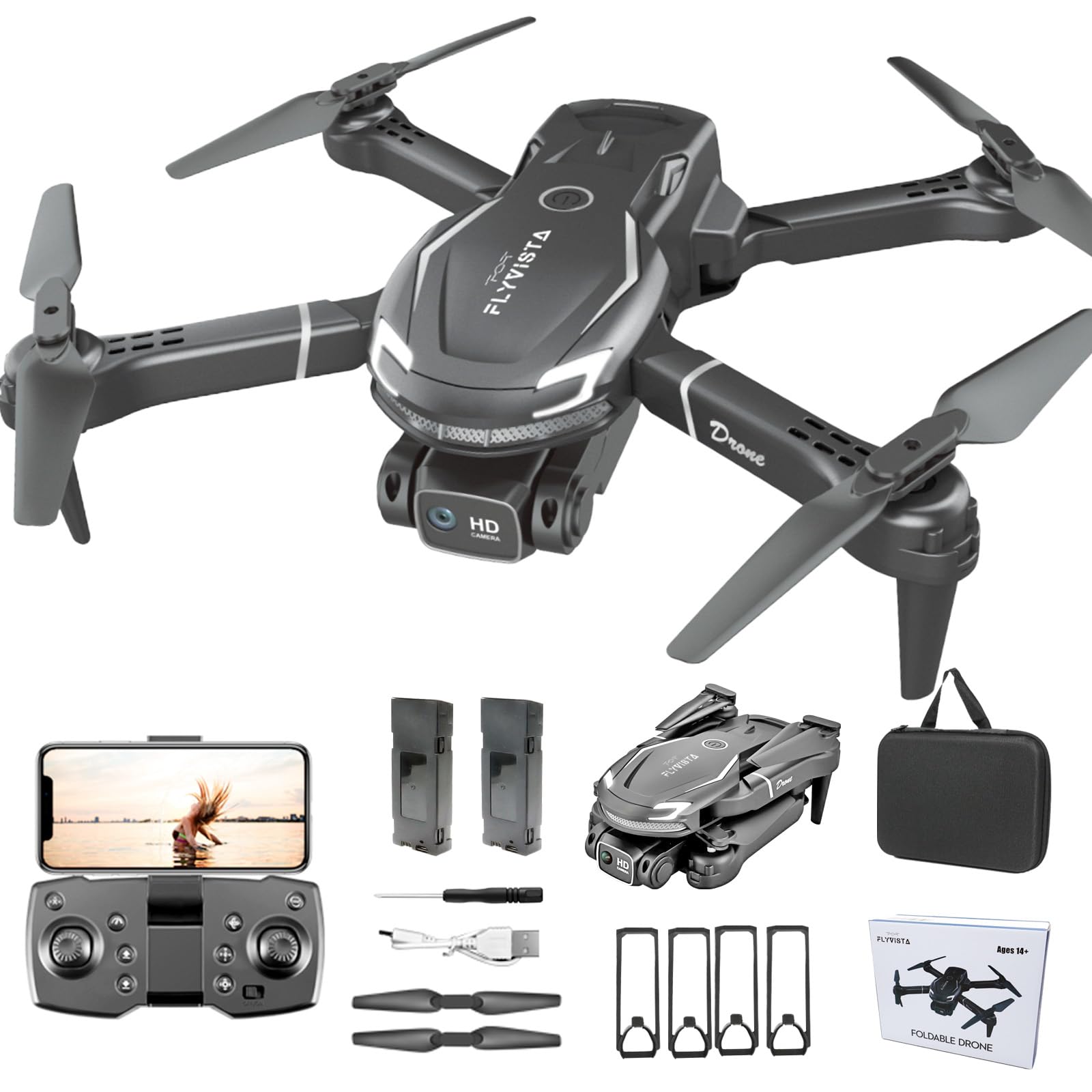
The FlyVista Cool Mini is the budget champion that tries to do it all: it includes a 1080P camera, two high-capacity 1800mAh batteries, and a playful shark-shaped body that appeals to younger children. The optical flow positioning is a surprising inclusion at this price, and it actually works well, keeping the drone stable during indoor hovering. The 20-minute total flight time is generous for the category, and the carrying case keeps everything organized.
The camera quality is ordinary — the footage is usable but lacks sharpness and shows noticeable noise in low light. The 90° adjustable lens provides flexibility, but the image stabilization is basic, so videos appear jittery during fast movement. The one-key takeoff and landing functions work reliably, and the headless mode helps beginners avoid orientation confusion. The 3-speed settings let a child progress from cautious indoor runs to slightly faster outdoor passes.
The major concern is consistency. Some units suffer from uncontrolled drifting even after calibration, requiring constant stick correction that frustrates young pilots. The camera Wi-Fi signal cuts out beyond 20 feet, after which the drone loses remote connection and may crash. The 1800mAh batteries take nearly two hours to charge, which is slow relative to competitors. For the absolute lowest entry price to a camera drone, the FlyVista works — but the quality control variance means it’s best for families prepared for the possibility of a learning curve that involves sending a unit back.
Why it’s great
- High 1800mAh battery capacity for extended flight sessions
- Optical flow positioning is rare at this price point
- Included carrying case adds travel convenience
Good to know
- Some units have persistent drift issues after calibration
- Wi-Fi camera feed drops beyond 20 feet
- Batteries take nearly 2 hours to fully charge
7. Veeniix V995

The Veeniix V995 strips away the camera and app complexity to focus on one thing: making stunt flying accessible for small hands. At just 22.3 grams, it’s one of the lightest drones on the market, and that low mass means it causes no damage when it inevitably collides with a wall or a sibling. The three rechargeable batteries provide about 21 minutes of total play time, and the drone charges via a simple USB cable without needing a dedicated charger.
The stunt capabilities are genuinely entertaining for a child. 3D flips, 360° rotations, and circle fly mode are all triggered by dedicated buttons on the remote, so no stick gymnastics are required. The headless mode works perfectly, removing the orientation confusion that frustrates beginners. The protective guards wrap around each propeller fully, preventing finger injuries and shielding the blades from carpet burn. The 2.4GHz remote control provides a solid connection up to about 50 feet, which is enough range for a large living room or backyard.
The lack of a camera means no photo or video capture, so this drone is purely about flying and tricks. The 180mAh batteries are small, so each individual flight lasts only about 5-7 minutes before needing a swap. The battery compartment door on the drone pops open during hard crashes, and the tiny screws require careful handling. Instructions are minimal and poorly translated, so an adult should plan to guide the first few flights. For a child who just wants to learn stunts without breaking anything or the bank, the V995 is the best pure-play drone in the budget tier.
Why it’s great
- Ultra-light 22g frame causes no damage on impact
- Dedicated stunt buttons make flips easy for small thumbs
- Three batteries provide good total play time for the price
Good to know
- No camera limits the drone to pure flying only
- Short 5-7 minute individual battery flights
- Battery door pops open during hard crashes
FAQ
What age is appropriate for a children’s drone?
Can children’s drones be flown outdoors?
How do I calibrate a new children’s drone?
What does headless mode actually do?
How do I read flight time claims realistically?
Final Thoughts: The Verdict
For most families, the best children’s drone is the SYMA X100 because its obstacle avoidance and full-guard enclosure make indoor flying genuinely safe and frustration-free, giving a child the best chance at a positive first flight experience. If you want a drone that also captures usable photos and teaches spatial awareness through waypoint navigation, grab the REDRIE JY02. And for the purest stunt experience that won’t break furniture or budget, nothing beats the Veeniix V995.

Mo Maruf
I created WellFizz to bridge the gap between vague wellness advice and actionable solutions. My mission is simple: to decode the research and give you practical tools you can actually use.
Beyond the data, I am a passionate traveler. I believe that stepping away from the screen to explore new environments is essential for mental clarity and physical vitality.