Our readers keep the lights on and my smoothie glass nicely filled. As an Amazon Associate, I earn from qualifying purchases.
A grainy, blurry license plate at the moment of an accident is the same as no video at all. When you need a reliable witness, the resolution, sensor quality, and processing power of your dash cam determine whether you walk away with an insurance win or a frustrating he-said-she-said. The gap between a kit and a premium dual-channel system is measured in the crispness of plates at 60 feet, the stability of footage on bumpy roads, and the staying power of a parking mode that wakes only on real threats.
I’m Mohammad Maruf — the founder and writer behind WellFizz. I’ve spent dozens of hours dissecting sensor specs, frame rates, aperture numbers, and parking mode logic across the most popular front and rear dash cam models to separate marketing claims from true performance.
After analyzing the hardware, real user feedback, and key metrics like dynamic range and low-light sensor quality, I’ve narrowed the field to the models that matter for best dash cams front and rear. This guide breaks down exactly what makes each unit worth your consideration.
How To Choose The Best Dash Cams Front And Rear
Not all dual-channel systems are created equal. The front camera often gets all the marketing hype, but the rear unit and the supporting electronics determine whether your footage is actually usable. Focus on these four areas to avoid a disappointing purchase.
Front and Rear Resolution Balance
A 4K front camera is useless if the rear unit maxes out at 720p with poor dynamic range. Look for systems where the rear camera offers at least 1080p, or better yet, 2.7K. Balanced resolution ensures that both ends of your vehicle have evidentiary-quality footage, especially crucial in rear-end collision scenarios where the other driver’s plate is only readable from the back.
Night Vision and Sensor Quality
The difference between seeing a plate at 10 PM and a muddy blur is dictated by the sensor. STARVIS sensors from Sony or OmniVision capture exceptional detail in extremely low light. Pair this with a large aperture (F1.5 or F1.6) and WDR/HDR processing. A budget dash cam with a cheap sensor and F2.0 aperture will produce unusable footage on unlit roads.
Parking Mode and Power Management
If you park on the street, parking mode is a must. The most effective systems use buffered recording (capturing a few seconds before an event) and low-bitrate continuous recording. These require a hardwire kit, not just the cigarette lighter adapter. Supercapacitor-based dash cams handle extreme heat better than lithium-ion battery units, which can degrade quickly in hot climates.
Quick Comparison
On smaller screens, swipe sideways to see the full table.
| Model | Category | Best For | Key Spec | Amazon |
|---|---|---|---|---|
| DDPAI N5 Dual | Screenless | Stealthy parking mode & reliability | 32GB eMMC + 512GB expandable | Amazon |
| Vantrue E2 | High-Res Dual | Crystal-clear rear recording | 2.7K + 2.7K STARVIS | Amazon |
| REDTIGER F7N-N | Fast Wi-Fi | Quick phone downloads | 20MB/s 5.8GHz Wi-Fi 4K front | Amazon |
| Nanoby M1 | 3-Channel | Cabin coverage for rideshare | 4K front + 1080P cabin + 1080P rear | Amazon |
| FAIMEE 4K+2K | Dual-Band Wi-Fi | Solid all-rounder with GPS | 4K front / 2K rear, dual-band 5.8GHz | Amazon |
| Coolcrazy N8 | Budget 4K | Entry-level 4K value | STARVIS, 170° FOV, 128GB included | Amazon |
| 70mai A410 | Compact Dual | Discreet size & GPS tracking | 2.5K front, 125° FOV, F1.55 aperture | Amazon |
In‑Depth Reviews
1. DDPAI N5 Dual
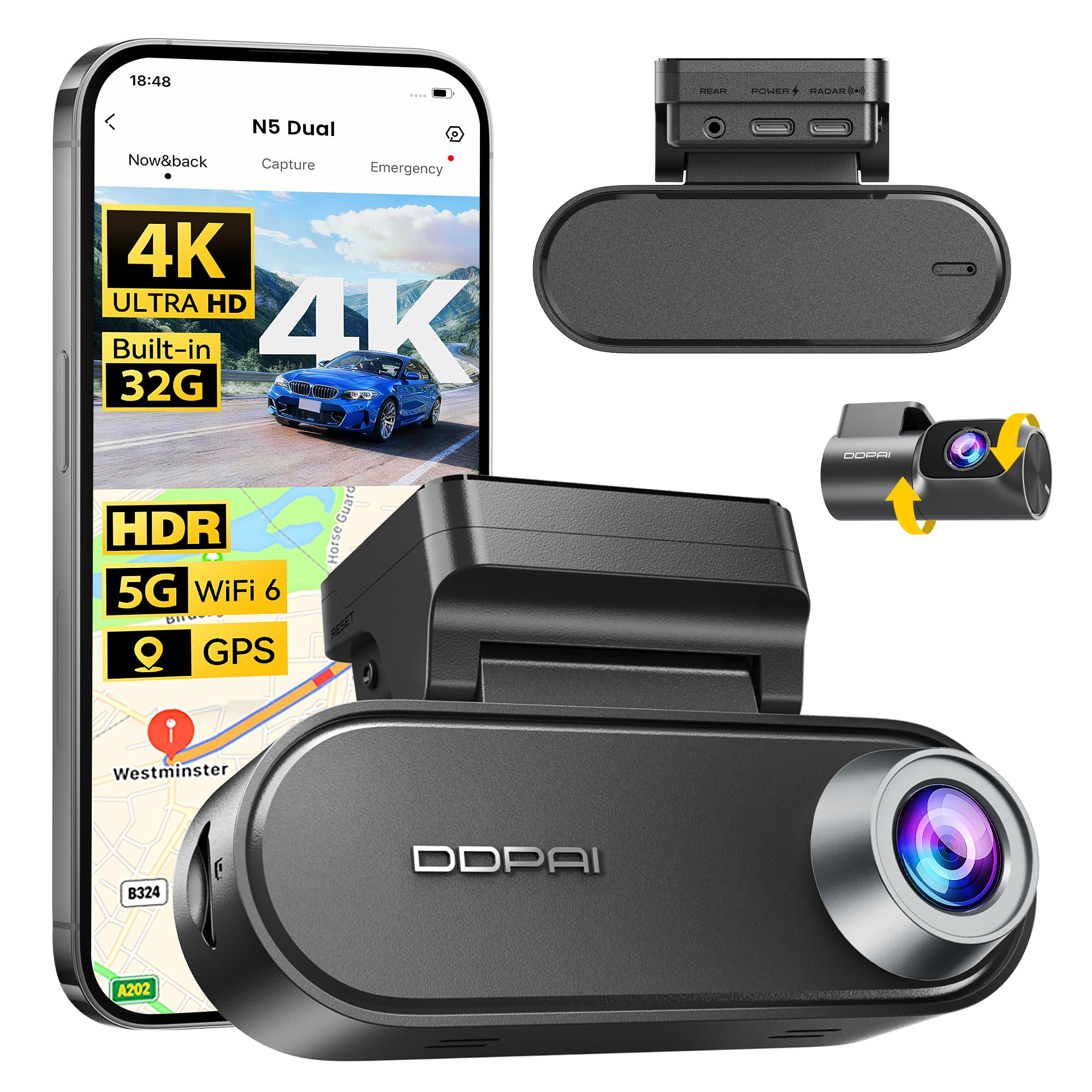
The DDPAI N5 Dual redefines reliability by ditching the single point of failure — the memory card. Its built-in 32GB eMMC storage is far more resistant to corruption than a standard microSD, and you can still expand with a TF card up to 512GB for a dual-storage safety net. This is a screenless unit, designed to sit discreetly behind the mirror, with a compact aluminum body that dissipates heat efficiently — critical for surviving summer dashboards.
The star feature here is the 72-hour radar parking mode. An included radar module detects moving objects near the car and wakes the camera only when needed, preserving battery life while still capturing hit-and-runs. The AI ISP image processing with HDR produces exceptional clarity in low-light tunnels and garages, making plates readable without the grainy noise typical of budget sensors. The Wi-Fi 6 connectivity is genuinely fast, allowing a 1-minute 4K clip to download in under 30 seconds.
ADAS alerts like forward-vehicle movement and fatigue warnings are a nice addition, but the real value lies in the recording integrity. The G-sensor works with loop recording, and footage is time-stamped with GPS coordinates and speed. Some users note the app can occasionally crash due to Wi-Fi interference from Apple CarPlay, but the hardware itself is rock solid. If you park on the street and want the best chance of catching vandals, this is the system to beat.
Why it’s great
- Built-in eMMC storage eliminates card corruption risk
- Radar parking mode extends battery life to 72 hours
- Excellent AI-enhanced night vision with HDR
Good to know
- Screenless design means no live preview without the app
- Radar module and hardwire kit sold separately
2. Vantrue E2

The Vantrue E2 is one of the few front and rear dash cams where the rear camera actually matches the front’s resolution. Both channels record an impressive 2.7K (2592x1944P) using Sony STARVIS sensors, meaning the license plate of a car that hits you from behind is just as clear as the one in front. This is a rare spec even among mid-range premium kits — most competitors cap the rear at 1080P or 2K, not true 2.7K.
Voice control is genuinely useful here. Commands like “lock the video” or “show rear camera” work without yelling, and the included wireless remote button lets you snap photos without touching the dash cam. The 5GHz Wi-Fi is fast for app transfers, and the built-in GPS embeds speed, route, and coordinates onto footage. The parking mode offers four options, including buffered motion detection that captures 15 seconds before and 30 seconds after an event — crucial for proving fault in a parking lot hit.
Installation is straightforward with the included adhesive GPS mount and a generous 20-foot rear cable. Some users report that wireless Apple CarPlay can interfere with the Vantrue app connection, and a few have noted the dash cam can stop recording arbitrarily — though this seems to be a software issue on early batches. If you prioritize equal resolution on both cameras and want the security of a dual 2.7K setup, this is the top-tier pick.
Why it’s great
- True 2.7K recording on both front and rear cameras
- Buffered parking mode captures pre-event footage
- Voice control and wireless remote work reliably
Good to know
- Some units have intermittent recording issues
- Wireless Apple CarPlay can interfere with Wi-Fi connection
3. REDTIGER F7N-N
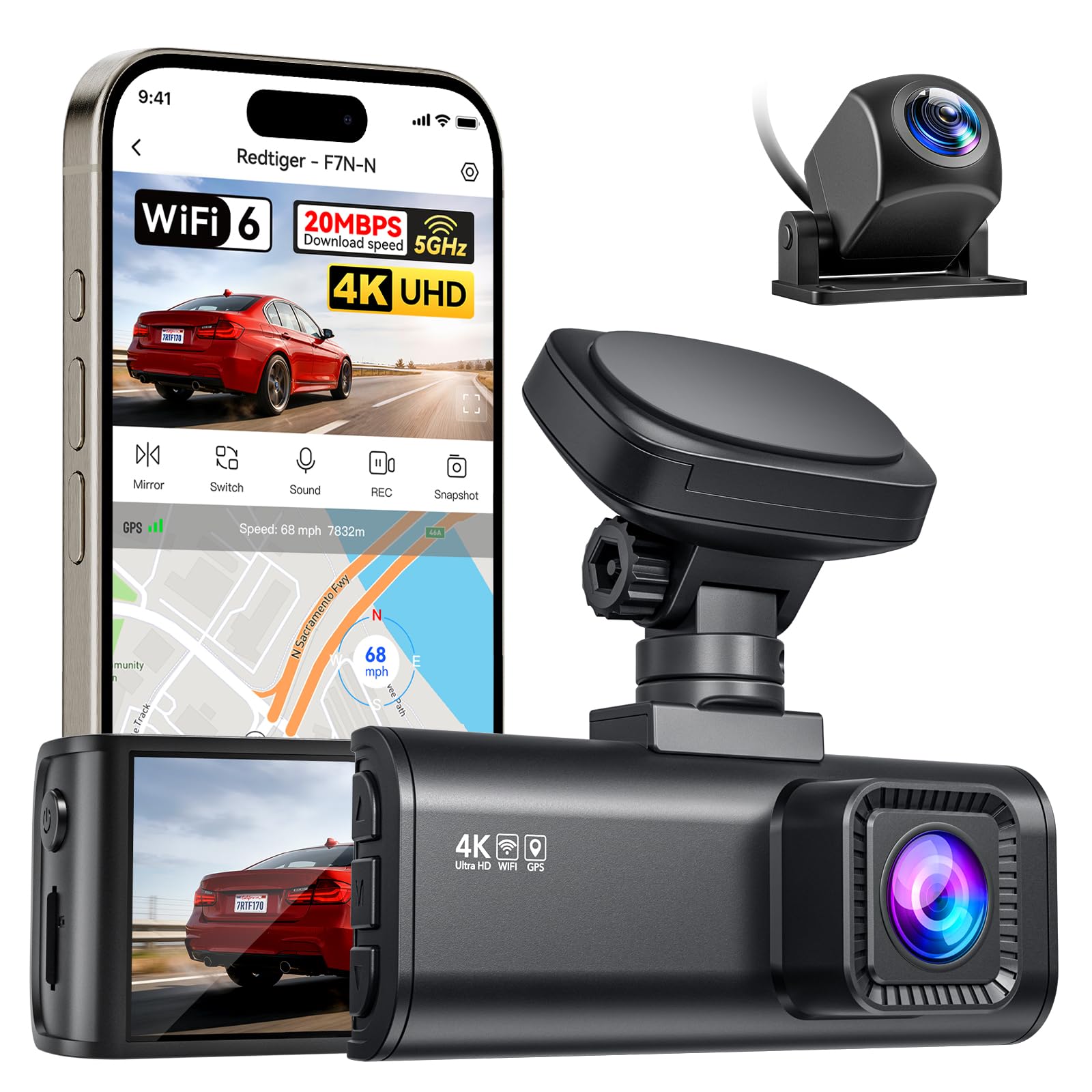
The REDTIGER F7N-N focuses on one thing most dash cams do poorly: transfer speed. Its 5.8GHz Wi-Fi hits up to 20 MB/s, which means a 1-minute 4K clip downloads in about 8 seconds. If you frequently need to pull footage onto your phone — whether for insurance claims or sharing road trip highlights — this feature alone saves significant time. The front camera records crisp 4K at 60fps, and the rear captures 1080P at a wide 140 degrees.
Night vision is handled by a 6-layer glass lens and an F1.5 aperture, paired with WDR. This combination cuts through headlight glare and lifts shadow detail on dark rural roads. The supercapacitor design handles extreme heat better than lithium-ion batteries, making the F7N-N a safer choice for cars parked in direct sunlight. Parking mode requires a separate hardwire kit but supports motion detection and collision locking when powered.
GPS is built into the adhesive mount, not the cam body — this allows for a slimmer unit but means the mount is specific to this model. The 3.18-inch IPS screen is bright and clear for live playback. Some users have reported long-term reliability concerns, with units failing after a year or two and date/time resets. For the price, the hardware package is strong, but the durability record is mixed. It’s a great choice if fast downloads are your priority.
Why it’s great
- 20 MB/s transfer speed with 5.8GHz Wi-Fi
- F1.5 aperture for excellent low-light capture
- Supercapacitor design handles high heat well
Good to know
- No memory card included despite high resolution
- Long-term reliability reports are mixed
4. Nanoby M1

The Nanoby M1 stands out by adding a third channel: an interior cabin camera. This is a game-changer for rideshare drivers, taxi operators, or anyone who wants to monitor passengers inside the vehicle. The front captures 4K, while the interior and rear both record at 1080P — giving you complete situational awareness. The 160-degree front and 155-degree cabin/rear angles mean minimal blind spots around the car.
The cabin camera uses 4 infrared LEDs and an F1.6 aperture for night vision, producing clear footage even in total darkness. The 3.18-inch IPS screen is larger than most in this class, making it easy to review clips without pulling out your phone. The 5.8GHz Wi-Fi supports fast downloads (up to 8 MB/s), and the built-in GPS logs speed, route, and location. A 64GB card is included and pre-installed, so you can start recording immediately.
Installation is straightforward thanks to the electrostatic stickers that leave no residue, and the three cameras can be independently rotated to fine-tune angles. The car charger includes an extra USB port for charging a phone — a thoughtful touch. Some users find the 3-channel unit slightly bulkier than a standard dual-cam setup, but the added cabin coverage justifies the size. For fleet management or personal security, this is a complete package.
Why it’s great
- Triple-channel captures cabin interior plus front and rear
- IR LEDs provide clear cabin footage in total darkness
- 64GB card included and pre-installed
Good to know
- Larger unit due to the 3-channel configuration
- Internal cabin camera may feel intrusive for some drivers
5. FAIMEE 4K+2K
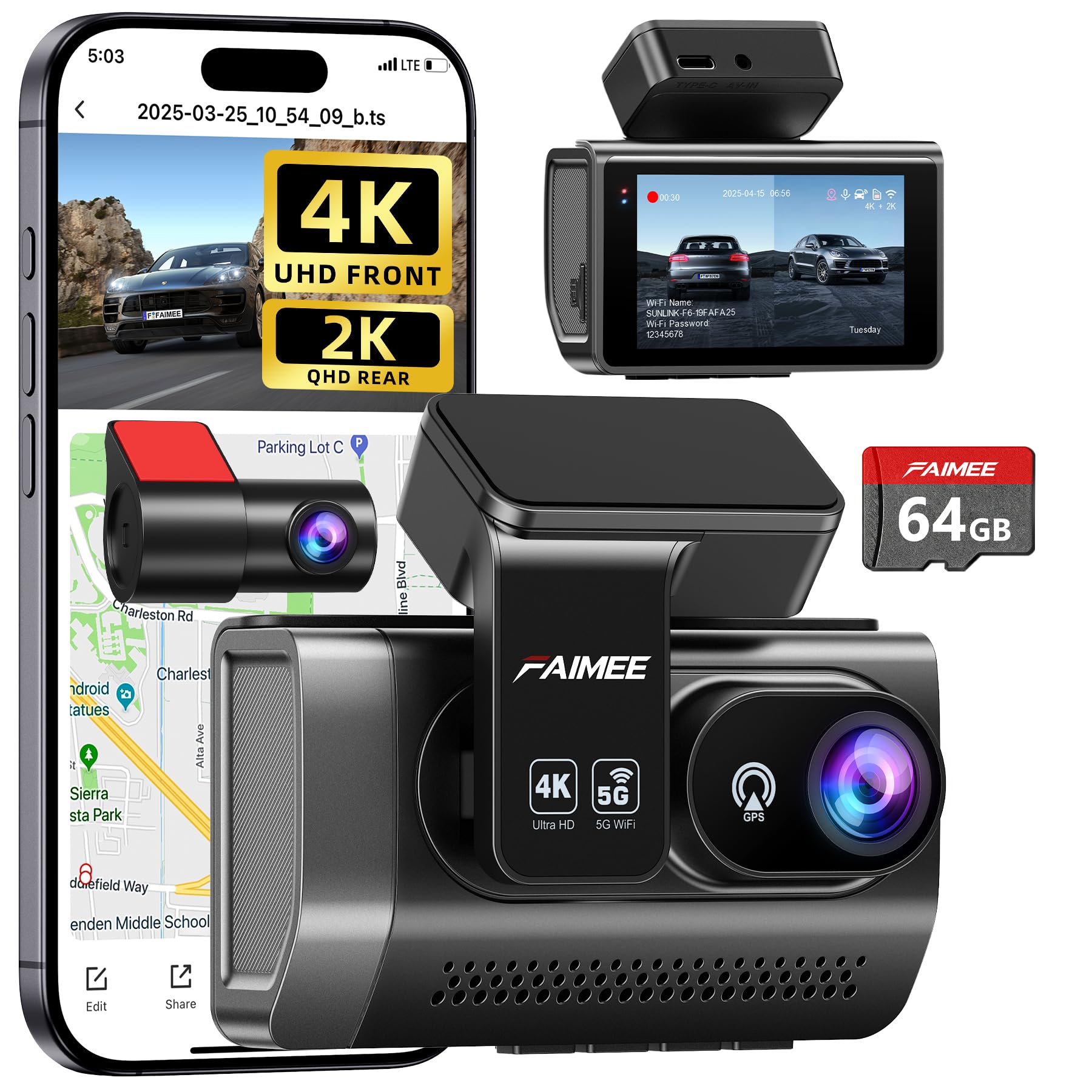
The FAIMEE dash cam hits a sweet spot in the mid-range: a 4K front camera paired with a 2K rear camera, which is a step above the standard 1080P rear units. The front uses an F1.8 aperture with WDR and night vision, producing sharp, well-exposed footage in varied lighting. The 170-degree wide-angle lens captures up to six lanes of traffic, reducing blind spots at intersections and highway merges.
Dual-band Wi-Fi (2.4GHz and 5.8GHz) provides a stable connection to the FAIMEE app for live viewing and downloads. The built-in GPS logs speed, route, and coordinates, and the data can be viewed on a map within the app or on a computer. The 3-inch IPS screen is clear and shows a live feed, and the discreet design hides nicely behind the rearview mirror without blocking your view.
The parking mode uses time-lapse recording to capture continuous footage at a low bitrate, which is better than motion-only systems because it catches the entire event. However, it requires a separate hardwire kit. A 64GB high-endurance memory card is included, and the system supports up to 256GB. Some users have noted that the included suction mount works well, but the instructions can be poorly translated. For the price, this offers a very solid balance of features and performance.
Why it’s great
- 2K rear camera is better than standard 1080P
- Dual-band Wi-Fi for stable app connection
- Time-lapse parking mode captures continuous footage
Good to know
- Hardwire kit required for parking mode
- Instructions and on-device menus are not well translated
6. Coolcrazy N8
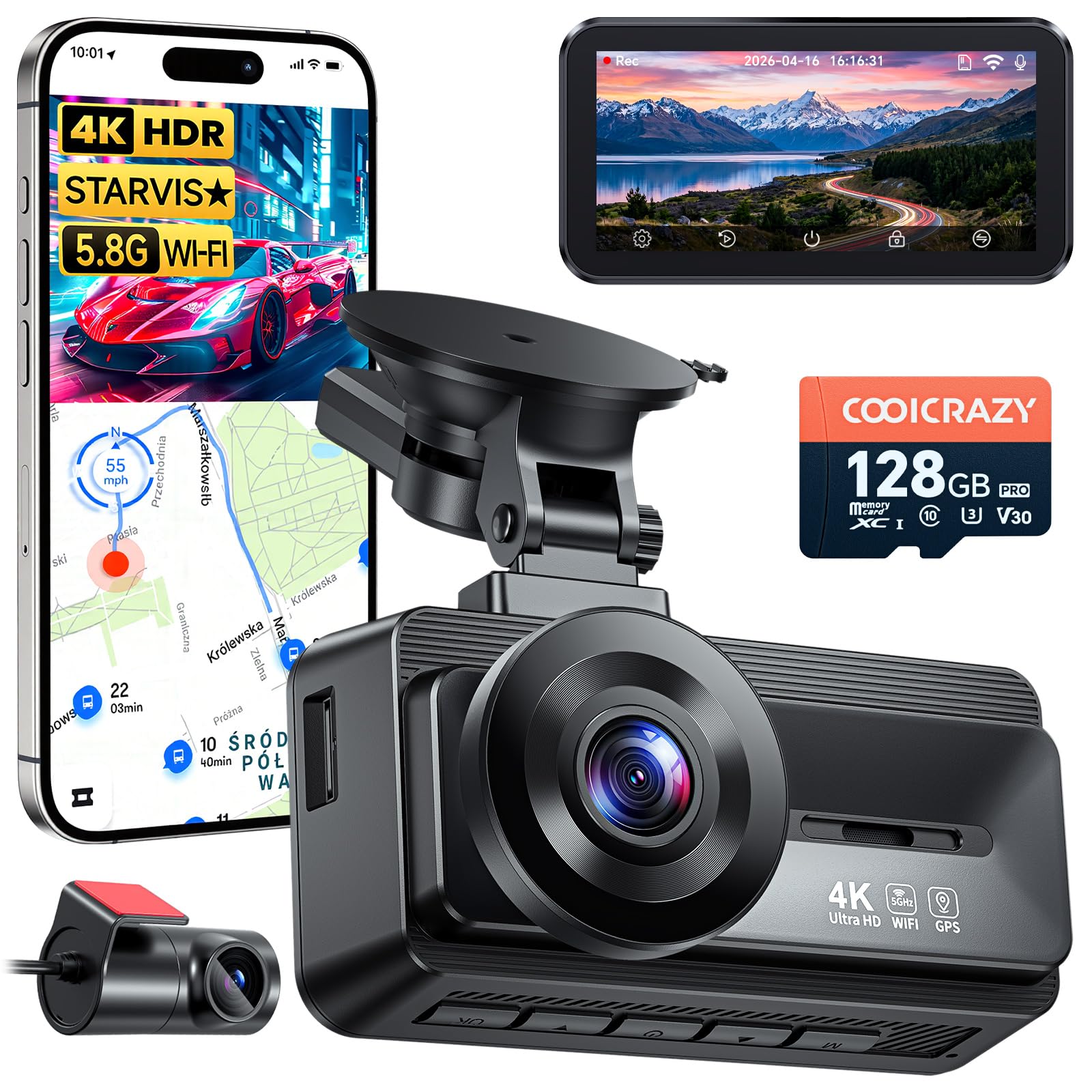
The Coolcrazy N8 is the most aggressive value proposition in its tier. It includes a 128GB memory card right in the box, a rarity at this price point, and features a Sony STARVIS sensor in the front camera — the same sensor found in units costing twice as much. The front records smooth 4K at 60fps, while the rear captures 1080P, both with WDR for handling high-contrast scenes like sun glare or tunnel exits.
The 170-degree front and 150-degree rear ultra-wide-angle lenses cover a massive field of view. The 5GHz Wi-Fi supports fast app downloads, and the built-in GPS logs speed and route data. The G-sensor locks footage on impact, and loop recording ensures you never run out of space. The parking mode watches for motion and collision when hardwired, though this requires a separate kit.
Installation is straightforward with electrostatic stickers and a long 20-foot rear cable. A few users reported that the rear adhesive can fail in extreme heat, and the app connection can be finicky at first. The unit also prompts you to reformat the card at every startup, which is a minor annoyance. For the price, the STARVIS sensor and included 128GB card make it an incredible entry point into 4K dual-channel recording.
Why it’s great
- STARVIS sensor delivers excellent low-light performance
- 128GB card included — no extra purchase needed
- Very competitive price for a 4K system
Good to know
- Rear adhesive can fail in extreme heat
- Reformat prompt at every startup can be annoying
7. 70mai A410
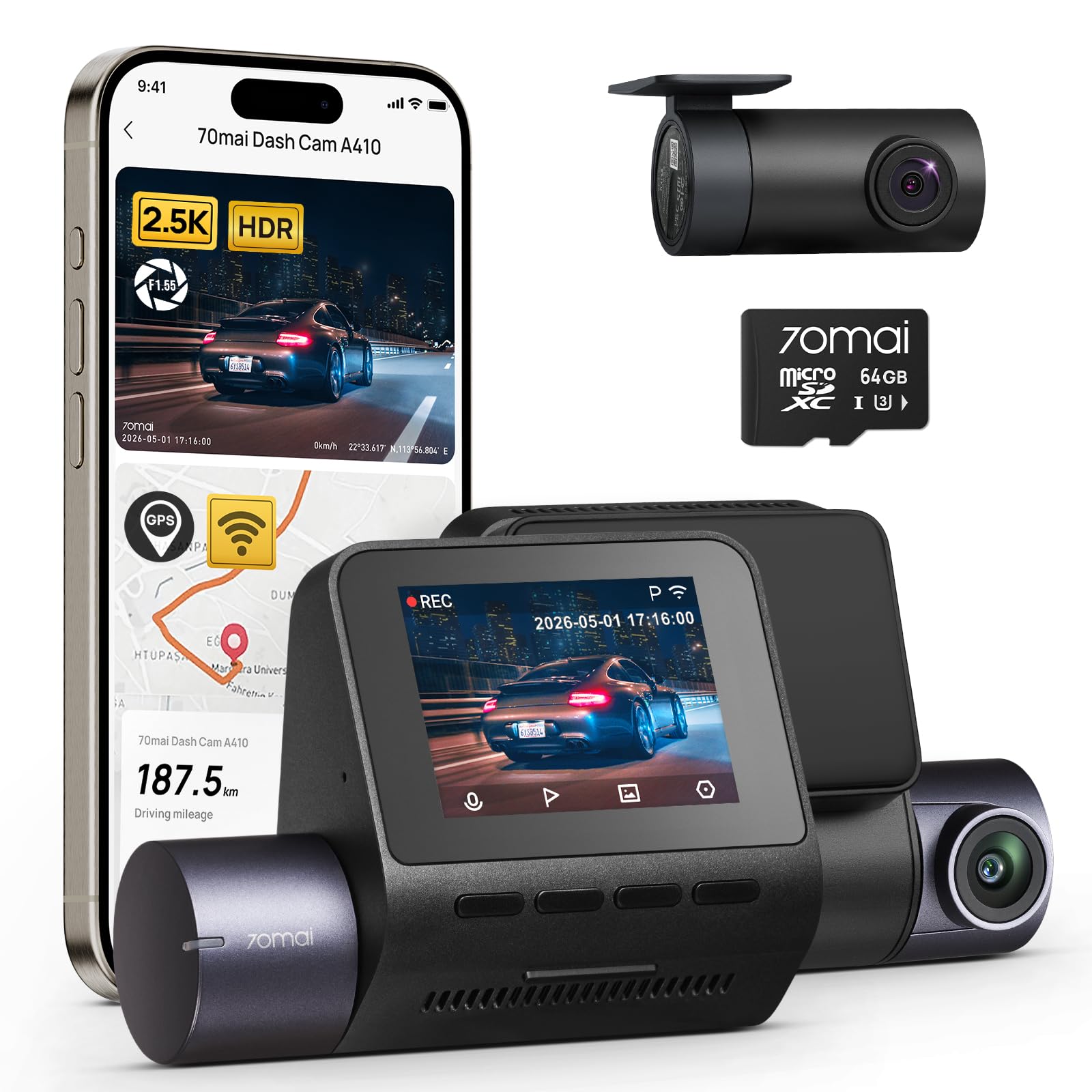
The 70mai A410 prioritizes discreet size and simplicity. Its front camera body is remarkably compact, fitting behind the rearview mirror with minimal visual intrusion, while still delivering 2.5K (2560x1440P) video. The rear camera captures 1080P, and the 125-degree wide-angle lens is narrower than most competitors but still covers four lanes — enough for most urban driving.
What sets the A410 apart is its F1.55 aperture — the widest in this lineup. Combined with HDR and enhanced night vision, it pulls remarkable detail from near-darkness, making plates readable in unlit parking lots and backroads. The electrostatic sticker mounting system is clever: it holds firmly without sticky residue or suction cup failures, which is great for leased cars or people who move the cam between vehicles.
Built-in GPS embeds coordinates, speed, and timestamps onto footage. The app connects via Wi-Fi for live viewing and downloads, and the unit includes a 64GB card. Parking mode is available with a separate hardwire kit. Some users note the UI is not the most intuitive, and distant plates at night can be hard to read. The battery in the unit lasts about 1.5 to 2 years and is user-replaceable. This is a solid, no-frills option for those who want a small camera with exceptional night vision.
Why it’s great
- F1.55 aperture provides best-in-class low-light capture
- Compact, discreet design hides behind mirror
- Electrostatic sticker mount is clean and residue-free
Good to know
- User interface could be more intuitive
- Battery is replaceable but only lasts ~2 years
FAQ
Do I need a hardwire kit for parking mode?
Is a 4K front camera worth the extra cost?
How much storage do I really need for a dual dash cam?
Final Thoughts: The Verdict
For most users, the best dash cams front and rear winner is the DDPAI N5 Dual because its built-in eMMC storage and radar parking mode solve the two biggest pain points: card corruption and false parking alerts. If you demand equal resolution on both cameras, grab the Vantrue E2. And for rideshare drivers needing interior cabin coverage, nothing beats the 3-channel Nanoby M1.

Mo Maruf
I created WellFizz to bridge the gap between vague wellness advice and actionable solutions. My mission is simple: to decode the research and give you practical tools you can actually use.
Beyond the data, I am a passionate traveler. I believe that stepping away from the screen to explore new environments is essential for mental clarity and physical vitality.