Our readers keep the lights on and my smoothie glass nicely filled. As an Amazon Associate, I earn from qualifying purchases.
Drilling into hardened steel, stainless plate, or cast iron demands a cutting tool that won’t glaze over after the first few holes. Standard high-speed steel bits burn up fast under the friction, leaving you with a smoking blank and a ruined workpiece. That’s why the alloy composition and tip geometry of your bit determine whether you walk away with a clean hole or a snapped shank.
I’m Mohammad Maruf — the founder and writer behind WellFizz. I’ve spent hundreds of hours cross-referencing Rockwell hardness figures, cutting-angle tests, and real-world torque data to separate the bits that actually bite from those that just spin.
Making the right choice means knowing which cobalt percentage, coating, and flute design will handle your specific metal. This guide ranks the best drill bits for hard metal based on material science and proven field performance rather than marketing claims.
How To Choose The Best Drill Bits For Hard Metal
Hard metal drilling is a battle of heat and abrasion. The bit must resist softening at the cutting edge while ejecting hot chips fast enough to prevent work-hardening the hole wall. Here are the critical selection criteria.
Cobalt Content and Rockwell Hardness
M35 cobalt steel contains about 5 percent cobalt, which raises the alloy’s red hardness — its ability to stay sharp at cherry-red temperatures. Look for bits rated at least 67 HRC on the Rockwell C scale. Higher cobalt percentages (M42, around 8 percent) push hardness toward 70 HRC but become more brittle, so M35 offers the best balance for most shop work.
Point Geometry and Split Point
A 135-degree split point is non-negotiable for hard metal. It creates a chisel edge that bites into the surface rather than skating across it. Standard 118-degree points walk excessively on hardened steel, requiring a center punch for every hole. The split-point design also reduces thrust pressure, letting the bit self-feed.
Coating and Surface Treatment
Bare HSS bits lack lubricity. Titanium Aluminum Nitride (TiAlN) coatings handle sustained high heat, while black oxide retains cutting oil and resists corrosion. For intermittent drilling in stainless, a TiAlN or nitride-hardened surface significantly extends tool life between sharpenings.
Quick Comparison
On smaller screens, swipe sideways to see the full table.
| Model | Category | Best For | Key Spec | Amazon |
|---|---|---|---|---|
| Pro Edge M35 Cobalt TiAlN | Premium | High-temperature stainless | 70 HRC / TiAlN coated | Amazon |
| STROTON M35 Cobalt 17pc | Mid-Range | General hard-metal drilling | 68 HRC / 3x ground edge | Amazon |
| WildBossy M35 Cobalt 20pc | Mid-Range | Snapped tap/stud removal | 67 HRC / 135° split point | Amazon |
| CaRoller HSS Black & Gold 29pc | Mid-Range | Multi-material versatility | 135° split / black oxide | Amazon |
| Jerax M2 Step Bit | Budget | Thin stainless / sheet metal | M2 HSS / nitride hardened | Amazon |
In‑Depth Reviews
1. Pro Edge M35 Cobalt TiAlN 20pc
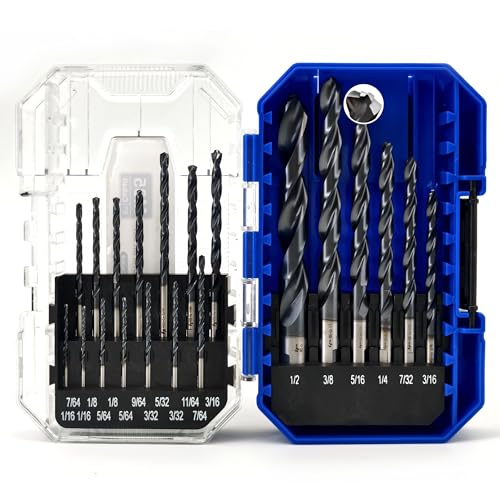
This set pushes the hardness ceiling to 70 HRC by pairing M35 cobalt substrate with an industrial-grade Titanium Aluminum Nitride coating. The TiAlN layer maintains its lubricity at higher cutting temperatures than standard TiN, making it the strongest choice for sustained runs in stainless steel without frequent pecking to cool the bit.
The bullet-point tip geometry improves centering on curved or uneven surfaces, reducing the likelihood of breakout when drilling through hardened metal. Each of the 20 bits includes a 3-flat shank that prevents slip in the chuck — a detail that matters when torque loads spike during deep cuts.
Real-world users report these bits chewing through galvanized steel and 6mm stainless roll pins where cheaper sets crumbled. The coating does add cost, but the per-hole value improves dramatically because the edge stays sharp three to five times longer than uncoated M35 bits.
Why it’s great
- TiAlN coating resists heat buildup on prolonged cuts
- Bullet-point tip reduces walking on slick surfaces
- 3-flat shank ensures zero chuck slip under heavy torque
Good to know
- Set lacks the very smallest sizes below 1/16 inch
- Harder material means increased brittleness if abused at high RPM
2. STROTON M35 Cobalt 17pc

STROTON uses a triple-ground cutting edge on its 5 percent cobalt steel bits, reaching a claimed 68 HRC. The three-stage grind produces a sharper edge geometry that slices chips rather than grinding them, which reduces heat generation at the contact zone — a critical advantage when drilling through case-hardened steel or cast iron.
The 17-piece assortment skips duplication of the ultra-small sizes in favor of offering a single bit for each common diameter from 1/16 up to 1/2 inch, with extras given only for the most frequently replaced sizes. This lean approach keeps the kit compact while still covering every standard jobber length a metalworker needs.
Long-term users note the bits stay sharp through repeated holes in 1/4-inch steel plate, with one 76-year-old woodworker calling them the best set he has owned. The hard plastic case features tight individual clamps that prevent bits from rattling against each other during transport.
Why it’s great
- Triple-ground edge produces cleaner chip formation and less heat
- Compact case with secure bit clamps prevents edge damage
- Warranty replacement service for defective bits
Good to know
- Smaller diameter bits under 3/16 inch can snap under high side load
- No coating layer for additional thermal protection
3. WildBossy M35 Cobalt 20pc

WildBossy’s 20-piece set uses M35 cobalt steel with a titanium surface treatment and a precise 135-degree split point. The titanium layer adds a modest lubricity boost over bare steel, helping the bit resist galling in softer hard metals like aluminum alloys and thin stainless sheet.
The set includes duplicate bits for the six most common sizes (1/16, 5/64, 3/32, 1/8, 1/4), which is practical for shops that burn through small diameters quickly when drilling pilot holes in hardened metal. The plastic storage case keeps everything organized but is basic in construction compared to premium clamshell designs.
Users report success drilling out snapped taps and studs in turbo housings, a task that demands both edge toughness and chip clearance. Some units arrive with one or two bits that cut slightly dull, but the overall value for the range of sizes is competitive for light to medium hard-metal drilling.
Why it’s great
- Duplicate bits for the most-used sizes reduce downtime
- 135-degree split point prevents walking on smooth surfaces
- Titanium surface aids chip flow in softer hard metals
Good to know
- Inconsistent edge sharpness reported on a small number of bits
- Not suitable for glass, ceramic, or hardened tool steel
4. CaRoller HSS Black & Gold 29pc

CaRoller takes a different approach by offering 29 individual sizes from 1/16 to 1/2 inch with a black oxide finish over W4 high-speed steel. The black oxide layer not only resists corrosion but also holds cutting oil at the cutting edge, reducing friction during deep drilling cycles in mild and stainless steel.
The 135-degree split point is paired with a round straight shank that fits standard 3-jaw chucks without modification. While the W4 HSS substrate lacks the cobalt content of M35 bits, the amber coating and black oxide treatment improve thermal performance enough to handle occasional stainless work at reduced feed rates.
A professional reviewer drilled 30 holes in a steel I-beam with a single bit, noting that the cutting edge remained intact through the run with only slight chipping. For the price, this set provides the widest size range, making it a practical choice for shops that need fractional increments for threading operations.
Why it’s great
- 29-piece set covers nearly every fractional size between 1/16 and 1/2 inch
- Black oxide retains oil for reduced friction in deep holes
- 135-degree split point centers reliably on curved surfaces
Good to know
- W4 HSS base metal dulls faster than M35 on hardened steel
- Requires cutting oil and slow RPM for stainless to avoid glazing
5. Jerax M2 Step Bit 1-3/8 Inch

This single step bit covers five hole sizes — 7/8, 1-1/8, 1-7/32, 1-1/4, and 1-3/8 inches — eliminating the need to swap between multiple twist bits when enlarging starter holes in electrical panels, junction boxes, or thin stainless sheet. The nitride surface hardening on M2 HSS provides a harder outer shell that resists wear from abrasive metal chips.
The polished step edges with engraved size markings allow you to see the target diameter without stopping mid-cut, which speeds up repetitive hole production. The double-fluted straight groove design evacuates chips efficiently, though it works best on material up to 12-gauge (2.7 mm) thickness for stainless steel.
Electricians report the step bit cuts through stainless sink flanges in under a minute where standard bits failed entirely. For thicker plate, the M2 substrate will dull faster than cobalt alternatives, but for thin-gauge hard metal work, the nitride-hardened edge delivers excellent value.
Why it’s great
- Five hole sizes in a single tool reduces bit changes
- Nitride hardening adds surface durability against chip abrasion
- Engraved step markings allow visual size confirmation during cut
Good to know
- Limited to stainless thickness of 12-gauge or less
- M2 HSS base metal lacks the red hardness of M35 cobalt
FAQ
Can I use a step bit on 1/4-inch stainless steel plate?
Does TiAlN coating really help when drilling hardened steel?
Why do my drill bits keep snapping when drilling hard metal?
Final Thoughts: The Verdict
For most users, the best drill bits for hard metal winner is the Pro Edge M35 Cobalt TiAlN 20pc because its 70 HRC hardness and industrial coating handle sustained high-heat cuts in stainless and hardened steel without glazing. If you want a broader size range and prefer triple-ground sharpness for clean chip formation, grab the STROTON M35 Cobalt 17pc. And for multi-material versatility with 29 incremental sizes, nothing beats the CaRoller HSS Black & Gold 29pc.

Mo Maruf
I created WellFizz to bridge the gap between vague wellness advice and actionable solutions. My mission is simple: to decode the research and give you practical tools you can actually use.
Beyond the data, I am a passionate traveler. I believe that stepping away from the screen to explore new environments is essential for mental clarity and physical vitality.