Our readers keep the lights on and my smoothie glass nicely filled. As an Amazon Associate, I earn from qualifying purchases.
Mixing two clear liquids, brushing them onto paper, laying down a fern frond, and watching the sun turn everything but its shadow a deep, permanent Prussian blue feels less like a craft and more like a slow-developing photograph from another century. That’s the magic locked inside a cyanotype kit — a historic photographic process that requires no darkroom, no expensive lenses, and nothing more than water, sunlight, and your own curiosity.
I’m Mohammad Maruf — the founder and writer behind WellFizz. I’ve spent weeks researching the chemical components, paper weights, brush quality, and exposure behavior of the most popular cyanotype kits on the market to help you pick the set that actually delivers the rich, archival blues you’re after, without the trial-and-error frustration.
Whether you are printing botanical specimens onto handcrafted bookmarks or teaching a classroom of kids the basics of photogrammetry, this guide breaks down everything you need to find the right cyanotype kit for your creative goal and your budget.
How To Choose The Best Cyanotype Kit
A cyanotype kit looks simple on the surface — chemicals, paper, brush — but the quality of your final print depends heavily on a few key decisions you make before you ever step into the sun. The right choice balances your surface material, the type of sensitizer, and the scale of your projects.
Two-Part Liquid vs. Pre-Sensitized Sheets
Liquid sensitizer kits (Part A + Part B) give you total freedom. You can coat watercolor paper, raw cotton, silk, linen, canvas, or even wood. The trade-off is that you need to mix only what you’ll use within a few hours, and you must brush evenly in dim light. Pre-sensitized sheets, on the other hand, are already coated. You pull one out, place your objects, and expose — but you’re locked into one fabric or paper type and size. For experimental or textile-heavy work, liquid kits win. For quick classroom demonstrations or perfectly even coats every time, pre-treated sheets are the better call.
Paper Weight and Absorbency
The paper included in budget kits is often thin (around 120–150 gsm), which buckles when wet and produces muddy highlights. Better kits include A5 or larger watercolor paper (200–300 gsm) or cotton rag that holds the sensitizer on the surface rather than soaking it through. Heavier paper means sharper edges on your shadows and a more professional final print that doesn’t crinkle during the rinse step.
Volume and Longevity
If you plan on making more than a dozen prints, the total solution volume matters enormously. Some entry-level kits ship tiny bottles that produce only five or six full-size prints. Mid-range and premium kits label the millilitres clearly — look for 50 ml of each component (Part A and Part B) as a baseline for a weekend of experimentation. Larger volumes drop the cost per print significantly.
Quick Comparison
On smaller screens, swipe sideways to see the full table.
| Model | Category | Best For | Key Spec | Amazon |
|---|---|---|---|---|
| Jacquard Cyanotype Kit | Liquid Sensitizer | Professional Artists & Textiles | 65+ prints per two-part bottle | Amazon |
| Csyidio Cyanotype Kit | Liquid Sensitizer | High-Volume Classrooms & Beginners | 40 sheets A5 paper + 10 bookmarks | Amazon |
| Jacquard Pre-Sensitized Sheets | Pre-Treated Fabric | Instant Fabric & Quilt Projects | Cotton sateen 11 x 8.5 in (10 sheets) | Amazon |
| LARICEO Cyanotype Kit | Liquid Sensitizer | Versatile Surfaces & Gift-Giving | Works on fabric, wood & paper | Amazon |
| Toysmith Solar Print Kit | Pre-Treated Paper | Kids & Casual Outdoor Crafting | 36 sheets solar paper + stencils | Amazon |
In‑Depth Reviews
1. Jacquard Cyanotype Kit

Jacquard’s two-part sensitizer set is the reference standard in the cyanotype world, and this kit bundles it with a dedicated sponge brush designed for even, streak-free application. The Part A (ferric ammonium citrate) and Part B (potassium ferricyanide) bottles each hold enough liquid to produce well over sixty prints on standard A4 paper — a figure that blows past most entry-level competitors by a factor of ten.
What separates this from simpler sets is the depth of the Prussian blue it produces. Experienced users report that mixing only what you need for a session and using mixed-media paper (200 gsm or above) yields rich, archival tones with visible tonal separation in the highlights. The brush itself is wide and soft, making it easier to coat large surfaces without lap lines. A dark, dim environment is recommended during the coating and drying phase to prevent premature exposure.
The instructions are clear but assume some familiarity with the process. Beginners should expect a short learning curve around the mixing ratio and drying time, but the forgiveness of the chemistry means even imperfect first prints look compelling. For serious artists, photographers, and anyone who wants a single kit that lasts for months, this is the smartest investment.
Why it’s great
- Highest print yield per dollar in the category
- Produces professional-grade, deep blue tones with good highlight separation
- Works on any natural surface — paper, cotton, linen, silk, wood, leather
Good to know
- The included sponge brush is functional but may shed slightly on first use
- Requires a very dark space for coating and drying to avoid fogging
- Mixing only usable amount per session is recommended to avoid waste
2. Csyidio Cyanotype Kit
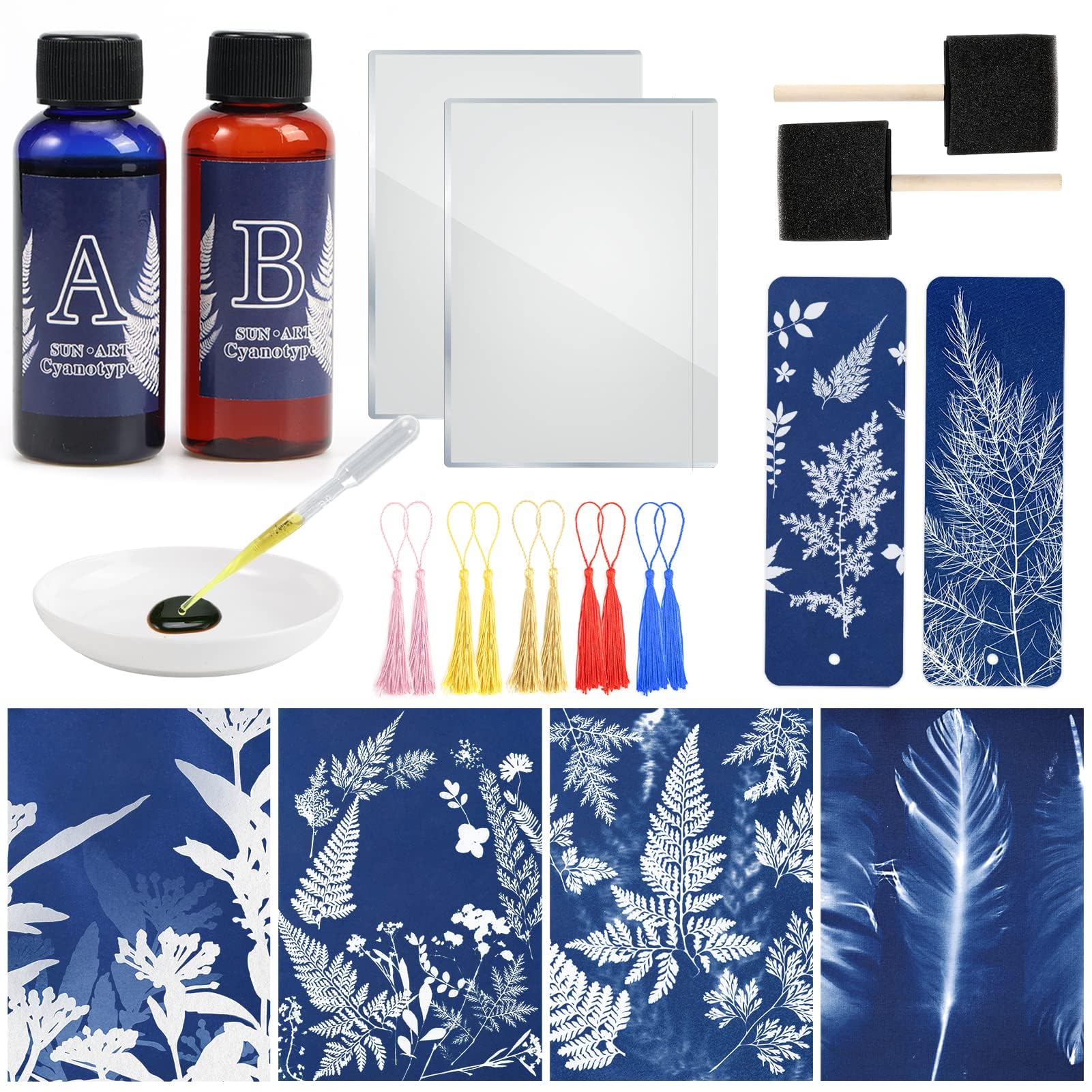
This kit is the volume king for beginners and classroom settings. It ships with 40 sheets of A5 paper (about 5.8 x 8.2 inches), 10 pre-cut bookmark blanks with tassels, a plastic tray, two droppers, a brush, and a protective folder — essentially everything except sunlight. The 50 ml of pre-mixed sensitizer solution is enough to coat all included paper and bookmarks comfortably.
The paper is a watercolor-grade stock that handles the wet chemistry without excessive buckling, a notable improvement over the ultra-thin papers found in budget solar-print sets. The resulting prints show good shadow density and reasonable highlight retention, though the blue tone is slightly cooler and less saturated than what Jacquard’s chemistry produces. The bookmarks are a thoughtful addition for gift-making or classroom take-home projects.
Where this kit falls slightly short is in the instruction detail. Several users noted that the included directions skip finer points like optimal drying time before exposure and the benefit of a hydrogen peroxide bath for contrast. That said, for a group activity or a first-time exploration where you want lots of material to experiment with, the per-print cost is the lowest of any liquid kit here.
Why it’s great
- Huge number of prints per kit — 40 sheets plus 10 bookmarks
- Includes tray, droppers, and brush for immediate use
- Watercolor-grade paper resists buckling better than budget alternatives
Good to know
- Sensitizer is pre-mixed, so you cannot adjust the Part A/Part B ratio for tonal effects
- Instructions are light on technical detail for advanced techniques
- Bookmark paper is thinner than the A5 sheets
3. Jacquard Cyanotype Fabric Sheets (10-Pack)
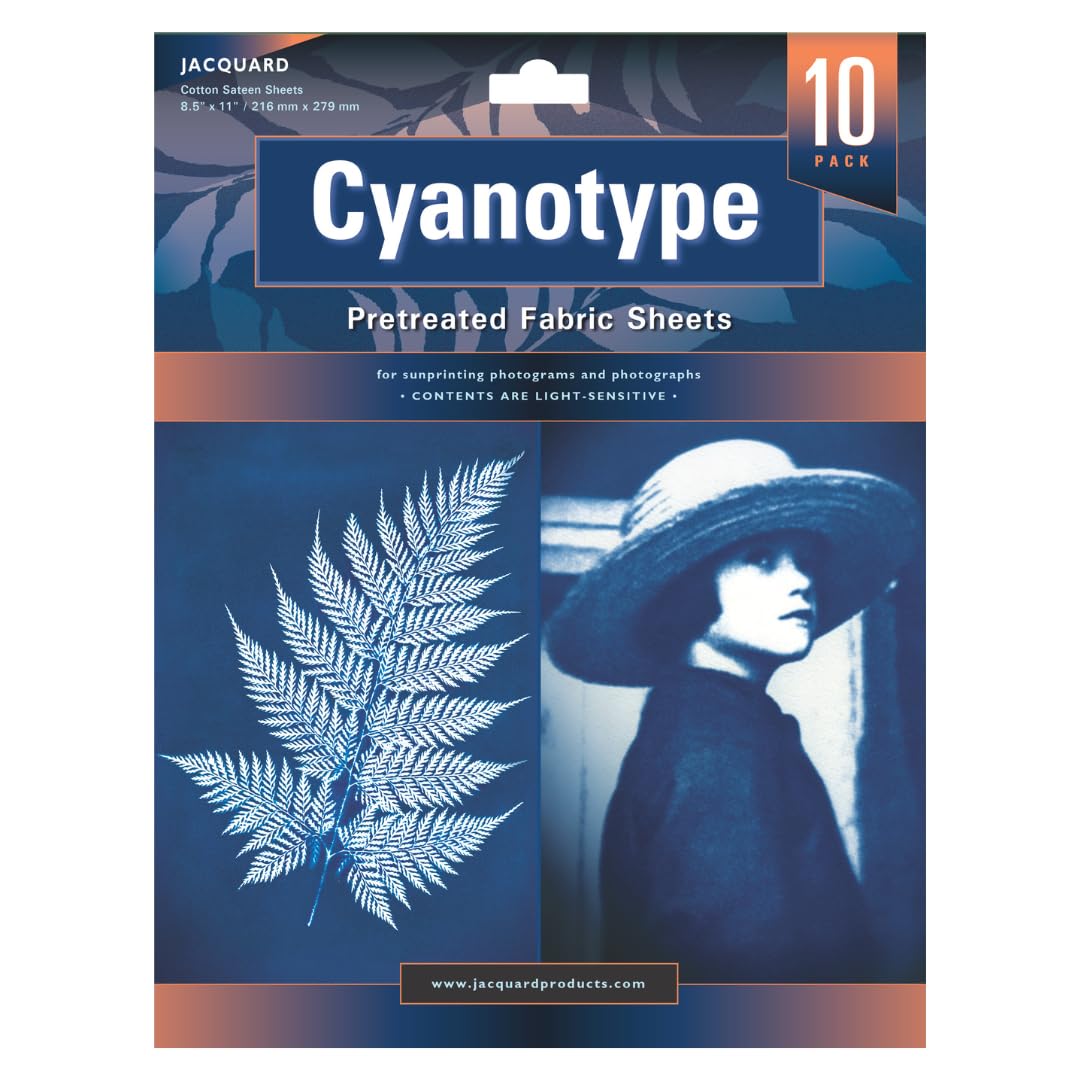
If the idea of mixing chemicals and brushing sensitizer onto fabric sounds like too much friction, this pack of 10 pre-sensitized cotton sateen sheets eliminates that entire step. Each sheet is pre-coated with a consistent layer of cyanotype emulsion. You pull one out, arrange your objects, expose to UV light for 10–20 minutes, and rinse with cold water to reveal the print.
The chemical application across these sheets is noticeably even — no water spots, no thin patches, no edge fading. The cotton sateen fabric is sturdy yet supple enough to hand-sew into quilts, tote bags, or decorative panels after printing. Users who have worked with both homemade sensitizer and these sheets report that the pre-treated fabric requires significantly shorter exposure times, sometimes as little as one minute in direct summer sun versus 8–15 minutes with hand-coated materials.
The limitation is straightforward: you are locked into 11 x 8.5 inch rectangles of cotton sateen. If your creative vision calls for printing on raw silk, thick watercolor paper, or found objects, this set won’t adapt. But for consistent, repeatable results on fabric without any setup mess, these sheets are the most reliable option on the market.
Why it’s great
- Zero mixing — ready to use straight from the package
- Extremely fast exposure times in sunlight (often under 5 minutes)
- Even chemical coating with no streaks or water spots
Good to know
- Expensive per-sheet compared to liquid kits
- Cotton sateen only — cannot print on wood, paper, or other fabrics
- Exposed sheets fade if left in bright indoor light for weeks
4. LARICEO Cyanotype Kit
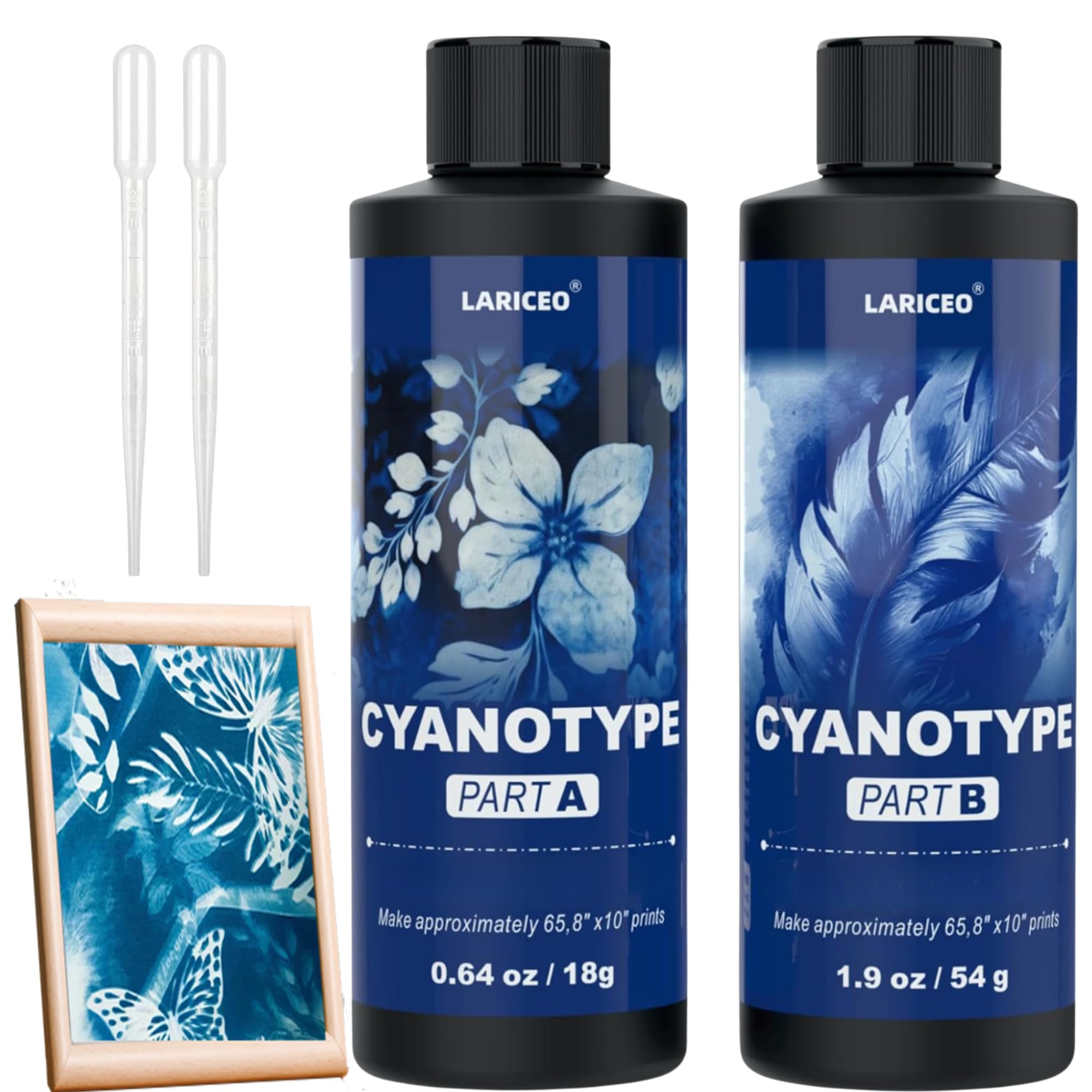
LARICEO’s kit markets itself as a multi-surface cyanotype set, and the chemistry delivers on that promise. The two-part sensitizer can be applied to fabric, paper, wood, and even lightly sanded canvas. The included instructional sheet is one of the clearest in this roundup, explicitly recommending distilled water for mixing, a 15–20 minute exposure window (adjusting for your local UV index), and a cold-water rinse followed by a diluted hydrogen peroxide bath to push the blue to its maximum brilliance.
In testing, the kit’s chemical composition produced stable, fade-resistant prints that held up under normal indoor lighting conditions. The bottle sizes are on the smaller side — several users noted the bottles look tiny — but once diluted with distilled water according to the instructions, you get enough working solution for approximately 10–12 standard prints on 8 x 10 inch paper. This makes it a solid entry point for one or two dedicated afternoons of printing.
Where this kit excels is in its beginner-friendliness. The clear ratio instructions and exposure guidelines reduce the frustration that commonly derails first-timers. If you want to try cyanotype on different surfaces without committing to the larger bottle sizes of a professional kit, this is the most approachable liquid option available.
Why it’s great
- Explicit, beginner-friendly instructions with exposure time guidelines
- Formulated for multiple surfaces — fabric, paper, wood, and canvas
- Final prints show good fade resistance in normal indoor light
Good to know
- Small dry chemical bottles — yields only 10–12 standard prints per kit
- Requires distilled water for optimal results
- Best results require hydrogen peroxide bath step not mentioned in all kits
5. Toysmith Outdoor Discovery Solar Print Kit
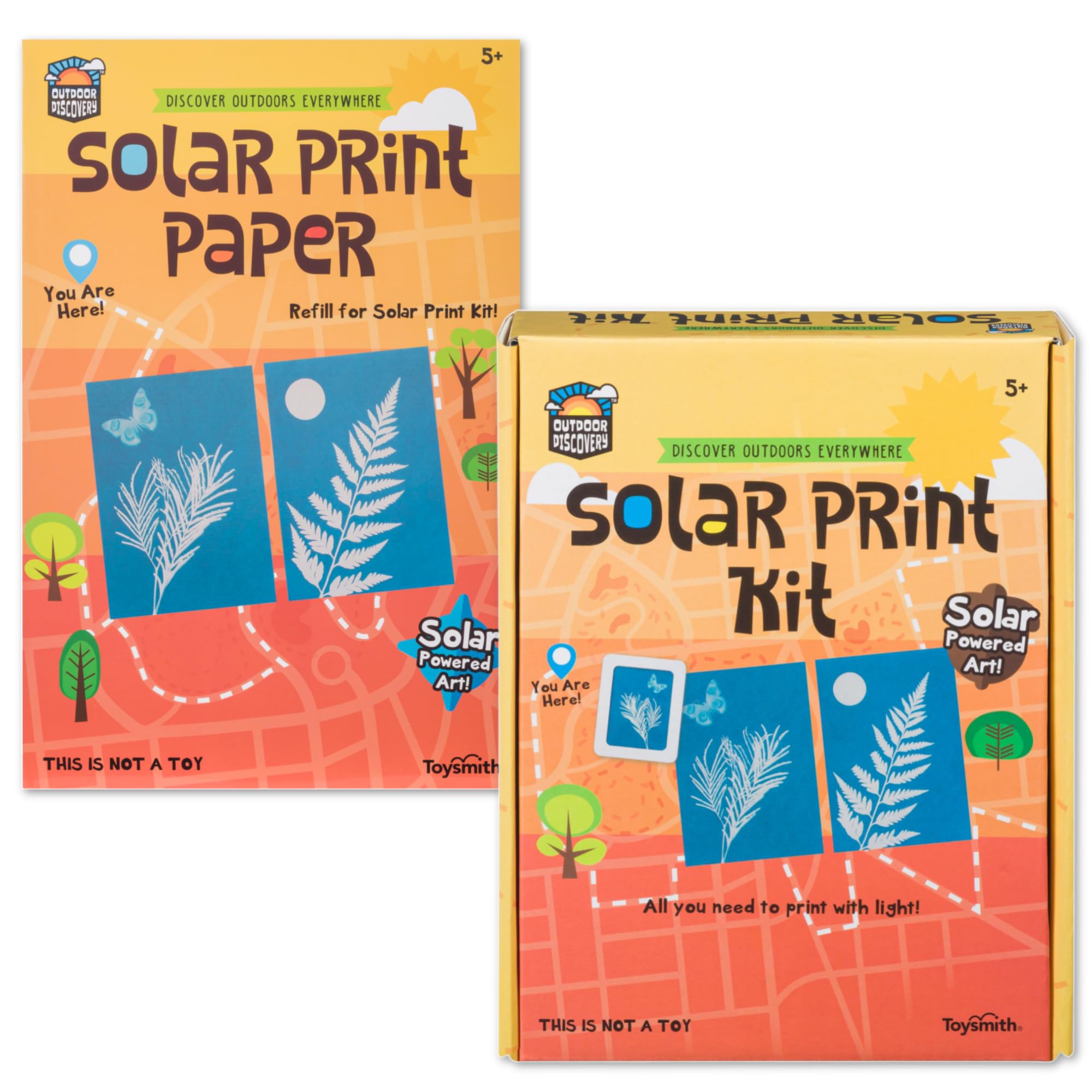
Toysmith takes a completely different approach — this is not a traditional cyanotype chemistry kit but a pre-treated solar paper system designed for quick, mess-free results, especially with children. The kit includes 36 sheets of light-sensitive paper, a set of stencils, and multiple frames to hold your objects in place during exposure. The process is simple: lay objects on the paper, expose to sunlight until the paper turns nearly white, rinse in water, and watch the image appear.
The paper is engineered for speed — exposures take as little as 2–5 minutes in strong sunlight, which keeps young attention spans engaged. The resulting prints have a softer, more pastel blue tone compared to the deep Prussian blue of a liquid chemistry kit, but the trade-off in saturation is offset by the near-zero barrier to entry. No mixing, no measuring, no waiting for coated surfaces to dry in the dark.
This is not the kit for archival work or fine art. The paper is thin, relatively low contrast, and the image stability is not as robust as a properly fixed cyanotype print. But for camping trips, birthday party activities, or a science project demonstrating UV light, it offers the highest fun-per-minute ratio in this comparison. The included stencils help first-timers produce recognizable shapes immediately.
Why it’s great
- Fastest setup and exposure — ideal for kids and outdoor group activities
- 36 sheets provide plenty of material for experimentation
- Stencils and frames help beginners create recognizable prints instantly
Good to know
- Blue tone is softer and less saturated than traditional cyanotype chemistry
- Paper is thin and prone to curling during rinse and dry
- Not suitable for fabric, wood, or other porous surfaces
FAQ
Can I use a cyanotype kit on fabric that I plan to wash?
Do I need a UV lamp, or can I rely on natural sunlight?
Why do my cyanotype prints look washed out or pale blue?
Final Thoughts: The Verdict
For most users, the cyanotype kit winner is the Jacquard Cyanotype Kit because it offers the highest print yield per bottle, professional-grade tonal depth, and the flexibility to coat any natural surface. If you want zero mixing and instant results on fabric, grab the Jacquard Pre-Sensitized Fabric Sheets. And for a low-cost, high-fun introduction for kids or casual outdoor crafting, nothing beats the Toysmith Solar Print Kit.

Mo Maruf
I created WellFizz to bridge the gap between vague wellness advice and actionable solutions. My mission is simple: to decode the research and give you practical tools you can actually use.
Beyond the data, I am a passionate traveler. I believe that stepping away from the screen to explore new environments is essential for mental clarity and physical vitality.