Our readers keep the lights on and my smoothie glass nicely filled. As an Amazon Associate, I earn from qualifying purchases.
Your smartphone’s internal audio circuitry was designed for convenience, not critical listening. The output is often noisy, underpowered, and incapable of driving high-impedance headphones or revealing the micro-details in lossless files. A dedicated mobile digital-to-analog converter bypasses that compromised hardware entirely, replacing it with clean amplification and precision decoding.
I’m Mohammad Maruf — the founder and writer behind WellFizz. I’ve spent countless hours analyzing DAC chip architectures, comparing measured SINAD figures, and cross-referencing real-world headphone compatibility to compile this guide.
After sorting through dozens of portable dongles and digging into the technical specs that actually matter for on-the-go listening, here is a definitive breakdown of the best dac for mobile phone setups available right now.
How To Choose The Best DAC For Mobile Phone
A mobile DAC is a small but critical purchase — the wrong one leaves you with battery drain, compatibility headaches, or a sound quality that barely beats your phone’s headphone jack. Focus on these four factors to cut through the noise.
DAC Chip Architecture
The heart of any dongle is its decoding chip. Cirrus Logic chips (CS43131, CS43198) tend to deliver a neutral, detailed sound with excellent measured SINAD, while ESS Sabre chips (ES9038Q2M, ES9281AC) often emphasize crisper highs and a more dynamic presentation. Burr-Brown chips (used by iFi) offer a warmer, more analogue texture. Your choice here dictates the tonal foundation of everything you hear.
Output Power and Headphone Compatibility
Measured in milliwatts (mW), output power determines which headphones your DAC can drive without distortion. For sensitive in-ear monitors, 30mW is plenty. For full-size over-ear headphones like the Sennheiser HD 600 (300 ohms), you need at least 100mW on a balanced output. Look for models that list power at both 32 ohms and 300 ohms — that tells you how the DAC handles low-impedance IEMs versus high-impedance cans.
Balanced vs. Single-Ended Output
A 4.4mm balanced connection delivers roughly double the voltage swing compared to a standard 3.5mm single-ended jack. This means more headroom, lower crosstalk, and significantly better channel separation. If you own headphones with a balanced cable, a DAC with a 4.4mm output is a major upgrade. Many premium dongles now include both outputs for maximum versatility.
Power Management and Phone Battery Drain
Some mobile DACs draw power continuously from your phone, even when idle, which can drain the battery noticeably during a workday. Others, like the FiiO KA15, feature intelligent power monitoring that adjusts consumption based on playback status. Battery-powered models like the iFi Hip-dac 3 isolate the drain entirely from your phone — ideal for long listening sessions where you can’t afford a dead phone.
Quick Comparison
On smaller screens, swipe sideways to see the full table.
| Model | Category | Best For | Key Spec | Amazon |
|---|---|---|---|---|
| FiiO KA15 | Premium Dongle | Power users who want PEQ + a screen | 560mW balanced, dual CS43198 | Amazon |
| iFi Hip-dac 3 | Battery-Powered | High-impedance headphones, long sessions | Battery-powered, Burr-Brown DAC | Amazon |
| Questyle M12i | MFi Certified | iPhone users, ultra-low noise floors | PCM 768kHz/DSD512, ESS ES9281AC | Amazon |
| Fosi Audio DS1 | ESS Flagship | High-res streaming, dual outputs | ES9038Q2M, 220mW, 4.4mm/3.5mm | Amazon |
| Fosi Audio DS2 | Dual-Chip | Balanced IEMs, clean soundstage | Dual CS43131, 170mW balanced | Amazon |
| Moondrop Dawn Pro 2 | App-Tunable | EQ tweakers, balanced connection fans | Dual CS43198, 124mW, app PEQ | Amazon |
| FiiO KA11 | Entry-Level | Budget first-timers, IEMs | CS43131, 245mW, tiny form | Amazon |
In‑Depth Reviews
1. FiiO KA15

The FiiO KA15 is the most feature-packed mobile DAC dongle at this level, combining a 0.96-inch IPS color screen with a retro tape-deck UI that makes navigating settings genuinely enjoyable. Under the hood, dual CS43198 DAC chips paired with dual SGM8262 op-amps deliver a balanced output of 560mW — enough headroom to drive demanding headphones like the Sennheiser HD 660S2 or Hifiman Edition XS with authority. The patented Desktop Mode unlocks the full power potential, a 207% increase over the previous KA5 generation.
The real differentiator here is the high-precision 10-band lossless PEQ, adjustable via the FiiO Control app or a web interface. You can simulate headphone frequency curves or correct tonal imbalances with surgical accuracy. The 3.5mm jack also functions as a SPDIF coaxial output, and the detachable USB cable adds versatility. A few users report that the track skip buttons can be unresponsive at times, and the volume integration can occasionally feel clunky with USB Audio Player Pro.
On the battery management front, the KA15 uses real-time voltage and current monitoring to dynamically adjust power draw, plus an ultra-low-power sleep mode when music stops. This makes it one of the most phone-battery-friendly dongles on the market. For the combination of output power, EQ depth, and daily usability, the KA15 is the most complete mobile DAC package for serious listeners.
Why it’s great
- Industry-leading 560mW balanced output drives full-size headphones easily
- 10-band lossless PEQ with app support for precise tuning
- IPS screen with intuitive UI and retro design appeal
- Intelligent power monitoring reduces phone battery drain
Good to know
- Track skip/pause buttons can be unresponsive at times
- Volume integration can act oddly with certain music player apps
- Some units may not power up on first attempt
2. iFi Hip-dac 3

The iFi Hip-dac 3 takes a fundamentally different approach — it’s a battery-powered DAC/amp that isolates power draw entirely from your phone. This means zero battery drain on your mobile device during listening sessions, and it also eliminates any electrical noise contamination from the phone’s USB bus. The revised Burr-Brown True Native DAC handles PCM up to 384kHz, DSD256, and full MQA decoding, delivering a warm, analogue-style sound signature that pairs beautifully with Sennheiser HD 600 and similar high-impedance headphones.
Both 4.4mm balanced and 3.5mm S-Balanced outputs are included, along with PowerMatch gain adjustment to match headphone sensitivity and iEMatch for ultra-sensitive in-ear monitors that would otherwise hiss. The XBass button provides a physical bass boost that’s surprisingly musical and well-tuned. The stealth black aluminum enclosure feels rugged and pocketable, and the included Lightning-to-USB-C cable saves iPhone users from buying an extra accessory. Battery life runs around 8 hours at high volume, and the unit charges via a separate USB-C input for audio data and charging.
Where the Hip-dac 3 truly shines is in its ability to drive demanding headphones without straining. Users report that it pairs seamlessly with Sony MDR-MV1 studio monitors and delivers a noticeable improvement over standard USB dongles. The downsides are its larger pocket footprint compared to a thin dongle, and the fact that you need to remember to charge it. For anyone who prioritizes absolute isolation from phone power and a rich, musical sound signature, this is the premium choice.
Why it’s great
- Battery-powered design eliminates phone battery drain
- Warm, analogue Burr-Brown sound signature
- PowerMatch and iEMatch for headphone/IEM optimization
- Includes Lightning-to-USB-C cable for iPhone users
Good to know
- Larger footprint than a standard dongle — not as pocket-minimal
- Requires separate charging; ~8 hour battery life
- No Bluetooth functionality — wired only
3. Questyle M12i

The Questyle M12i stands out for its MFi certification, meaning it’s been officially validated by Apple for seamless integration with iPhone and iPad. The “i” in the name signals this compatibility, and it works without any driver hassle. The ESS ES9281AC flagship DAC chip decodes PCM up to 768kHz/32bit and DSD512, with Questyle’s patented Current Mode amplifier technology driving the noise floor below -130dB. This makes it one of the quietest dongles available — ideal for high-sensitivity IEMs that reveal background hiss from lesser units.
Users consistently describe the M12i as punching above its price tier, with a sound quality that equals or approaches much more expensive models like the DC Elite. The presentation is clean, detailed, and slightly warm, with excellent micro-detail retrieval. The 3.5mm output works with microphones on compatible headphones, which is a rarity among portable DACs. The aluminum build is compact and lightweight, making it an easy daily carry.
The main drawbacks are occasional fade-in effects where the first ~2 seconds of a track may be missing on playback or skip, and some units have shown QA issues with the 3.5mm jack soldering over extended use. Battery drain on the phone is also more noticeable than with power-managed alternatives. For iPhone users who want an MFi-guaranteed dongle with a black background and detailed presentation, the M12i is a top-tier pick.
Why it’s great
- MFi certified for hassle-free iPhone/iPad compatibility
- Ultra-low -130dB noise floor — dead silent with sensitive IEMs
- Current Mode amplifier tech delivers exceptional detail and separation
- Compact, premium aluminum build
Good to know
- Fade-in effect can miss first ~2 seconds on track start/skip
- Some units have shown 3.5mm jack soldering QA issues
- Noticeable phone battery drain during use
4. Fosi Audio DS1

The Fosi Audio DS1 leverages the ESS ES9038Q2M DAC chip — a flagship Sabre reference design — to deliver a crisp, dynamic sound profile with forward mids and fast bass transients. It supports DSD512 and PCM up to 32-bit/768kHz through both a 3.5mm single-ended output and a 4.4mm balanced output, each rated at 220mW. This power output comfortably drives headphones above 200 ohms, including budget planar magnetic models, with plenty of headroom.
The aluminum housing feels substantial for its size, and the volume rocker provides local control independent of your phone — a feature that’s increasingly rare at this price point. The included USB-A to USB-C converter adds desktop versatility. Measured THD+N is below 0.0006% with an SNR above 120dB, keeping the noise floor extremely low. Users report that the sound is crystal clear with no distortion, and the dual output jacks make it easy to swap between IEMs and full-size headphones.
Where the DS1 falls short is compatibility — several users have reported issues with Google Pixel 8 and other recent Android phones, where static noise or intermittent dropouts occur. It also runs warm during extended use, and the volume control lacks any visual indicator, so you’re adjusting blind. For those with compatible phones who want ESS Sabre sound in a compact dual-output dongle, the DS1 delivers excellent value.
Why it’s great
- Flagship ES9038Q2M DAC delivers crisp, forward sound
- Both 3.5mm and 4.4mm outputs for maximum flexibility
- 220mW output drives high-impedance headphones with ease
- Volume rocker provides local control independent of phone
Good to know
- Compatibility issues reported with Google Pixel 8 and similar phones
- Runs warm during extended use
- Volume control has no visual feedback — you tune by ear
5. Fosi Audio DS2

The Fosi Audio DS2 is built around two Cirrus Logic CS43131 DAC chips in a dual configuration, delivering a cleaner signal path and lower distortion than single-chip solutions. It outputs 170mW per channel on the 4.4mm balanced jack, with a noise floor of just 1μV and THD+N of 0.0001%. The measured 130dB SNR and 109dB SINAD place this dongle in the territory of desktop-class performance in a pocketable aluminum chassis.
Independent 60-step volume buttons let you adjust level separately from your phone’s coarse volume control, and the volume memory function means your last setting is restored automatically. Users report that the DS2 pairs exceptionally well with IEMs from brands like Ziigaat, Moondrop, and 7Hz, adding depth, timbre, and soundstage without any distortion. It also works as an external sound card for PS5, Mac Studio, and Windows laptops — users describe it as a “Swiss Army knife” for audio.
The included USB-C cable is notoriously flimsy and may need replacing. The DS2 also draws noticeable power from the phone — roughly 16% per 2 hours on an iPhone — so it’s not ideal for all-day battery conservation. For the combination of dual-chip transparency, excellent measured specs, and versatile connectivity, the DS2 is one of the strongest mid-range values available.
Why it’s great
- Dual CS43131 chips provide extremely clean, low-distortion sound
- 130dB SNR and 109dB SINAD — desktop-grade measurements
- Independent 60-step volume control with memory
- Works across PS5, Mac, Windows, and Android/iOS
Good to know
- Included USB-C cable is poor quality; budget for a replacement
- Significant phone battery drain (~16% per 2 hours on iPhone)
- Volume steps can feel coarse compared to smooth analogue pots
6. Moondrop Dawn Pro 2
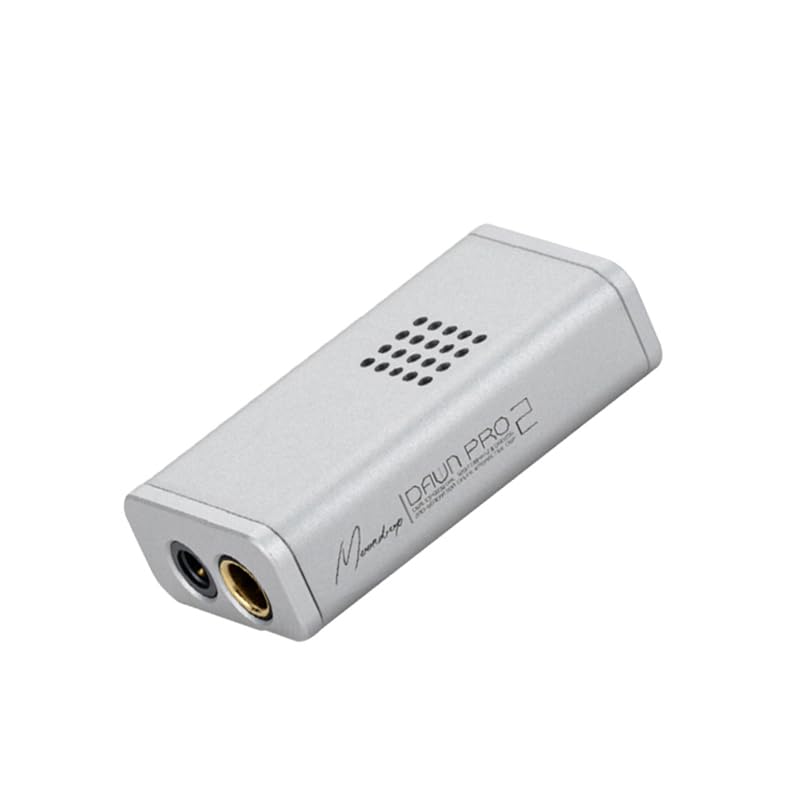
The Moondrop Dawn Pro 2 brings app-based parametric EQ to the mobile dongle space with an interface that lets you adjust filter type, frequency point, gain, and Q value with professional precision. The companion Moondrop App includes a comprehensive headphone frequency response database for reference, making it easy to correct tonal imbalances or apply community-shared tunings. The dual CS43198 flagship DAC chips are paired with three independent LDO power regulators, ensuring clean power delivery to the decoding and digital sections.
The output is rated at 124mW per channel on both 3.5mm and 4.4mm jacks, with a 4Vrms output voltage that provides clean headroom for most IEMs and some full-size headphones. Users report that the Dawn Pro 2 offers a flat frequency response with a subtle bass boost, and the 100-level smooth DAC volume control prevents signal compression during level adjustment. The aviation-grade aluminum alloy housing uses desktop-inspired venting above the hottest chips for better heat dissipation.
The most significant quirk is that programmed EQ settings reset to factory defaults whenever the dongle is unplugged — which means you’ll be re-applying your curve every time you reconnect. Some units also have a slightly finicky 4.4mm jack where the cable must be seated precisely to avoid channel imbalance. For listeners who value precise EQ control and community tunings, the Dawn Pro 2 offers a genuinely unique feature set.
Why it’s great
- Full parametric EQ tuning via Moondrop App with community database
- Dual CS43198 chips with independent LDO power regulation
- 100-level lossless DAC volume control prevents compression
- Aluminum alloy housing with heatsink venting design
Good to know
- EQ settings reset to factory when unplugged — requires re-application
- 4.4mm jack can be finicky with cable seating
- Some units have shown QA issues with connector alignment
7. FiiO KA11

The FiiO KA11 is the entry-level champion in this lineup, delivering 245mW of power from a single CS43131 DAC chip in a body that measures just 44 x 9.7 x 10.5mm and weighs 8.5 grams. That power output is enough to drive demanding IEMs and even some full-size headphones like the Hifiman Edition XS at half volume, which is remarkable for a dongle in this price tier. The THD+N of less than 0.0006% and SNR of 125dB keep the noise floor inaudible with sensitive monitors.
UAC 1.0 support means you can plug this directly into a Nintendo Switch or PS5 for low-latency gaming audio, and the USB-C connector works across Android, iOS (with an adapter), Windows, and macOS. Users consistently highlight the neutral, uncolored sound signature — the KA11 simply reproduces the file without adding any tonal flavor, which is exactly what purists want from a transparent DAC. The build is matte black plastic with a clean, minimalist look.
Reliability is the primary concern here. Multiple reports indicate that the internal wire connections can detach after 2-3 months of normal use, causing one channel to fail or the unit to stop working entirely. The bright blue LED on the front cannot be turned off, which is distracting for nighttime listening. And despite the impressive power specs, the KA11 does drain phone battery even when idle. For the price, it’s an incredible introduction to mobile DACs — just be aware that it may not be a long-term investment.
Why it’s great
- Outstanding 245mW output for its tiny size and price point
- Neutral, uncolored sound signature — true transparent DAC
- UAC 1.0 support for Switch and PS5 gaming
- Extremely lightweight and portable at 8.5g
Good to know
- Durability concerns — internal wires may detach after 2-3 months
- Blue LED is always on and cannot be disabled
- Phone battery drains even when device is idle
FAQ
Will a mobile DAC drain my phone battery significantly?
Can I use a mobile DAC with a Lightning iPhone?
What’s the difference between 3.5mm and 4.4mm output?
Do I need a DAC if my phone still has a headphone jack?
What is PEQ and why does it matter for mobile DACs?
Final Thoughts: The Verdict
For most users, the best dac for mobile phone winner is the FiiO KA15 because it combines the highest balanced output power in its class with a 10-band lossless PEQ, an intuitive color screen, and intelligent power management that preserves phone battery. If you want a battery-powered solution that isolates your phone from any power drain, grab the iFi Hip-dac 3. And for the most budget-friendly entry point into mobile HiFi, nothing beats the tiny but mighty FiiO KA11.

Mo Maruf
I created WellFizz to bridge the gap between vague wellness advice and actionable solutions. My mission is simple: to decode the research and give you practical tools you can actually use.
Beyond the data, I am a passionate traveler. I believe that stepping away from the screen to explore new environments is essential for mental clarity and physical vitality.