Our readers keep the lights on and my smoothie glass nicely filled. As an Amazon Associate, I earn from qualifying purchases.
Nothing ruins a tiling project faster than a blade that chips the glaze, wanders off the line, or burns out halfway through a row of porcelain. The right diamond blade for tile is the difference between a professional-grade finish and a pile of cracked scrap—yet the wrong choice is surprisingly easy to make when every product claims to cut everything from glass to granite.
I’m Mohammad Maruf — the founder and writer behind WellFizz. After sifting through hundreds of real user reports and cross-referencing bond hardness, rim design, and arbor compatibility, I’ve zeroed in on the five blades that actually deliver on their promises.
Whether you’re a weekend DIYer or a seasoned tradesman, finding the best diamond blade for tile comes down to matching the blade’s rim profile and bond matrix to the specific material you’re cutting.
How To Choose The Best Diamond Blade For Tile
Tile blades look similar at a glance—same round shape, same diamond edge. The critical difference lives in the rim design, the bond hardness, and the arbor hole size. Ignore these three specs and you risk chipped edges, burned motors, or a blade that simply doesn’t fit your saw.
Rim Design: Continuous vs. Segmented vs. Turbo
Continuous rim blades feature a smooth, unbroken edge that produces the cleanest cuts with minimal chipping—ideal for ceramic, porcelain, and glass tile. Segmented rims have gaps that aid cooling and debris removal but leave a rougher edge, making them better suited for stone or brick. Turbo rims add a serrated profile to the continuous edge, offering a compromise between speed and finish quality.
Diamond Bond Hardness
A soft bond releases worn diamond particles quickly, exposing fresh grit for aggressive cutting—good for hard materials like porcelain. A hard bond retains diamonds longer, which works well on softer materials like marble but can glaze over and stop cutting if used on hard tile. Match the bond to the tile’s hardness, or you’ll end up with a shiny but useless blade.
Arbor Size and Compatibility
Most tile saws and angle grinders accept either 5/8-inch or 7/8-inch arbors, and some blades ship with reducer rings to accommodate both. Check your tool’s arbor before ordering—forcing an undersized blade risks vibration, wobble, and dangerous instability at high RPM.
Quick Comparison
On smaller screens, swipe sideways to see the full table.
| Model | Category | Best For | Key Spec | Amazon |
|---|---|---|---|---|
| DEWALT DW4765 | Premium | Porcelain & marble on wet saws | High diamond concentration matrix | Amazon |
| QEP 6-7006GLQ | Specialty | Glass mosaic tile | 7mm continuous hi-rim, 8730 RPM max | Amazon |
| TOOLEAGUE 10-Pack | Value | Porcelain pavers & ceramic | 1.2mm super-thin kerf | Amazon |
| DEWALT DW4738 | Mid-Range | General tile on wet/dry saws | Continuous rim, 4-3/8 inch diameter | Amazon |
| LOZLIN 3-Pack | Entry-Level | Multi-material cuts with grinder | 0.05-inch cutting thickness | Amazon |
In‑Depth Reviews
1. DEWALT Diamond Blade for Porcelain Tile 4-1/2-Inch (DW4765)

The DEWALT DW4765 leads the pack because its high diamond concentration matrix delivers a noticeably faster cut rate than standard blades without sacrificing longevity. Users consistently report straight, chip-free cuts through 12-inch marble tiles and dense porcelain when used with a wet saw, and the blade’s steel core is tensioned to resist wobble at high operating temperatures—a common failure point in cheaper discs.
Arbor flexibility is a standout feature here: the blade ships with a brass reducer ring that converts the native 7/8-inch arbor to 5/8-inch, making it compatible with the widest range of tile saws and angle grinders. Real-world tests show minimal chipping on glazed ceramic when cutting at moderate feed rates, though some users note that an angle grinder’s high speed can still produce minor edge flakes on very brittle tiles.
For anyone cutting porcelain or marble regularly, this blade’s combination of diamond quality, core stability, and arbor adaptability makes it the single most reliable choice on this list. It does cost more than multi-packs, but the extended life and cut quality justify the premium.
Why it’s great
- Faster cut rate through hard porcelain due to optimized diamond exposure
- Included brass arbor reducer fits both 5/8″ and 7/8″ saws
- Core tensioning reduces vibration and blade wander
Good to know
- May cause slight chipping on delicate ceramic when used dry with an angle grinder
- Higher upfront investment compared to multi-blade value packs
2. QEP 6-7006GLQ 7-Inch Continuous Rim Glass Tile Diamond Blade

The QEP 6-7006GLQ is purpose-built for the trickiest tile material: glass. Its 7mm continuous hi-rim design keeps the edge in constant contact with the material, eliminating the shock-load that causes glass to fracture. Users have cut through 1-inch glass mosaic sheets, wine bottles, and even beer bottles with clean, smooth edges that require only light sanding afterward.
This blade is rated for wet cutting only, and the 7-inch diameter with a 5/8-inch arbor fits most standard wet tile saws. The extra rim height—7mm instead of the typical 5mm—provides more diamond depth, extending usable life when cutting abrasive glass. One trade-off is that the cut edge isn’t polished to a factory shine; you’ll need a separate polishing step if a glossy finish is required.
If your project involves glass tile, mirror, or delicate stone, the QEP specialized rim geometry prevents the thermal stress that causes cracks. It is not a general-purpose blade, but within its narrow lane it outperforms every universal blade.
Why it’s great
- Continuous rim produces chip-free edges on fragile glass tile
- 7mm rim height offers extended cutting life
- Cuts cleanly through bottles and mosaic sheets, not just flat tile
Good to know
- Wet cutting only—cannot be used dry on an angle grinder
- Edges require separate polishing for a glossy glass finish
3. TOOLEAGUE Diamond Saw Blade 4-1/2 Inch Super Thin 10-Pack

The TOOLEAGUE 10-pack delivers exceptional value for anyone who cuts porcelain pavers, ceramic tile, or stone regularly. Each blade uses a super-thin 1.2mm kerf that reduces motor strain and material waste, and the X-gear rim design accelerates cutting speed while maintaining a chip-free finish. Real-world users have reported dozens of cuts through 3/4-inch outdoor porcelain pavers with no perceptible wear.
This pack covers you for years of typical DIY use, and each blade fits both 7/8-inch and 5/8-inch arbors via reducer rings. The blades are rated for wet and dry use, though the cutting quality improves noticeably with water. Some users noted that the thin kerf can flex under heavy side-loading, so maintaining a straight feed is important.
For the price per blade, the TOOLEAGUE set is the smartest buy for high-volume or multi-project tiling. You sacrifice some of the DEWALT’s premium diamond concentration, but the sheer number of discs means you’re never stuck with a dull blade mid-job.
Why it’s great
- Super-thin 1.2mm kerf reduces material waste and motor load
- 10 blades provide exceptional run-life for the cost
- X-gear rim delivers smooth, chip-free cuts on porcelain and ceramic
Good to know
- Thin kerf can flex if side pressure is applied during cutting
- Dry cuts produce more dust and slightly rougher edges than wet cuts
4. DEWALT 4-3/8-Inch Tile Blade, Wet/Dry (DW4738)

The DEWALT DW4738 is the smallest blade in this lineup at 4-3/8 inches, but its continuous rim design and extended diamond matrix make it surprisingly capable for tight cuts on tile saws and circular saws alike. Users have successfully cut concrete fiber board, slate, and standard ceramic tile with it, noting that the blade runs cool enough to avoid warping even without constant water flow.
The smaller diameter means a shallower depth of cut—ideal for notch cuts and thin tile rather than thick stone pavers. Arbor compatibility is strong: the blade comes with a thin bushing that adapts the 20mm arbor down to 3/4-inch, fitting compact tile saws like the Workforce THD250. Some users noted that the blade works fine dry for short bursts, but wet cutting extends life and improves chip control.
If you’re working with a smaller saw or need a dedicated blade for detail cuts on ceramic and thin porcelain, the DW4738’s compact form and DEWALT’s diamond matrix provide a long-lasting, precise option.
Why it’s great
- Compact 4-3/8-inch diameter fits smaller tile saws perfectly
- Continuous rim design produces chip-free cuts on ceramic
- Extended diamond matrix lasts longer than standard compact blades
Good to know
- Smaller size limits depth of cut for thick materials
- Requires bushing adapter for some non-DEWALT saw arbors
5. LOZLIN Diamond Blades 3-Pack 4.5-Inch Multi-Purpose
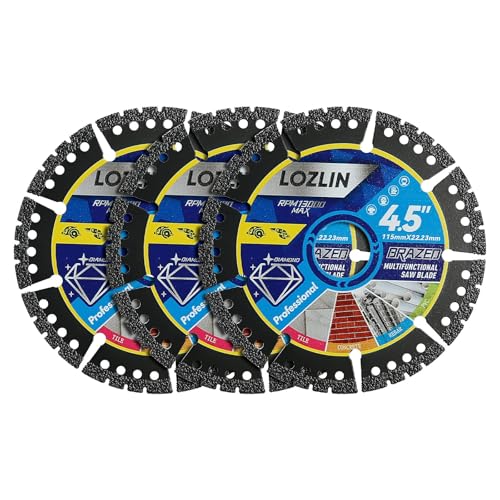
The LOZLIN 3-pack offers the lowest cost per blade in this group, making it an attractive option for DIYers who need a disposable disc for mixed-material jobs. Each 4.5-inch blade with a 0.87-inch arbor fits standard angle grinders, and the diamond-coated edge cuts through marble, quartz, stone, tile, metal, and plastic without swapping blades.
Users describe the cutting action as smooth and fast, with one reviewer noting it “slices like butter” through concrete fiber board siding. The 0.05-inch thickness keeps the kerf narrow, and cooling holes help prevent the blade from overheating during extended use. However, the multi-material versatility comes at the cost of specialized performance—dedicated tile blades typically produce cleaner edges on porcelain and glass.
For a general-purpose starter set or rough-cutting tasks where finish quality is secondary, the LOZLIN 3-pack delivers impressive performance at a budget-friendly entry point. It is not the blade for precision tile work, but it excels as a utility disc for demolition and mixed-material projects.
Why it’s great
- Cuts through tile, metal, plastic, and stone without changing blades
- Three-blade pack provides good value for multi-material jobs
- Cooling holes reduce heat buildup during extended use
Good to know
- General-purpose design produces less refined edge on tile than dedicated blades
- Not recommended for porcelain or glass where chip-free finish is critical
FAQ
Can I use a diamond tile blade dry on an angle grinder?
What does continuous rim mean on a tile blade?
Final Thoughts: The Verdict
For most users, the best diamond blade for tile winner is the DEWALT DW4765 because its high diamond concentration delivers consistent, chip-free cuts through porcelain and marble while offering arbor flexibility for nearly any saw. If you need a blade specifically for glass tile, grab the QEP 6-7006GLQ for its continuous hi-rim design that prevents fractures. And for high-volume or budget-conscious projects, nothing beats the value of the TOOLEAGUE 10-pack, giving you a super-thin kerf and enough blades to last through multiple renovations.

Mo Maruf
I created WellFizz to bridge the gap between vague wellness advice and actionable solutions. My mission is simple: to decode the research and give you practical tools you can actually use.
Beyond the data, I am a passionate traveler. I believe that stepping away from the screen to explore new environments is essential for mental clarity and physical vitality.