Our readers keep the lights on and my smoothie glass nicely filled. As an Amazon Associate, I earn from qualifying purchases.
A video editor’s timeline is only as good as the display it lives on. A panel that shifts color, clips shadows, or skews gamma forces you to export blind, hoping the final cut looks right on your audience’s screens. The wrong monitor turns every grading session into a gamble, costing hours of rework and undermining the quality of your output.
I’m Mohammad Maruf — the founder and writer behind WellFizz. I’ve spent hundreds of hours analyzing panel technologies, color gamut coverage, factory calibration reports, and real-world reviews to isolate the displays that actually deliver consistent, accurate color for professional video work.
Whether you’re cutting in a DaVinci Resolve suite or color grading in Premiere Pro, the right best display for video editing must combine high resolution, wide color coverage, and reliable out-of-box accuracy to let you trust what you see on screen.
How To Choose The Best Display For Video Editing
Selecting a display for video editing is a search for predictable, repeatable color. Unlike general use monitors, video work demands a panel that holds its calibration across brightness levels and maintains uniform luminance from edge to edge. The decision hinges on a few key specifications that separate a professional tool from a consumer screen.
Color Gamut and Volume: Rec. 709 and DCI-P3
Video editing lives inside two color spaces: Rec. 709 for broadcast and web delivery, and DCI-P3 for cinema and HDR workflows. A display that covers 99–100% of Rec. 709 ensures standard footage looks correct without guesswork. For HDR grading, look for at least 90% DCI-P3 coverage. Avoid monitors that list only sRGB coverage without mentioning Rec. 709 — while sRGB is close, Rec. 709 has a slightly different gamma curve that matters for video.
Delta E (ΔE) and Factory Calibration
Delta E measures the difference between the intended color and what the display actually shows. A ΔE of less than 2 is the industry threshold for professional use — anything higher means you’re seeing color shifts that don’t exist in your source file. Factory calibration reports (included with many pro-grade monitors) verify individual-unit performance out of the box, saving you from manual tweaking.
Panel Technology: IPS vs. OLED for Video
IPS panels remain the workhorse for video editing because they offer wide viewing angles and consistent luminance across the screen. OLED panels deliver deeper blacks and infinite contrast, which is seductive for HDR work, but they can suffer from burn-in with static timeline elements and may require more frequent calibration to maintain accuracy. VA panels fall in between but often exhibit color shift at off-center viewing angles, which is a problem for collaborative grading sessions.
Connectivity: USB-C with Power Delivery
A single USB-C cable that carries video, data, and power to a laptop simplifies an editor’s desk dramatically. Look for at least 65W of power delivery (PD) to charge a MacBook Pro during long sessions. Thunderbolt support adds daisy-chaining capability for multi-monitor setups without extra desktop clutter.
Quick Comparison
On smaller screens, swipe sideways to see the full table.
| Model | Category | Best For | Key Spec | Amazon |
|---|---|---|---|---|
| ASUS ProArt PA279CV | Mid-Range | Entry-level color-critical editing | ΔE < 2, 100% sRGB/Rec.709 | Amazon |
| ASUS ProArt PA279CRV | Mid-Range | Wide gamut HDR editing | 99% DCI-P3, 99% Adobe RGB | Amazon |
| ViewSonic VP3256-4K | Mid-Range | Professional content creation | Pantone Validated, 100% sRGB | Amazon |
| BenQ PD3205U | Mid-Range | Mac-based editing workflows | 99% Rec.709, ΔE ≤ 3 | Amazon |
| BenQ SW272Q | Premium | Photography and print-focused editing | 99% Adobe RGB, 98% DCI-P3 | Amazon |
| Dell U3818DW | Premium | Ultrawide multi-window workflows | 38″ 3840 x 1600, KVM switch | Amazon |
| Dell U4025QW | Premium | High-resolution ultrawide grading | 5K2K 5120 x 2160, 120Hz, IPS Black | Amazon |
| MSI PRO MAX 271UPX | Premium | HDR and OLED video evaluation | QD-OLED, ΔE < 2, 120Hz | Amazon |
| ViewSonic VP3456A | Mid-Range | Curved ultrawide color grading | 34″ 3440 x 1440, ΔE < 2 | Amazon |
| LG 32UN650-W | Budget | Entry-level 4K video editing | DCI-P3 95%, 4K UHD IPS | Amazon |
| Dell U4025QW (Alt) | Premium | High-res productivity editing | 5K2K 5120 x 2160, 120Hz, USB-C | Amazon |
In‑Depth Reviews
1. ASUS ProArt PA279CV

The ASUS ProArt PA279CV hits the sweet spot for video editors who need reliable color without stretching into premium pricing. Its 27-inch 4K IPS panel covers 100% sRGB and 100% Rec. 709 right out of the box, confirmed by a Calman Verified factory calibration report that targets Delta E under 2. That means skin tones and color grades you apply in Premiere Pro or DaVinci Resolve translate faithfully to the screen from day one, without hours of manual profiling.
Connectivity is where the PA279CV punches above its tier. The USB-C port delivers 65W of power delivery, enough to charge a MacBook Pro during a full editing session, while the built-in USB 3.1 hub and HDMI/DisplayPort inputs handle multi-source setups. The fully ergonomic stand — height, tilt, swivel, and pivot — accommodates portrait mode for vertical timelines or script review, a feature often missing on cheaper monitors.
A few trade-offs keep the PA279CV from being a pure HDR workstation. The 350-nit brightness is adequate for SDR grading but lacks the peak luminance for serious HDR evaluation, and the 60Hz refresh rate is fine for video but won’t satisfy editors who also game. For an editor focused on broadcast and web delivery at a fair price, this remains the most balanced choice.
Why it’s great
- Factory-calibrated with ΔE < 2, ready for Rec. 709 work immediately
- USB-C with 65W PD simplifies laptop-powered editing rigs
- Fully adjustable stand with portrait pivot for timeline-heavy workflows
Good to know
- Peak brightness of 350 nits limits HDR grading capability
- 60Hz refresh rate is standard for video but not for gaming
2. ASUS ProArt PA279CRV

The PA279CRV inherits the same 27-inch 4K IPS foundation as its predecessor but expands the color envelope significantly. Where the PA279CV tops out at sRGB/Rec. 709, this model covers 99% of DCI-P3 and 99% of Adobe RGB, making it a better fit for editors who grade in HDR or work with footage from cinema cameras that record in wider gamuts. The factory pre-calibration targets Delta E under 2, and the included report confirms individual unit performance.
This single cable can power a 16-inch MacBook Pro at full speed while carrying video and data, which simplifies a desk setup dramatically. The 5-year warranty (3 years plus 2 with online registration) also signals ASUS’s confidence in the panel’s longevity for daily professional use.
The 60Hz refresh and 400-nit peak brightness remain standard for video work but won’t handle high-end HDR evaluation where 1,000-nit peaks are needed. Some users report a slight red or green cast on gray screens, though this varies by unit and can be corrected with a calibration tool. For editors transitioning into HDR grading, the PA279CRV offers the widest usable gamut at this price tier.
Why it’s great
- 99% DCI-P3 and Adobe RGB coverage for HDR cinema-grade editing
- 96W USB-C PD charges even the largest MacBook Pros during use
- Long 5-year warranty with online registration
Good to know
- Some units need minor tint adjustment in the OSD for neutral grays
- Not bright enough for pro HDR grading above 400 nits
3. ViewSonic VP3256-4K

The VP3256-4K steps up to a 32-inch 4K IPS panel with Pantone Validation and Delta E under 2 accuracy, a combination that directly serves video editors who need to match branded colors or deliver to broadcast specifications. Its 100% sRGB and 100% Rec. 709 coverage ensures standard video content appears as intended, while the 350-nit brightness keeps SDR grades punchy and consistent across the screen.
The USB-C port delivers 65W of power delivery and doubles as a hub with Ethernet and USB-A ports, reducing cable clutter for editors who connect multiple peripherals. The advanced ergonomic stand — tilt, swivel, pivot, and height — provides all-day comfort during long grading sessions, and the thin bezels make it suitable for multi-monitor arrays without distracting borders.
Some Mac users report that the auto-rotation feature for portrait mode does not function with macOS, which is a limitation for editors who like to view vertical video or long scripts. The on-screen display menu is also clunkier than competitors, though ViewSonic’s software control can mitigate this. For editors prioritizing color certification and physical screen real estate, the VP3256-4K justifies its higher price.
Why it’s great
- Pantone Validated and factory-calibrated for reliable color matching
- 32-inch screen provides more room for timelines and scopes
- USB-C hub with 65W PD and Ethernet streamlines the editing desk
Good to know
- Auto-rotation for portrait mode doesn’t work with macOS
- On-screen menu navigation is less intuitive than the competition
4. BenQ PD3205U

The BenQ PD3205U is built specifically for Mac-based editing workflows, with ICC Sync that automatically matches the monitor’s color profile to the connected Mac, eliminating the mismatch that plagues many third-party displays. Its 32-inch 4K IPS panel covers 99% of Rec. 709 and sRGB with an average Delta E of 3, which is slightly looser than the ASUS ProArt line but still within professional tolerance for most video projects.
The included HotKey Puck G2 is a practical addition for video editors — it lets you switch between color modes (Rec. 709, sRGB, DCI-P3) without diving into OSD menus, useful when toggling between editing and client review. The USB-C port delivers 90W of power delivery, more than enough to keep a MacBook Pro charged, and the built-in KVM switch lets you share one keyboard and mouse between two computers.
The built-in speakers are notably weak, with tinny output that won’t replace dedicated monitors for audio editing. Portrait mode also requires a separate stand attachment, which is not included. For editors who want a seamless Mac experience with hardware calibration support and physical control over color modes, the PD3205U delivers on its promise.
Why it’s great
- ICC Sync automatically matches Mac color profiles for consistent grading
- HotKey Puck G2 offers quick access to Rec. 709, sRGB, and DCI-P3 modes
- 90W USB-C PD powers a MacBook Pro at full speed
Good to know
- Built-in speakers are too weak for audio reference
- Stand doesn’t support portrait rotation out of the box
5. BenQ SW272Q

The BenQ SW272Q targets a specific niche: video editors who also shoot and grade stills. Its 27-inch QHD 1440p IPS panel covers 99% Adobe RGB and 98% DCI-P3, giving it one of the widest color envelopes in this roundup. The Nano Matte Panel with TUV anti-reflection certification reduces glare in brightly lit rooms, a practical advantage for production spaces with overhead lighting.
BenQ’s Paper Color Sync technology simulates how an image will look when printed on specific paper types, which is more relevant to photographers than pure video editors. The included shading hood blocks ambient light from the screen, and the wireless remote puck allows quick color space switching between Adobe RGB, sRGB, and DCI-P3 without touching the display. The 16-bit 3D LUT provides smooth gradation for subtle color transitions in graded footage.
The main limitation is resolution: at 1440p, the SW272Q lacks the pixel density of 4K monitors for editing 4K timelines. Editors who need to see every pixel at 1:1 scale will find the 27-inch QHD panel less sharp than a 4K alternative. Price is also steep for a QHD panel. For photo-focused editors who occasionally grade video, the color accuracy justifies the premium.
Why it’s great
- 98% DCI-P3 and 99% Adobe RGB for wide-gamut grading
- Nano Matte Panel with anti-reflection coating reduces studio glare
- Wireless remote puck enables one-touch color space switching
Good to know
- 1440p resolution limits 4K timeline detail at 1:1 zoom
- Premium price for a QHD panel in a 4K-centric market
6. Dell U3818DW

The Dell U3818DW is a different breed — a 38-inch curved ultrawide with 3840 x 1600 resolution that replaces dual monitor setups for editors who need sprawling timeline real estate. The 21:9 aspect ratio lets you preview a wide timeline while keeping scopes and bins open on the same screen, reducing the need to alt-tab between windows. Its IPS panel offers 99% sRGB coverage and decent out-of-box accuracy, though it lacks factory calibration certification.
The built-in KVM switch lets you control two computers with one keyboard and mouse, useful for editors who test exports on a secondary machine. USB-C with 65W power delivery handles video and charging through one cable, and the thin bezels minimize distraction in multi-monitor arrays. The curve (2300R) wraps slightly around your field of view, which reduces eye movement during long timeline scrubbing sessions.
Color accuracy is good but not pro-grade — there’s no factory calibration report, and the panel tops out at standard sRGB coverage without DCI-P3 support for HDR work. The 60Hz refresh and 350-nit brightness are standard. For video editors who prioritize screen space and multitasking efficiency over pinpoint color certification, the U3818DW’s sheer real estate transforms the editing experience.
Why it’s great
- 38-inch ultrawide curvature provides massive timeline and tool space
- KVM switch enables seamless control of two editing computers
- USB-C with 65W PD powers a laptop through a single cable
Good to know
- No DCI-P3 coverage, limiting HDR grading capability
- Lacks factory calibration report for verified out-of-box accuracy
7. Dell U4025QW

The Dell U4025QW is a 40-inch 5K2K ultrawide monitor that brings 5120 x 2160 resolution into the editing suite, offering a staggering level of pixel density for timeline clarity and 4K preview at full resolution. Its IPS Black panel technology improves contrast ratio to 2000:1, delivering deeper blacks than standard IPS panels while maintaining wide viewing angles — a visible upgrade when grading shadow-heavy footage.
The 120Hz refresh rate is unusual for a professional monitor, but it makes timeline scrubbing and UI navigation feel dramatically smoother than 60Hz panels. Dell’s built-in Thunderbolt 4 hub handles 140W power delivery for the largest laptops, and the integrated KVM switch works across multiple computers. The 450-nit peak brightness supports HDR600 certification, providing enough luminance for basic HDR evaluation without the cost of a full reference monitor.
The price tag is substantial, and while the 5K2K resolution is exceptional, macOS scaling can introduce minor performance overhead on older Macs. Some users report plastic build quality that doesn’t match the price, though the adjustable stand is robust. For editors who demand the highest pixel density, an ultrawide canvas, and smooth 120Hz UI performance, the U4025QW is a workstation investment.
Why it’s great
- 5K2K resolution offers massive pixel density for detailed timeline work
- IPS Black technology boosts contrast to 2000:1 for better shadow detail
- 120Hz refresh rate makes UI navigation and scrubbing noticeably smoother
Good to know
- High price point limits accessibility for budget-conscious editors
- macOS scaling at 5K2K may impact performance on older Macs
8. MSI PRO MAX 271UPX
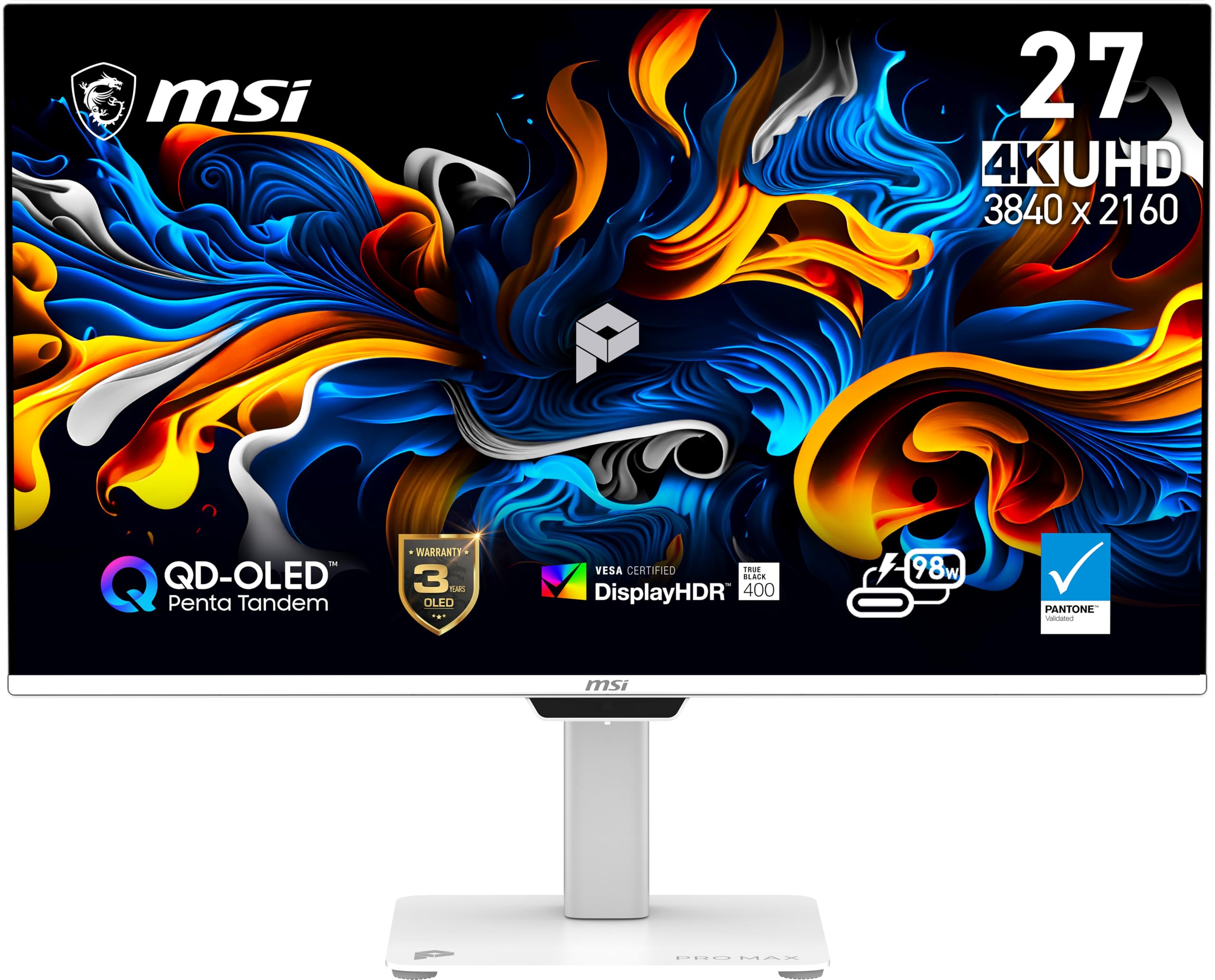
The MSI PRO MAX 271UPX brings QD-OLED technology to the editing desk, delivering the deepest blacks and highest contrast ratio of any panel in this roundup. Its 27-inch 4K UHD resolution with Delta E under 2 accuracy and VESA DisplayHDR True Black 400 certification means HDR content displays with per-pixel luminance that IPS panels can’t match — light sources against dark backgrounds appear with striking realism.
The 120Hz refresh rate, combined with FreeSync Premium Pro, makes the monitor versatile for editors who also produce or review motion graphics. Dual USB-C ports (one with 98W power delivery) support Mac devices with MSI’s Mac Optimization Software for color synchronization, and the built-in speakers are better than average for a monitor, though still not a replacement for dedicated monitors. The stand offers height, tilt, and swivel adjustment.
OLED burn-in is the primary concern for video editing, where static UI elements like timeline windows remain in the same position for hours. While modern QD-OLED panels include pixel shift and refresh cycles, editors planning to use the same monitor for 8+ hours daily should consider their tolerance for this risk. The price is also steep. For HDR grading and motion graphics review, the QD-OLED visual quality is genuinely transformative.
Why it’s great
- QD-OLED delivers true blacks and infinite contrast for HDR grading
- ΔE < 2 and True Black 400 certification for accurate HDR evaluation
- 98W USB-C PD powers the largest MacBooks at full speed
Good to know
- Burn-in risk with static timeline UI elements over long sessions
- Premium price may not suit editors on a tight budget
9. ViewSonic VP3456A

The ViewSonic VP3456A merges an ultrawide 34-inch curved 21:9 format with professional color certification, covering 99% sRGB and Rec. 709 with Delta E under 2 accuracy. Its 3440 x 1440 resolution isn’t as dense as 4K panels, but the 1800R curvature wraps the display around you, reducing eye strain during marathon editing sessions and providing a natural viewing angle across the entire screen.
The 100W USB-C power delivery is the highest in this roundup, charging even the most power-hungry laptops at full speed. The built-in Ethernet port is a thoughtful addition for editors who need a stable wired connection for cloud-based collaborative projects. Pantone Validation ensures that branded color matching — common in commercial video work — stays accurate to the Pantone Matching System reference.
The 1440p resolution means that pixel-peeping 4K footage at 1:1 requires zooming in, and the 400-nit brightness is good for SDR but not HDR reference. Some users report out-of-box color being slightly cool, requiring a quick adjustment in the OSD. For editors who value an immersive curved workspace with reliable color and high power delivery, the VP3456A is a strong mid-range ultrawide choice.
Why it’s great
- 1800R curvature provides immersive viewing for long editing days
- 100W USB-C PD is the highest power delivery in this comparison
- Pantone Validated and ΔE < 2 for reliable color matching
Good to know
- 1440p resolution limits 4K timeline detail at 1:1 zoom
- Out-of-box color may need minor temperature adjustment
10. LG 32UN650-W

The LG 32UN650-W is the entry-level 4K monitor that surprises video editors with better-than-expected color performance for its price point. Its 32-inch IPS panel covers DCI-P3 95% — a wider gamut than many budget monitors — and the 4K UHD resolution provides sufficient pixel density for timeline navigation and 4K preview. The 350-nit brightness and HDR10 compatibility add basic HDR support, though peak brightness limits true HDR impact.
Editors on a budget will appreciate the large 32-inch screen size at 4K resolution, which offers more real estate than typical 27-inch panels without a significant price premium. The 3-side virtually borderless design works well in multi-monitor setups, and the height-adjustable stand (unusual at this price) reduces neck strain during long sessions. The VA panel variant is noted in the specs, but the IPS version delivers the wide viewing angles editors depend on.
The trade-offs are clear: no factory calibration report, no USB-C connectivity (only HDMI and DisplayPort), and a basic stand that lacks swivel and pivot. Color accuracy is good for the price but won’t match factory-calibrated monitors from ASUS or BenQ. For editors starting out who need a large 4K screen with decent gamut coverage, the LG 32UN650-W maximizes screen size per dollar.
Why it’s great
- 32-inch 4K IPS panel at a price that undercuts most competitors
- DCI-P3 95% coverage exceeds typical budget monitor gamut
- Height-adjustable stand for ergonomic comfort without extra cost
Good to know
- No factory calibration report or USB-C connectivity
- Lacks swivel and pivot adjustment for advanced ergonomics
11. Dell UltraSharp U4025QW (Alt Config)

This alternate configuration of the Dell UltraSharp U4025QW shares the same 40-inch 5K2K (5120 x 2160) resolution and 120Hz refresh rate but lists a different brightness specification of 600 nits peak, which improves visibility in brightly lit environments. The IPS Black technology delivers a 2000:1 contrast ratio, and the 21:9 curved panel provides the same ultrawide canvas that allows editors to run a timeline, preview, and scopes side by side.
Connectivity includes Thunderbolt 4, DisplayPort, HDMI, and Ethernet, with USB-C power delivery that charges most laptops at full speed. The KVM switch allows sharing of keyboard and mouse between two computers, a workflow advantage for editors who render on a dedicated machine while editing on another. The 5ms response time is faster than the standard version, improving motion clarity during video playback review.
The price remains the main barrier, and the 600-nit peak brightness, while higher, still doesn’t reach the 1000-nit threshold for full HDR reference monitoring. Some users note that achieving the best image quality requires adjusting sharpness downward from default settings, as the factory preset oversharpens text. For editors who work at 5K resolution and need the largest practical single-screen workspace, this configuration delivers exceptional productivity.
Why it’s great
- 5K2K resolution with 120Hz refresh for ultra-detailed timeline work
- 600-nit peak brightness improves visibility in brighter edit suites
- KVM switch and Thunderbolt 4 simplify multi-computer workflows
Good to know
- High investment cost limits accessibility for small studios
- Factory sharpness setting may need adjustment for clean text display
FAQ
Is a 60Hz monitor acceptable for video editing?
Can I use a standard 4K gaming monitor for color grading?
How often should I calibrate my video editing monitor?
What is the difference between Rec. 709 and sRGB for video?
Final Thoughts: The Verdict
For most editors, the best display for video editing winner is the ASUS ProArt PA279CV because it combines factory-calibrated Rec. 709 accuracy, a fully adjustable stand, and USB-C with 65W PD at a price that doesn’t require a studio budget. If you need wider DCI-P3 coverage for HDR grading, grab the ASUS ProArt PA279CRV. And for an ultrawide workspace that maximizes timeline real estate without sacrificing color certification, nothing beats the ViewSonic VP3256-4K.

Mo Maruf
I created WellFizz to bridge the gap between vague wellness advice and actionable solutions. My mission is simple: to decode the research and give you practical tools you can actually use.
Beyond the data, I am a passionate traveler. I believe that stepping away from the screen to explore new environments is essential for mental clarity and physical vitality.