Our readers keep the lights on and my smoothie glass nicely filled. As an Amazon Associate, I earn from qualifying purchases.
Adding extra USB ports to a desktop PC seems straightforward until you plug in a high-bandwidth device and realize your single internal controller is drowning. A DMA card, specifically a PCIe USB expansion card, bypasses that bottleneck by tapping directly into your motherboard’s high-speed lanes, giving your peripherals the dedicated bandwidth they need. Whether you run multiple cameras, external NVMe enclosures, or VR systems, the right card transforms your machine from port-starved to fully connected.
I’m Mohammad Maruf — the founder and writer behind WellFizz. I’ve spent hundreds of hours analyzing PCIe interface specifications, USB controller chipsets, and real-world bandwidth allocation to find the cards that actually deliver on their advertised throughput.
After comparing Renesas and ASMedia controllers, self-powered designs, and multi-channel architectures, I’ve narrowed the field to five models that solve real connection limits. This guide covers the best dma card choices for expanding your desktop’s USB capabilities without introducing lag or dropouts.
How To Choose The Best DMA Card
Not all PCIe USB cards are built the same. The number of controllers, the PCIe interface width, and the power delivery method all determine whether your devices will run at full speed or stutter under load. Here are the three factors that matter most.
Single Controller vs. Multi-Channel Architecture
A card with a single USB controller splits its total 5Gbps bandwidth across all ports. That works fine for keyboards, mice, and flash drives. But plug in three high-speed cameras or a pair of NVMe enclosures, and that shared pipe chokes. Multi-channel cards, like the FebSmart FS-4C-U8S-Pro, use four independent controllers to give each group of ports its own dedicated 5Gbps lane, delivering up to 20Gbps aggregate throughput.
PCIe Interface Width and Slot Compatibility
PCIe x1 cards fit into any slot, but x4 and x8 cards require a physically larger slot. Check your motherboard layout before buying. A x4 card like the DICHEN FPGA DMA card won’t work in a x1 or x2 slot. Also, confirm whether your case supports full-height or low-profile brackets — many cards now include both in the box to accommodate slim chassis.
Power Delivery Without External Cables
High-consumption devices like USB-powered monitors and external SSDs draw up to 10W per port. Cards with self-powered technology pull enough wattage directly from the PCIe slot, eliminating messy SATA power cables. The FebSmart FS-U7S-Pro delivers 5V/2A per port without any extra connection, while still providing electronic fuses to protect against overcurrent.
Quick Comparison
On smaller screens, swipe sideways to see the full table.
| Model | Category | Best For | Key Spec | Amazon |
|---|---|---|---|---|
| FebSmart FS-4C-U8S-Pro | Multi-Channel | High-bandwidth multi-device rigs | 20Gbps total / 4 dedicated channels | Amazon |
| FebSmart FS-U7S-Pro | Single Controller | Balanced port count & ease of install | 7 ports / 1 Renesas controller / 5Gbps shared | Amazon |
| DICHEN FPGA 75T DMA | Specialty DMA | Direct memory access & development work | PCIe x4 / FPGA / PCILeech compatible | Amazon |
| RIITOP 7-Port USB 3.0 Card | Budget Friendly | Basic peripheral expansion | 7 ports / 2 Renesas chips / 5Gbps shared | Amazon |
| QTHREE GeForce GT 730 | Graphics Card | Multi-monitor office productivity | 4GB DDR3 / 4 outputs / PCIe x8 | Amazon |
In‑Depth Reviews
1. FebSmart FS-4C-U8S-Pro

The FS-4C-U8S-Pro is the only card in this lineup that uses four independent Renesas UPD720201 controllers, each feeding a dedicated 5Gbps channel. That architecture translates to 20Gbps aggregate bandwidth — enough to run multiple NVMe enclosures, VR headsets, or industrial cameras without any single device starving the others. The ASMedia ASM1812 PCIe bridge splits the x4 lane cleanly across all four controllers.
Self-powered technology delivers 5V/3A per channel directly from the slot, so there are no SATA power cables to route. Eight electronic safety fuses and eight voltage-stable capacitors protect connected devices from surges. The card includes both full-height and low-profile brackets, which means it fits standard towers and slim cases alike. After a year of continuous use, reviewers report zero port failures and full compatibility with ESXi passthrough setups.
The main trade-off is the PCIe x4 slot requirement — it will not work in x1 or x2 slots, so confirm your motherboard layout first. It is also the most expensive option here, but for users pushing multiple high-bandwidth devices simultaneously, the per-channel independence makes it the definitive choice for serious workstation expansion.
Why it’s great
- Four independent 5Gbps channels eliminate bandwidth contention
- No external power cable needed; self-powered at 5V/3A per channel
- Includes both full-height and low-profile brackets for case flexibility
Good to know
- Requires a PCIe x4 or larger slot; incompatible with x1/x2 slots
- Premium price reflects the multi-controller hardware
2. FebSmart FS-U7S-Pro

The FS-U7S-Pro strikes a clever balance between port variety and installation simplicity. It provides five rear USB-A ports plus a 19-pin internal header that extends to two front-panel USB-A ports, giving you seven ports total. The single Renesas UPD720201 controller handles all ports at a shared 5Gbps bandwidth — perfectly adequate for mixed workloads involving storage drives, webcams, and input devices.
FebSmart’s self-powered technology delivers 5V/2A per port without any external power draw, and the card includes eight electronic fuses plus seven voltage capacitors for clean power delivery. It is plug-and-play on Windows 10 and 11, and the driver disk covers older OS versions. The PCIe x1 interface fits any available slot, including x4, x8, and x16 lanes, making it broadly compatible with almost any desktop motherboard.
Some users note that the bottom PCIe slot can place the card directly above a power supply fan, which may restrict airflow. Also, the 19-pin header is not keyed for all front-panel cables, so check your case’s header orientation before buying. For general-purpose expansion without the complexity of a multi-channel card, this is the most versatile single-controller option available.
Why it’s great
- Five rear ports plus two front ports via included 19-pin header
- Self-powered at 5V/2A per port eliminates extra cables
- Plug-and-play on modern Windows and Linux kernels
Good to know
- Shared 5Gbps bandwidth limits simultaneous high-speed transfers
- 19-pin header may conflict with certain case cable layouts
3. DICHEN FPGA 75T DMA Card
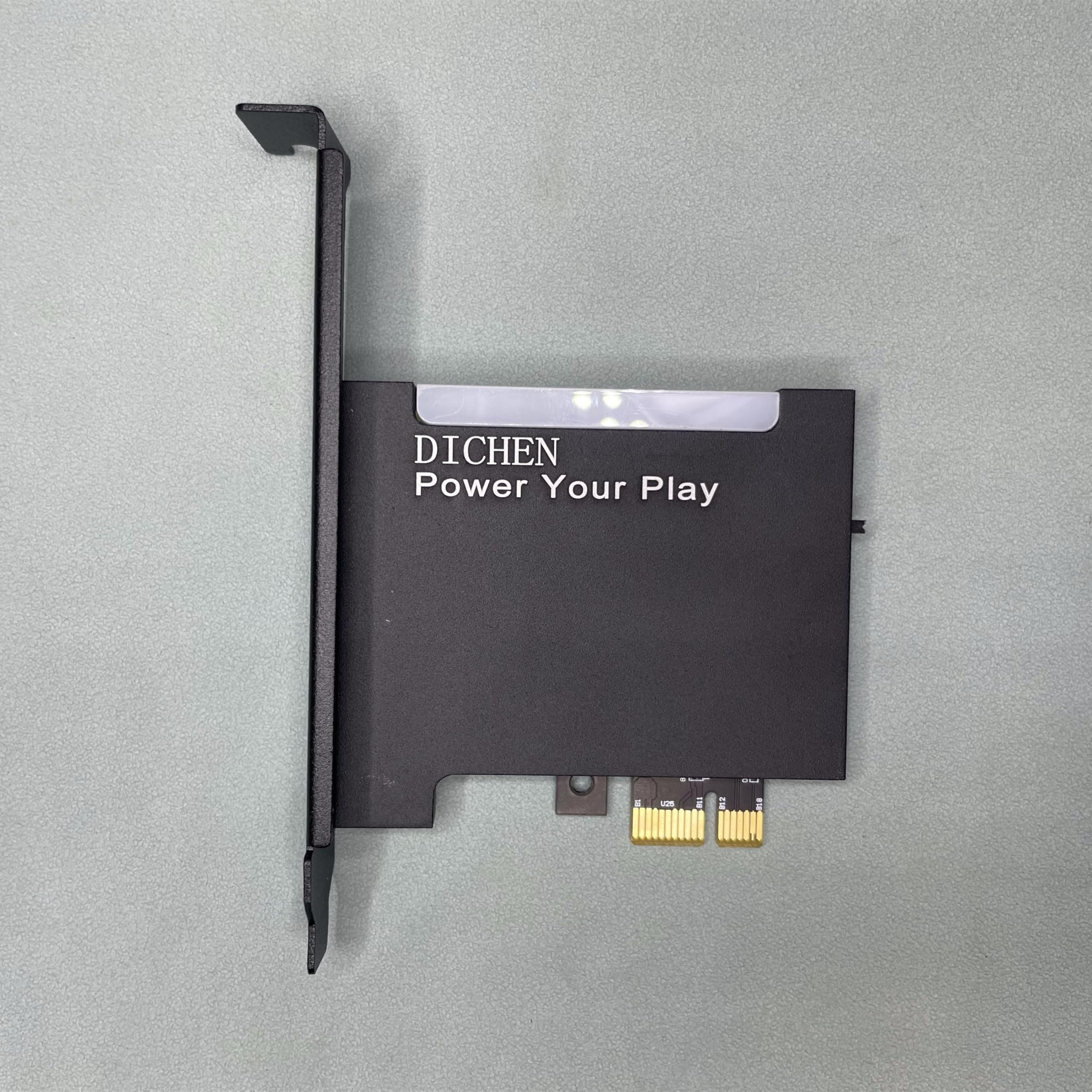
The DICHEN FPGA 75T is not a general-purpose USB hub — it is a direct memory access development board designed for PCILeech compatibility. The FPGA core enables 64-bit memory access over PCIe TLP, allowing read and write operations directly to target system memory. This makes it suitable for security research, firmware flashing, and debugging scenarios where standard USB controllers cannot provide low-level memory access.
A physical on/off switch lets you deactivate the card without unplugging it, which is useful for isolating the device when not in use. The layered cooling design pairs a heatsink with an aluminum alloy cover to prevent FPGA thermal throttling during sustained operations. It supports Windows, Linux, and macOS, though the card ships without custom firmware — users must load their own software stack.
Setup requires more technical knowledge than a standard USB expansion card. Some users report difficulty establishing communication over the data port even after successful JTAG flashing, and the card does not provide out-of-the-box functionality for non-specialized tasks. For legitimate development and research workflows, it is a capable tool. For anyone seeking simple port expansion, this is not the right fit.
Why it’s great
- FPGA-based DMA enables direct memory access for advanced debugging
- On/off switch adds hardware isolation without physical removal
- Layered aluminum/heatsink cooling prevents thermal throttling
Good to know
- Requires custom firmware and technical setup; not plug-and-play
- Some units have data line issues despite functional JTAG
4. RIITOP USB 3.0 PCI-e Expansion Card

The RIITOP card proves you don’t need to spend heavily to add seven USB 3.0 ports. It uses two Renesas chipsets — one UPD720201 as the host controller and a secondary chip for hub management — all sharing a single 5Gbps pipe. Install takes about five minutes, and the card is plug-and-play on Windows 11 without any driver disk. Users report transferring 9.31GB in under two minutes, roughly three times faster than USB 2.0.
The PCIe x1 interface fits any slot type, and the card draws power entirely from the motherboard. There are no external cables to manage, and the included screws secure the bracket to standard cases. The 0.11-kilogram weight means it will not sag or stress the slot over time. Backward compatibility with USB 2.0 and 1.0 devices ensures older peripherals remain usable.
The main limitation is the shared 5Gbps bandwidth — plugging multiple high-speed drives simultaneously will cause contention. Also, the USB connectors sit very close to the PCI bracket, which can make cable insertion tight in some cases. For budget-conscious users who mostly connect flash drives, mice, and printers, this card delivers reliable performance at a very low investment.
Why it’s great
- Seven USB 3.0 ports from a single PCIe x1 slot
- Plug-and-play on Windows 11 without driver installation
- Lightweight construction prevents slot strain over time
Good to know
- Shared 5Gbps bandwidth limits simultaneous high-speed device performance
- USB ports are tight against the bracket, making connection fiddly
5. QTHREE GeForce GT 730 4GB

The QTHREE GT 730 is a low-profile graphics card that serves a different purpose than USB expansion — it adds four display outputs (2x HDMI, VGA, DP) for multi-monitor office setups. With 4GB of DDR3 memory and a 902 MHz core clock, it handles 2560×1440 resolution at 60Hz across three screens without stutter. The Kepler architecture draws only 30W, so no external power connector is needed.
Installation is straightforward: slot it into a PCIe x8 or larger lane, and Windows automatically installs the driver. The fan runs whisper-quiet even under sustained load, making it ideal for quiet workstation environments. A low-profile bracket is included for slim chassis, and the card works with Windows 11 and DirectX 12.
The primary drawback is performance — this is not a gaming card. The 64-bit memory interface and DDR3 VRAM limit 3D acceleration, and the VGA port on some units fails to output a signal properly despite driver updates. For spreadsheet-heavy multi-monitor productivity or light media playback, it is a reliable and silent solution. For any GPU-intensive task, look elsewhere.
Why it’s great
- Drives up to four monitors at 2560×1440/60Hz
- Low power draw with no external power connector required
- Whisper-quiet fan suitable for noise-sensitive environments
Good to know
- 64-bit DDR3 memory limits 3D and gaming performance
- VGA output may not work on some units despite driver updates
FAQ
Will a PCIe x1 USB card work in a PCIe x16 slot?
Why do some DMA cards need external power when others do not?
Final Thoughts: The Verdict
For most users, the best dma card winner is the FebSmart FS-4C-U8S-Pro because its four dedicated channels deliver true 20Gbps aggregate bandwidth for high-demand peripherals without lane sharing. If you want balanced port count and easy installation in any desktop, grab the FebSmart FS-U7S-Pro. And for specialized direct memory access or development work, nothing beats the DICHEN FPGA 75T DMA Card.

Mo Maruf
I created WellFizz to bridge the gap between vague wellness advice and actionable solutions. My mission is simple: to decode the research and give you practical tools you can actually use.
Beyond the data, I am a passionate traveler. I believe that stepping away from the screen to explore new environments is essential for mental clarity and physical vitality.