Our readers keep the lights on and my smoothie glass nicely filled. As an Amazon Associate, I earn from qualifying purchases.
A safari vehicle bounces across a dusty track, a lion stalks through the golden grass hundreds of yards away, and you have exactly one second to capture the shot. Your phone’s digital zoom will turn that mane into a blurry blob. The right camera for this moment needs a reach measured in millimeters, not megapixels, and stabilization that compensates for a moving Land Cruiser.
I’m Mohammad Maruf — the founder and writer behind WellFizz. I’ve spent hundreds of hours analyzing the optical zoom ranges, sensor sizes, image stabilization specs, and real-world portability trade-offs of dozens of superzoom and interchangeable-lens cameras to build this guide specifically for the person who needs one device for both an African savanna and a cramped economy seat.
After combing through thousands of field reviews, the essential qualities of the best digital camera for safari and travel reduce to three measurable specs: raw optical reach beyond 600mm, sensor performance that doesn’t collapse in dust or dusk, and a body light enough to carry from sunrise game drive to airport gate without a second thought.
How To Choose The Best Digital Camera For Safari And Travel
Selecting a single camera for both safari and general travel forces a compromise between optical reach and bulk. A 125x superzoom built for the Serengeti might feel absurdly oversized at a Parisian café. The key is to identify which specifications matter most for your specific trip ratio — wildlife mornings versus urban afternoons — and find the model that delivers the critical zoom without sacrificing portability to the point that you leave it at the hotel.
Optical Zoom: The Defining Spec
For safari photography, optical zoom is the single non-negotiable spec. Digital zoom crops into a sensor and destroys detail; optical zoom uses the lens to physically magnify the subject. A 60x optical zoom (like the Panasonic FZ80D’s 20-1200mm equivalent) lets you fill the frame with a cheetah 200 yards away. A standard 18-55mm kit lens on a DSLR will show that same cheetah as a tiny speck. Look for at least 50x optical zoom for dedicated wildlife safaris, though 30x models (like the Panasonic ZS99) can still work if combined with thoughtful composition.
Sensor Size and Low-Light Performance
Superzoom cameras use small sensors (typically 1/2.3-inch) to keep the lens barrel physically manageable, but these sensors struggle when the sun drops during golden-hour game drives. Cameras with larger APS-C or full-frame sensors, like the Canon EOS R7 or Sony a7 III, handle low light much better but require expensive, heavy telephoto lenses to match the reach of a superzoom. The trade-off is stark: a Nikon P1100 gives you 125x zoom in one unit, but its small sensor produces grain above ISO 1600, whereas a Sony a7 III at ISO 6400 still delivers clean files, but you will need a lens costing thousands to reach 600mm.
Image Stabilization for Handheld Reach
At 1200mm or 3000mm, even micro-vibrations from your pulse become visible in the frame. Camera manufacturers rate stabilization stops differently, but for safari, Dual Detect Optical VR (Nikon) or Power O.I.S. (Panasonic) matters far more than stabilization mode count. Without effective stabilization, you will need a tripod or monopod on every game drive, which adds weight and setup time. The best safari cameras allow reliable handheld shooting up to roughly half of their maximum zoom range.
Weight, Size, and Dust Resistance
A camera you dread carrying will take zero photos. The lightest superzoom in this guide, the Panasonic ZS99, weighs about 0.6 pounds and fits in a jacket pocket. The Nikon P1100 weighs nearly 3 pounds and is roughly the size of a small DSLR with a long lens attached. For a trip that combines open-vehicle safari with backpacking between cities, weight becomes a decisive factor. Dust sealing, rarely advertised on superzooms, is equally critical — open safari vehicles generate plumes of fine dust that can get into lens barrels and sensor cavities. Interchangeable lens bodies like the Nikon D500 and Canon EOS R7 offer better environmental sealing than most bridge cameras.
Quick Comparison
On smaller screens, swipe sideways to see the full table.
| Model | Category | Best For | Key Spec | Amazon |
|---|---|---|---|---|
| Nikon COOLPIX P1100 | Superzoom | Maximum wildlife reach | 125x optical zoom (24-3000mm) | Amazon |
| Nikon COOLPIX P950 | Superzoom | Balance of zoom and value | 83x optical zoom (24-2000mm) | Amazon |
| Canon EOS R7 Kit | Mirrorless | Hybrid safari / general travel | 32.5MP APS-C, 15fps burst | Amazon |
| Nikon D850 | DSLR | Maximum resolution and crop flexibility | 45.7MP full-frame sensor | Amazon |
| Sony a7 III Kit | Mirrorless | Best low-light performance | 24.2MP full-frame, 693 AF points | Amazon |
| Nikon D500 | DSLR | Professional wildlife speed | 20.9MP APS-C, 153-point AF | Amazon |
| Panasonic LUMIX FZ80D | Bridge | Budget entry with 60x zoom | 60x optical zoom (20-1200mm) | Amazon |
| Panasonic LUMIX ZS99 | Compact | Pocketable 30x travel zoom | 30x optical zoom (24-720mm) | Amazon |
| Canon Rebel T7 Bundle | DSLR | Entry-level with bundled telephoto | 24.1MP APS-C, included 500mm lens | Amazon |
| Nikon COOLPIX P1000 | Superzoom | Extreme zoom in a single lens | 125x optical zoom (24-3000mm) | Amazon |
| Nikon P1100 Bundle | Superzoom Kit | P1100 with extra accessories | 125x optical zoom, 2x 64GB cards | Amazon |
In‑Depth Reviews
1. Nikon COOLPIX P1100

The Nikon COOLPIX P1100 is the current ceiling for all-in-one superzoom reach, delivering a 125x optical zoom that covers an astonishing 24-3000mm equivalent range. This single camera replaces what would require a suitcase of glass on an interchangeable lens system. The Dual Detect Optical Vibration Reduction, rated at up to 4.0 stops, makes handheld shooting feasible at moderate telephoto lengths, though framing anything beyond 2000mm handheld still demands a steady brace and fast shutter speeds. For safari, this means you can photograph a lion at a half-mile distance and then swing around for a wide-angle landscape without swapping a lens.
The 16MP BSI CMOS sensor is the same one used in the P1000, and its real-world performance is sharp in good light but shows visible grain above ISO 1600. That’s the trade-off for the extreme zoom — small sensor physics limit dynamic range and high-ISO clarity. The Bird-Watching mode on the mode dial optimizes shutter speed and focus for common safari birds, but reviewers note that the tracking autofocus in this mode struggles with fast-moving birds in flight. Manual focus via the customizable control ring is a reliable backup, and the 2.36M-dot electronic viewfinder is bright enough to compose in harsh midday glare.
At nearly three pounds, the P1100 is not a pocket camera, but it is lighter and more compact than a full-frame body plus a 600mm telephoto lens. The 3.2-inch vari-angle LCD is useful for low-angle compositions from a safari vehicle. Where this camera truly excels is giving a non-professional photographer the ability to capture distant subjects that would otherwise be invisible — glacier crystal formations half a mile away, a leopard draped over a branch 300 yards out, or the craters of the moon from a hotel window.
Why it’s great
- 125x optical zoom reaches subjects invisible to most cameras
- Dual Detect VR allows decent handheld telephoto work
- One single unit replaces multiple heavy lenses
- Bird-Watching mode simplifies settings for wildlife
Good to know
- Small sensor shows grain above ISO 1600
- Bird-tracking autofocus unreliable for fast birds in flight
- Feels somewhat delicate and plastic in construction
- Video at max zoom requires a tripod to avoid stuttering
2. Nikon COOLPIX P950

The Nikon COOLPIX P950 sits in the sweet spot of the superzoom category, offering 83x optical zoom (24-2000mm equivalent) at a significantly lower entry point than the P1100. For safari-goers who want very long reach but aren’t trying to photograph a mountain goat at 3000mm, the P950 delivers 95% of the wildlife capability for less cost. The dedicated Bird and Moon scene modes are genuinely useful — they automatically set the exposure and focus parameters for those specific subjects, reducing the fiddling that can cause missed shots when the action is fleeting.
The 16MP sensor with a 1/2.3-inch format has the same inherent low-light limits as the P1100, but the 83x zoom is easier to stabilize handheld. Reviewers consistently praise the image stabilization at full zoom, calling it usable for static or slow-moving wildlife without a tripod. The autofocus uses contrast detection with 399 points; it locks onto large subjects quickly but hunts on small, distant birds against busy backgrounds. The manual focus wheel on the left side of the lens barrel is a fast workaround when AF fails.
This camera supports 4K UHD video and RAW (NRW) format, giving you latitude in post-processing that JPEG-only cameras lack. The macro mode lets you get as close as 1cm from a subject at the wide end, which means a single camera can handle a butterfly at dawn and a cheetah at noon. The rotating LCD screen flips out and swivels, making it easy to shoot from a low safari vehicle window without contorting your body. For the price, it is the most pragmatic superzoom for mixed safari and travel use.
Why it’s great
- Excellent 83x zoom range for most safari needs
- Dedicated Bird and Moon modes simplify shooting
- Good handheld stabilization up to 1500mm
- Macro mode adds close-up versatility
Good to know
- AF hunts on small birds against cluttered backgrounds
- Small sensor limits low-light and depth of field
- Photo quality doesn’t match larger sensor cameras
- Auto mode can miss specific action shots
3. Canon EOS R7 Kit

The Canon EOS R7 is a mirrorless APS-C camera that bridges the gap between superzoom simplicity and professional image quality. The 32.5MP sensor delivers exceptional detail and crop flexibility — you can shoot at the 18-150mm kit lens range and crop into a distant animal in post, relying on the high pixel count to retain usable resolution. The RF-S 18-150mm lens gives a 28.8-240mm equivalent field of view, which is not enough for distant wildlife but pairs beautifully with a RF 100-400mm or adapted EF 70-300mm lens for genuine safari reach.
The Dual Pixel CMOS AF II system with 651 AF points and subject detection is a predator-prey tracking monster. It locks onto animal eyes, bird eyes, and vehicle-based subjects with minimal hunting, and the 15fps mechanical shutter captures fast action sequences that most superzooms cannot handle. The 5-axis in-body image stabilization provides up to 7 stops of shake correction, making it possible to get sharp shots at shutter speeds that would produce blur on unstabilized systems.
For the traveler, the R7 body is compact and the weather sealing is robust enough for dusty safari conditions. The LP-E6NH battery delivers solid endurance, and USB-C charging means you can top up from a power bank on long transfer drives. The biggest limitation is lens cost — a native RF 100-500mm lens costs nearly as much as the camera body. Budget-conscious safari photographers can adapt older EF lenses with an adapter, but the size and weight savings over a DSLR vanish once a long telephoto is mounted.
Why it’s great
- 32.5MP sensor allows heavy cropping for distant subjects
- Excellent animal eye-tracking autofocus
- 7 stops of IBIS for steady handheld telephoto shooting
- Weather-sealed body handles dust well
Good to know
- Kit lens lacks the reach for dedicated wildlife safaris
- RF telephoto lenses are expensive
- Some low-light noise at high ISO compared to full-frame
- APS-C sensor means 1.6x crop factor affects wide-angle
4. Nikon D850

The Nikon D850 remains the high-resolution DSLR benchmark for wildlife photographers who want to travel with one camera that does everything. The 45.7MP backside-illuminated full-frame sensor with no optical low-pass filter resolves feather texture, fur strands, and landscape detail that smaller sensors simply cannot capture. For safari work, the resolution is a massive asset — you can shoot with a 200-500mm lens, then crop into a 16MP frame and still have enough detail for a sharp print or stock sale.
The 153-point AF system with 99 cross-type sensors is exceptionally fast and accurate for moving subjects, and the 9fps burst rate (with battery grip) captures running impalas or hunting cheetahs without losing focus. The 180K-pixel RGB metering sensor evaluates scene conditions and communicates with the AF system to improve tracking reliability in changing light. The ISO 64 base setting produces remarkably clean, rich files that rival medium format for dynamic range, and the sensor performs well up to ISO 12,800 for pre-dawn game drives.
The trade-off for this capability is weight and bulk. The D850 body alone weighs just over two pounds, and adding a telephoto lens like the Nikon 200-500mm f/5.6 pushes the total past six pounds. The tilting touchscreen is useful for low vehicle angles, but this is a large camera that demands a serious bag. For photographers who prioritize maximum image quality and are willing to carry the gear, the D850 paired with a high-quality telephoto zoom produces safari images that no all-in-one superzoom can approach.
Why it’s great
- 45.7MP resolution allows extreme cropping for distant wildlife
- Excellent dynamic range and ISO 64 base quality
- Fast, accurate 153-point AF for moving subjects
- Solid weather sealing for dusty environments
Good to know
- Heavy — over 2 lbs body only before adding lens
- Requires high-speed SD/XQD cards and large hard drives
- Video autofocus is mediocre compared to modern mirrorless
- Complex menus can overwhelm beginners
5. Sony a7 III Kit

The Sony a7 III is the full-frame mirrorless that redefined value in its class, and for safari photographers who shoot at dawn and dusk, its low-light capability is transformative. The 24.2MP back-illuminated sensor with 15 stops of dynamic range captures clean images at ISO 6400 that would be unusable from a superzoom’s small sensor. The 693 phase-detection AF points cover 93% of the frame, and Real-time Eye AF for animals locks onto lion eyes with a stickiness that makes action shots feel automatic.
The 28-70mm kit lens is a decent starting point for landscapes and camp scenes, but for safari it is virtually useless on its own. You will need to budget for a telephoto zoom — the Sony 200-600mm f/5.6-6.3 is the natural partner, adding significant weight and cost. The a7 III’s 5-axis in-body stabilization works with any mounted lens, making the 200-600mm handheld at 600mm surprisingly usable. The battery life is outstanding for a mirrorless camera, rated at 710 shots per charge, which means one battery can survive a full day of game drives.
For the traveler, the a7 III is compact for a full-frame body but the lenses are not. The weather sealing is moderate — the camera is splash and dust resistant, but not sealed as tightly as the Nikon D500 or D850 for heavy dust. The menu system is famously dense, though customizable function buttons help once set up. Where the a7 III truly wins is in giving you the ability to shoot early-morning river crossings and late-afternoon predator action at ISO levels that keep your shutter speed high and your images clean.
Why it’s great
- Excellent high-ISO performance up to ISO 6400
- Fast and accurate animal eye-tracking autofocus
- Long battery life for all-day shooting
- Compact body for a full-frame mirrorless
Good to know
- Kit lens lacks safari-relevant telephoto reach
- Expensive telephoto lenses required for wildlife
- Menu system is complicated for new users
- Weather sealing is not as robust as pro DSLRs
6. Nikon D500

The Nikon D500 is widely considered the best DX-format DSLR ever made for wildlife, and for safari photographers who prioritize tracking and speed, it remains a formidable tool. The 20.9MP APS-C sensor provides a 1.5x effective magnification of any mounted lens, turning a 200-500mm lens into a 300-750mm equivalent. This reach advantage is critical for safari — you get more subject detail without needing longer, heavier glass. The Multi-CAM 20K 153-point AF system, inherited from the flagship D5, tracks animals across the frame with astonishing reliability.
The 10fps continuous shooting with a buffer of 200 frames means you can hold the shutter down during a cheetah sprint and not hit a wall. The metering sensor is a 180K-pixel RGB unit that evaluates scene brightness and communicates with the AF to improve tracking in dappled light under acacia trees. The 3.2-inch tilting touchscreen is useful for low-angle vehicle shooting, and the weather sealing is excellent — the D500 handles dust, moisture, and the fine grit of an open safari vehicle better than most mirrorless bodies.
The camera’s weight (about 1.7 pounds body only) is moderate for a DSLR, but with a telephoto lens it becomes a substantial kit. The SnapBridge Wi-Fi implementation is widely criticized for its finicky connection and limited iOS support. Battery life is good, though the default wireless module can drain the battery if not turned off in the menu. For the photographer who already owns Nikon F-mount glass, the D500 is the most cost-effective way to gain serious safari reach without switching systems.
Why it’s great
- 1.5x crop factor gives instant reach with any lens
- D5-class AF system for fast, reliable tracking
- 10fps burst with huge buffer for action sequences
- Excellent weather sealing for dust and moisture
Good to know
- SnapBridge Wi-Fi is unreliable, especially on iOS
- No Easy ISO button on this body
- APS-C noise is higher than full-frame at same ISO
- Discontinued in some markets; may be harder to find New
7. Panasonic LUMIX FZ80D

The Panasonic LUMIX FZ80D is the budget bridge camera that punches above its weight for entry-level safari and travel use. The 60x optical zoom (20-1200mm equivalent) reaches far enough to photograph most savanna animals at typical safari distances, and the Power O.I.S. stabilization performs well enough to keep 1200mm shots reasonably steady handheld. The 2,360K-dot Live View Finder is bright and glare-resistant, which is essential when composing shots in the direct midday sun of the African bush.
The 4K Photo mode extracts 8-megapixel stills from 4K video, which is a practical feature for capturing fast action — you can record 30fps video, then pull the exact frame where a bird takes off. The Post Focus feature allows you to change the focus point after the shot is taken, which is surprisingly useful when a fast-moving subject passes through the frame at an unexpected distance. The camera captures decent detail in bright light, but the small sensor shows grain at ISO 800 and above, limiting its golden-hour effectiveness.
Weighing about 1.4 pounds, the FZ80D is light enough for all-day hiking and fits in a moderate-size daypack. It lacks built-in Wi-Fi for quick phone transfers, and the interface feels dated compared to Panasonic’s ZS-series cameras. Battery life is average, and reviewers note that zooming aggressively drains the battery faster than expected. For the safari traveler on a tight budget who needs very long reach, the FZ80D delivers the zoom range for a fraction of the cost of a superzoom or mirrorless system.
Why it’s great
- 60x optical zoom provides serious safari reach
- Lightweight at 1.4 pounds
- 4K Photo mode captures action frames from video
- Post Focus lets you change focus after the shot
Good to know
- Small sensor produces grain at ISO 800 and above
- No built-in Wi-Fi for phone transfer
- Battery drains quickly with heavy zoom use
- Image quality is best for social media, not large prints
8. Panasonic LUMIX ZS99

The Panasonic LUMIX ZS99 (TZ99 in Europe) is the take-everywhere compact for travelers who prioritize portability over extreme telephoto power. The 30x optical zoom Leica DC lens covers a practical 24-720mm equivalent range, which handles landscape vistas, market scenes, and medium-distance wildlife well — but it is not a dedicated safari camera for distant animals. Where it shines is the ability to slip into a jacket pocket, eliminating the reason to leave the camera at the hotel for city days or short hikes.
The 1,840K-dot tiltable touchscreen is bright enough for most conditions, though some reviewers found it difficult to read in direct sun. The built-in Bluetooth 5.0 and dedicated Send Image button allow quick transfers to a smartphone without fumbling through menus. The 4K PHOTO burst at 30fps is useful for capturing unpredictable moments, like a market vendor tossing fruit or a child running. Image quality is decent up to ISO 1600, with the characteristic Leica color science producing rich, accurate tones out of camera that require minimal editing.
The biggest limitation is the 720mm telephoto end — for a genuine safari with big cats at distance, that reach is marginal. The autofocus system is hybrid contrast/phase and works well in good light but hunts in low light. The lack of a built-in flash is a minor inconvenience for evening camp shots. For the traveler who is doing one safari day mixed with two weeks of general travel, the ZS99 is the camera that will actually be in your hand when the moment happens.
Why it’s great
- Fits in a jacket pocket for true every-day carry
- Leica lens produces pleasing color science
- 30x zoom range is versatile for non-safari travel
- Easy smartphone transfer via dedicated button
Good to know
- 720mm maximum reach is short for serious safari work
- Autofocus hunts in low-light conditions
- No built-in flash for evening photos
- Small sensor limits image quality compared to larger cameras
9. Canon EOS Rebel T7 Bundle
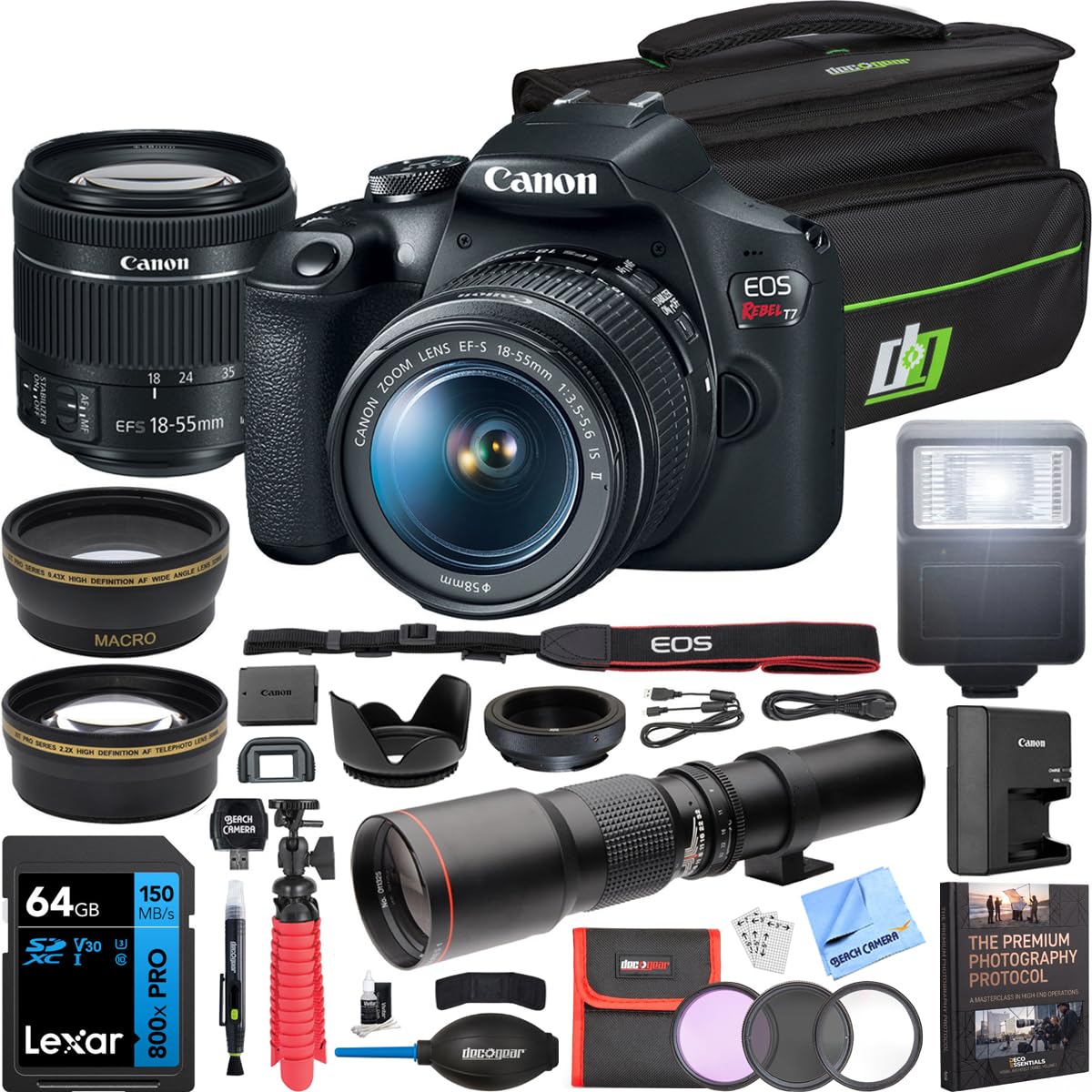
The Canon EOS Rebel T7 bundle is aimed at the budget-conscious traveler who wants to move beyond a smartphone without committing to an expensive system. The 24.1MP APS-C sensor delivers good detail and the familiar Canon color science that produces pleasing skin tones and landscape colors out of camera. The bundled 500mm preset telephoto lens provides genuine long-reach capability for safari distances, though it is a preset lens — you must manually focus it to the approximate subject distance, which means fast-moving animals are difficult to capture.
The 18-55mm kit lens is fine for landscapes and camp scenes, and the 9-point AF system is basic but functional for static subjects. The camera shoots at 3fps continuous, which is slow for action but acceptable for a beginner. The built-in Wi-Fi and NFC allow basic image sharing to a phone, though the process is slower than modern systems. The bundle includes a bag, memory card, filters, and flash, which reduces the initial outlay but the accessories are entry-level quality.
The major weakness is battery life — several reviewers report the included battery dies after as few as eight to twenty shots, suggesting either a defective unit or a battery that arrived discharged. A spare battery is essential. The 500mm preset lens produces soft images compared to an autofocus telephoto, and the camera’s 3fps burst means capturing action is frustrating. For the absolute beginner who wants a budget-friendly way to shoot a single safari with longer reach than a phone, this bundle works, but it is the most limited option in this guide for serious wildlife photography.
Why it’s great
- Lowest entry cost for a DSLR with bundled telephoto
- 24.1MP sensor produces good image quality in good light
- Bundle includes multiple accessories to get started
- Canon EF/EF-S lens system has huge upgrade path
Good to know
- Battery life is poor — some units die after a few shots
- Preset telephoto lens requires manual focus, misses action
- 3fps burst is too slow for wildlife action
- Bundle accessories are low-quality and some arrive mismatched
10. Nikon COOLPIX P1000
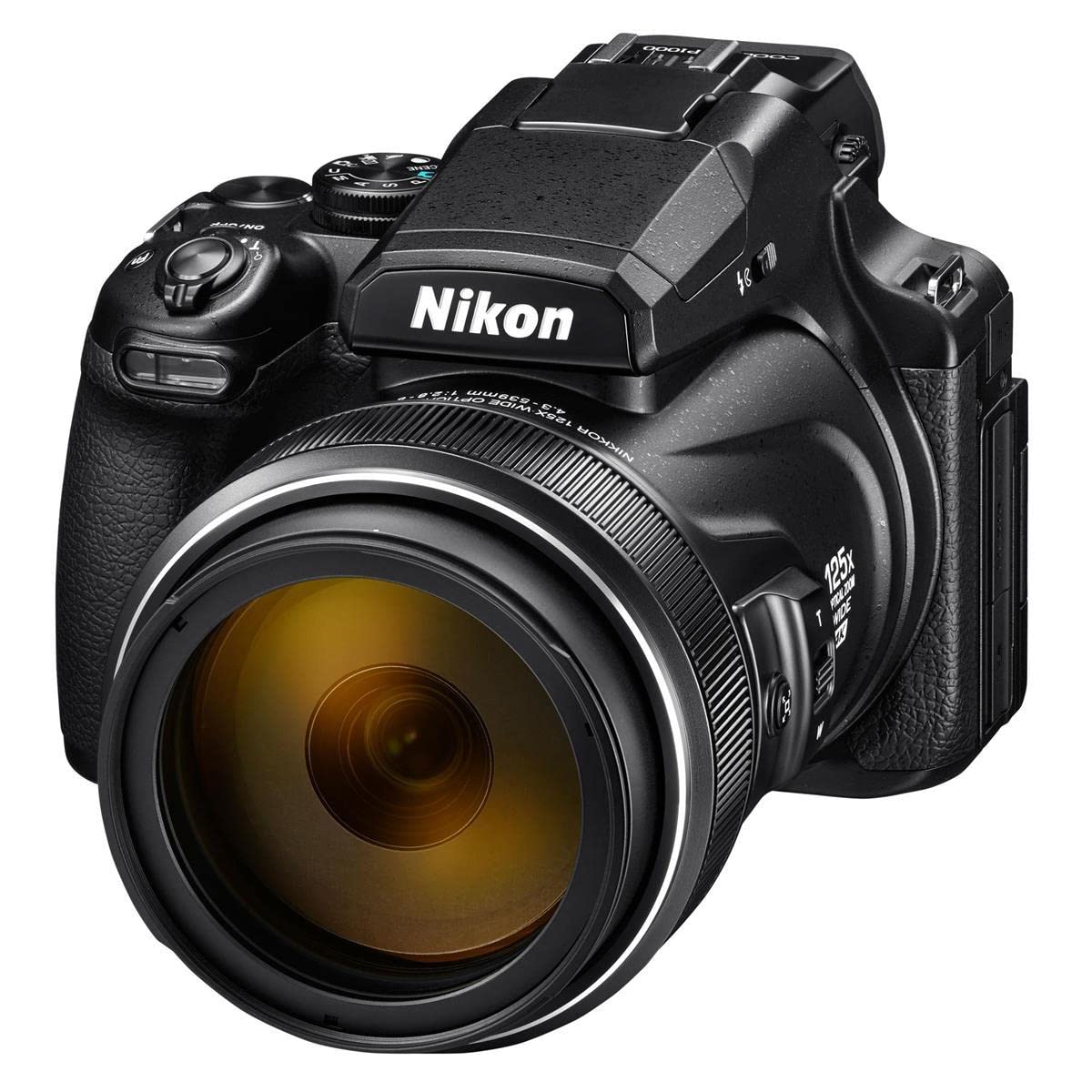
The Nikon COOLPIX P1000 was the camera that made 3000mm optical zoom a reality for consumers, and while it has been succeeded by the P1100, it remains a capable and often more affordable option for extreme-telephoto safari work. The 125x optical zoom covers 24-3000mm equivalent, and at the long end, you can photograph a bird at 100 yards that looks like a speck in the viewfinder of any other camera. The Dual Detect Optical VR makes handheld shooting usable up to around 1500mm, but at 3000mm, a tripod is essential for consistent sharpness.
The 16MP CMOS sensor is the same generation as the P950, producing sharp images in bright light but suffering from noise and reduced dynamic range in low light. The RAW (NRW) output gives you room to recover shadows and adjust white balance, which helps when the midday sun creates harsh contrast. The accessory hot shoe accepts an external microphone for better audio during 4K video, and the HDMI output connects to external monitors for vlogging. The vari-angle 3.2-inch LCD is visible from almost any angle, useful for overhead or low shots.
The biggest drawback of the P1000 is its size and weight — it is nearly three pounds with a lens barrel that extends significantly at full zoom, making it conspicuous and awkward on public transport or crowded streets. The autofocus can struggle at extreme telephoto distances, often hunting for focus before locking. For the dedicated safari photographer who wants the longest possible reach in a single self-contained unit and is willing to manage the bulk, the P1000 still delivers capabilities no other non-interchangeable system matches.
Why it’s great
- 3000mm optical zoom captures subjects invisible to most cameras
- Dual Detect VR aids handheld shooting at moderate telephoto
- RAW support allows post-processing flexibility
- Built-in time-lapse and interval timer for creative work
Good to know
- Heavy — nearly 3 pounds, awkward for general travel
- Small sensor limits low-light performance
- AF hunts at extreme zoom ranges
- Battery life is short; extra batteries are essential
11. Nikon COOLPIX P1100 Bundle

This bundle packages the Nikon COOLPIX P1100 with accessories that address the camera’s main limitations — battery life and storage. The inclusion of two EN-EL20 replacement batteries and an external charger means you can shoot through a full-day game drive without worrying about depleting the single factory battery. Two 64GB Extreme PRO UHS-I SDXC cards provide enough capacity for thousands of RAW images or hours of 4K video, which is important because the P1100’s extreme zoom encourages heavy shooting.
The 3-piece 77mm filter kit includes a UV filter for lens protection in dusty environments, a circular polarizer for reducing glare on water and foliage, and an FLD filter for balancing color in mixed lighting. The padded camera bag fits the bulky P1100 body, though several reviewers note the bag is a tight fit. The flexible tripod is useful for tabletop stabilization but cannot support the camera at full zoom — a full-size tripod is still needed for 3000mm work. The cleaning kit, memory card reader, and cap keeper are welcome additions that reduce the immediate accessory shopping after purchase.
The core camera is the same P1100 reviewed above, with the same strengths — 125x zoom, Dual Detect VR, 4K video — and the same weaknesses — small sensor, slow AF at full zoom, plastic build feel. The value of this bundle depends on whether you would purchase these accessories separately. For a first-time superzoom buyer planning an intensive safari, having spare batteries and a second memory card from day one makes this bundle more practical than buying the camera alone.
Why it’s great
- Two extra batteries solve the P1100’s short battery life
- Two 64GB UHS-I cards provide ample storage
- Filter kit offers lens protection and creative control
- Bundled accessories reduce immediate secondary purchases
Good to know
- Camera bag is a tight fit for the bulky body
- Flexible tripod is not stable for max-zoom use
- Some bundle accessories are low quality
- Better value to buy camera alone and choose own accessories
FAQ
Can I use a smartphone instead of a dedicated camera for safari and travel?
What focal length do I need for safari wildlife photography?
How does dust affect cameras on an open vehicle safari?
Do I need a tripod for superzoom safari photography?
Final Thoughts: The Verdict
For most users, the best digital camera for safari and travel winner is the Nikon COOLPIX P1100 because it delivers the longest optical reach available in a single unit while remaining compact enough for air travel. If you want better image quality and autofocus tracking with the flexibility to upgrade lenses over time, grab the Canon EOS R7. And for the budget-conscious traveler who needs a 60x zoom without the cost, the Panasonic LUMIX FZ80D provides the reach at a fraction of the price.

Mo Maruf
I created WellFizz to bridge the gap between vague wellness advice and actionable solutions. My mission is simple: to decode the research and give you practical tools you can actually use.
Beyond the data, I am a passionate traveler. I believe that stepping away from the screen to explore new environments is essential for mental clarity and physical vitality.