Our readers keep the lights on and my smoothie glass nicely filled. As an Amazon Associate, I earn from qualifying purchases.
Choosing between a classic optical viewfinder and a silent electronic one, or deciding whether 24 megapixels is enough when a 45-megapixel sensor promises incredible detail — that is the central tension when shopping for a digital SLR camera today. The market now splits between traditional DSLR bodies with mirrors and modern mirrorless systems that use electronic viewfinders, yet both camps share the same core legacy of interchangeable lenses and manual control. Understanding where your photography style lands between raw resolution, burst speed, and low-light capability will determine which body earns a permanent spot in your bag.
I’m Mohammad Maruf — the founder and writer behind WellFizz. I’ve spent countless hours parsing through sensor readout speeds, autofocus point counts, and optical viewfinder coverage figures to deliver a guide that cuts through the marketing noise and focuses on what actually matters when you press the shutter.
Whether you are upgrading from a smartphone or building a professional kit, this detailed analysis of the best digital camera slr options will help you match sensor technology, lens ecosystems, and autofocus performance to your real-world shooting needs.
How To Choose The Best Digital Camera SLR
Before you sort through megapixel counts, you need to decide whether you want a traditional DSLR with an optical viewfinder or a mirrorless camera with an electronic viewfinder. Both are interchangeable-lens systems, but they differ fundamentally in how they preview and capture the scene. DSLRs use a mirror to reflect light into an optical viewfinder, delivering a lag-free, battery-friendly preview. Mirrorless cameras, by contrast, send light directly to the sensor and display a live preview on the EVF, giving you real-time exposure and depth-of-field feedback before you shoot.
Sensor Size and Megapixels
The sensor is the heart of any camera body. APS-C sensors (found in models like the Canon Rebel T7 and Nikon D7500) are smaller but let you use lighter, less expensive lenses. Full-frame sensors (used in the Canon EOS RP, Sony a7 III, and Nikon D850) capture more light, produce shallower depth of field, and deliver better high-ISO performance. Megapixels matter for cropping and large prints, but a 24-megapixel full-frame sensor will often outresolve a 24-megapixel APS-C sensor due to larger individual pixels that gather light more efficiently.
Autofocus System and Burst Rate
Autofocus point count and type directly affect your ability to track moving subjects. A 9-point phase-detection system (Canon T7) is fine for static portraits, while a 153-point system (Nikon D850) with cross-type sensors is essential for sports and wildlife. Mirrorless cameras with on-sensor phase-detection cover a much larger percentage of the frame. Burst rate, measured in frames per second (fps), determines how many shots you can capture during fast action. Entry-level bodies offer up to 3.0 fps, while high-end models reach 10–40 fps with electronic shutters.
Lens Ecosystem and Mount Compatibility
Your camera body is only as good as the lenses you can mount to it. Canon EF/EF-S mounts have decades of glass available, including budget-friendly primes and professional L-series zooms. Nikon F-mount offers similar breadth. Mirrorless systems like Sony E-mount and Canon RF-mount are newer, with native lenses still growing but with adapters available for older DSLR glass. If you plan to invest in lenses over time, the mount you choose today locks your system for years.
Quick Comparison
On smaller screens, swipe sideways to see the full table.
| Model | Category | Best For | Key Spec | Amazon |
|---|---|---|---|---|
| Nikon D850 | DSLR | Ultra-high resolution & wildlife | 45.7MP BSI sensor, 153-point AF | Amazon |
| Sony a7 IV | Mirrorless | Hybrid photo & video work | 33MP, 4K 60p 10-bit, IBIS | Amazon |
| Canon EOS R6 Mark II | Mirrorless | Fast action & events | 40fps burst, 6K oversampled 4K | Amazon |
| Canon EOS 5D Mark IV | DSLR | Professional studio & travel | 30.4MP, 61-point AF, 4K video | Amazon |
| Sony a7 III | Mirrorless | All-round full-frame value | 24.2MP BSI, 693-point AF | Amazon |
| Canon EOS R8 | Mirrorless | Lightweight full-frame entry | 24.2MP, 4K 60p uncropped | Amazon |
| Canon EOS RP | Mirrorless | Budget full-frame travel | 26.2MP, RF mount, 5-stop IS | Amazon |
| Nikon D7500 | DSLR | Enthusiast APS-C shooter | 20.9MP, 51-point AF, 8fps | Amazon |
| Pentax K-1 Mark II | DSLR | Landscape & astrophotography | 36.4MP, Pixel Shift II, Astrotracer | Amazon |
| OM System OM-3 | Mirrorless | Travel & weather-sealed compact | 20MP Stacked, IP53, 5-axis IBIS | Amazon |
| Canon EOS Rebel T7 Bundle | DSLR | Entry-level learning kit | 24.1MP, 9-point AF, 3.0fps | Amazon |
In‑Depth Reviews
1. Nikon D850 FX-Format Digital SLR Camera Body

The Nikon D850 remains the benchmark for high-resolution DSLRs because it combines a back-side illuminated full-frame sensor with no optical low-pass filter, delivering 45.7 megapixels of detail that rivals medium-format systems. The 153-point autofocus system with 99 cross-type sensors gives you reliable tracking for fast-moving wildlife and sports, while the tilting touchscreen makes low-angle composition practical.
At up to 9 fps with full AF performance, the D850 is fast enough for action yet offers exceptional dynamic range and ISO 64 base sensitivity for landscape photographers. The optical viewfinder provides nearly 100% frame coverage, and the body is weather-sealed for field work. The XQD slot is fast but requires a costly card, and the Snapbridge wireless connection can be finicky to set up.
Video capabilities include 4K time-lapse and slow-motion up to 120 fps at 1080p, but the video autofocus is noticeably behind mirrorless competitors. The 45.7MP files demand high-quality glass and a powerful computer for processing, but the raw image quality is unmatched in a DSLR body.
Why it’s great
- Industry-leading 45.7MP BSI sensor with no low-pass filter
- 153-point AF system with 99 cross-type sensors for fast tracking
- Excellent weather sealing and deep ergonomic grip
- Focus shift shooting for macro and product work
Good to know
- Video autofocus is poor compared to mirrorless rivals
- XQD card slot requires expensive cards and reader
- Large file sizes need high-capacity cards and fast computer
- Snapbridge WiFi connection can be unreliable
2. Sony Alpha 7 IV Full-frame Mirrorless Camera

The Sony a7 IV strikes a near-perfect balance between still photography and video capabilities, featuring a 33-megapixel back-illuminated CMOS sensor paired with the BIONZ XR processor. The 693-point phase-detection AF system covers 93% of the sensor area and includes real-time Eye AF for humans, animals, and birds — making it one of the most reliable autofocus systems for both photo and video work.
The 4K 60p 10-bit 4:2:2 recording with 7K oversampling at 30p delivers exceptional video quality, and the S-Cinetone color profile produces cinematic tones straight out of camera. In-body image stabilization (IBIS) gives you up to 5.5 stops of shake correction, and the dual UHS-II SD card slots provide flexible workflow options. Battery life is impressive, often exceeding 2,000 shots per charge with careful use.
No camera is perfect, and the a7 IV has a crop in 4K 60p mode, which reduces the effective field of view. The menu system, while improved, still has a learning curve compared to Canon’s more intuitive layout. Some users find the body slightly larger than previous a7 models, but the grip is comfortable for long shoots.
Why it’s great
- 33MP BSI sensor with excellent dynamic range and color
- Real-time Eye AF works for human, animal, and bird subjects
- 4K 60p 10-bit 4:2:2 with S-Cinetone color profile
- Dual UHS-II SD card slots and strong battery life
Good to know
- 4K 60p mode has a 1.5x crop factor
- Menu system is complex for beginners
- Body is slightly larger and heavier than a7 III
- Top shutter speed limited to 1/8000 sec mechanical
3. Canon EOS R6 Mark II Mirrorless Camera

The Canon EOS R6 Mark II is built for speed, with a 24.2-megapixel full-frame CMOS sensor and DIGIC X processor that enable electronic shutter burst rates up to 40 fps with full AF tracking. The Dual Pixel CMOS AF II system covers 100% of the frame with 1,053 AF zones and uses deep learning to detect people, animals, vehicles, horses, trains, and aircraft.
Video features are equally impressive — uncropped 4K 60p oversampled from 6K, 1080p slow-motion up to 180 fps, and support for Canon Log 3. The 8-stop in-body image stabilization makes handheld shooting viable even in low light, and the 3.0-inch vari-angle touchscreen simplifies vlogging and self-recording. The body is weather-sealed and ergonomically refined, with a deep grip that balances well with larger RF lenses.
The LP-E6NH battery provides roughly 500 shots per charge, and the camera can overheat during extended 4K 60p recording sessions lasting longer than 30 minutes. The single UHS-II SD card slot is a limitation for professionals who need instant backup. This is one of the best all-around mirrorless cameras available today.
Why it’s great
- 40 fps electronic shutter with full autofocus tracking
- 6K oversampled 4K 60p video with C-Log 3
- 8-stop IBIS for handheld low-light shooting
- Excellent subject detection including trains and horses
Good to know
- Single UHS-II SD card slot only
- 4K 60p can overheat after ~30 minutes of continuous recording
- LP-E6NH battery requires spares for all-day shoots
- No built-in flash
4. Canon EOS 5D Mark IV Digital SLR Camera

The Canon 5D Mark IV has been a professional staple since its release, and for good reason. Its 30.4-megapixel full-frame CMOS sensor paired with the DIGIC 6+ processor delivers excellent dynamic range and low-noise performance through ISO 3200, expandable to 102,400. The 61-point AF system with 41 cross-type sensors is fast and reliable for studio portraits, weddings, and travel photography.
The optical viewfinder offers nearly 100% coverage, and the 3.2-inch touchscreen enables intuitive AF point selection during live view. Built-in Wi-Fi and NFC allow quick file transfer to a smartphone, and the 4K Motion JPEG video at 30 fps is usable for short clips, though file sizes are massive. Battery life is stellar — one LP-E6N pack lasts a full day of shooting.
The 5D Mark IV lacks a tilting or vari-angle screen, which limits high-angle or low-angle composition. The 4K video uses a 1.74x crop factor, making wide-angle shooting difficult without specialized glass. The single SD card slot is also SD UHS-I only, limiting buffer clearing speed. For current 5D Mark III owners, the improved dynamic range and Dual Pixel AF make this a worthwhile upgrade.
Why it’s great
- Excellent dynamic range and low-noise performance
- 61-point AF system with 41 cross-type sensors is reliable
- Stellar battery life for full-day shoots
- Built-in Wi-Fi and NFC for quick file sharing
Good to know
- 4K video uses Motion JPEG with 1.74x crop
- Screen is fixed, not tilting or vari-angle
- Single SD card slot limited to UHS-I speed
- Older DIGIC 6+ processor compared to current mirrorless
5. Sony a7 III Full-Frame Mirrorless Camera

The Sony a7 III is the camera that convinced many photographers to switch to mirrorless. Its 24.2-megapixel back-illuminated full-frame sensor offers 15 stops of dynamic range and ISO sensitivity up to 204,800, allowing clean images in extremely low light. The 693-point phase-detection AF system covers 93% of the frame, and real-time Eye AF for humans and animals makes portrait and pet photography effortless.
At 10 fps with mechanical or silent shutter and AE/AF tracking, the a7 III is capable of capturing fast action. The 5-axis in-body stabilization provides up to 5 stops of compensation, which is useful for handheld video and low-light stills. Battery life is exceptional for a mirrorless camera — the NP-FZ100 battery typically lasts 710 shots per charge, outperforming many DSLRs.
The 28-70mm f/3.5-5.6 kit lens is functional but lacks the sharpness and speed of better glass. The menu system is notoriously complex, with a steep learning curve for first-time Sony users. The 4K video is spectacular but requires a UHS-II card for best results, and the touchscreen is only used for focus point selection, not menu navigation.
Why it’s great
- 15-stop dynamic range with excellent low-light performance
- 693-point AF with real-time Eye AF for people and animals
- Incredible battery life (710 shots per charge)
- 5-axis IBIS for handheld shooting
Good to know
- Menu system is complex and non-intuitive
- Kit lens is average; budget for better glass
- Touchscreen only works for AF point selection
- No 10-bit video or S-Cinetone color
6. Canon EOS R8 Mirrorless Camera Body

The Canon EOS R8 brings the core technology from the R6 Mark II into a significantly lighter and more affordable body, making it the lightest full-frame RF-mount mirrorless camera available. The 24.2-megapixel CMOS sensor paired with the DIGIC X processor delivers the same image quality, autofocus performance, and 4K 60p uncropped video as its more expensive sibling.
The Dual Pixel CMOS AF II system covers 100% of the frame, with subject detection for people, animals, and vehicles. The 0.39-inch OLED EVF has a 120 fps refresh rate and 2.36 million dots, providing a clear view even in bright conditions. The 3.0-inch vari-angle touchscreen is excellent for vlogging and creative angles, and the body weighs only 461 grams with battery and card.
The LP-E17 battery is small, providing only about 500 shots or 1 hour of video per charge. The single UHS-II SD card slot is a limitation, and the lack of in-body image stabilization means you rely on lens-based stabilization or a tripod. The 40 fps electronic shutter has rolling shutter effects with fast-moving subjects, but the image quality is pro-grade for the price.
Why it’s great
- R6 Mark II-level image quality in a lighter, cheaper body
- 4K 60p uncropped video with C-Log 3 support
- 40 fps electronic shutter for fast action
- Excellent subject detection autofocus system
Good to know
- No in-body image stabilization (IBIS)
- LP-E17 battery life is mediocre
- Single UHS-II SD card slot
- 4K 60p can overheat after 30 minutes
7. Canon EOS RP + RF24-105mm Lens Kit

The Canon EOS RP is the most affordable way to enter the full-frame RF mount system, offering a 26.2-megapixel CMOS sensor in a body that weighs only 485 grams. It is ideal for travel, vlogging, and portrait work when you want the depth-of-field control and low-light advantages of full-frame without the bulk or budget of higher-end models.
The RF 24-105mm f/4-7.1 IS STM kit lens provides a versatile zoom range with optical stabilization rated at up to 5 stops, making it effective for handheld video and low-light stills. The Dual Pixel CMOS AF system delivers smooth, accurate autofocus during video and live view, and the vari-angle touchscreen simplifies self-recording and high-angle composition. The 0.39-inch OLED EVF has 2.36 million dots for a clear preview.
The RP uses the older LP-E17 battery, which offers only about 250-300 shots per charge — carry spares. The 4K video has a 1.6x crop and is limited to 24/25 fps, making it less capable than newer models. The burst rate maxes out at 5 fps, so it is not suitable for fast action. This is a gateway full-frame body best paired with high-quality RF primes for maximum image quality.
Why it’s great
- Lightest full-frame mirrorless body (485g)
- Accessible entry point into Canon RF mount system
- Articulating touchscreen for vlogging and selfies
- RF 24-105mm kit lens has solid 5-stop IS
Good to know
- Battery life is poor (~250 shots)
- 4K video has 1.6x crop and limited frame rates
- Slow 5 fps burst rate
- Older sensor technology compared to R8 or R6 II
8. Nikon D7500 20.9MP DSLR Camera

The Nikon D7500 brings pro-level features from the D500 to an enthusiast APS-C body, including the same 20.9-megapixel CMOS sensor, EXPEED 5 processor, and 51-point AF system with 15 cross-type sensors. Its 8 fps burst rate is nearly twice as fast as entry-level DSLRs, making it suitable for sports and wildlife photography on a budget.
The 3.2-inch tilting touchscreen LCD with 922K dots provides clear live view and touch focusing. The 18-140mm f/3.5-5.6G ED VR kit lens is one of the most versatile all-in-one zooms available, covering wide-angle to short telephoto with effective vibration reduction. The optical viewfinder is large and bright, and the body is weather-resistant for use in light rain or dusty environments.
The D7500 uses a single SD card slot (UHS-I compatible), which is a downgrade from the D7200’s dual slots. The 20.9-megapixel resolution is lower than many competitors, but the sensor delivers excellent image quality with low noise up to ISO 6400. The 4K UHD video at 30 fps is solid, though the autofocus in live view mode is slower than mirrorless alternatives.
Why it’s great
- D500-grade image sensor and autofocus in a lighter body
- 8 fps continuous shooting for action photography
- Excellent 18-140mm VR kit lens included
- Weather-resistant body for outdoor shooting
Good to know
- Single SD card slot (UHS-I only)
- 20.9MP resolution is lower than entry-level competitors
- Live view autofocus is slow compared to mirrorless
- No headphone jack for video monitoring
9. Pentax K-1 Mark II w/D-FA 28-105 WR Lens

The Pentax K-1 Mark II is a niche gem built specifically for landscape and astrophotography enthusiasts. Its 36.4-megapixel full-frame sensor offers exceptional resolution and dynamic range, and the Pixel Shift Resolution System II captures four images and combines them into a single RAW file for unprecedented detail and color accuracy on static subjects.
The 5-axis shake reduction II provides 5 shutter stops of compensation, and the flexible tilt-type LCD monitor can be angled along the optical axis for comfortable shooting from any position. Weather sealing with 87 rubber seals makes it dustproof and weather-resistant, and the Astrotracer feature uses GPS and the sensor-shift system to track celestial bodies without an equatorial mount — a unique advantage for night photographers.
The D-FA 28-105mm WR kit lens is sharp, fast-focusing, and weather-sealed, making it a perfect match for the body. The camera is heavy and large, and the autofocus system (33-point 399 sensor) is not as fast or accurate as contemporary Nikon or Sony systems. Video features are limited, and the SnapBridge-like wireless connectivity is clunky. This is not a general-purpose camera but an outstanding choice for landscape shooters who value resolution and built-in Astrotracer over speed.
Why it’s great
- 36.4MP sensor with Pixel Shift II for exceptional detail
- 5-axis SR II provides 5 stops of shake compensation
- Astrotracer for star tracking without an equatorial mount
- Fully weather-sealed body with 87 rubber seals
Good to know
- Heavy and bulky compared to full-frame mirrorless
- Autofocus system is slower than Nikon/Sony rivals
- Video capabilities are limited
- Wireless connectivity is clunky
10. OM System OM-3 Micro Four Thirds Camera

The OM System OM-3 combines a vintage metal body design with modern computational photography features, all in a small, weather-sealed Micro Four Thirds package. The 20-megapixel stacked BSI Live MOS sensor is the same sensor found in the OM-1 Mark II, offering fast readout speeds, low rolling shutter, and excellent dynamic range for its class.
The 5-axis IBIS is class-leading, providing up to 7 stops of shake correction, and the IP53 weather-sealing (dustproof, splashproof, freezeproof) means you can shoot confidently in heavy rain or freezing conditions. Computational features include built-in GND filter simulation, high-res multi-shot mode, and live ND filters — all accessible through a dedicated lever. The M.Zuiko Digital ED 12-45mm F4.0 PRO kit lens is compact, sharp, and weather-sealed.
Micro Four Thirds has a smaller sensor than APS-C or full-frame, so depth-of-field control is more limited and high-ISO performance is not as clean at equivalent ISOs. The 20-megapixel resolution is lower than most competitors in this guide, and the lens ecosystem requires an adapter for non-MFT glass. The OM-3 is perfect for travel photographers who prioritize portability and weather resistance over ultimate shallow depth-of-field.
Why it’s great
- IP53 weather-sealing for rain, dust, and freezing conditions
- Class-leading 7-stop 5-axis IBIS for handheld shots
- Built-in computational features (GND filter, live ND, HDR)
- Extremely compact and lightweight system
Good to know
- 20MP resolution is lower than full-frame competitors
- Micro Four Thirds has limited depth-of-field control
- High-ISO noise is more prominent than larger sensors
- Lens ecosystem requires adapter for non-MFT glass
11. Canon EOS Rebel T7 Digital SLR Camera Bundle
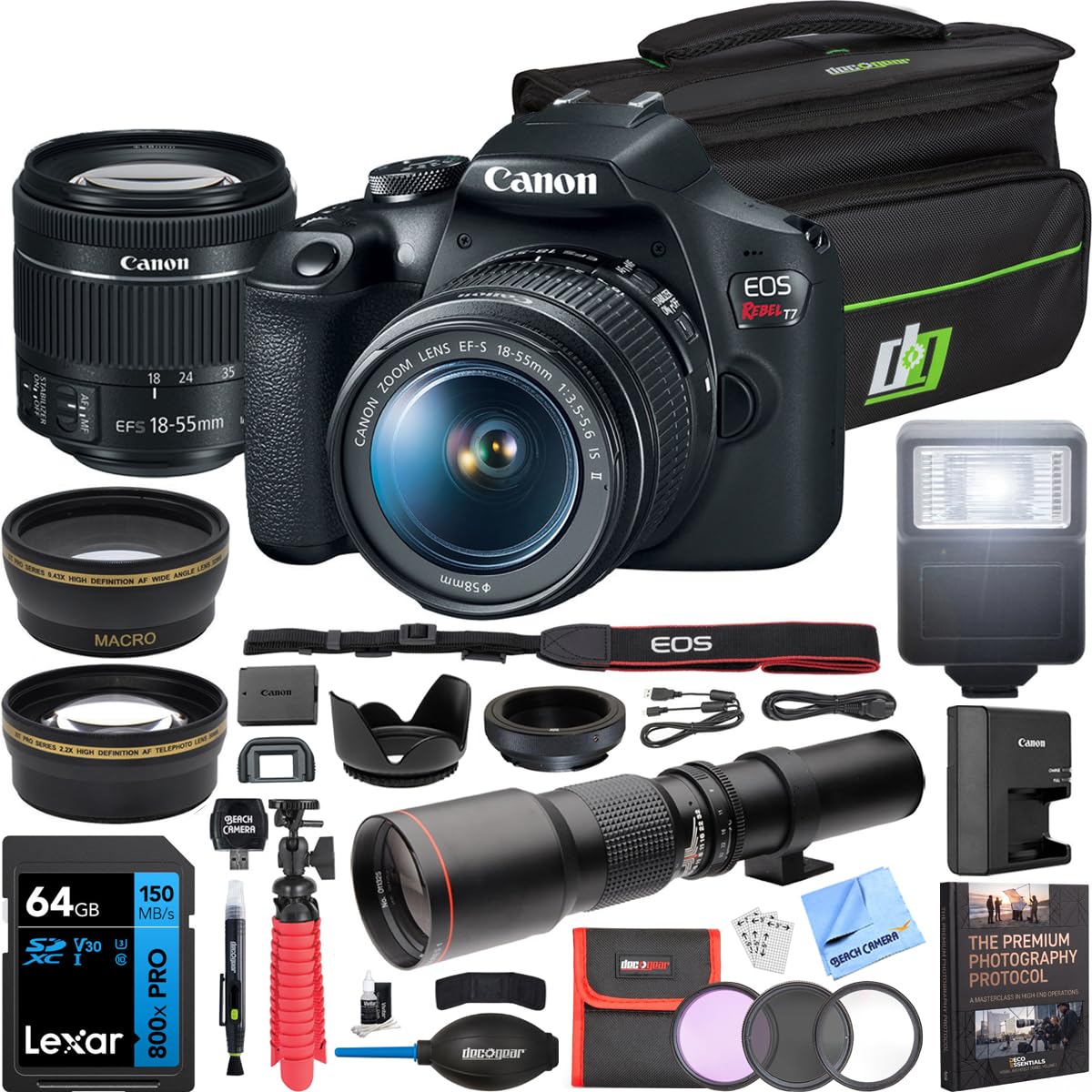
The Canon EOS Rebel T7 bundle is the quintessential starter kit for learning photography on a budget. The 24.1-megapixel APS-C CMOS sensor paired with the DIGIC 4+ processor delivers good image quality for the price, and the 18-55mm f/3.5-5.6 IS II kit lens includes optical stabilization for handheld shooting. The 9-point AF system with AI Servo AF is basic but functional for general photography.
This bundle includes 13 items: the camera body, 18-55mm lens, a 500mm preset telephoto lens, 0.43x wide-angle adapter, 2.2x telephoto adapter, flash, tripod, bag, 64GB SD card, filter kit, and cleaning accessories. The value is undeniable for someone starting from nothing, but the accessory quality is mixed — the telephoto adapter and wide-angle adapter degrade image quality significantly compared to dedicated glass.
The 3.0 fps burst rate is very slow, and the 3.0-inch LCD with 920K dots is adequate but not touch-enabled. Battery life is rated at ~500 shots, but some units ship with batteries that drain quickly after a full charge — order from a reliable seller and consider a spare battery. The built-in Wi-Fi and NFC work for wireless image transfer. This is an ideal first camera for learning manual exposure and composition, but expect to grow beyond the accessories quickly.
Why it’s great
- Complete 13-piece kit includes everything a beginner needs
- 24.1MP sensor delivers good image quality
- 18-55mm IS II lens is stabilized and versatile
- Wi-Fi and NFC for easy image sharing
Good to know
- 3.0 fps burst rate is very slow for action
- 9-point AF system is basic and limited
- Battery quality is inconsistent across units
- Included telephoto adapters degrade image quality
FAQ
Is it worth buying a DSLR in 2024, or should I go mirrorless?
How many megapixels do I really need for professional prints?
Can I use old Canon or Nikon lenses on a new mirrorless camera?
Why do some cameras have a crop factor, and how does it affect my lens choice?
What is in-body image stabilization (IBIS), and do I need it?
Final Thoughts: The Verdict
For most users, the best digital camera slr winner is the Nikon D850 because it combines unparalleled 45.7MP resolution, robust weather sealing, and a world-class 153-point autofocus system in a body that works for both studio and field photography. If you want exceptional hybrid video and still capabilities with real-time autofocus tracking, grab the Sony Alpha 7 IV. And for a compact, weather-sealed travel companion that fits in a small sling bag and shoots in a downpour, nothing beats the OM System OM-3.

Mo Maruf
I created WellFizz to bridge the gap between vague wellness advice and actionable solutions. My mission is simple: to decode the research and give you practical tools you can actually use.
Beyond the data, I am a passionate traveler. I believe that stepping away from the screen to explore new environments is essential for mental clarity and physical vitality.