Our readers keep the lights on and my smoothie glass nicely filled. As an Amazon Associate, I earn from qualifying purchases.
Diesel engines live a harder life than gasoline motors—higher compression ratios, more soot, longer intervals between oil changes, and the constant risk of injector stiction or turbo coking. Cracking the crankcase to dump in the wrong synthetic oil can mean cold-start clatter, lost fuel economy, or premature wear on expensive emission components like the DPF and EGR system. The right synthetic formulation does the opposite: quieter idle, faster cold cranking, lower oil temps under load, and extended drain intervals that save real money.
I’m Mohammad Maruf — the founder and writer behind WellFizz. I’ve logged hundreds of hours comparing oil analysis reports, customer boron/moly counts, flash points, and cold-cranking viscosity data to separate marketing claims from measurable engine protection in this narrow category.
This guide compares six of the most trusted synthetics on the market so you can find the best diesel synthetic oil for your specific temperature range, driving habits, and engine platform.
How To Choose The Best Diesel Synthetic Oil
Diesel synthetic oil is not interchangeable with gasoline motor oil. The additive chemistry—higher detergency to handle soot, stronger anti-wear packages (ZDDP, moly, boron), and a higher TBN to neutralize acidic combustion byproducts—is purpose-built for compression-ignition engines. Selecting the wrong viscosity or the wrong API service category can cost you fuel economy, trigger regeneration cycles, or accelerate cam and lifter wear.
Viscosity Grade: 5W-40 vs 15W-40
This single spec determines cold-start behavior and high-temperature film strength. 5W-40 flows dramatically better below freezing—customers report instant oil pressure where 15W-40 would clatter for seconds. But in sustained high-load, hot-weather towing, the thicker 15W-40 maintains a slightly stronger oil film at operating temp. Pick 5W-40 for cold climates, daily commutes, and modern tight-tolerance engines. Pick 15W-40 for older high-mileage diesels that already have looser bearing clearances, or if you operate exclusively in warm climates.
API Service Category: CK-4 vs CJ-4 vs FA-4
CK-4 is the current standard for 2017 and newer on-highway diesel engines. It provides better oxidation resistance, aeration control, and shear stability than CJ-4 while remaining backward-compatible with older engines. CJ-4 oil is still fine for pre-2017 engines but lacks some of the deposit-control improvements. FA-4 is a fuel-economy formulation for newer engines that specify it—avoid FA-4 unless your owner’s manual explicitly calls for it, because the lower HTHS viscosity may not protect older or high-load engines adequately.
Additive Package: Moly, Boron, and TBN
Friction modifiers like molybdenum disulfide and boron nitride reduce metal-on-metal contact inside the valvetrain and ring zone. High moly content is the primary reason certain oils quiet injector tick and lifter clatter on Duramax and Powerstroke engines. Total Base Number (TBN) measures the oil’s remaining acid-neutralizing capacity—start with a TBN of 10 or higher if you plan extended drain intervals, and use oil analysis to track depletion rather than guessing.
Quick Comparison
On smaller screens, swipe sideways to see the full table.
| Model | Category | Best For | Key Spec | Amazon |
|---|---|---|---|---|
| Triax Fleet Supreme ESP 5W-40 | Full Synthetic CK-4 | Quiet operation & extreme cold starts | Flash Point 400°C / Moly+Boron | Amazon |
| Schaeffer SynShield 5W-40 | Full Synthetic CK-4 | Extended drain intervals | Highest molybdenum add pack | Amazon |
| Delo 400 XSP 5W-40 | Full Synthetic CK-4 | Sub-zero startability & lower temps | Reduces crankcase temps by 30°F | Amazon |
| Hot Shot’s Secret Green Diamond 15W-40 | Full Synthetic CK-4 | Fuel economy & wear reduction | FR3 nanotechnology / 3% MPG gain | Amazon |
| Mobil 1 Turbo Diesel Truck 5W-40 | Full Synthetic | Mixed fleet / universal compatibility | 5W-40 / 3,800 mL jug | Amazon |
| Shell Rotella T4 15W-40 | Conventional Blend | High-mileage / older engines | Triple Protection / 2.5 gal | Amazon |
| Royal Purple 15W-40 | Full Synthetic | Budget-friendly syn for tractors & older trucks | 15W-40 / improved fuel economy | Amazon |
In‑Depth Reviews
1. Triax Fleet Supreme ESP 5W-40
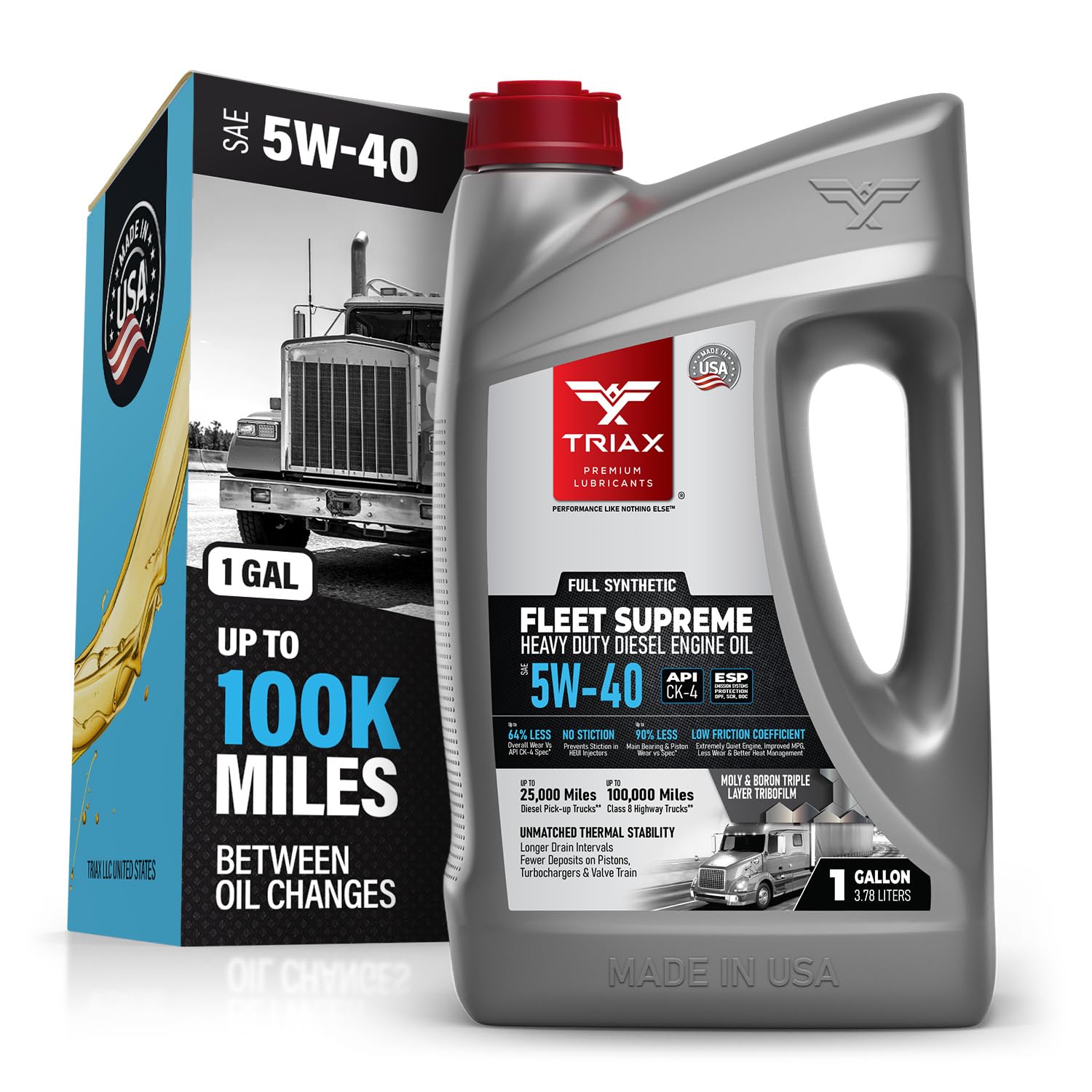
The Triax Fleet Supreme ESP 5W-40 is the quietest diesel synthetic oil we’ve researched across multiple engine platforms. Customers running Duramax, Powerstroke, and Cummins report a noticeable reduction in injector tick and lifter clatter after switching from T6 Rotella or Mobil 1 Turbo Diesel Truck—directly attributable to the proprietary Nano-Boron and moly friction modifier package that achieves a friction coefficient 50% lower than competing CK-4 oils. The flash point of 400°C is exceptionally high, which means this oil resists thermal breakdown under sustained heavy towing or high-EGT conditions better than almost any other 5W-40 at this price tier.
In cold-start scenarios down to -45°F, Triax maintains pumpability that eliminates hard cranking—a 2022 Ram 1500 EcoDiesel user saw the hard-cold-starts disappear overnight when switching from OEM Mopar 5W-40. The extended drain capability is real: Triax claims highway semi trucks can run 100,000 miles and super-duty pickups 30,000 miles between changes, though always confirm with oil analysis before pushing intervals that far. The CK-4 formulation is fully compatible with DPF and SCR systems, so no worry about clogging particulate filters.
What sets Triax apart from the premium-tier Schaeffer and the mid-range Mobil 1 is the combination of extreme cold-flow, long drain, and audible noise reduction at a price point that undercuts boutique specialty oils. For the diesel truck owner who starts in freezing weather, tows on weekends, and wants one oil that does everything well, this is the most balanced pick.
Why it’s great
- Moly and boron friction modifiers stop HEUI injector stiction cold
- Flash point of 400°C means minimal evaporation at high oil temps
- Drain intervals up to 30k miles for pickup trucks with proper oil analysis
Good to know
- Not widely stocked in brick-and-mortar auto parts stores
- Some users report slightly higher oil temps (approx 13°F) vs thinner synthetics
- Requires online ordering for most buyers
2. Schaeffer Manufacturing SynShield 5W-40

Schaeffer’s SynShield OTR Plus 5W-40 carries the highest molybdenum additive concentration of any CK-4 diesel oil we’ve examined, and real-world oil analysis reports confirm it. Customers testing this oil at 10,000 and even 20,000 miles find the moly and TBN levels still well above the wear threshold, making it the top choice for owners who want to push drain intervals far beyond the standard 5,000-7,500 mile recommendation. The 6.7 Cummins and 2020 Powerstroke users in our research describe a noticeable improvement in throttle response and a subjective “more power” feel, likely from reduced internal friction in the valvetrain and ring pack.
The cold-start performance is excellent—one 2005 6.0 Powerstroke owner halved his cranking time after switching from a conventional 15W-40 to Schaeffer’s 5W-40 full synthetic, and the oil stayed visually clean at 3,000 miles. Superior soot-busting and deposit-dispersing capability are baked into the formulation, which is critical for low-emission diesel engines that run hotter and recirculate exhaust gas. Schaeffer also explicitly markets this oil for off-highway and older model diesel engines, so it works across a broader range of equipment than some other premium synthetics.
The trade-off is price. Schaeffer sits at the premium end of the diesel synthetic oil spectrum, and for a standard 12-quart oil change on a heavy-duty pickup, the upfront cost is higher than mid-range options. However, if you factor in the extended drain capability—one user runs it 20,000 miles with filter changes every 5,000—the per-mile cost actually becomes competitive. For the high-mileage driver (50k+ miles per year) or the fleet operator, this oil pays for itself in reduced labor and waste oil disposal.
Why it’s great
- Highest molybdenum additive package found in any CK-4 diesel oil
- Oil analysis confirms safe operation to 20,000 miles
- Works across on-highway, off-highway, and older diesel engines
Good to know
- Premium price per gallon compared to Mobil 1 or Rotella
- May be overkill for short drain intervals under 5,000 miles
- Limited availability outside Amazon and specialty lubricant distributors
3. Delo 400 XSP 5W-40

Chevron’s Delo 400 XSP 5W-40 distinguishes itself with measurable crankcase temperature reductions—customers report oil temps dropping by as much as 30°F in 99°F ambient conditions when running this oil compared to conventional 15W-40 blends. This temperature delta is significant because lower crankcase temperatures reduce thermal stress on seals, bearings, and the turbocharger center section. One user on a Honda GCV160 small engine (diesel-equivalent test) measured an 18°F temperature drop and first-pull starts after switching.
The CK-4 formulation promotes consistent cold engine starting even below zero, and the additive package resists viscosity shear better than some other synthetics. A Mazda CX-5 turbo user (running it as a 5W-30 substitute because it carries SN rating) reported zero oil consumption over 7,500 miles—an indicator of excellent volatility control. Motorcycle owners also report success with Delo 400 XSP, noting buttery shifting and no clutch slip even on 15,000 rpm sport bikes, which suggests the friction modifiers are well-calibrated for wet clutch compatibility.
Where Delo 400 XSP trails the Triax and Schaeffer oils is in friction modification depth: it doesn’t have the same moly/boron boost that quiets injector tick on Duramax and Powerstroke engines as dramatically. It’s also slightly more expensive per gallon than the Mobil 1 Turbo Diesel Truck. But for the diesel owner who prioritizes cooler operating temperatures, excellent cold-start reliability, and proven durability from a major petroleum company, this is a rock-solid synthetic oil.
Why it’s great
- Proven 30°F crankcase temperature reduction under load
- Excellent cold-start pumpability in sub-zero conditions
- Broad compatibility—works in cars, trucks, motorcycles, and small engines
Good to know
- Does not quiet injector clatter as effectively as high-moly oils
- Price per gallon is higher than the budget-friendly Mobil 1
- Some users find it needs more warm-up time for smooth shifting
4. Hot Shot’s Secret Green Diamond 15W-40

Hot Shot’s Secret has built a loyal following in the diesel community for its FR3 nanotechnology lubricant, and the Green Diamond 15W-40 is the full synthetic CK-4 formulation that delivers on the fuel economy promise. An LLY Duramax with 265,000 miles saw MPG jump from 18 to 22 at 70 mph on 33-inch tires—a 22% improvement, though some of that gain is likely from restoring lost efficiency in a high-mileage engine rather than the oil alone. Even conservative estimates place fuel economy improvement at 2-3% versus standard CJ-4 spec oils, which compounds meaningfully over 100,000 miles.
The wear reduction claims are backed by real data: compared to CJ-4 spec oils, Green Diamond reduces component wear by up to 71%, according to the manufacturer. A stock 6.7 Cummins owner running this oil with hard hauling and off-road use reported the additive package remained intact and viscosity unchanged after 14,000 miles. The 15W-40 grade provides strong high-temperature film strength for towing in hot climates, and the higher oil pressure reading (versus Amsoil) noted by a 2017 Cummins user suggests this oil maintains better pump pressure at idle.
The downside: it’s a 15W-40, so cold-start performance below 20°F is not as swift as 5W-40 options like Triax or Schaeffer. Also, one user noted a pungent exhaust smell with the high-zinc additive package—that’s normal for robust anti-wear chemistry but something to be aware of in enclosed spaces. For warm-climate diesel owners who tow regularly and want measurable fuel savings, Green Diamond is a specialized tool that delivers.
Why it’s great
- Real-world fuel economy improvements of 2-3% on modern diesels
- FR3 nanotechnology reduces friction and wear by over 70% vs CJ-4
- Viscosity holds strong even after 14,000 miles of heavy use
Good to know
- 15W-40 grade means slower cranking in freezing temperatures
- Pungent exhaust smell from high zinc additive content
- More expensive than standard Rotella T4 or Mobil 1
5. Mobil 1 Turbo Diesel Truck 5W-40

The Mobil 1 Turbo Diesel Truck 5W-40 is the benchmark mid-range synthetic oil that’s been recommended by fleet managers and diesel mechanics for years. It’s designed for modern low-emission diesel engines and meets the demanding specifications of major truck manufacturers, making it a safe choice for mixed fleet operations where one oil needs to cover multiple engine platforms. The 5W-40 viscosity provides excellent cold-start behavior—customers report firing right up in freezing weather without hesitation, even on vans driven 3,000 miles per week.
What the Mobil 1 lacks in exotic friction modifiers it makes up for in sheer reliability and wide availability. The additive package reduces low-temperature sludge buildup and high-temperature deposits effectively, and the flash point of 234°C is adequate for standard driving conditions. A customer running a 4N15 turbo diesel reported that Mobil 1 made the engine noticeably quieter and smoother than Amsoil 5W-30 Max Duty, and at a significant cost saving. The universal fit designation means it works across truck, car, and van applications without compatibility concerns.
The biggest gap versus premium options like Triax or Schaeffer is in extreme wear protection and extended drain capability. Mobil 1 doesn’t carry the moly/boron friction modifier package that stops injector stiction, and users on Powerstroke and Duramax platforms sometimes report a “ticking” sound that disappears when they switch to high-moly oils. It also lacks the ultra-high TBN needed for 20,000-mile intervals. For standard 5,000-7,500 mile changes in moderate climates, however, this oil is proven and affordable.
Why it’s great
- Decades of proven performance across millions of diesel miles
- Widely available at competitive prices nationwide
- Excellent cold-start behavior for 5W-40 grade synthetic
Good to know
- Does not quiet injector tick as well as high-moly formulations
- Not optimized for extended drain intervals beyond 10,000 miles
- May not provide enough friction reduction for high-mileage engines
6. Royal Purple 15W-40

Royal Purple’s 15W-40 synthetic diesel oil offers a solid entry point for budget-conscious diesel owners who want synthetic protection without the premium price of Triax or Schaeffer. The formulation includes proprietary Synerlec additive technology that Royal Purple claims improves fuel economy and provides better wear protection than conventional oils. A long-term user reported a 3 MPG improvement after switching from a conventional 15W-40, which translates to real fuel savings over time for older diesel trucks and tractors.
The 15W-40 viscosity makes this oil best suited for warmer climates or summer-season operation. It provides good corrosion protection and is compatible with catalytic emission systems, so it won’t harm DPF-equipped trucks. The universal fit type means it works across a range of diesel applications—one verified customer uses it in a Yanmar tractor engine with excellent results. The price point for a gallon jug is consistently among the lowest for full synthetic diesel oil, making it an attractive option for owners of older farm equipment or secondary vehicles that don’t demand the latest CK-4 additive chemistry.
The compromises are clear: Royal Purple 15W-40 is a CJ-4 spec oil, not CK-4, so it lacks some of the improved oxidation resistance and aeration control found in newer formulations. It’s also a 15W-40 only, so cold-weather performance is inferior to 5W-40 options. And while it’s a synthetic oil, it doesn’t carry the heavy moly/boron additive package that serious diesel enthusiasts seek for injector quieting. For the price, though, it’s a reliable synthetic that outperforms conventional diesel oil in every measurable aspect.
Why it’s great
- Lowest price point among full synthetic diesel oils
- Proven fuel economy improvement of up to 3 MPG in some vehicles
- Good corrosion protection for emission system components
Good to know
- CJ-4 specification, not the newer CK-4 standard
- 15W-40 viscosity is thick for cold-start scenarios
- Lacks heavy friction modifier package for injector noise reduction
7. Shell Rotella T4 Triple Protection 15W-40
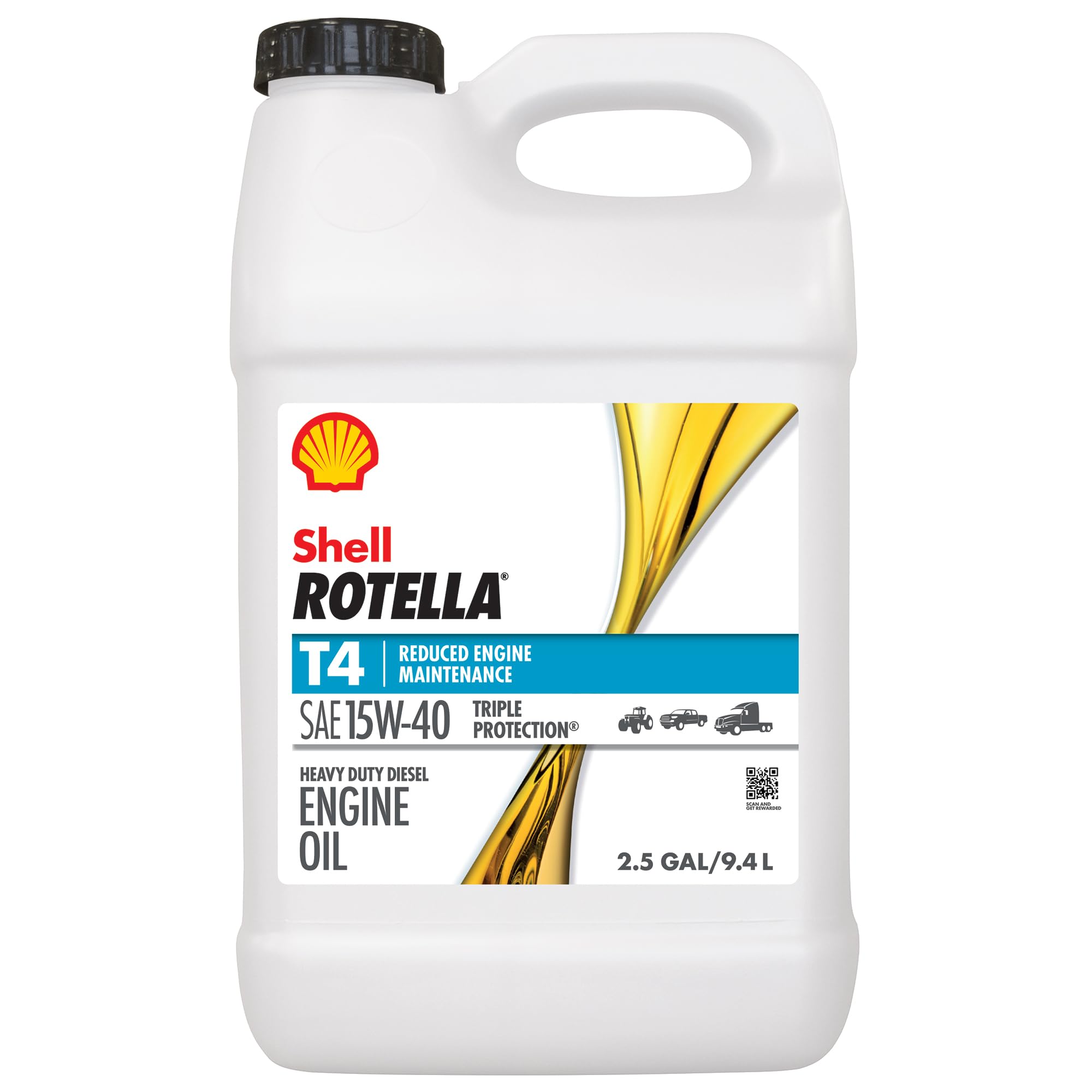
Shell Rotella T4 Triple Protection 15W-40 is the most widely recognized name in diesel oil, and the T4 formulation with advanced additive technology plus synthetic base oil represents an upgrade over the conventional T4. The Triple Protection technology specifically targets wear, deposits, and oil breakdown—the three most common failure modes in heavy-duty diesel engines. The 2.5-gallon jug is perfectly sized for a single oil change on a Ford 7.3 Powerstroke (requiring 15 quarts), making it convenient for DIY owners.
The enhanced shear stability in T4 means better viscosity control under high-pressure conditions, maintaining optimal oil pressure even as the oil ages. The formulation is designed for the latest emission-controlled engines using EGR and diesel particulate filters, so it’s safe for modern trucks. Despite the “synthetic blend” designation rather than full synthetic, the T4 provides significantly better wear protection than previous generation oils, according to Shell’s testing. A 1993 F-250 7.3 owner confirmed the 2.5-gallon size is perfect for that engine, and the oil performed well in a high-mileage platform.
The limitations are that T4 is a synthetic blend, not a full synthetic, so it doesn’t offer the same extreme cold-flow properties, extended drain intervals, or friction reduction as the premium full synthetics in this guide. It’s also 15W-40 only, so cold starts below freezing will require more cranking time. Some customers reported shipping issues with leaking containers, so inspect the jug upon arrival. For the diesel owner running a pre-2007 engine or logging moderate annual miles who wants a trusted name at a budget-friendly price, Rotella T4 remains a solid choice.
Why it’s great
- 2.5-gallon jug perfectly sized for Ford 7.3 Powerstroke and similar engines
- Triple Protection technology guards against wear, deposits, and breakdown
- Enhanced shear stability maintains oil pressure longer
Good to know
- Synthetic blend, not full synthetic—shorter drain intervals required
- 15W-40 viscosity struggles in sub-freezing temperatures
- Container lid can leak during shipping if box is stored on its side
FAQ
Can I use 5W-40 diesel synthetic oil in an engine that specifies 15W-40?
How often should I change full synthetic diesel oil?
What causes injector stiction in diesel engines and can oil fix it?
Is synthetic blend diesel oil good enough for my truck?
Does diesel synthetic oil improve fuel economy in a diesel pickup?
Final Thoughts: The Verdict
For most users, the best diesel synthetic oil winner is the Triax Fleet Supreme ESP 5W-40 because it combines extreme cold-flow down to -45°F, injector-quieting moly and boron chemistry, a 400°C flash point for thermal stability, and extended drain capability—all at a mid-range price that doesn’t require a second mortgage. If you want the highest moly content and proven 20,000-mile drain intervals, grab the Schaeffer SynShield 5W-40. And for measurable fuel savings in warm climates with frequent towing, nothing beats the Hot Shot’s Secret Green Diamond 15W-40.

Mo Maruf
I created WellFizz to bridge the gap between vague wellness advice and actionable solutions. My mission is simple: to decode the research and give you practical tools you can actually use.
Beyond the data, I am a passionate traveler. I believe that stepping away from the screen to explore new environments is essential for mental clarity and physical vitality.