Our readers keep the lights on and my smoothie glass nicely filled. As an Amazon Associate, I earn from qualifying purchases.
Upgrading from a noisy, cogging gear-driven wheel to a direct drive base is the single biggest leap in sim racing fidelity you can make. The difference isn’t subtle—it’s the difference between feeling a tire’s slip angle through your palms versus just knowing the car understeered. A direct drive motor connects you to the virtual road with zero mechanical slack, delivering force feedback that is instant, linear, and far more detailed than any belt or gear system can muster.
I’m Mohammad Maruf — the founder and writer behind WellFizz. For this guide, I’ve spent countless hours analyzing torque curves, encoder resolutions, ecosystem compatibility, and thermal management across the leading direct drive wheel base options, from entry-level bundles to pro-grade standalone units.
Whether you race on console or PC, drift in Assetto Corsa, or chase lap times in iRacing, finding the best direct drive wheel bases requires matching Newton-meters of torque to your rig’s rigidity, your sim of choice, and your budget for a complete ecosystem.
How To Choose The Best Direct Drive Wheel Bases
Selecting a direct drive wheel base is a multi-year investment that ties your entire sim rig together. The wrong choice can limit your choice of wheel rims, pedals, or even which games you play. The right choice will serve as the foundation for years of immersive racing. Below are the critical factors that separate a well-informed purchase from a regrettable one.
Torque (Nm) vs. Your Rig’s Rigidity
Torque output, measured in Newton-meters (Nm), directly determines how much force the base can exert on your hands. A 3.9Nm base is excellent for desk-clamp setups, providing enough detail without shaking your monitor. A 12Nm base, however, will flex a cheap desk to the point of vibration and noise; it demands a dedicated aluminum-profile rig (at least 40x80mm extrusions) to feel solid. Always match your torque target to the structural integrity of your mounting solution.
Encoder Resolution and Smoothness
High torque does not automatically equal smooth force feedback. The encoder—a sensor that tells the motor your exact steering angle—determines the granularity of the feedback loop. Cheaper bases use lower-resolution magnetic encoders that introduce a subtle “graininess” in center feel. Premium bases use 20-bit or higher optical or high-precision Hall-effect encoders, which eliminate stepping and allow the motor to apply micro-corrections that feel like a real steering rack. Look for bases that advertise at least a 16-bit encoder as a baseline for smooth fidelity.
Ecosystem Lock-In: QR, Rims, and Pedals
Every major brand (MOZA, Fanatec, Logitech G, Thrustmaster) uses a proprietary quick-release (QR) mechanism and electrical pinout for wheel rims. If you buy a MOZA base, you are largely limited to MOZA’s wheel rims (unless you use third-party USB adapters, which add latency and cable mess). Similarly, pedal sets and shifters often plug directly into the base for reduced cable clutter—but only within the same brand. Before choosing a base, confirm that the brand’s rim lineup and pedal ecosystem fits your long-term racing plans (e.g., GT, Formula, round for drifting).
Console Compatibility vs. PC-Only
If you race on PlayStation or Xbox, your base options narrow significantly. PlayStation compatibility typically requires an official license from Sony (Fanatec DD Pro, Logitech RS50, Thrustmaster T598). Xbox compatibility depends on the wheel rim attached—some bases are Xbox-ready only when a licensed Xbox rim is connected (MOZA R3 bundle works this way). PC is the most open platform, supporting virtually every direct drive base. Never assume a base works with your console; check the “Compatible Devices” field in the tech specs before purchasing.
Thermal Management and Sustained Performance
Direct drive motors generate substantial heat during long stints—especially with high-torque bases and high-detail FFB profiles. Passive cooling (large aluminum heatsinks) is silent but can lead to thermal throttling during extended 30-minute-plus sessions in hot rooms. Active cooling (internal fans) maintains consistent torque but adds a noise floor that some sim racers find distracting. Review thermal design carefully if you plan to race endurance events (like 24h of Nürburgring) or if your rig is in a room without climate control.
Quick Comparison
On smaller screens, swipe sideways to see the full table.
| Model | Category | Best For | Key Spec | Amazon |
|---|---|---|---|---|
| MOZA R12 V2 | Mid-Range | High-torque Fidelity | 12Nm torque, 280MHz processor | Amazon |
| Logitech G RS50 | Mid-Range | PS5/PC Seamless | 8Nm peak torque, TRUEFORCE | Amazon |
| Fanatec Gran Turismo DD Pro | Premium | GT7 on PS5 | 5Nm FluxBarrier DD (upgradable to 8Nm) | Amazon |
| Thrustmaster T598 | Mid-Range | PS5/PS4 + Console Ecosystem | 5Nm constant, +100% peak overshoot | Amazon |
| PXN VD6 Bundle | Entry-Level | Budget PC Sim Racing | 6Nm cont. / 7Nm peak, Sense+ algorithm | Amazon |
| MOZA R3 Bundle | Entry-Level | Xbox + PC Beginner | 3.9Nm DD, 11-inch round wheel | Amazon |
In‑Depth Reviews
1. MOZA R12 V2 Direct Drive Sim Racing Wheelbase
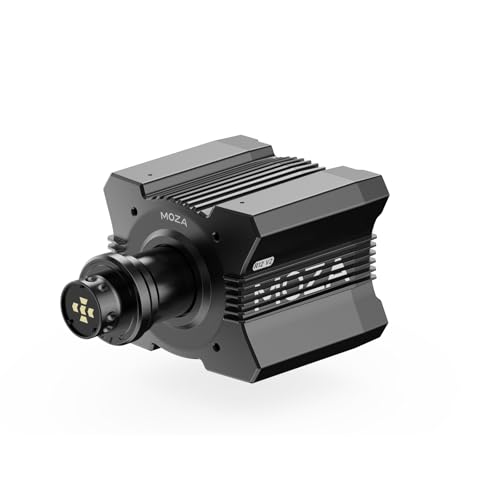
The R12 V2 hits the sweet spot of torque that serious sim racers crave without crossing into the unwieldy, rig-cracking territory of 20Nm+ units. Its 12Nm servo motor uses a slanted-pole design that yields ultra-low torque ripple—meaning the force feedback feels consistently smooth across the entire rotation range, not just at center. The integrated industrial slip ring, rated for over 5 million revolutions, enables infinite wheel rotation while maintaining a clean signal path to the rim, a critical detail for drift and rally drivers who spin the wheel full lock repeatedly.
MOZA’s ecosystem compatibility is a major advantage here. The R12 V2 works with the full MOZA wheel rim lineup (including the CS, GS, and RS ranges) via the company’s quick-release system, and the Pit House software provides granular control over FFB curves, rotation limits, and game profiles. The base is passively cooled via its aviation-grade aluminum housing, which means zero fan noise during long sessions—but under sustained 12Nm load in a warm room, thermal management becomes a consideration.
Of course, 12Nm is serious force. You absolutely need a rigid aluminum-profile cockpit (not a desk clamp) to prevent the base from shaking your rig apart. The R12 V2 also lacks console support out of the box—it is a PC-native base, though MOZA offers Xbox compatibility via specific wheel rim attachments. For PC sim racers who want high-fidelity, smooth, and detailed FFB with a scalable ecosystem, this is the reference point.
Why it’s great
- 12Nm of clean, low-ripple torque delivers exceptional detail and headroom.
- Passive cooling means silent operation, ideal for noise-sensitive setups.
- Aviation-grade aluminum construction and 5M-revolution slip ring ensure long-term durability.
Good to know
- Requires a dedicated, rigid cockpit—desk clamps and wheel stands are inadequate for 12Nm.
- Console support is limited; primarily a PC-focused base.
- Heatsink can become hot to the touch during extended high-torque sessions.
2. Logitech G RS50 Racing Wheel, Hub, and Base for PS5/PS4/PC
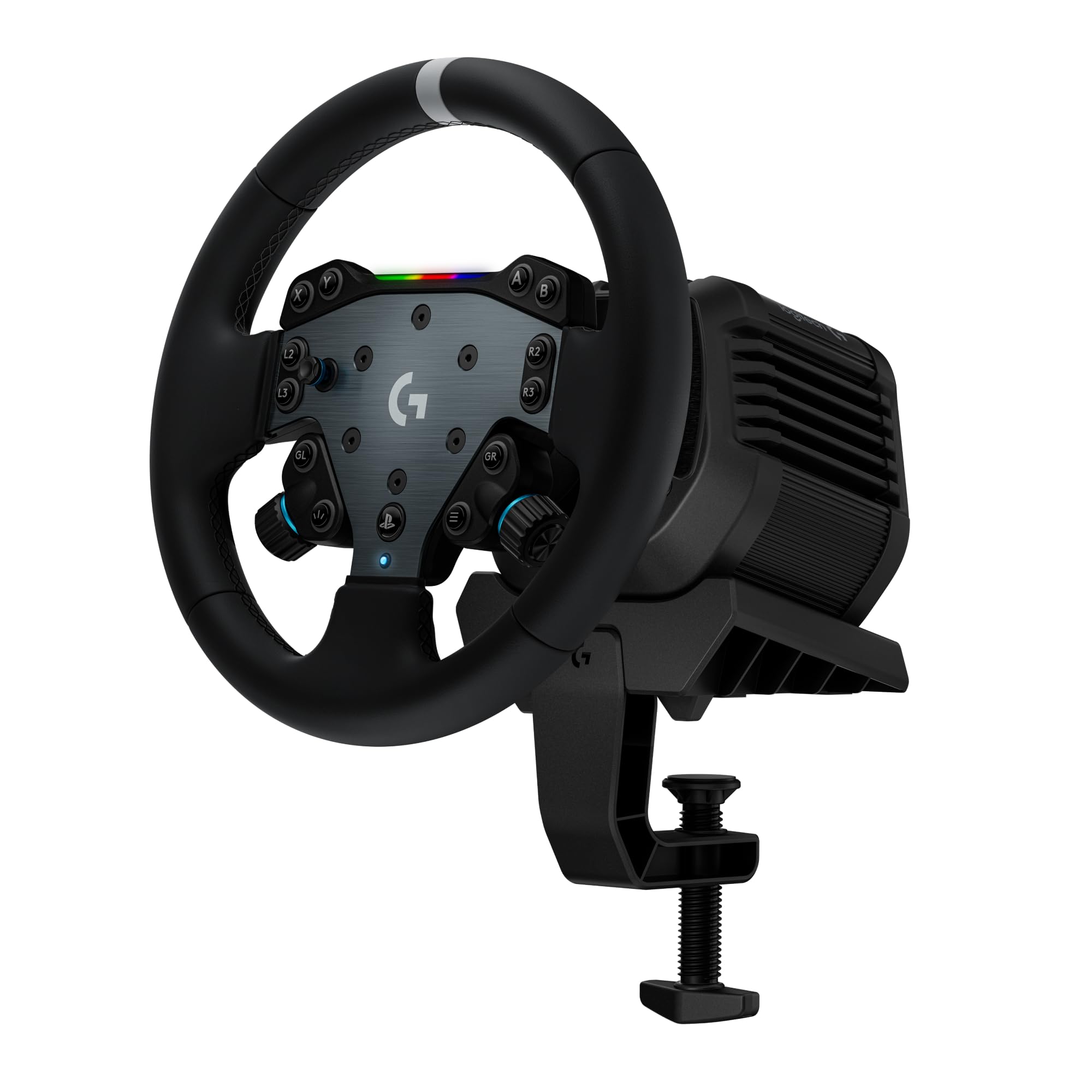
The RS50 is Logitech’s direct answer for console racers who want DD fidelity without leaving the PlayStation ecosystem. Its 8Nm peak torque is managed through Logitech’s proprietary TRUEFORCE technology, which processes game audio and telemetry data in real-time to produce force feedback that feels responsive in nuance—like gravel texture changes mid-corner—rather than just reacting to wheel slip. The base is whisper-quiet during operation, a strong departure from the gear-driven whine of the older G-series wheels.
Logitech designed the RS50 around modularity. The included RS Wheel Hub accepts various RS and PRO-series rims via a quick-release system, and the 11-inch round wheel (covered in high-performance silicone leather) is ideal for rally and drifting due to its full grip and rapid rotation capability. The bundle includes a table clamp and full mounting hardware for cockpits. On the software side, G-Hub provides comprehensive FFB tuning, though some users report occasional profile resets that require a full software reinstall to fix.
That said, the 8Nm peak torque is less than what the MOZA R12 V2 offers, and the RS50 ecosystem is narrower than MOZA’s or Fanatec’s—fewer rim options, no dedicated Formula-style wheel at this writing. The base also relies on active cooling (a fan), which is audible in a quiet room. But for PS5 owners who want plug-and-play console direct drive with a strong, detailed FFB signature, the RS50 is the benchmark.
Why it’s great
- TRUEFORCE delivers exceptional game-specific force feedback detail and realism.
- Extremely quiet operation—almost silent compared to belt or gear-driven wheels.
- Native PS5/PS4 support with full console functionality including button maps and menus.
Good to know
- 8Nm peak torque is mid-range; may leave experienced racers wanting more headroom.
- G-Hub software can be glitchy; occasional profile corruption requires reinstall.
- At the higher end of the mid-range price tier without including pedals in the bundle.
3. Fanatec Gran Turismo DD Pro

The Gran Turismo DD Pro is the officially licensed direct drive base for Polyphony Digital’s Gran Turismo 7, and that integration shows. The 280mm steering wheel, co-designed with Polyphony, features a compact diameter that suits GT7’s car list perfectly, with four 5-way directional sticks mapped to traction control, brake balance, torque split, and fuel mapping adjustments on the fly. The 5Nm FluxBarrier motor (upgradable to 8Nm with a separate power supply) delivers a linear, consistent FFB curve with minimal cogging, making it feel precise and predictable lap after lap.
Fanatec’s ecosystem is vast—compatible with over a dozen wheel rims (Formula, round, GT, drift), all pedal sets, and the ClubSport shifter and handbrake. The quick-release system is robust and widely adopted by third-party rim manufacturers. The base is passively cooled via its aluminum housing, so it stays silent even during long GT7 endurance races. Setup requires a one-time connection to a PC for firmware updates and center calibration, but once configured, it works plug-and-play with PS5.
On the downside, the 5Nm stock torque feels underpowered for experienced sim racers who want strong, immersive feedback—the 8Nm power supply upgrade is almost mandatory for serious use. The base does not include mounting screws for cockpits, which is an oversight given the price. For GT7 players who value console-native integration and a massive ecosystem, this is the definitive choice, but prepare for the upgrade cost to unlock its full potential.
Why it’s great
- Official PlayStation license guarantees full compatibility with GT7 and all PS5/PS4 racing titles.
- FluxBarrier motor technology provides exceptional linearity and smoothness for a DD at this level.
- Massive Fanatec ecosystem of rims, pedals, and shifters offers unmatched upgrade paths.
Good to know
- 5Nm base torque is entry-level; the 8Nm power supply upgrade is expensive and sold separately.
- Comes with a 2-pedal set; a load cell brake pedal upgrade is strongly recommended for consistency.
- Does not include cockpit mounting screws; you must source these separately.
4. Thrustmaster T598 Servo Base
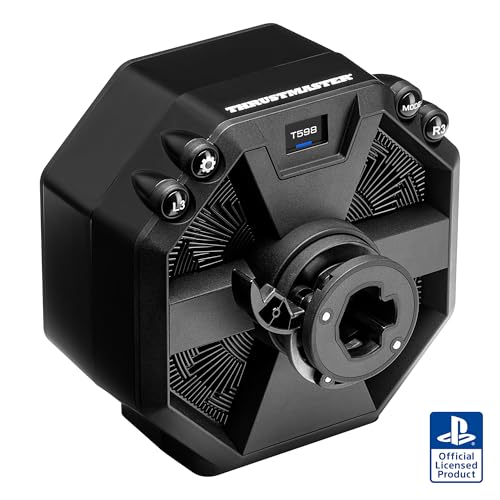
Thrustmaster’s T598 introduces a unique approach to direct drive with its “Direct Axial Drive” motor that delivers a constant 5Nm of torque but with an overshoot capability of +100%, meaning instantaneous effects like curbs, collisions, and gear shifts can hit with double the sustained torque momentarily. Combined with HARMONY technology, which maintains high-frequency vibration detail, the T598 can communicate subtle road texture and tire slip that lower-resolution DD bases miss. The integrated Race Dash screen on the base shows FFB settings and game data without needing a separate display.
Console support is a strong point: the T598 works natively with PS5, PS4, and PC, and is compatible with the extensive Thrustmaster ecosystem of wheel rims (including the T300/T500 adapters), pedal sets, shifters, and handbrakes. The base mounts to cockpits via four underside attachment points, and a separate desk clamp kit (sold separately) is available. The 5Nm base torque is well-suited for desk-clamp users who want DD performance without overwhelming a desktop.
However, reliability is a concern. Multiple user reports describe setup difficulties where throttle and brake inputs failed to map correctly, and intermittent USB connectivity issues led to frustrating disconnects mid-race. The T598’s load cell brake upgrade is also expensive relative to the base. For PS5 users who want a dedicated DD base with unique FFB overshoot technology, the T598 is intriguing, but the reliability track record should give buyers pause.
Why it’s great
- +100% overshoot capability creates powerful, impactful transient effects (curbs, collisions).
- HARMONY technology delivers high-frequency detail that enhances immersion.
- Integrated Race Dash screen allows on-the-fly FFB adjustments and telemetry display.
Good to know
- Multiple reports of unreliable connectivity and complex initial setup.
- 5Nm constant torque feels low-mid range; the overshoot is not sustained torque.
- Desk clamp sold separately, increasing initial investment.
5. PXN VD6 Bundle
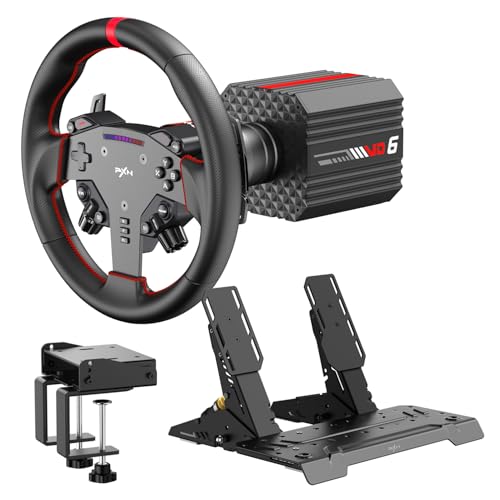
The PXN VD6 bundle is a compelling entry into direct drive for PC sim racers on a tight budget. The 20-pole low-inertia servo motor delivers 6Nm continuous and 7Nm peak torque—more than enough to provide a significant upgrade over gear-driven wheels like the Logitech G923—and the 24-bit high-precision encoder ensures smooth, stepping-free feedback. The Sense+ algorithm processes road surface and tire slip data to deliver FFB that feels detailed rather than binary, which is rare at this price point.
The bundle includes a complete system: the VD6 base, an 11-inch round wheel with 19 programmable buttons, two rotary encoders, four paddle shifters (two linear, two tactile), an RGB telemetry light bar, a full-metal Hall-effect 2-pedal set (throttle, brake, clutch), and a desk clamp. The quick-release system is compatible with PXN’s VD-series wheels, and the PXN SimRacing software allows full customization of FFB, button mapping, and pedal curves. The inclusion of a clutch pedal is a standout feature at this tier—most budget bundles omit it.
That said, the VD6 is PC-only (no console support), and the 11-inch wheel diameter may feel small for drivers accustomed to full-size round rims. Some users report USB connectivity issues with external shifters. The ecosystem is limited compared to big brands; aftermarket rim support requires third-party mods (e.g., Acelith). For PC sim racers entering the DD world who want a complete, high-value kit with strong build quality, the VD6 bundle is excellent.
Why it’s great
- 6Nm continuous torque with a 24-bit encoder provides smooth, detailed FFB at an entry-level price.
- Full bundle includes wheel, base, pedals with clutch, and desk clamp—ready to race out of the box.
- Hall-effect sensors on pedals ensure long-term accuracy without contact wear.
Good to know
- PC only—no compatibility with PlayStation or Xbox consoles.
- The 11-inch wheel diameter may feel small for drifting or rally driving.
- Ecosystem is limited; aftermarket rim support requires third-party modifications.
6. MOZA R3 Racing Wheel and Pedals Bundle for Xbox & PC

The MOZA R3 is the most accessible direct drive entry point for Xbox players who want to leave gear-driven wheels behind. Its 3.9Nm DD motor, while modest by torque standards, produces ultra-low torque ripple that delivers a cleaner, more connected feel than the cogging of belt-driven equivalents. The 11-inch round wheel features ISF PU grips for sweat resistance and 22 programmable buttons, which is an unusually high button count for an entry-level wheel and provides plenty of mapping space for complex sims like iRacing or Assetto Corsa.
This bundle is designed for simplicity: everything needed to race—base, wheel, Hall-effect two-pedal set, and a 5mm CNC machined steel desk clamp—is included. The pedals use high-strength steel construction for rigidity and a Hall sensor for consistent input. The MOZA Pit House software allows FFB tuning, rotation adjustment, and game profile management across PC and mobile, although the mobile app can be inconsistent. The race-level quick-release system is the same used on MOZA’s higher-end bases, meaning you can upgrade the wheel rim later.
The primary limitation is torque. At 3.9Nm, the R3 is best suited for desk-clamp setups, and experienced sim racers may outgrow it quickly. Xbox mode also restricts button mapping and requires specific firmware. The brake pedal feels soft (a load cell upgrade is not available for this pedal set). For Xbox owners taking their first step into direct drive, the R3 is a fantastic, affordable gateway that preserves the MOZA upgrade path to stronger bases later.
Why it’s great
- Class-leading entry price for an Xbox-compatible direct drive bundle with a full ecosystem.
- 22-button wheel provides extensive mapping options for complex simulation titles.
- Racing-level quick-release system is compatible with MOZA’s upper-tier wheel rims for future upgrades.
Good to know
- 3.9Nm torque is low; experienced racers will quickly want a higher-torque base.
- Xbox mode has limited button mapping and requires careful firmware management.
- Brake pedal lacks load cell feel; soft pedal feel reduces braking consistency.
7. Next Level Racing F-GT Elite 160 Wheel Plate Edition

While not a wheel base itself, the F-GT Elite 160 is the structural foundation that a high-torque direct drive base demands. Built from custom 160mm x 40mm anodized aluminum profiles and powder-coated carbon steel brackets, it offers zero flex under forces up to 20Nm+—making it future-proof for even the most powerful consumer direct drive bases. The cockpit supports multi-position ergonomics spanning Formula, GT, Hybrid, Truck, and Tank seating positions, a critical feature for sim racers who switch between disciplines.
The pre-drilled universal mounting pattern accepts all major steering wheel base brands (MOZA, Fanatec, Logitech, Thrustmaster, Simagic, etc.) without adapter plates. The wheel plate design itself allows precise angle and distance adjustment, though setting it up optimally is best done with two people due to the weight of the profiles. The rigid structure eliminates the chassis flex that can mask subtle force feedback details, allowing a 12Nm base to communicate micro-details you’d miss on a flexible rig.
Assembly is a significant project (4-5 hours for first-time builders) and the rig is extremely heavy (over 140 lbs before adding a seat, base, and pedals). Some users report that the instruction manual could be clearer, and adjustments require tools rather than quick-release levers. The high cost may be prohibitive for casual racers. For serious sim racers who want a single, rock-solid cockpit that won’t limit future upgrades, the F-GT Elite 160 is the definitive choice.
Why it’s great
- 160mm x 40mm profiles eliminate all flex, even with 20Nm+ direct drive bases.
- Universal pre-drilled pattern accepts every major wheel base brand out of the box.
- Multi-position design (Formula to Truck) accommodates wide variety of simulation disciplines.
Good to know
- Assembly is complex and time-consuming (4-5 hours); initial setup requires patience.
- Extremely heavy; moving the rig or adjusting wheel plate angle is a two-person job.
- Cost is high; it is a premium investment for dedicated sim racers only.
8. Wahoo KICKR V6 Smart Indoor Trainer

The KICKR V6 is the flagship direct-drive smart trainer for cyclists who demand realistic road feel and precise power measurement. The high-inertia flywheel combined with the KICKR AXIS feet creates a side-to-side rocking motion that mimics real-world bike handling—a significant immersion advantage over static trainers. The unit delivers over 2,200 watts of resistance accurate to within +/- 1%, and automatic calibration means you never need to worry about drift during structured training sessions.
Connectivity is robust: integrated 2.4 GHz WiFi provides instant data syncing with Zwift, TrainerRoad, Rouvy, and SYSTM, while ANT+ and Bluetooth are available for older devices. The unit is remarkably quiet, with only the sound of the drivetrain audible—your breathing will be the loudest part of a session. The included KICKR AXIS feet and stiff/easy foot options allow fine-tuning of lateral flex to match your outdoor bike’s feel.
On the downside, the KICKR V6 is a premium product with a large footprint, and it only makes sense for cyclists who commit to indoor training year-round. WiFi setup can be finicky, sometimes requiring you to disconnect your phone from WiFi first. For weight weenies, the unit is heavy (48.5 lbs). For serious cyclists who want the best direct-drive experience with seamless software integration and realistic ride feel, the KICKR V6 remains the gold standard.
Why it’s great
- Exceptional road feel through high-inertia flywheel and AXIS feet side-to-side movement.
- Precision power measurement (+/- 1%) requires no manual calibration.
- WiFi connectivity provides fast, stable data transfer during Zwift races and workouts.
Good to know
- High price and large footprint; it is a serious investment for dedicated indoor cyclists.
- WiFi setup can be initially tricky, requiring correct network configuration.
- Heavy unit (48.5 lbs); not easily portable for travel or storage.
9. Garmin Tacx Neo 2T Smart Trainer

The Tacx Neo 2T is renowned for being virtually silent—even under high-load sprint efforts, the only sound you’ll hear is the chain and rear tire. This is achieved through its magnetic resistance system using 32 neodymium magnets, which eliminates the mechanical contact that creates noise in other trainers. The Neo 2T also features Dynamic Inertia, which simulates the weight and momentum of real riding—heavier flywheel feel at speed, lighter feel at low speed—for an exceptionally natural pedaling sensation.
Power accuracy is excellent (claimed within +/- 1%), and the unit measures both power output and left/right pedal balance (a useful data point for cyclists addressing leg imbalances). Built-in cadence and speed sensors eliminate the need for external sensors. The Neo 2T folds compactly for storage and includes front wheel support. It works seamlessly with Zwift, TrainerRoad, and Garmin’s own Tacx Training app via ANT+, Bluetooth, and WiFi. The unit also simulates road surfaces (cobblestones, boardwalk) through subtle vibrations in the flywheel mechanism, adding a layer of immersion that other trainers lack.
The main trade-off is price—the Neo 2T sits at the top of the consumer trainer market, and it requires a correctly spaced cassette (Shimano/SRAM 8-11 speed) for setup. Some users report needing an extra spacer for certain framesets. For cyclists who prioritize quiet operation, realistic road feel through dynamic inertia, and a premium, reliable package, the Neo 2T is a standout choice.
Why it’s great
- Whisper-quiet magnetic resistance ensures silent indoor training.
- Dynamic Inertia provides remarkably natural flywheel feel—heavy at speed, light when climbing.
- Road surface simulation (cobblestone, boardwalk) adds haptic feedback immersion.
Good to know
- Premium price point; it is an investment for serious cyclists only.
- Requires correct cassette spacing; some frames may need additional spacers for proper alignment.
- Folds for storage but remains a large, heavy unit.
10. Minoura MagTurboDirectDrive MD640

The Minoura MD640 is a non-smart direct drive trainer built for simplicity, quietness, and reliability. Unlike smart trainers that rely on electronic resistance control, the MD640 uses a manual 7-stage dial load adjustment system—you turn the knob to increase or decrease resistance. This makes it ideal for cyclists who want a simple, maintenance-free trainer without the complexity of WiFi pairing, firmware updates, or subscription fees. It is compatible with Shimano-style 8/9/10/11-speed cassettes and both quick-release and thru-axle standards.
The direct drive design eliminates tire wear and noise associated with wheel-on trainers, and the magnetic resistance system is notably quiet—many users report it being the quietest trainer they’ve used, with only chain noise audible. The folding legs make it compact for storage, and the earthquake-treatment adjuster legs ensure stability even during hard efforts. The included speed sensor works with basic cycling computers for speed and cadence data (though it lacks power measurement).
The major drawback is the lack of smart connectivity—no automatic resistance adjustment via Zwift, no power data, and no ERG mode for structured training. You also need to purchase a compatible cassette, tools, and quick-release separately, which increases the initial investment. Quality control has been inconsistent; some units arrive with assembly defects or non-functioning sensors. For budget-conscious cyclists who want a quiet, simple direct drive trainer for manual resistance training without smart features, the Minoura MD640 gets the job done affordably.
Why it’s great
- Exceptionally quiet magnetic direct drive design—ideal for apartment living or shared spaces.
- Simple 7-stage manual load dial requires no software, subscriptions, or power supply management.
- Compact folding legs make it easy to store between sessions.
Good to know
- No smart connectivity: no app integration, no power data, no automatic resistance.
- Cassette, tools, and quick-release skewer are not included; you must source these separately.
- Quality control varies; some units arrive with assembly defects or non-functional sensors.
11. Wahoo Fitness KICKR CORE 2 ZWIFT COG and Click
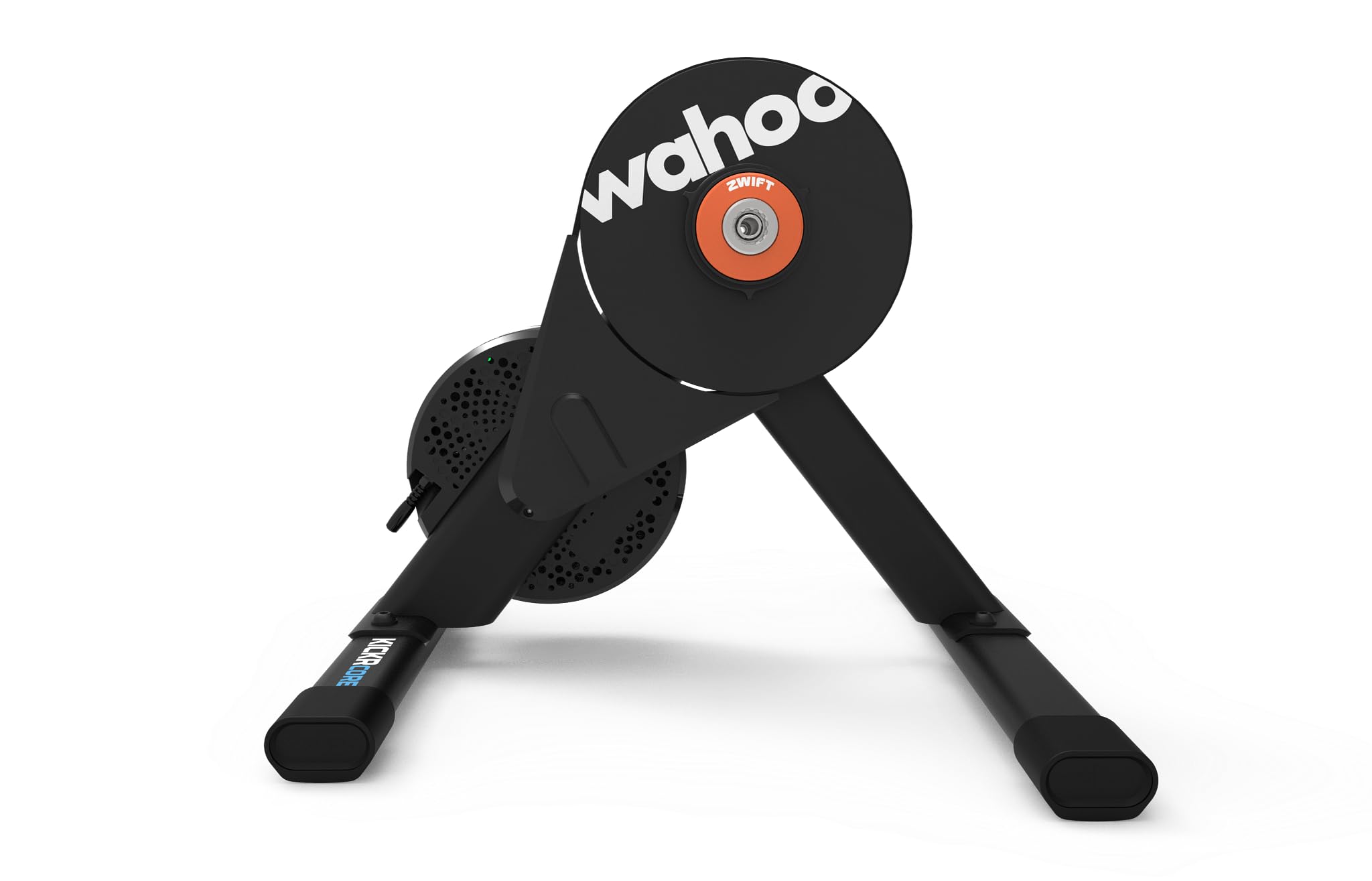
The KICKR CORE 2 is an evolution of the original CORE and a direct competitor to the KICKR V6, but at a more accessible price point while retaining the legendary KICKR ride feel. It delivers similar smooth resistance and road-like feel as the V6 but with a simpler setup: integrated WiFi for faster pairing and automatic firmware updates, and the Zwift Click and Cog system enables virtual shifting without needing a physical cassette. This makes the CORE 2 ideal for Zwift users who want a hassle-free, clean setup—no cassette to install, no chain alignment to worry about.
The unit is built on a sturdy alloy steel frame, supports up to 220 lbs load capacity, and is compatible with both quick-release and thru-axle bikes via included adapters. Power accuracy is maintained via automatic calibration. The Zwift Click works smoothly for virtual gear changes (simulating up to 20 gears) once the Zwift subscription is active. The trainer pairs instantly with the Zwift Companion app and supports ANT+ and Bluetooth for HR monitors and other accessories.
The biggest catch is the subscription requirement: the Zwift Click and Cog virtual shifting system only functions with a Zwift subscription (/month or /year). Without it, you’re stuck pedaling in a single mid-range gear. Some users report difficulty getting the virtual shifting to register even after subscribing, though updates have improved this. For Zwift subscribers who value simplicity, quiet operation, and a tidy drivetrain-free setup, the KICKR CORE 2 with Zwift Cog is a polished, low-fuss solution.
Why it’s great
- Virtual shifting via Zwift Click means no cassette to install or chain noise to manage.
- Integrated WiFi provides fast, reliable data syncing and automatic firmware updates.
- Legendary KICKR ride feel delivers smooth, realistic resistance for structured training.
Good to know
- Requires a Zwift subscription for virtual shifting; without subscription, only works in single mid-range gear.
- Some users report the Click shifting mechanism can be unreliable or fail to register shifts.
- No built-in power meter for standalone use outside Zwift-compatible apps.
FAQ
What is the difference between direct drive and belt-driven wheel bases?
How much torque (Nm) do I need for sim racing?
Can I use a direct drive wheel base on PlayStation or Xbox?
Do I need a load cell brake pedal for direct drive?
What rig or cockpit do I need for a high-torque direct drive base?
Final Thoughts: The Verdict
For most sim racers, the best direct drive wheel bases winner is the MOZA R12 V2 because it delivers a superb balance of smooth, detailed 12Nm torque with passive cooling and a strong ecosystem at a price that undercuts the competition significantly. If you need native PlayStation compatibility and TRUEFORCE game integration, grab the Logitech G RS50. And for a complete entry-level bundle with Xbox support that gets you on track immediately, nothing beats the MOZA R3 Bundle.

Mo Maruf
I created WellFizz to bridge the gap between vague wellness advice and actionable solutions. My mission is simple: to decode the research and give you practical tools you can actually use.
Beyond the data, I am a passionate traveler. I believe that stepping away from the screen to explore new environments is essential for mental clarity and physical vitality.