Our readers keep the lights on and my smoothie glass nicely filled. As an Amazon Associate, I earn from qualifying purchases.
A microbe bloom in your diesel tank turns clean fuel into a sludgy, corrosive mess that clogs filters and stalls engines. You need a biocide that actually penetrates the water layer where the bacteria breed—not just a stabilizer that masks the problem.
I’m Mohammad Maruf — the founder and writer behind WellFizz. This guide comes from hundreds of hours analyzing lab reports, customer field tests, and concentration ratios for diesel fuel biocides so you can pick the right algae killer without guesswork.
After reviewing each formula’s active chemistry and real-world dosing data, I’ve ranked the top solutions to help you find the absolute best diesel algae killer for your tank, equipment, and storage needs.
How To Choose The Best Diesel Algae Killer
Killing algae in diesel isn’t the same as adding a lubricity booster. You need a product that targets the microbial colony living at the fuel‑water interface. Here are the three most important factors to consider before buying.
Dual‑Phase Effectiveness
Microbes grow in the water layer at the bottom of your tank. A single‑phase additive that only mixes with fuel won’t reach them. Look for a biocide labeled “dual‑phase” or one that is effective in both diesel fuel and water — this ensures the active ingredient migrates down to kill the colony at its source.
Concentration and Treatment Volume
Each product has a specific dose expressed as gallons treated per ounce. A 16‑ounce bottle that treats 1,280 gallons is far more concentrated than one that only covers 300 gallons. Match the treatment volume to your typical tank size to avoid waste or under‑dosing. A shock dose for an active bloom usually requires 2–3 times the maintenance rate.
EPA Registration and Warranty Compliance
Major diesel engine manufacturers often recommend only EPA‑registered biocides for warranty compliance. Check the product label for EPA registration numbers. An unregistered “fuel cleaner” may not actually kill microbes — it might just disperse sludge temporarily, allowing the bloom to return.
Quick Comparison
On smaller screens, swipe sideways to see the full table.
| Model | Category | Best For | Key Spec | Amazon |
|---|---|---|---|---|
| Power Service Bio Kleen 09016-09 | Biocide | Shock dose & dual‑phase kill | Dual‑phase, 16 oz | Amazon |
| Power Service 09280-06 Clear Diesel | Cleaner | Post‑biocide tank flush | 80 oz, water dispersant | Amazon |
| FPPF Killem 00119 | Biocide | High‑volume tank treatment | Treats 1,280–1,920 gal | Amazon |
| Hot Shot’s Secret Fuel Duo | Kit | Clean + boost combo | 2× 16 oz, cetane boost | Amazon |
| Star Tron Enzyme Diesel | Enzyme | Preventive stabilization | 8 oz, 2‑year storage | Amazon |
In‑Depth Reviews
1. Power Service Bio Kleen Diesel Fuel Biocide 09016-09

This is the gold standard for killing an active microbial bloom. Power Service’s Bio Kleen is formulated as a dual‑phase biocide, meaning it works in both the diesel fuel layer and the water layer where algae and bacteria actually thrive. A single 16‑ounce shock dose can clear a heavy infestation in one treatment — users report black filters clogging with dead biomass within minutes of running the treated fuel.
It is recommended by major diesel engine manufacturers because the active chemistry is EPA‑registered and fully compatible with Ultra Low Sulfur Diesel (ULSD) and biodiesel blends. The lack of alcohol in the formula means it won’t attack seals, injectors, or fuel lines. For farm tractors, RV tanks, or bulk storage, this is the go‑to when you need results fast.
One bottle treats roughly 300 gallons at maintenance dosing, but for an active bloom you’ll want to double the dose. Pair it with Power Service’s Clear Diesel cleaner to flush out dead sludge after treatment. The only real downside is the smaller coverage per bottle compared to cheaper concentrates, but the effectiveness justifies the premium.
Why it’s great
- True dual‑phase kills microbes in water layer
- EPA‑registered, major OEM recommended
- Alcohol‑free and safe for ULSD systems
Good to know
- Shock dose uses 2–3 oz per 100 gallons
- Expect to change filters after first treatment
2. Power Service Clear Diesel Fuel & Tank Cleaner 09280-06

Clear Diesel is not a biocide itself — it is a tank and fuel system cleaner designed to be used after you kill the algae. It works by dispersing the water, sludge, and dead microbial debris left behind after a biocide shock dose. If you skip this step, the dead biomass will plug your filters within the first 50 miles of driving.
The 80‑ounce bottle is a generous size for multiple treatments, and the formula is effective in ULSD, biodiesel, and blends. It contains no alcohol, so it won’t dry out seals or O‑rings. Users with storage tanks and heavy equipment report that a single bottle cleared up repeated filter plugging issues after just one fill‑up.
This product also offers “Petro Fresh” stabilizers that keep stored fuel viable for long periods — making it a dual‑purpose option for seasonal equipment storage. The biggest caveat is that you still need a primary biocide like Bio Kleen to actually kill the microbes first. Clear Diesel does the mopping up.
Why it’s great
- Clears dead sludge after biocide treatment
- Works with ULSD and biodiesel blends
- Large 80 oz container for multiple uses
Good to know
- Not a standalone biocide — kills nothing alive
- Requires fuel to be circulating to work
3. FPPF Killem Biocide 00119

FPPF Killem delivers extraordinary value per ounce. A single 16‑ounce bottle treats up to 1,920 gallons of diesel fuel at the maintenance rate, making it one of the most concentrated biocides on the market. This is the go‑to for large bulk storage tanks, farm fuel barrels, and fleet operations where you need to treat hundreds of gallons without buying a case.
The active ingredient is EPA‑registered specifically for controlling bacteria and fungi growth in diesel, and it also reduces corrosion and slime formation. Users report that a 5‑ounce dose per 200 gallons cleared up heavy filter clogging within 10 minutes of engine run time. It works as a shock treatment and as a regular preventive additive.
Some buyers note that you need to follow the dosing chart carefully — over‑treating is wasteful, and under‑treating may not kill a heavy bloom. The manufacturer offers no written warranty, but the brand has decades of credibility in the fuel additive space. For the price per treated gallon, this is hard to beat.
Why it’s great
- Treats up to 1,920 gallons per bottle
- EPA‑registered for bacteria and fungi
- Works fast — clears filters within minutes
Good to know
- No manufacturer warranty included
- Must measure dose carefully for best results
4. Hot Shot’s Secret Fuel Duo – Diesel Extreme & EDT

This kit bundles two specialized formulas: Diesel Extreme, a high‑concentration biocide, and EDT, a cetane booster and lubricity additive. It is designed for owners of modern high‑pressure common rail diesel engines (Duramax, Power Stroke, Ecodiesel) who need both algae control and fuel performance in one purchase.
Users report that the biocide component cleared up “ticking” injector noise in a GMC 2500HD Duramax after four weeks of regular dosing. The EDT additive boosts cetane number and improves lubricity to protect fuel pumps in Euro‑designed engines known for pump failures. It also helps prevent winter fuel gelling.
Because it is a kit, you pay for two products in one purchase. If you only need a biocide, buying them separately may save you money. The brand also faces competition from dedicated biocides like Opti‑Lube, but for a complete one‑stop treatment and performance package, this combo delivers convenience and proven results.
Why it’s great
- Complete biocide + cetane boost in one kit
- Fixes injector ticking and improves response
- Prevents winter gelling in cold climates
Good to know
- More expensive than buying biocide alone
- Kit format may not suit all tank sizes
5. Star Tron Enzyme Fuel Treatment – Concentrated Diesel
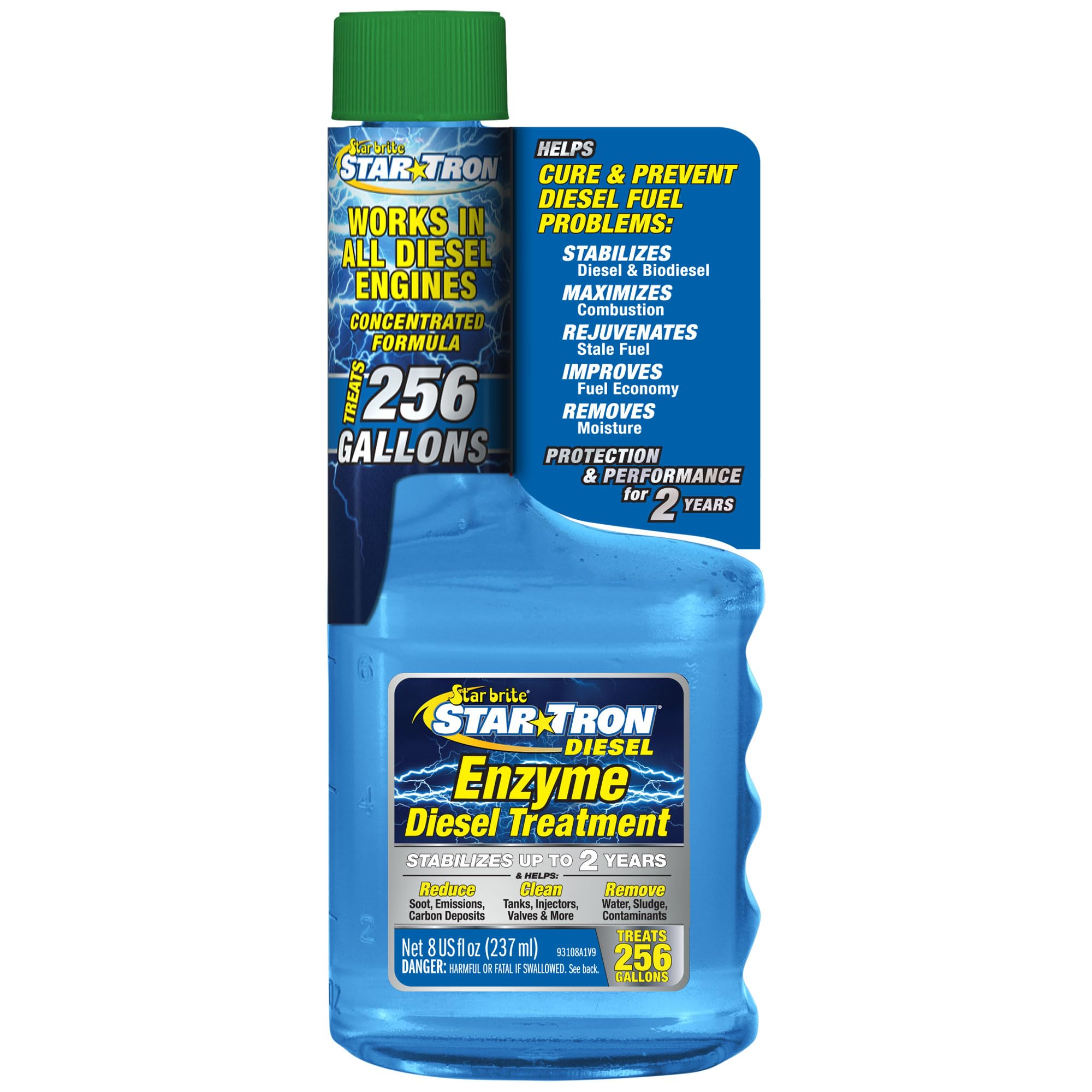
Star Tron uses an enzyme‑based approach rather than a traditional biocide. It works by breaking down the sludge and gum that microbes create, while also dispersing water into submicron droplets that burn off during combustion. It does not directly kill algae — instead, it makes the environment uninhabitable and cleans up the mess.
The concentrated 8‑ounce bottle is ideal for small engines, generators, seasonal boats, and motorcycles. It stabilizes diesel fuel for up to two years in storage, preventing the formation of varnish and hardness that clog injectors. Users with 15+ years of use report recovering fuel systems without needing carburetor repairs.
If you already have a heavy algae bloom, Star Tron will help clean the fuel but won’t deliver the same immediate kill as a dedicated biocide. It is best used as a preventive additive in equipment that sits for months. The enzyme formula is also safe for both gasoline and diesel engines, making it a versatile shop additive.
Why it’s great
- Enzyme technology prevents future build‑up
- Stabilizes fuel up to two years
- Safe for gas and diesel engines
Good to know
- Not a fast‑acting biocide for active bloom
- Small 8 oz bottle covers limited volume
FAQ
Can I use a fuel stabilizer to kill algae in my diesel tank?
How much biocide should I add for a shock dose?
Will a diesel algae killer damage my fuel injectors or seals?
Final Thoughts: The Verdict
For most users, the best diesel algae killer winner is the Power Service Bio Kleen 09016-09 because it is a true dual‑phase biocide that kills microbes at the water layer and is recommended by major engine builders. If you need to treat a very large storage tank on a budget, grab the FPPF Killem 00119. And for a complete fuel system cleanup after a bloom, nothing beats pairing the Power Service Clear Diesel 09280-06 as the follow‑up flush.

Mo Maruf
I created WellFizz to bridge the gap between vague wellness advice and actionable solutions. My mission is simple: to decode the research and give you practical tools you can actually use.
Beyond the data, I am a passionate traveler. I believe that stepping away from the screen to explore new environments is essential for mental clarity and physical vitality.