Our readers keep the lights on and my smoothie glass nicely filled. As an Amazon Associate, I earn from qualifying purchases.
A dog door with a sensor collar promises freedom — your pet comes and goes while stray animals stay out. But the reality of buying one involves navigating lock mechanisms, battery life, sensor range, and installation complexity that varies wildly between models. Get the wrong one, and you end up with a noisy flap that scares your pet or a drafty gap that invites trouble.
I’m Mohammad Maruf — the founder and writer behind WellFizz. I’ve analyzed countless hours of customer data and technical specifications to separate the reliable sensor-collared doors from the ones that cause more headaches than they solve.
This guide breaks down the top contenders for the best dog door with sensor collar, focusing on selective entry, build quality, and real-world reliability so you can choose with confidence.
How To Choose The Best Dog Door With Sensor Collar
Choosing a sensor-collared dog door is not just about matching your dog’s size. The sensor technology, lock speed, battery system, and installation method all determine whether the door becomes a seamless part of your home or a constant source of frustration. Here is what matters most.
Sensor Technology: RFID vs Ultrasonic
Most sensor-collared doors use RFID (radio frequency) transmitters worn on the collar. RFID doors unlock when the pet approaches, but range varies — some detect only within a few inches, others up to a foot or two. Ultrasonic doors use a different approach: a collar emits a silent signal that activates a motor-driven panel. Ultrasonic systems generally offer better directional sensing, reducing false triggers when a pet walks past the door without intending to go through. If you have multiple pets, confirm how many keys or collars the door supports.
Lock Mechanism Speed and Noise
A slow or loud lock can startle a pet, making them hesitant to use the door. Some doors have a 15-second delay before locking after a pet passes through, which is helpful in multi-pet households but can also let another animal sneak in. The locking sound itself is a common complaint — consider whether your pet is noise-sensitive. Motor-driven vertical doors from brands like High Tech Pet offer quieter operation compared to the loud “pop” of solenoid-based flaps.
Power Source and Battery Life
Most sensor doors run on batteries. RFID flap doors typically use AA or D-cell batteries and can last several months depending on traffic. Ultrasonic motorized doors usually run on AC power with an optional battery backup — critical if you experience outages. Proprietary batteries (found in some collar transmitters) cost more and can be harder to replace on short notice. Check if the door supports a wired adapter before committing to a battery-only system.
Quick Comparison
On smaller screens, swipe sideways to see the full table.
| Model | Category | Best For | Key Spec | Amazon |
|---|---|---|---|---|
| Power Pet PX-2DM | Ultrasonic Motor | Large dogs up to 100 lbs | 12.25″ x 16″ opening | Amazon |
| Power Pet PX-1 | Ultrasonic Motor | Medium dogs up to 30 lbs | 8.25″ x 10″ opening | Amazon |
| SureFlap Connect | Microchip RFID | Activity tracking | 6.75″ x 7″ opening | Amazon |
| PetSafe SmartDoor (Large) | RFID Collar | Large dogs, extra key | Programs up to 5 keys | Amazon |
| PetSafe Never Rust | RFID Collar | Durable build | Up to 100 lb dogs | Amazon |
| Eillion Sliding Door | Manual Flap | Sliding glass doors | 10″ x 16″ flap opening | Amazon |
| Cat Flap Fever Window Insert | Custom Window | Renters, windows | Custom-cut plexiglass | Amazon |
| SureFlap Microchip Cat Flap | Microchip Only | Cats, small dogs | 4.75″ x 5.625″ opening | Amazon |
| Power Pet PX-1C | Ultrasonic Motor | Medium dogs, security | 8.25″ x 10″ opening | Amazon |
In‑Depth Reviews
1. Power Pet PX-2DM (Large)
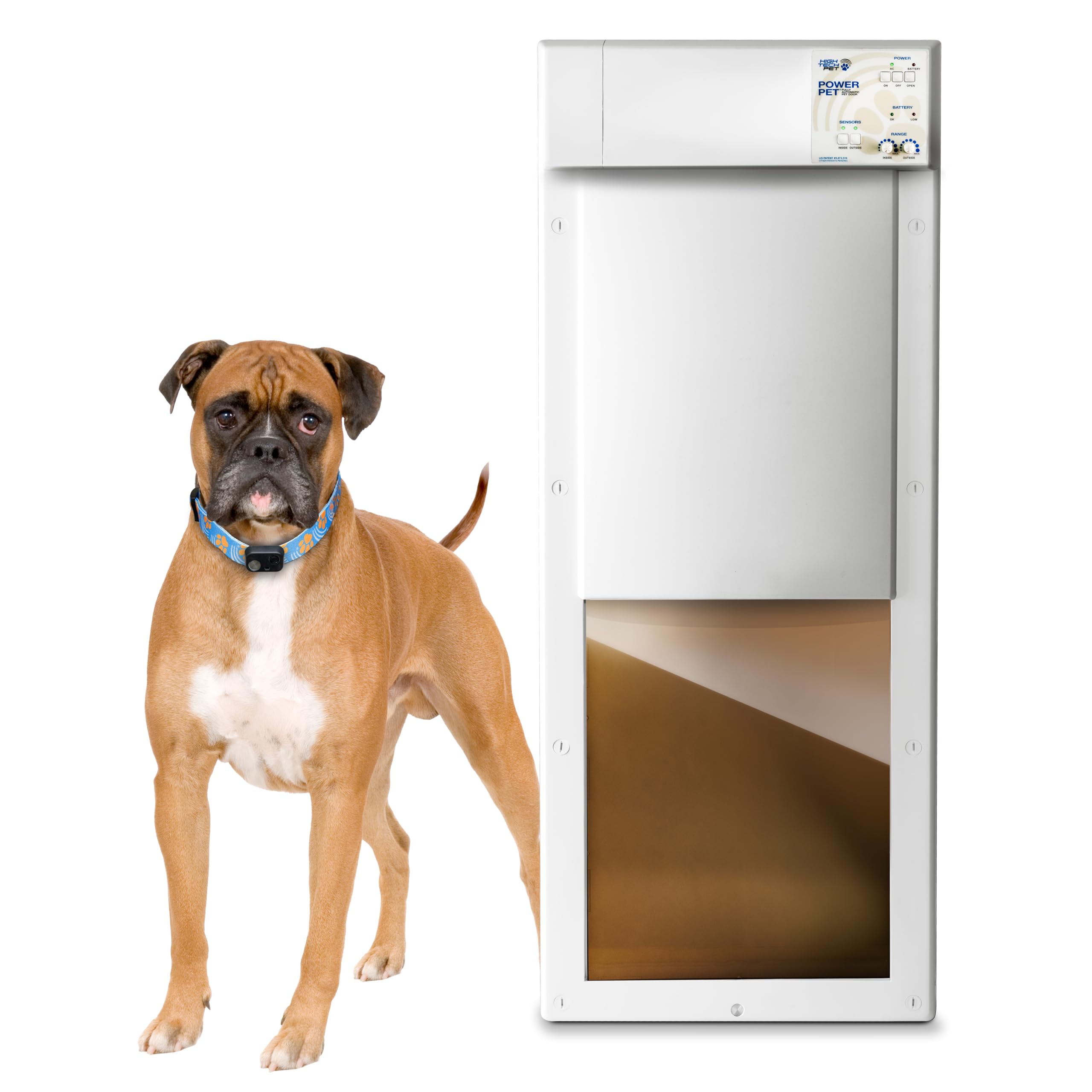
The Power Pet PX-2DM sets the standard for large-breed sensor doors. Its motor-driven, hermetically sealed panel provides an airtight seal that outperforms any flap-based design in weather resistance and insulation. The ultrasonic collar triggers a vertical door that slides open — no flimsy plastic flap catching in the wind. Directional sensing ensures the door only opens when your pet approaches directly, eliminating false triggers from nearby activity.
Installation is straightforward for a door mount, and the included AC adapter means no worrying about dead batteries. The automatic steel deadbolt locks instantly after the panel closes, providing genuine security against intruders or stray animals trying to force entry. The anti-pinch safety system automatically reverses if it detects an obstruction, a critical feature for any pet door.
Users report dogs learning the door in under 15 minutes, with whisper-quiet operation that doesn’t scare skittish pets. The adjustable range and delay settings let you fine-tune detection to your specific layout. Order the optional backup battery if power outages are common in your area — the door stops working without juice and the rechargeable backup is not shipped by default.
Why it’s great
- Airtight seal stops drafts completely
- Anti-pinch protection auto-reverses on obstruction
- Whisper-quiet motor operation
- Steel deadbolt for real security
Good to know
- Requires AC power; battery backup sold separately
- Ultrasonic collars use proprietary batteries
- Larger initial investment than flap doors
2. Power Pet PX-1 (Medium)
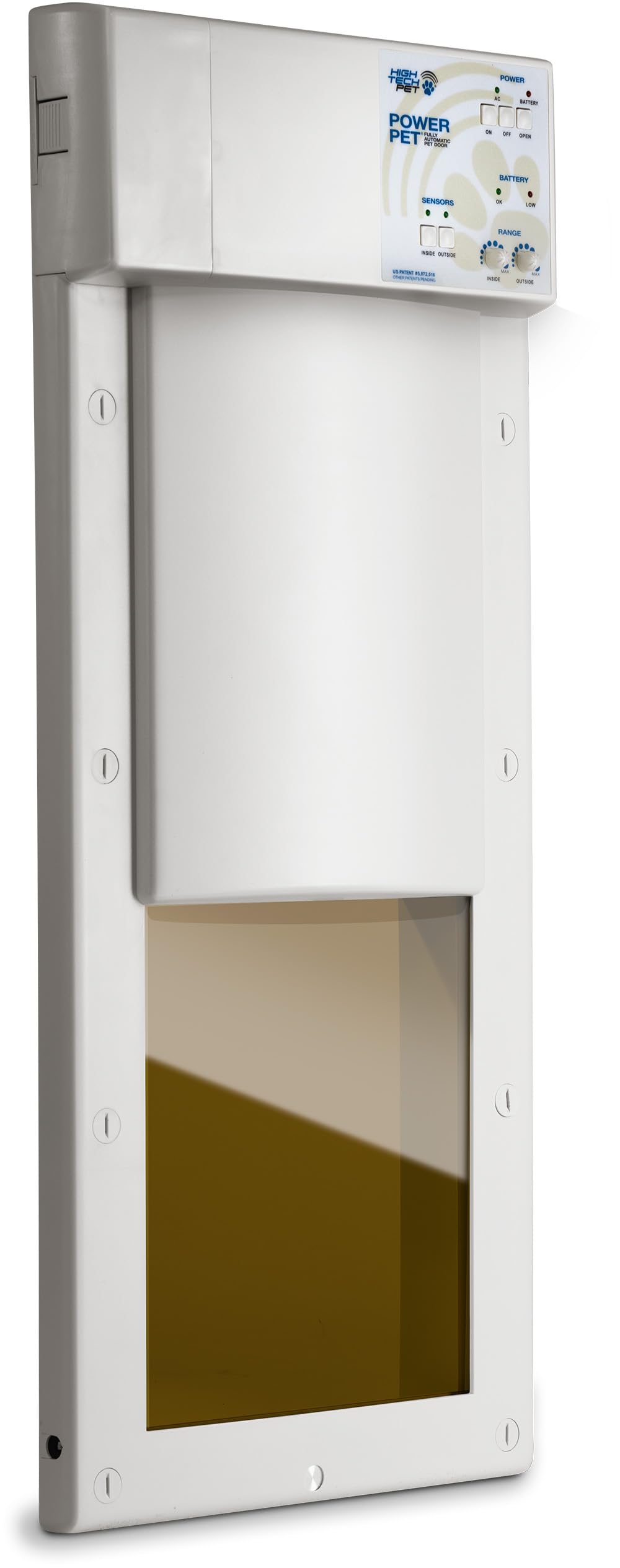
The PX-1 is the medium-sized sibling of the PX-2DM, sharing the same ultrasonic collar technology and motor-driven vertical panel design. The panel size of 8.25 by 10 inches accommodates dogs up to 30 pounds, making it ideal for smaller breeds and cats who dislike traditional flaps. The directional sensing system earns high marks for reliability, only activating when a pet approaches from the correct angle — not when they sleep next to the door.
Installation takes about 90 minutes for DIYers with basic tools, and users consistently report that pets adapt quickly, often within one day with treat-based training. The four-way access control (In Only, Out Only, Full Access, Closed) gives flexibility for training or nighttime restrictions. The wind and weatherproof seal remains completely airtight, and the automatic deadbolt provides security that passive flaps simply can’t match.
Long-term owners with up to six small dogs report it performing flawlessly for years, requiring only occasional line replacement on the lift mechanism. The ultrasonic collars are durable but the included sensor housing is bulky — some users rig them onto existing collars with elastic bands. The collar batteries are proprietary and branded, so plan ahead for replacements.
Why it’s great
- Airtight seal with no draft or flap
- Directional sensing prevents false triggers
- Pets adapt within a day
- Backup battery port available
Good to know
- Collar sensor is bulky
- Proprietary collar batteries require advance ordering
- Can freeze in extreme cold without weatherization
3. SureFlap Microchip Pet Door Connect

The SureFlap Connect reads your pet’s implanted microchip or an optional RFID collar tag, eliminating the need for a separate sensor collar. The app tracks when your pet comes and goes, providing activity monitoring that can alert you to changes in behavior. The flap opening of 6.75 by 7 inches suits cats and small dogs, with selective entry that locks out strays while letting your pet pass freely.
Users report effectively stopping raccoons and other wildlife from entering, with the app providing peace of mind by confirming safe returns. The Hub (sold separately) is required for app connectivity and activity logging — without it, the door functions as a basic microchip flap with curfew timers but no remote control. Battery life on four AA cells reaches up to 12 months depending on traffic, which is impressive for a connected device.
The door lacks dual-sensor technology, so it only reads microchips on entry — exit is unrestricted unless you enable the curfew lock. Some users find the flap stiff, requiring significant force for small cats to push through. If your pet struggles, a training mode would help, but none exists. The 30-day return window is tight for a product at this price tier.
Why it’s great
- Tracks pet activity via app
- Uses pet’s existing microchip
- Excellent wildlife deterrent
- Long battery life
Good to know
- Hub required for app features
- Flap stiffness can deter small pets
- No wall power option included
4. PetSafe Electronic SmartDoor (Large with Extra Key)

The PetSafe SmartDoor combines selective entry with an extra SmartKey included for multi-pet households. The RFID collar key unlocks the flap when your pet approaches within range, locking automatically after they pass through. The large size accommodates big breeds up to 100 pounds, and programming up to five keys is a button-press affair — no apps or hubs required.
Users appreciate the convenience for large dogs who need frequent access, especially paired with an outdoor pen. The auto-locking feature keeps out unwanted animals, though the flap mechanism makes a noticeable noise when unlocking that some pets need to acclimate to. The plastic frame is durable, but the battery compartment drains AAA batteries faster than ideal — several users recommend wiring a wall adapter for consistent power.
Reliability is mixed. Some units work flawlessly for years while others develop inconsistent locking behavior. The sensor alignment is critical — minor shifts during installation can cause the flap to jam or fail to recognize the key. If you are handy, the wall-adapter mod solves the battery issue entirely, making this a solid mid-range pick.
Why it’s great
- Extra SmartKey included for multiple pets
- Simple button programming
- Large flap fits big breeds
- Auto-lock keeps animals out
Good to know
- Batteries drain quickly
- Lock noise may scare pets
- Sensor alignment is finicky
5. PetSafe Never Rust Electronic Pet Door

The PetSafe Never Rust employs a waterproof electronic key worn on your pet’s collar, with programmable selective entry, exit, and auto-lock options. The flap features insulated UV protection, which helps with energy efficiency in sun-exposed doors. It handles dogs up to 100 pounds and programs for up to five keys, making it suitable for households with multiple large pets.
Level installation is absolutely critical — if the frame is not perfectly square, the flap can bind and fail to lock. The unlocking mechanism produces a loud “pop” that many users describe as startling, though most dogs adjust within a week. The door uses four D-cell batteries, which last about two to three months with average traffic — some users convert to wall power for convenience.
Long-term reliability varies. Some units have lasted over three years of daily use before needing replacement, while others develop a random-locking fault that strands pets outside. The wall-mount installation kit has documented fitment issues with stucco walls, so stick to door installations unless you are prepared for custom framing. The 15-second lock delay is generous enough for slow pets but can let a second animal slip through behind your dog.
Why it’s great
- Insulated flap reduces energy loss
- Waterproof collar key works in rain
- Programmable selective entry/exit
- Fits large breeds up to 100 lbs
Good to know
- Loud “pop” when unlocking
- Requires perfect level installation
- Batteries need quarterly replacement
6. Eillion Sliding Glass Door Pet Door

This Eillion model is designed specifically for sliding glass doors, replacing the screen panel with an aluminum frame and flap system. The flap opening measures 10 by 16 inches, accommodating dogs up to 100 pounds. The frame adjusts from 75.875 to 81 inches in height, fitting most standard patio doors. While not sensor-activated, it earns a spot for its robust build and compatibility with sliding glass doors — a setup where most sensor doors cannot install without permanent wall modifications.
Assembly requires drilling into the door frame and roughly two hours of work. The flap uses a strong magnetic seal that withstands wind, but the single-flap design can misalign with the magnet over time if not installed perfectly level. Users report that the lock mechanism sits against the sliding door track, which might require a dowel or secondary lock for full home security.
The semi-transparent flap passes light but dogs cannot see through it, which may slow initial training. The all-metal construction feels substantial compared to plastic competitors, but replacement flaps are not available if the original wears out. This is a good option if you need a large opening for your sliding door and are willing to skip sensor integration.
Why it’s great
- Robust aluminum frame construction
- Large flap for big dogs
- Adjustable height fits most sliders
- Magnetic seal resists wind
Good to know
- No sensor or selective entry
- Complex installation requires drilling
- No replacement flaps available
7. Cat Flap Fever Custom Window Insert
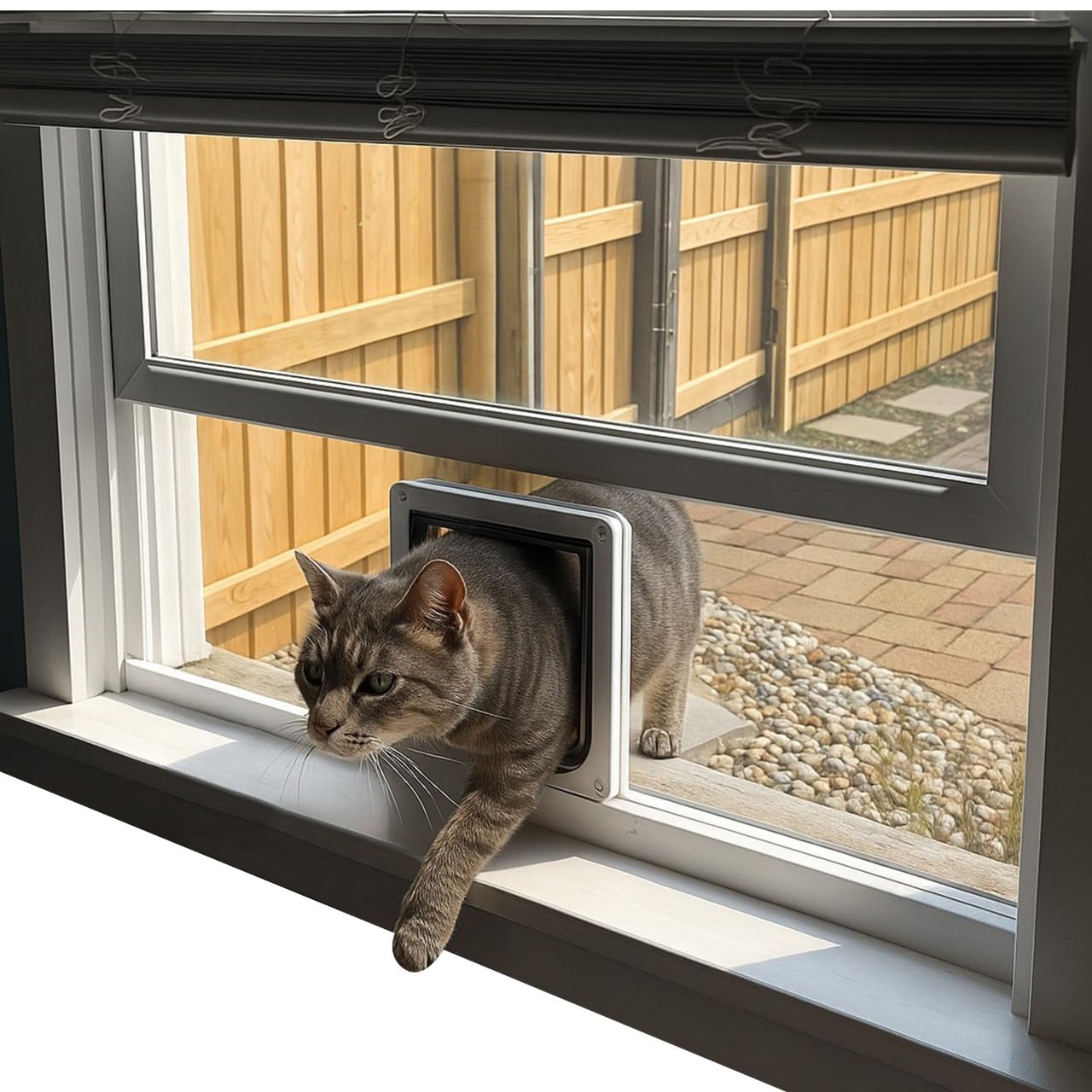
Cat Flap Fever offers custom-cut plexiglass window inserts that install without drilling or hardware, making them ideal for renters or seasonal homes. The 0.25-inch plexiglass panel fits horizontally or vertically into the window track, sealed with foam and brush weatherstripping. While the default model uses a magnetic or 4-way lock, microchip lock options are available for selective entry — a rare feature for a window insert.
Each insert is handcrafted to your exact window dimensions, ensuring a snug fit that blocks drafts and insects. Installation takes under two minutes: open the window, place the insert, close the window against it. The plexiglass lets natural light through while providing insulation. Users consistently praise the customer service for correcting measurement errors and replacing damaged units quickly.
The downsides are minimal but real: the flap opening is sized for small dogs and cats, not large breeds. The 0.25-inch thickness means it is not as impact-resistant as thicker acrylics, though it withstands normal pet traffic. If you move frequently or want a non-permanent solution with selective entry, this is the only option that delivers without modifying your home structure.
Why it’s great
- No drilling or permanent modification
- Custom fit blocks drafts effectively
- Microchip lock option available
- Made in the USA
Good to know
- Only suitable for small dogs and cats
- Thinner plexiglass less impact-resistant
- Requires exact window measurements
8. SureFlap Microchip Cat Flap

The SureFlap Microchip Cat Flap reads your cat’s implanted ID microchip (or an optional RFID collar tag) to allow selective entry. The flap opening is 4.75 by 5.625 inches, which works for cats and very small dogs. It programs up to 32 identities with a simple button press, and runs on four AA batteries for up to 12 months. The three-year warranty is exceptional for this price range.
Users report it solving neighbor cat intrusion and giving bullied indoor cats safe access to a private room. If your cat is noise-sensitive, the lock can be disabled, but that defeats the selective-entry purpose. The flap locks quickly after the cat passes, but a trailing animal can sometimes follow before it engages.
Installation works on doors, walls, or windows with available accessories. The narrow tunnel and small flap size can physically trap larger cats if they rush through — several reviewers reported cats getting stuck mid-way. For cats under 10 pounds this is generally fine, but heavier cats may struggle with the restrictive dimensions.
Why it’s great
- Reads pet’s existing microchip
- Programs up to 32 pets
- Excellent battery life
- Three-year warranty
Good to know
- Loud unlocking sound scares some cats
- Flap opening too small for larger cats
- Cannot be fully unlocked both directions
9. Power Pet PX-1C (Medium Security)
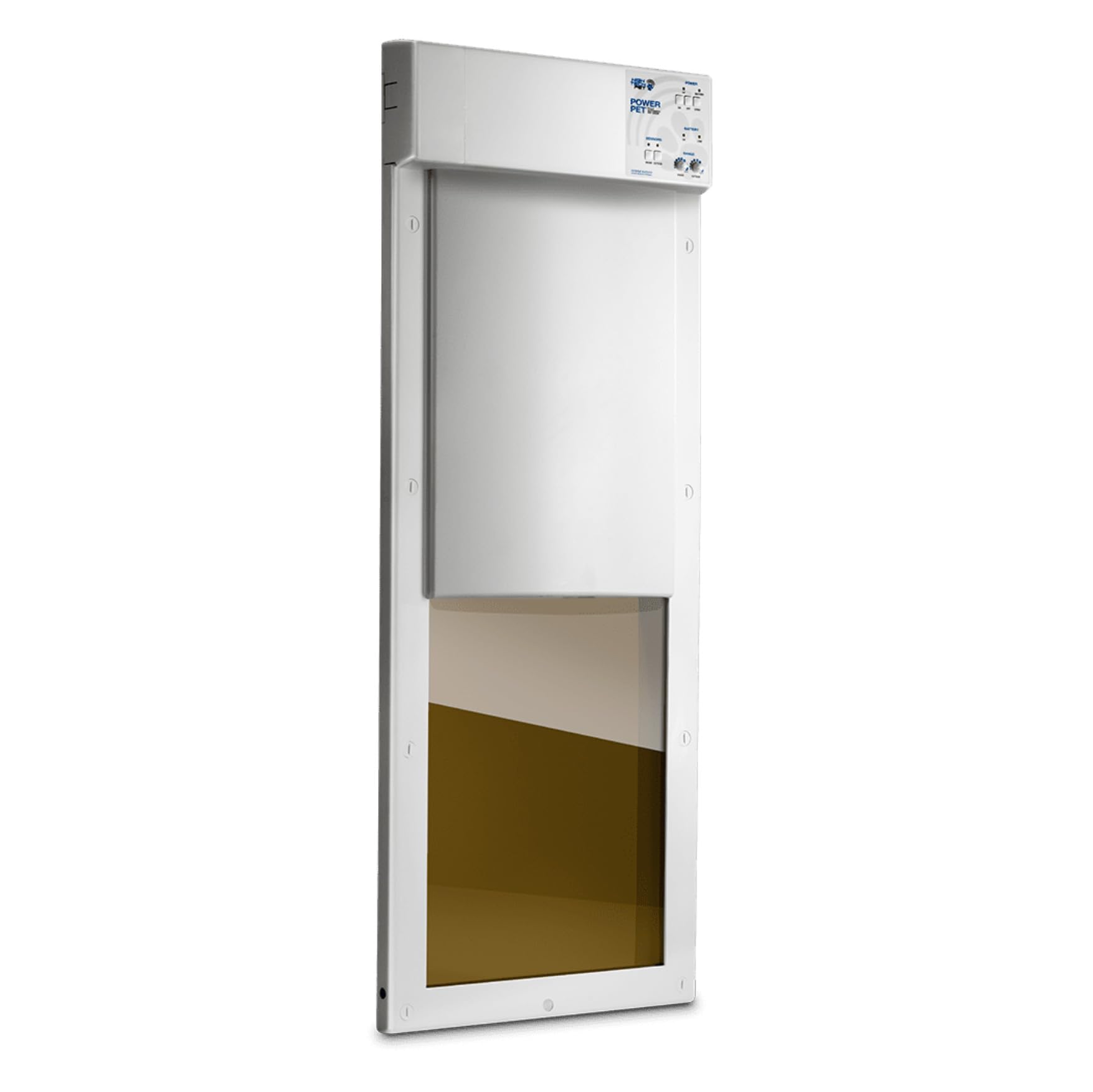
The PX-1C shares the same ultrasonic vertical-lift mechanism as the PX-1 but with a focus on security features. The steel deadbolt and airtight seal provide intruder-proof protection that no flap-based door can match. The panel is shatter-proof and cannot be forced open or lifted from the outside. Dual sensor systems allow independent adjustment of inside and outside activation ranges from zero to 30 feet, preventing false triggers from pets wandering near the door.
Installation is straightforward for a door mount, with clear instructions for cutting the hole and securing the frame. The gravity-closure system is intrinsically safe — the panel is lightweight and closes by gravity, not motor force, so pets cannot be injured. The patented anti-pinch system automatically reverses the panel upward if it encounters an obstruction during closing.
The limitations mirror the PX-1: proprietary collar batteries require advance ordering, and the ultrasonic collar sensor is bulky. The performance warranty requires genuine High Tech Pet collars and batteries, adding to long-term cost. Users with multiple pets report some sensor confusion that requires occasional resetting, and the collar pairing is specific enough that mixing brands causes failure.
Why it’s great
- Steel deadbolt for maximum security
- Dual sensor adjustment from 0-30 ft
- Gravity closure safe for pets
- Anti-pinch auto-reverse
Good to know
- Proprietary collar batteries
- Bulky collar sensor
- Warranty requires branded accessories
FAQ
Will an RFID sensor collar door work if my pet already has a microchip?
How do I prevent a second animal from sneaking in behind my pet?
Can I install a sensor collar door in a sliding glass door?
What happens if the batteries die on an RFID collar door?
Final Thoughts: The Verdict
For most buyers seeking the best dog door with sensor collar, the winner is the Power Pet PX-2DM because of its airtight seal, ultrasonic directional sensing, steel deadbolt, and anti-pinch safety — a complete package that works for large dogs and provides genuine home security. If you need a motorized door for small to medium pets, grab the Power Pet PX-1 — it shares the same core technology in a more compact size. And for a budget-friendly RFID flap door with programming for multiple pets, the PetSafe Electronic SmartDoor offers solid selective entry at a lower entry point, as long as you are comfortable addressing battery quirks.

Mo Maruf
I created WellFizz to bridge the gap between vague wellness advice and actionable solutions. My mission is simple: to decode the research and give you practical tools you can actually use.
Beyond the data, I am a passionate traveler. I believe that stepping away from the screen to explore new environments is essential for mental clarity and physical vitality.