Our readers keep the lights on and my smoothie glass nicely filled. As an Amazon Associate, I earn from qualifying purchases.
Your smartphone’s internal DAC is a compromise, squeezed onto a motherboard amidst radio interference and power constraints, which leaves detail, dynamics, and noise floor on the table. A dedicated cell phone DAC bypasses that entire circuit, handing decoding and amplification to a clean, shielded chipset designed for one job only.
I’m Mohammad Maruf — the founder and writer behind WellFizz. I’ve spent hundreds of hours cross-referencing DAC chip architectures, output power figures, and real-world user reports to separate the cheaply engineered dongles from the genuinely capable ones.
Whether you use lossless streaming or local FLAC files, the right external converter dramatically lifts clarity, soundstage, and bass control. In this guide, I analyze the top contenders to help you find the best cell phone dac for your headphones and listening habits.
How To Choose The Best Cell Phone DAC
A cell phone DAC is defined by its chip, output configuration, and power delivery. Knowing which of these three pillars matters most to your gear prevents you from overspending on power you don’t need or undershooting on clarity.
DAC Chip & Decoding Format
The chip does the actual digital-to-analog conversion. Flagship options like the ESS ES9281AC or dual Cirrus Logic CS43198 support sample rates up to PCM 768kHz and DSD512. For typical streaming, even 32-bit/384kHz is overkill, but a better chip directly lowers noise and distortion. Look for THD+N below 0.001% and SNR above 120 dB if you want genuinely clean sound.
Output Power & Impedance Matching
Measured in milliwatts (mW) at a given impedance, output power determines whether the DAC can drive your headphones. Sensitive IEMs need only 20 mW, while 300-ohm headphones like the Sennheiser HD 600 require at least 100 mW on a single-ended connection or 200 mW balanced. Dongles that spec power at 16Ω or 32Ω let you directly compare drive capability.
Single-Ended vs. Balanced Output
A 3.5mm single-ended jack is universal, but a 4.4mm balanced connection delivers roughly double the voltage swing, improving channel separation and headroom for demanding headphones. If you own or plan to buy a balanced cable, prioritize a DAC with a 4.4mm output. If you only use standard IEMs, a good single-ended implementation is sufficient.
Quick Comparison
On smaller screens, swipe sideways to see the full table.
| Model | Category | Best For | Key Spec | Amazon |
|---|---|---|---|---|
| iFi Hip-dac 3 | Premium Portable | Full-size headphones on the go | 4.4mm Balanced / 8 hr battery | Amazon |
| Questyle M15i | Premium Dongle | High-res detail with IEMs | ESS ES9281AC / DSD512 | Amazon |
| FiiO KA15 | Mid-Range Dongle | PEQ and desktop-style power | Dual CS43198 / 560mW balanced | Amazon |
| Fosi Audio DS2 | Mid-Range Dongle | Smartphone balanced output | Dual CS43131 / 170mW per ch | Amazon |
| MOONDROP Dawn PRO 2 | Mid-Range Dongle | App-based PEQ tuning | Dual CS43198 / 124mW per ch | Amazon |
| TempoTec Sonata BHD Pro | Value Dongle | Budget balanced + single-ended | PCM384 DSD256 / 4VRMS balanced | Amazon |
| FiiO KA11 | Value Dongle | Entry-level Hi-Fi on a budget | CS43131 / 245mW at 16Ω | Amazon |
In‑Depth Reviews
1. iFi Hip-dac 3

The Hip-dac 3 is a true portable DAC/amp with its own battery, meaning it doesn’t drain your phone at all. The revised Burr-Brown chipset and internal power supply deliver a quiet, black background with zero hiss, even on sensitive IEMs. The 4.4mm balanced output pushes enough current to drive Sennheiser HD 600 and similar 300-ohm cans to satisfying levels.
Features like PowerMatch (adjustable gain) and XBass (analog bass boost) let you tailor the sound signature to your headphones without losing the natural tone. The matte black aluminum case is pocket-friendly and feels substantial. It also includes a Lightning-to-USB-C cable, which saves iPhone users an extra purchase.
On the downside, the Hip-dac 3 lacks Bluetooth and has no onboard EQ beyond XBass. The battery lasts about eight hours, so you need to remember to charge it. For anyone wanting desktop-grade headphone output in a portable form, this is the most complete package available right now.
Why it’s great
- Built-in battery prevents phone drain
- PowerMatch and XBass offer real sonic flexibility
- Balanced 4.4mm output drives high-impedance headphones
Good to know
- No Bluetooth wireless option
- Requires charging like a separate device
- Slightly bulkier than a standard dongle
2. Questyle M15i

The M15i uses Questyle’s patented Current Mode Amplification, which keeps distortion ultralow and transient response rapid — a design more commonly found in desktop gear. The flagship ESS ES9281AC DAC handles PCM up to 768kHz and DSD512 natively, so every micro-detail from high-res files is preserved. It also has MFi certification, guaranteeing stable plug-and-play with iPhones and iPads.
Both 3.5mm single-ended and 4.4mm balanced outputs are present, plus a physical gain switch that adjusts sensitivity for IEMs versus full-size headphones. The aluminum body dissipates heat well, and the detachable USB-C cable adds durability. Users report that the M15i sounds comparable to desktop stacks costing multiples more.
The main trade-off is reliability. Several units have failed after a few weeks due to thermal shutdown or loose internal connections, and customer support response times vary. If you get a stable unit, the sound quality justifies the price, but the QC track record makes it a slightly riskier choice than the Hip-dac 3.
Why it’s great
- Current Mode Amplification is genuinely unique in this class
- DSD512 and PCM 768kHz support are top-tier
- Physical gain switch suits both IEMs and full-size cans
Good to know
- Some units develop issues within weeks
- Customer service can be slow to respond
- Windows compatibility is less polished than with Apple devices
3. FiiO KA15

The KA15 is the first dongle to combine a full-color IPS screen, a ten-band parametric EQ, and desktop-mode power (560mW per channel balanced) in one package. The dual CS43198 DACs and dual SGM8262 op-amps deliver a clean, powerful signal that easily drives low-sensitivity planars and high-impedance dynamics alike. The retro tape-deck UI is a fun bonus.
FiiO’s Control app allows deep PEQ customization, including importing headphone correction curves from the community. The UAC1.0 mode works with the Nintendo Switch and PS5, making it a versatile gaming companion as well. The coaxial SPDIF output from the 3.5mm jack is a rare feature for a dongle.
Several users report occasional power-up glitches and unresponsive physical buttons, though a firmware toggle usually fixes it. The stiff stock cable also puts strain on phone USB ports. For flexibility and sheer output, the KA15 is unmatched, but you may need to swap the cable and tolerate minor software quirks.
Why it’s great
- Desktop Mode delivers massive balanced power
- Full parametric EQ via FiiO Control app
- Small screen for settings and volume feedback
Good to know
- Stiff cable can damage phone USB ports
- Occasional power-on or button responsiveness issues
- Screen brightness cannot be dimmed sufficiently for dark rooms
4. Fosi Audio DS2

The DS2 packs two Cirrus Logic CS43131 DAC chips into a compact metal housing, achieving a noise floor of just 1μV and THD+N of 0.0001%. That translates to dead-silent background on even the most revealing IEMs. The 4.4mm balanced output delivers 170mW per channel, enough for Sennheiser HD 660S2 and similar mid-impedance headphones.
Independent 60-step volume buttons give you precise control separate from your phone’s digital volume, which preserves bit depth. The DS2 is fully plug-and-play with Android, iOS, Windows, and macOS. It also supports PS5 and Nintendo Switch in UAC1.0 mode, adding console gaming to its repertoire.
The cable is a weak point — the included USB-C cord is stiff and short, and the DS2 draws noticeable power from your phone (around 16% per two hours of use). It also lacks any form of EQ or app control. For a transparent, ultra-clean sound at a reasonable price, the DS2 is one of the best options available.
Why it’s great
- Extremely low noise floor for sensitive IEMs
- Independent volume buttons prevent digital attenuation loss
- 150mW per channel is ample for most headphones
Good to know
- Included cable is poor quality and stiff
- Battery drain on phones is higher than average
- No EQ or app-based customization available
5. MOONDROP Dawn PRO 2
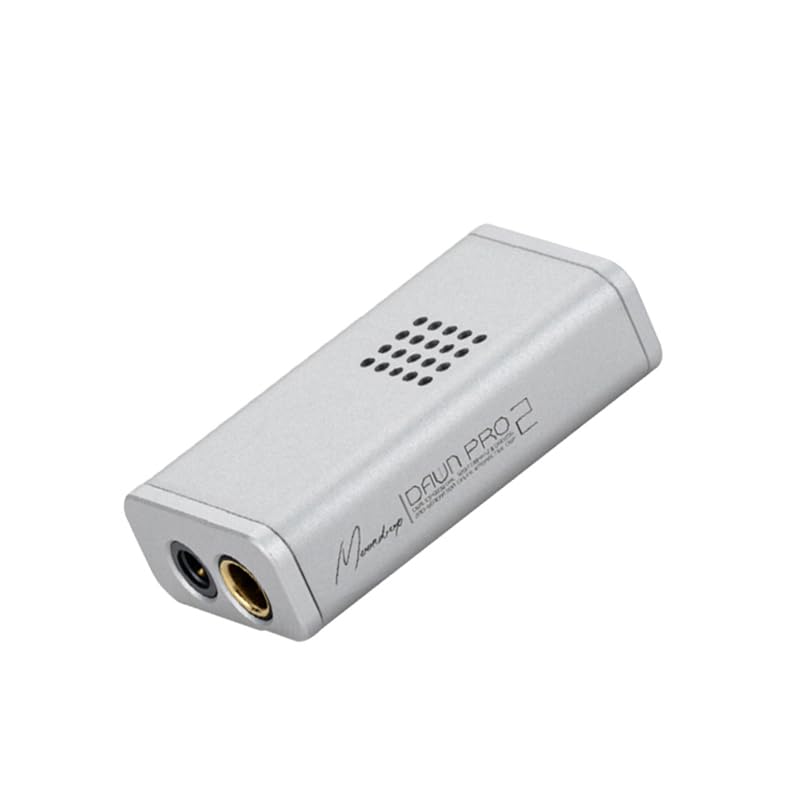
The Dawn PRO 2 distinguishes itself with deep software integration — MOONDROP’s app offers a parametric EQ with adjustable filter type, frequency, gain, and Q-value, plus a headphone frequency response database for reference. The dual CS43198 DAC chips produce 124mW per channel via the 4.4mm balanced output, which drives most IEMs and many full-size headphones cleanly.
An aluminum alloy housing with strategic venting keeps the chips cool during long listening sessions, and the 100-level smooth DAC volume control avoids the channel imbalance that plagues budget dongles at low levels. The flat frequency response with a subtle bass tilt gives a slightly warmer signature than the DS2, which some listeners prefer for long sessions.
The 4.4mm output is where the Dawn PRO 2 shines — on single-ended 3.5mm, power drops significantly. Quality control is also a concern: a few units have had loose 4.4mm jacks that require cable seating adjustment. For users who want app-driven tone shaping, this is a compelling choice, but the QC variability means buying from a return-friendly seller.
Why it’s great
- Comprehensive param EQ via MOONDROP app
- Smooth, near-lossless 100-step volume control
- Aluminum vented housing stays cool under load
Good to know
- Single-ended output power is limited
- Potential 4.4mm jack seating issues reported
- PEQ settings reset upon unplugging
6. TempoTec Sonata BHD Pro
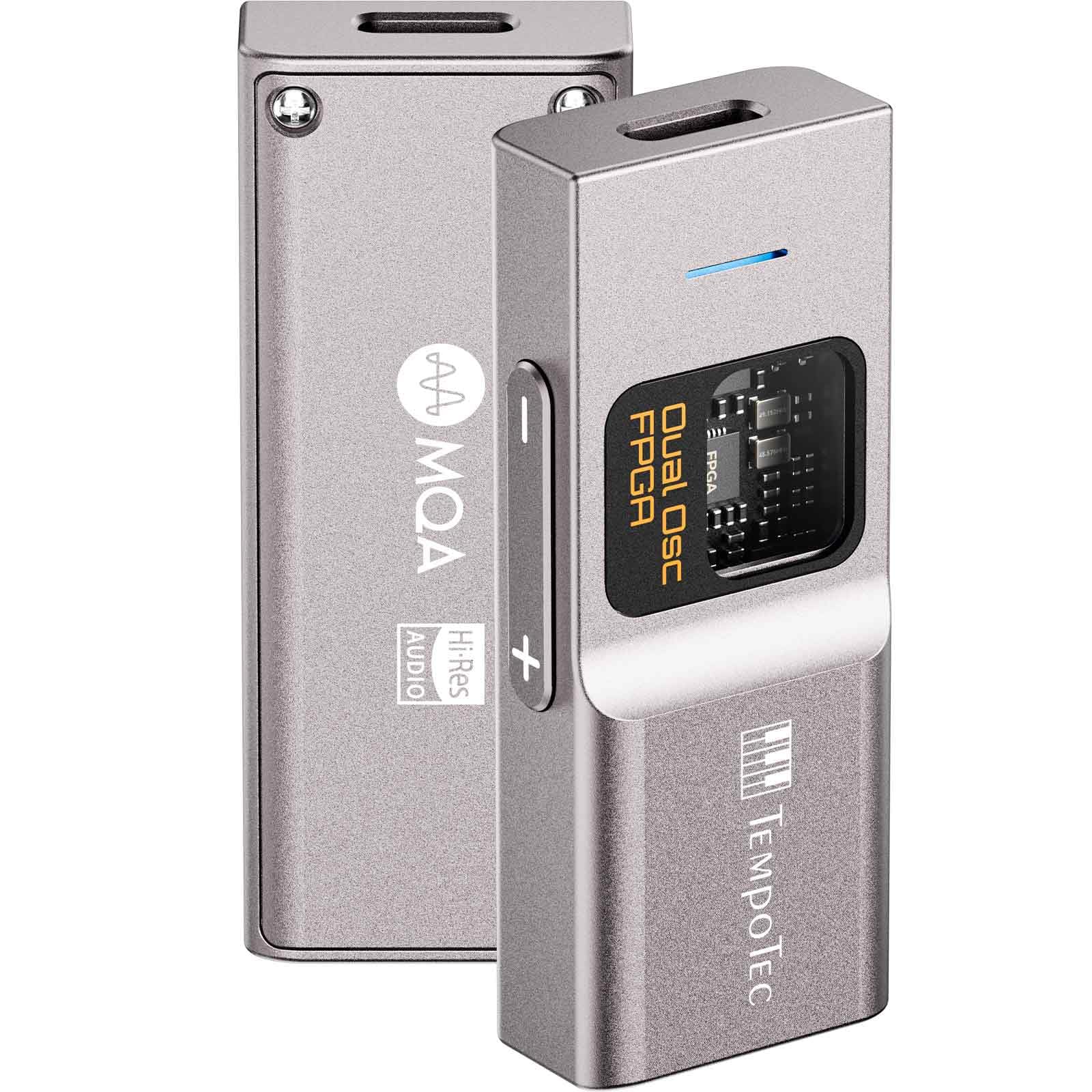
The Sonata BHD Pro gives you both 3.5mm single-ended and 4.4mm balanced outputs at an entry-level price point. The balanced output hits 4VRMS, which translates to ample volume for medium-impedance headphones like the Sennheiser HD 6XX. It supports PCM up to 384kHz, DSD256, and MQA 8X unfolding for Tidal subscribers.
The RGB indicator shows the sample rate and file type at a glance — red for MQA, green for DSD, blue for PCM. The metal body is small enough to dangle unobtrusively from a phone, and it stays cool even during extended use. Pro audio users confirm stable ASIO drivers on Windows for DAW work.
However, the Sonata BHD Pro draws noticeable current, which degrades phone battery life faster than some competitors. The auto-shutdown feature requires a USB reset to reactivate, and a few owners note persistent popping noises on PC despite capping the buffer. For a budget-friendly entry into balanced audio, it’s a solid start, but not the most refined option.
Why it’s great
- Both 3.5mm and 4.4mm outputs at low cost
- MQA 8X unfolding included
- Stable ASIO drivers for pro audio on Windows
Good to know
- Battery drain is higher than average
- Auto-shutdown feature is inconvenient
- Occasional pop/crackle on Windows requires troubleshooting
7. FiiO KA11

The KA11 is the entry-level champion, using the same CS43131 DAC chip found in pricier dongles to deliver 245mW at 16Ω and 200mW at 32Ω. That’s more than enough to drive most IEMs and portable headphones like the Fiio FT1 to satisfying levels. THD+N stays below 0.0006% with a 125dB SNR, so the sound is cleaner than anything your phone can produce internally.
The chassis is just 44mm long and weighs 8.5g, making it the most unobtrusive dongle here. It supports UAC1.0 mode for Switch and PS5, and works with Android, iOS, Windows, and Mac. The sound signature is neutral with no coloration, which suits purists who prefer a transparent chain.
Durability is the KA11’s weak spot — multiple users report loose internal wires causing failure after 2–3 months. The always-on blue LED is another annoyance in dark rooms. If you want to test the external DAC waters without a big investment, the KA11 is a fantastic audition tool, but consider it a consumable rather than a long-term investment.
Why it’s great
- Flagship-level DAC chip at a very low cost
- High output power for its tiny size
- Neutral, uncolored sound signature
Good to know
- Reported failures after 2–3 months from loose wiring
- Bright blue LED cannot be deactivated
- Plastic body feels less premium than metal competitors
FAQ
Will a cell phone DAC improve audio from streaming apps like Spotify or Apple Music?
What is the difference between a 3.5mm single-ended and a 4.4mm balanced output on a dongle DAC?
Does a cell phone DAC drain the phone battery faster than using the built-in jack?
Can I use a USB-C DAC with an iPhone or iPad?
Final Thoughts: The Verdict
For most users, the cell phone dac winner is the iFi Hip-dac 3 because it offers true portable power with a built-in battery, flexible gain and bass adjustments, and excellent driver support for both IEMs and full-size headphones. If you want a pocket-sized dongle with parametric EQ and a colorful screen, grab the FiiO KA15. And for the best value entry into balanced audio, nothing beats the Fosi Audio DS2.

Mo Maruf
I created WellFizz to bridge the gap between vague wellness advice and actionable solutions. My mission is simple: to decode the research and give you practical tools you can actually use.
Beyond the data, I am a passionate traveler. I believe that stepping away from the screen to explore new environments is essential for mental clarity and physical vitality.