Our readers keep the lights on and my smoothie glass nicely filled. As an Amazon Associate, I earn from qualifying purchases.
A single crooked shelf or a tile row that drifts by an eighth of an inch can ruin an entire day’s work. That nagging doubt — is it really level? — is why serious DIYers and pros alike reach for a dot laser. These compact tools project a precise reference point onto any surface, turning guesswork into measurable certainty for everything from hanging cabinets to laying out drop ceilings. The decision isn’t whether you need one, but which class of accuracy and coverage fits your workflow.
I’m Mohammad Maruf — the founder and writer behind WellFizz. I’ve spent countless hours analyzing diode brightness specs, self-leveling tolerances, battery chemistries, and accessory ecosystems to separate the tools that deliver repeatable precision from those that introduce more error than they solve.
Whether you’re framing a wall or installing kitchen uppers, the right tool saves hours of rework. This guide breaks down the top contenders for the best dot laser, matching each model to the real-world conditions where it actually excels.
How To Choose The Best Dot Laser
A dot laser is only as useful as its beam visibility, self-leveling reliability, and mounting flexibility. Nail these three factors and you’ll avoid the frustration of washed-out lines in bright rooms or slow re-leveling on uneven subfloors.
Beam Color and Brightness
Red diodes are cheaper and perfectly adequate for indoor work below 50 feet in moderate ambient light. Green diodes are roughly four times more visible to the human eye, making them the clear choice for bright job sites, longer reaches, or when working near windows. The trade-off is power consumption — green lasers drain batteries faster, so a quality rechargeable platform becomes more critical.
Self-Leveling Range and Lock Mechanism
A pendulum-based self-leveling mechanism typically corrects within ±3 to ±4 degrees of true level. If your surface exceeds that range, the laser will flash or beep an alert — a feature you want, not one to disable. Manual mode locks the pendulum so you can project sloped lines for stair stringers or drainage slopes. Prioritize models that make the switch between auto and manual mode obvious, with a physical lock switch rather than a buried menu option.
Line Layout: Cross-Line vs. 3D vs. 4D
Cross-line lasers project one horizontal and one vertical line, sufficient for most picture hanging and cabinet alignment. 3D models add a second vertical plane, covering opposing walls. 4D (dual horizontal, dual vertical) lasers illuminate all four walls, floor, and ceiling from a single setup — essential for drop-ceiling grids or full-room tile layouts. More lines mean more time saved repositioning the tool, but also higher cost and battery draw.
Mounting Ecosystem and Accessories
The magnetic bracket that ships with the laser can make or break your efficiency. Look for a bracket with 1/4″-20 and 5/8″-11 threads to accept standard tripods, plus a rotating base for fine angular adjustments. A mini tripod included in the kit often lifts the beam to a usable height, but a full-size tripod may be necessary for commercial work. Also confirm the laser accepts a remote receiver if you plan to use it outdoors in direct sun — pulse-mode compatibility extends effective range dramatically.
Quick Comparison
On smaller screens, swipe sideways to see the full table.
| Model | Category | Best For | Key Spec | Amazon |
|---|---|---|---|---|
| Huepar HM03CG | 3D Green | Full-room layouts with pulse-mode outdoor use | ±1/9″ at 33 ft, 3×360° green | Amazon |
| ENRIPRT 16 Lines | 4D Green | Comprehensive kit with remote for large builds | ±1/16″ at 23 ft, 4×360° green | Amazon |
| Angel Kiss 4×360 | 4D Green | Drop ceilings and extensive tiling projects | ±1/10″ at 32 ft, 100 ft range | Amazon |
| PREXISO 360° | 360 Green | Entry-level 360° green with tripod kit | 360° horizontal, 3x brighter than red | Amazon |
| SKIL LL932301 | Red Cross-Line | Trusted brand for trim and molding | 50 ft range, built-in rechargeable battery | Amazon |
| WEIDDW 4×360 | 4D Red | Budget-conscious full-room coverage | 2x3600mAh batteries, 8-10 hr runtime | Amazon |
| HYCHIKA Cross Line | Red Cross-Line | Simple DIY picture hanging and shelves | IP54 rated, 20 hr battery (AA) | Amazon |
In‑Depth Reviews
1. Huepar HM03CG
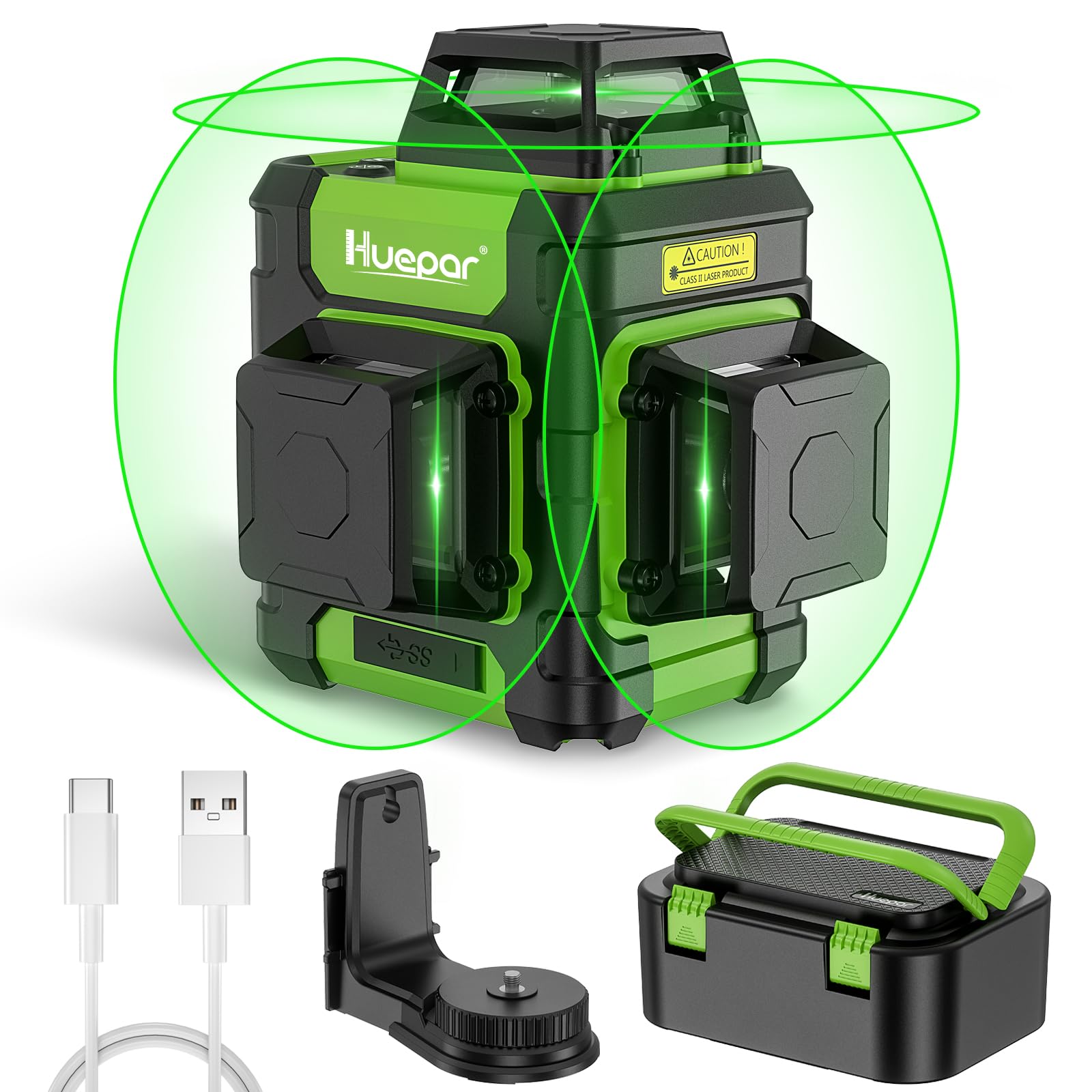
The Huepar HM03CG is the benchmark for mid-range 3D laser levels. Its green diode produces a beam easily visible at 98 feet indoors, and the pulse mode extends that range to 200 feet when paired with a Huepar receiver — a crucial feature for outdoor foundation work or bright commercial spaces. The TPR rubber overmold on the ABS housing adds genuine drop protection, which matters when the tool gets shifted between studs and scaffolding.
Self-leveling engages within three degrees of tilt, and the pendulum lock for manual mode is a physical slide switch, not a software toggle. That means no fumbling through menus when you need a slope line for a stair stringer. The 1/4″-20 thread and included 360-degree magnetic bracket give you multiple mounting paths, though the bracket’s magnet is strong enough for metal beams but won’t hold on painted steel without slipping over time.
Battery life clocks in around eight hours on a full charge with all lines active, and the Type-C charging port means you can top off from a laptop or car charger mid-job. The five-year warranty on the device and two years on the battery are well above the industry average. The only real limitation is that the HM03CG is a 3D unit, so it projects one horizontal and two vertical planes — not the full 4D coverage some large room layouts demand.
Why it’s great
- Pulse mode works with Huepar receiver for 200 ft outdoor range
- Type-C charging and 8-hour runtime reduce downtime
- TPR overmold absorbs job-site impacts
- 5-year warranty on the device body
Good to know
- 3D layout lacks the second horizontal plane of 4D models
- Magnetic bracket may slip on painted or coated steel
- Replacement battery is a proprietary pack, not standard cells
2. ENRIPRT 16 Lines 4×360
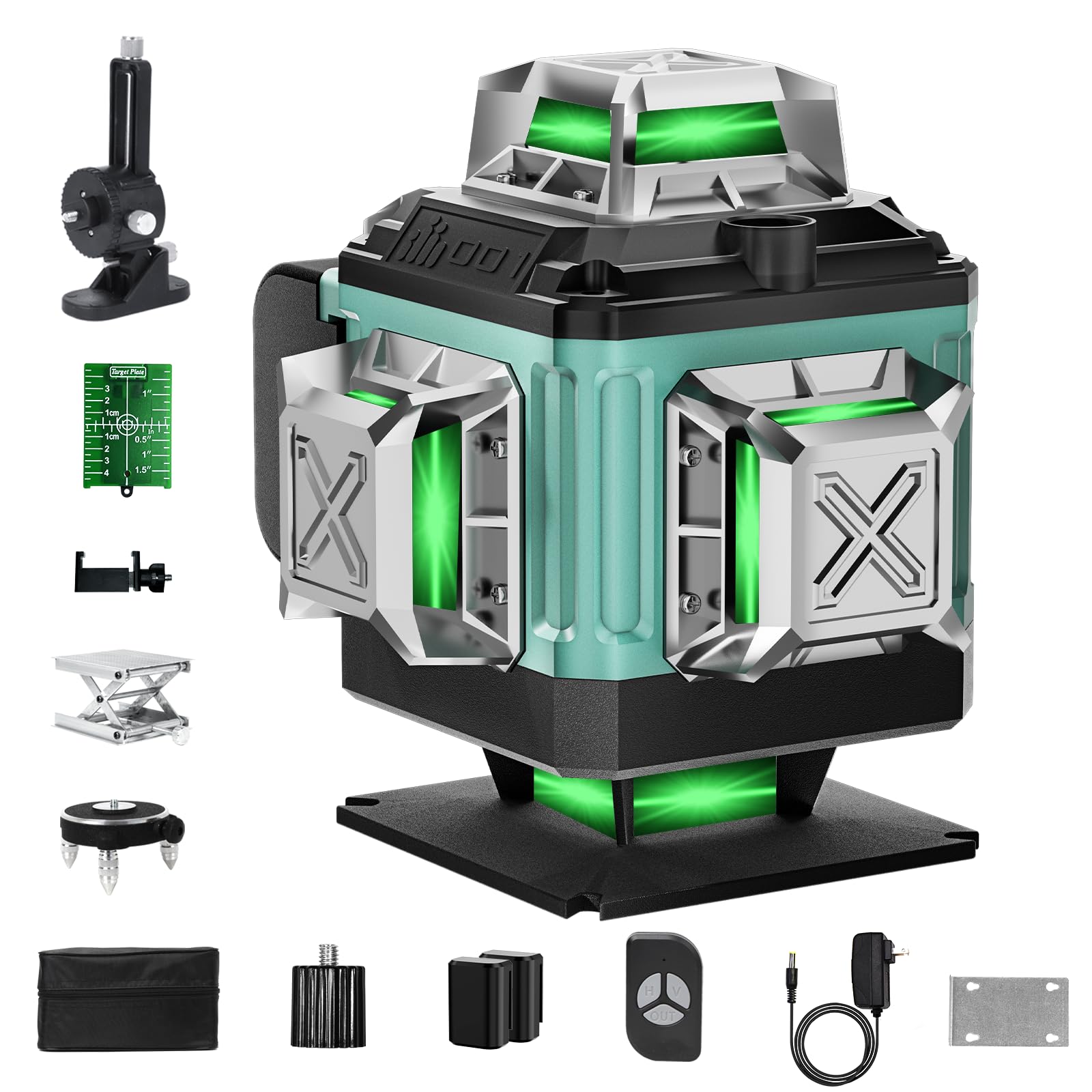
The ENRIPRT 16 Lines laser delivers full 4×360-degree coverage — two horizontal and two vertical planes — from a single setup. That means the floor, all four walls, and the ceiling are illuminated simultaneously, which dramatically speeds up drop-ceiling grid layout or full-room tile alignment. The stated accuracy of ±1/16 inch at 23 feet is tighter than most in this price tier, and in practice the beam stays crisp up to the claimed 130-foot range in moderate indoor light.
The remote control lets you toggle individual lines on and off from up to 30 feet away — a genuine time-saver when you’re standing at the far end of a hallway adjusting the beam pattern. The kit is exceptionally complete: two 2400mAh rechargeable batteries, a magnetic bracket, a mini tripod, a lifting platform, and a hard carry case. Having a spare battery means hot-swapping without waiting for a recharge cycle.
The self-leveling system handles up to three degrees of tilt before flashing an alert. Some users report the beam appears slightly fuzzy at extreme distances, though still usable for framing and conduit runs. The magnetic bracket feels substantial, but the mini tripod included is better suited for desktop height than standing work — you’ll want a full-size tripod for most construction tasks. Overall, this kit offers the best accessory-to-price ratio for anyone needing a 4D green laser.
Why it’s great
- 4×360 coverage eliminates repositioning for full-room layouts
- Remote control enables one-person operation over distance
- Two hot-swappable 2400mAh batteries keep work flowing
- Comprehensive kit with hard case and mounting accessories
Good to know
- Mini tripod height is too low for standing work
- Beam edge softens slightly beyond 80 feet
- Remote range can be inconsistent in direct sunlight
3. Angel Kiss 4×360 Self-Leveling Laser

The Angel Kiss 4×360 punches well above its category placement with a feature set normally reserved for more expensive units. The 4D layout — two horizontal and two vertical planes — covers a full room from one position, and the upgraded green diode holds clarity at the stated 100-foot indoor range with an accuracy tolerance of ±1/10 inch at 32 feet. That’s sufficient for tile layout and suspended-ceiling work where cumulative error over distance is the main concern.
Battery runtime is a genuine strong point: the built-in rechargeable pack delivers over seven hours with a single line active and roughly three and a half hours with all four lines running. The 360-degree rotating base and fine-tuning knobs allow micro-adjustments that are missing from some competitors, and the self-leveling pendulum re-stabilizes quickly even after accidental bumps. The inclusion of both 1/4″ and 5/8″-20 mounting threads gives tripod compatibility across nearly every standard.
The carrying bag is basic and lacks the foam inserts of a hard case, so you’ll want to store it carefully between jobs. A few users noted that the instruction manual is sparse on detail for the manual mode activation sequence. But for a 4D green laser at this price point, the performance-per-dollar ratio is hard to beat, especially for ambitious DIYers and small contractor crews.
Why it’s great
- Full 4×360 coverage at a price near 3D competitors
- Fine-tuning knobs allow precise line positioning
- Runs over 7 hours on a single line
- Accepts both 1/4″ and 5/8″ tripod threads
Good to know
- Soft carry bag offers less protection than a hard case
- Manual mode activation is not clearly explained
- Replacement battery is built-in, not swappable
4. PREXISO 360° Green Laser with Tripod

The PREXISO 360 is an approachable entry point for green beam lasers, projecting a continuous 360-degree horizontal line and a vertical cross. The beam is roughly three times brighter than an equivalent red diode, holding visibility up to 100 feet in moderate indoor light — bright enough for most residential and light commercial applications. Self-leveling engages within four degrees of tilt, and a sliding switch on the side locks the pendulum for sloped manual use.
The kit includes a 37.5-inch tripod with a quick-release plate, which is rare at this price point. The tripod is lightweight enough for quick moves between rooms, but its maximum height is short — the beam sits at roughly 38 inches, meaning you’ll need a taller stand or a workbench for ceiling-level work. A pair of green-enhancing glasses and a target plate are included to boost visibility in challenging conditions.
The main trade-off is power: this unit runs on four AA batteries rather than a rechargeable pack. The included Duracells are a nice touch, but ongoing battery cost adds up if you use the laser daily. There is no pulse mode for outdoor receiver use, so the PREXISO is best confined to indoor projects where you don’t need to fight direct sunlight. For the DIYer who wants green-beam clarity without a large upfront investment, this is a solid starting kit.
Why it’s great
- Green beam provides strong visibility at competitive price
- Includes functional mini tripod with quick-release plate
- Green-enhancing glasses help in bright rooms
- Straightforward sliding switch for manual mode
Good to know
- AA battery operation costs more over time than rechargeable
- Tripod is too short for ceiling-level alignment
- No pulse mode for outdoor receiver use
5. SKIL LL932301 Red Cross-Line Laser

SKIL’s LL932301 proves that a simple red cross-line laser can still earn a place in a well-stocked tool bag. The red beam projects a horizontal and vertical line up to 50 feet — adequate for cabinet installation, trim work, and shelving projects inside typical residential rooms. The self-leveling pendulum works reliably within a reasonable tilt range, and the built-in rechargeable lithium battery with micro-USB charging is a welcome convenience compared to disposable cells.
The included clamp attaches to the top or bottom of the tool, allowing you to mount it to shelf edges, door frames, or studs without needing a tripod. The battery life indicator and out-of-level alert light are straightforward and legible. At just under 9 ounces, this laser disappears into a tool pouch, and many users report it surviving accidental drops onto concrete without losing calibration.
Red beam visibility is the obvious limitation: in bright daylight near a window, the line washes out beyond about 20 feet. The clamp, while clever, has limited gripping force on thick or rounded surfaces and can slip if not tightened firmly. The 5-year warranty from SKIL is confidence-inspiring, but this tool is best suited for indoor finishing work where you control the lighting. It’s not a full-room layout tool, but for precision on individual cabinets or chair rails, it gets the job done cleanly.
Why it’s great
- Built-in rechargeable battery with micro-USB avoids AA costs
- Compact and lightweight for one-handed use and storage
- Clamp mount provides quick attachment to common surfaces
- SKIL 5-year warranty backs the investment
Good to know
- Red beam struggles in bright sunlight or large rooms
- Clamp grip is limited on thick or rounded edges
- No 360-degree coverage; horizontal line is segment only
6. WEIDDW 4×360 Red Laser with Tripod

The WEIDDW 4D laser brings full-room coverage — two horizontal and two vertical red planes — to a budget-friendly bracket. The red diode is serviceable for indoor use in dim to moderate light, and the self-leveling pendulum handles up to four degrees of tilt before triggering a warning. The standout feature here is the dual 3600mAh rechargeable batteries, which collectively deliver between 8 and 10 hours of runtime, easily lasting a full workday.
The kit includes a tripod and a remote control, which is generous at this price point. The tripod is functional but light-duty; reviewers note it feels flimsy and doesn’t extend very high, so plan to use it on a workbench or surface. The remote works reliably within a room, letting you toggle lines without walking back to the unit. The tool also offers a dimmable beam, which helps conserve battery when full brightness isn’t needed.
The limitations are mostly around build quality. The case and tripod feel inexpensive, and the manual mode — activated by a long button press — disables the tilt alarm but doesn’t physically lock the pendulum, so bumps can still shift the beam. USB-C charging is convenient, but the port cover is thin and may not seal well against dust over time. For a DIYer working on a home renovation who needs 4D coverage without spending heavily, this laser delivers the layout capability where it counts.
Why it’s great
- Dual 3600mAh batteries provide all-day run time
- 4D coverage projects onto all walls and ceiling
- Dimmable beam helps extend battery life
- Remote and tripod included in the kit
Good to know
- Tripod and case feel cheap and may not last long on job sites
- Manual mode doesn’t mechanically lock the pendulum
- Red beam washes out in bright ambient light
7. HYCHIKA Cross Line Laser Level

The HYCHIKA cross-line laser is the most compact and affordable entry in this guide, designed explicitly for light DIY tasks like hanging pictures, installing shelves, or laying tile in a single room. The red beam projects vertical, horizontal, or cross-line patterns at up to 50 feet, and the self-leveling pendulum locks within 6 seconds when tilt is under four degrees. The IP54 rating — shock-resistant, dust-sealed, and splash-proof — is unusual at this price and adds genuine durability for a tool that will get tossed into a garage drawer.
Power comes from two standard AA batteries, which deliver over 20 hours of continuous use — enough for multiple weekend projects before a swap. The magnetic L-bracket attaches securely to metal studs or beam flanges, and the 1/4″-20 thread allows tripod mounting. The housing is lightweight ABS plastic with a rubberized grip, comfortable for one-handed operation when you’re marking lines directly against a wall.
The obvious limitation is the red diode’s visibility in bright rooms; beyond 20 feet in sunlight, the line becomes difficult to see. There’s no rechargeable battery, no remote, and no 360-degree coverage — this is a focused cross-line tool, not a room-scale layout system. The accuracy is adequate for residential work but not specified to the tight tolerances of pricier green lasers. For the absolute lowest barrier to entry into laser leveling, this is a capable, no-regrets purchase.
Why it’s great
- IP54 dust and splash protection for garage and workshop life
- AA batteries achieve over 20 hours of runtime
- Compact size with rubberized grip for easy handling
- Incredibly low barrier to entry for first-time laser users
Good to know
- Red beam visibility drops sharply in bright indoor light
- No rechargeable battery — ongoing AA cost
- Cross-line only; can’t cover full room from one setup
FAQ
What does the accuracy spec like ±1/9 inch at 33 feet actually mean?
Is a green laser always better than a red laser for indoor DIY work?
Do I need a 4D laser or is a cross-line model enough?
Can I use a self-leveling laser outdoors?
What is the practical difference between a pendulum lock and a slide switch for manual mode?
Final Thoughts: The Verdict
For most users, the best dot laser winner is the Huepar HM03CG because it balances green beam brightness, pulse-mode expandability, and a robust build with a 5-year warranty at a price that makes sense for serious DIYers and pros alike. If you need full 4×360 coverage with a comprehensive kit, grab the ENRIPRT 16 Lines. And for budget-conscious full-room layouts that still deliver 4D performance, nothing beats the value of the Angel Kiss 4×360.

Mo Maruf
I created WellFizz to bridge the gap between vague wellness advice and actionable solutions. My mission is simple: to decode the research and give you practical tools you can actually use.
Beyond the data, I am a passionate traveler. I believe that stepping away from the screen to explore new environments is essential for mental clarity and physical vitality.