Our readers keep the lights on and my smoothie glass nicely filled. As an Amazon Associate, I earn from qualifying purchases.
Choosing the right flying camera under a strict budget means looking past marketing hype and focusing on what truly matters for stable, clear aerial footage. The gap between a toy and a capable tool narrows fast once you compare gimbal stabilization, transmission range, and flight time directly.
I’m Mohammad Maruf — the founder and writer behind WellFizz. I analyze flight controllers, gimbal designs, and camera sensors to find which drone delivers actual value for the price.
After comparing brushless motors, autonomous flight features, and battery performance across several models, here is the definitive guide to the best drone with camera under $500.
How To Choose The Best Drone With Camera Under $500
Picking a camera drone in this price range means balancing flight time, camera quality, and regulatory compliance. A few key specs will separate a capable aerial tool from a frustrating toy.
Gimbal Types: Mechanical vs. Electronic Stabilization
A physical 3-axis gimbal mechanically counteracts pitch, roll, and yaw drift, producing smooth footage even in moderate wind. Electronic Image Stabilization (EIS) crops the sensor and corrects digitally, which works for slow flights but suffers during fast maneuvers. Drone with a 3-axis brushless gimbal almost always delivers better results than relying on EIS alone.
Transmission System: Wired Digital vs. Wi-Fi
Dedicated digital transmission systems use a wired connection between your remote and phone, reducing latency and interference. Wi-Fi-based drones are cheaper but lose signal quickly beyond a few hundred feet. A wired relay or dedicated digital link is essential if you plan to fly beyond visual line of sight or in areas with radio noise.
Battery Life and Charging Considerations
Most drones in this class provide 25-40 minutes per battery under ideal conditions. Cold temperatures and wind cut that number by 30-40%. Models that include two or three batteries extend practical flight time. Check whether the battery supports fast charging (PD 3.0 or similar) to reduce ground time between flights.
Quick Comparison
On smaller screens, swipe sideways to see the full table.
| Model | Category | Best For | Key Spec | Amazon |
|---|---|---|---|---|
| DJI Mini 4K | Mid-Range | Cinematic beginners | 3-Axis Gimbal, 4K UHD | Amazon |
| Holy Stone Sentinel HS600D | Premium | Prosumer quality | 8K Photo, 6KM Transmission | Amazon |
| Bwine F7MINI 4K(RC3) | Premium | Controller with 1080P screen | 5.5″ 1080P RC Screen | Amazon |
| Ruko 4K UHD Drone | Premium | Long flight sessions | 96 Mins (3 batteries) | Amazon |
| Bwine F7GB2 Pro | Premium | Windy conditions | 6-Level Wind Resistance | Amazon |
| G11PRO 6K Drone | Mid-Range | Value with 3-axis gimbal | 3-Axis Brushless Gimbal | Amazon |
| Potensic ATOM LT | Mid-Range | Weight and range | 2.5K EIS, 4KM Range | Amazon |
| HOVERAir X1 | Mid-Range | Hands-free selfies | 125g Palm Takeoff | Amazon |
| K600GPS Brushless Drone | Budget | Beginners on a budget | 4.5″ Controller Screen | Amazon |
In‑Depth Reviews
1. DJI Mini 4K

The DJI Mini 4K delivers a true 3-axis mechanical gimbal and 4K UHD video in a sub-249-gram frame, making it the reference point for quality in this price segment. Its 10km OcuSync 2.0 transmission system provides a reliable, low-latency feed far beyond what Wi-Fi drones can achieve, and the 31-minute per-battery flight time is among the longest in its class.
Wind resistance up to Level 5 (38 kph) keeps the footage stable during coastal or hilltop flights, while QuickShots like Helix, Rocket, and Circle automate cinematic moves without manual stick inputs. The 1/2.3-inch CMOS sensor captures 12MP stills and 4K at 30fps with natural color reproduction.
Setup requires the DJI Fly app (not available on Google Play—download from the DJI website), and the single-battery configuration may feel limiting for longer sessions. Experienced pilots often prefer the two- or three-battery bundle to avoid frequent landings. The RC-N1C remote relies on a smartphone for the live feed, which some find cumbersome.
Why it’s great
- True 3-axis mechanical gimbal for smooth footage
- 10km OcuSync 2.0 transmission, not Wi-Fi
- Proven DJI software and flight safety features
Good to know
- Requires smartphone for live view
- Single battery limited to 31 minutes
2. Holy Stone Sentinel HS600D

Holy Stone’s HS600D uses a 1/2-inch Sony CMOS sensor with an f/1.8 aperture to capture 8K stills (48MP) and 4K HDR video, paired with a physical 3-axis gimbal plus EIS for dual-layer stabilization. At 603 grams, it exceeds the FAA exemption weight, so registration is required, but the heavier frame and 6-level wind resistance allow stable hovering in conditions that grounded lighter drones.
The 20,000-foot wired relay transmission system maintains a low-latency 1080p feed up to 6 kilometers, and the two 3,500mAh batteries deliver roughly 80 minutes of total flight time. Smart modes like follow me, time-lapse, panorama, and smart tracking execute complex flight paths automatically.
The remote lacks a built-in screen, meaning a phone is still needed for the live feed. The camera controls do not include manual ISO or exposure time adjustments, and the drone does not store RAW image files. Some users report that the battery charger uses USB-C to C for faster charging from a PD source.
Why it’s great
- High-quality Sony sensor with f/1.8 aperture
- Wired relay transmission for stable long-range feed
- Excellent wind resistance for its class
Good to know
- 603g weight requires FAA registration
- No manual camera controls or RAW capture
3. Bwine F7MINI 4K(RC3)
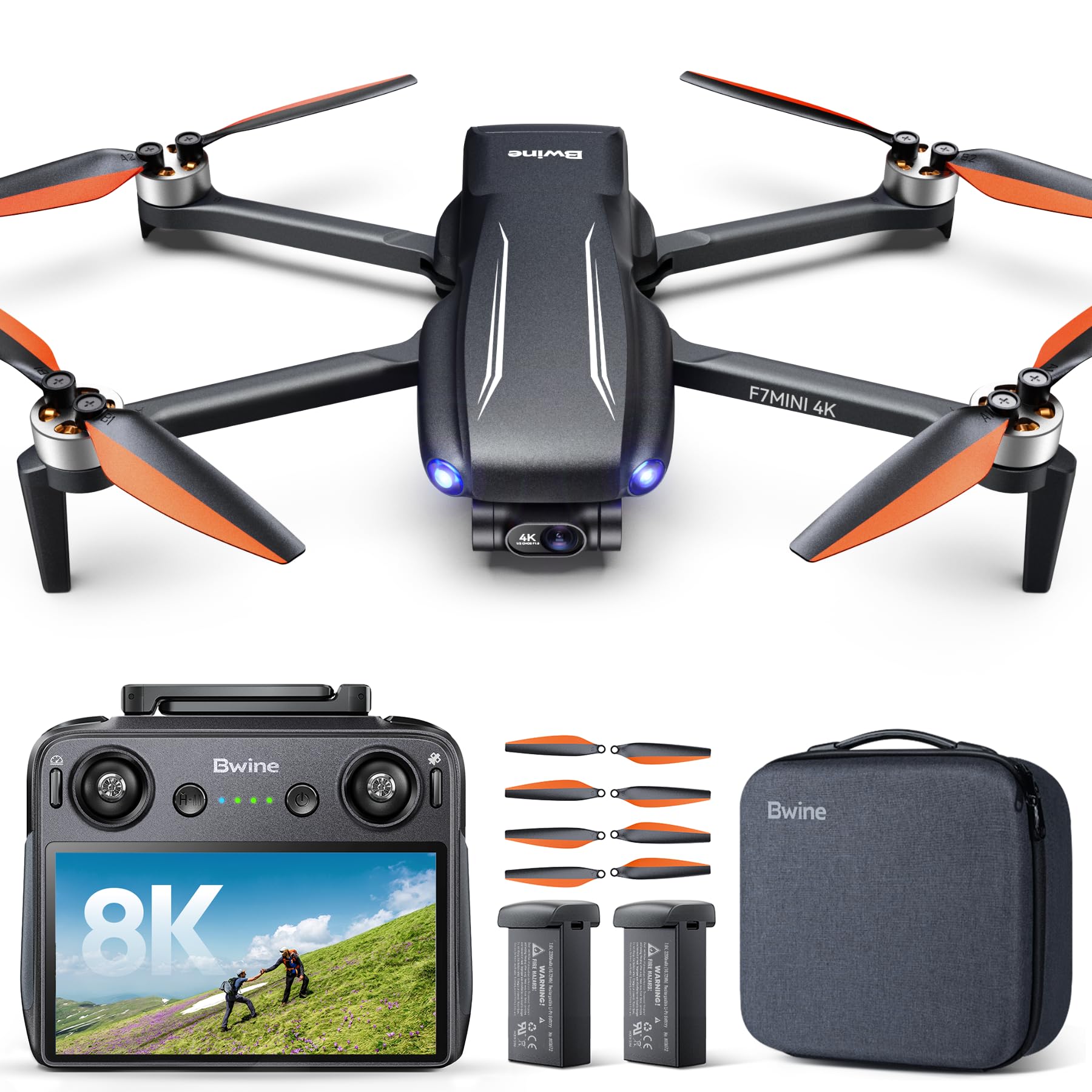
The Bwine F7MINI 4K(RC3) solves the phone-as-screen problem with a 5.5-inch 1080P 500-nit display built directly into the remote. There is no need to connect a smartphone for live view—the controller has 32GB of internal storage and a 3-hour battery life. The drone itself weighs under 249 grams, so no FAA registration is required.
The 4K camera uses a 1/2.8-inch 48MP sensor with f/1.8 aperture, 5x digital zoom, and vertical shooting mode for social media-friendly framing. A 3-axis brushless gimbal plus EIS keeps footage steady, and the 20,000-foot digital transmission system (0.1-second latency) maintains a stable signal for up to 6 kilometers. Two 2,200mAh batteries provide 64 minutes of total flight time.
The controller uses a proprietary connection cable (USB-C or Lightning) rather than a standard USB plug, and the digital zoom is strictly lossy crop rather than optical. Some users note that downloading footage from the controller to a phone takes longer than expected—direct computer transfer is quicker.
Why it’s great
- Built-in 5.5″ 1080P screen eliminates need for phone
- Under 249g, no FAA registration needed
- Very low-latency digital transmission system
Good to know
- Digital zoom reduces image quality
- Proprietary remote cable connection
4. Ruko 4K UHD Drone

Ruko’s offering packs three intelligent batteries for a total of 96 minutes of flight time, which is the highest combined airtime in this lineup. The drone weighs under 249 grams, uses a 1/2-inch 48MP sensor for 8K photos and 4K/30fps video, and pairs a 3-axis brushless gimbal with EIS for dual stabilization.
The R2 digital transmission system provides a 20,000-foot range without the interference issues common to Wi-Fi drones. AI-assisted takeoff and landing, quadruple positioning (GPS, barometric altitude hold, TOF, and optical flow), and a built-in beeper make this particularly beginner-friendly. The included hard shell carrying case is well-organized for all accessories.
The controller does not have a built-in screen, so a phone is still required. Some units have shipped with defective batteries—Ruko’s customer service is responsive about sending replacements. The joysticks are sensitive by default, and beginners may need to dial in expo settings to avoid jerky movements.
Why it’s great
- 96 minutes total flight with three included batteries
- Under 249g, no FAA registration needed
- AI-assisted takeoff/landing safety features
Good to know
- Phone required for live view
- Some units have battery defect issues
5. Bwine F7GB2 Pro

The Bwine F7GB2 Pro combines a one-click detachable 4K camera with a 3-axis gimbal and 5x digital zoom, all housed in a heavier frame that withstands Level 6 wind (45-50 kph tested). The 1806 brushless motors, compass, gyroscope, and barometer together allow flight at altitudes up to 2,000 meters above sea level—unusual for a drone under $500.
Three 2,600mAh intelligent batteries deliver a combined 75 minutes of flight time. The batteries are UL 2054 certified for safety, and Bwine recommends a 65W fast charger (sold separately) to reduce charging time to about 1.5 hours. The GQ2.0 digital transmission system provides a 10,000-foot range with a wired phone connection for low latency.
The remote does not have a built-in screen, so a phone is required for the live feed. The camera distorts slightly during fast turns due to rolling shutter without a global shutter sensor. Also, the remote screen overlay can be hard to read in direct sunlight.
Why it’s great
- Certified Level 6 wind resistance
- UL-certified smart batteries
- Can fly at 2,000m altitude
Good to know
- Phone screen needed for flight view
- Requires 65W fast charger separately
6. Gleesfun G11PRO 6K Drone

The Gleesfun G11PRO delivers a 3-axis brushless gimbal, 6K photo resolution, and 4K/30fps video at a price that undercuts most gimbal-equipped competitors. The GQ2.0 digital transmission system uses a two-way dual-antenna design for clear transmission up to 10,000 feet, and the wired connection avoids Wi-Fi dropouts.
Two 3,200mAh batteries provide 70 minutes of total flight time (35 minutes each) with about 2.5 hours of fast charging. The GL2.0 smart battery management system monitors charge cycles and includes a breathing alert light for safety. The kit is comprehensive: 40 pieces including a carrying case, spare propellers, and multiple adapter cables for different phone ports.
The camera’s 1/3.2-inch CMOS sensor is smaller than the Sony sensor found in the Holy Stone HS600D, so low-light performance is noticeably weaker. The follow-me mode works well but relies on GPS rather than visual tracking, so the drone may drift if the subject is moving fast. Cruise control mode simplifies filming but requires practice to master.
Why it’s great
- Affordable 3-axis gimbal drone
- Comprehensive 40-piece kit with carrying case
- Smart battery management with fast charging
Good to know
- Smaller sensor struggles in low light
- Follow-me mode is GPS-based, not visual
7. Potensic ATOM LT

The Potensic ATOM LT weighs exactly 249 grams and folds down to fit in a jacket pocket (3.5 x 5.6 x 2.3 inches), making it one of the most portable models here. Its PixSync 2.0 transmission system provides up to 4 kilometers of range, and the two 3,000mAh batteries deliver a rated 40 minutes each for 80 minutes of total flight time.
The 2.5K camera (2,560 x 1,440 at 30fps) uses a Sony IMX sensor with ShakeVanish 2.0 EIS stabilization—there is no mechanical gimbal, so footage in wind shows more roll than gimbal-equipped drones. The 118-degree field of view is wider than most competitors, and the camera tilts from +20° to -90° for dynamic angles. The SurgeFly 2.0 brushless motor system handles Level 5 winds.
There is no mechanical gimbal, so video stabilization is purely digital, which crops the image and can introduce warp artifacts during fast pans. The GPS satellite acquisition time is slower than many competitors—some users report 2-3 minutes before the drone will arm. The camera resolution is capped at 2.5K, so 4K output is not available.
Why it’s great
- Extremely portable foldable design
- 80 minutes flight time with two batteries
- Wide 118-degree FOV camera
Good to know
- No mechanical gimbal—EIS only
- Slow GPS fix before flight
8. HOVERAir X1

The HOVERAir X1 drops the standard controller entirely—it launches from your palm and follows you using visual tracking algorithms rather than GPS. At just 125 grams, it is the lightest drone in the guide and does not require FAA registration. Its fully enclosed propeller design with safety guards makes it safe for close-range selfies and indoor use.
The camera captures 2.7K at 30fps and 1080P HDR video with a triple stabilization system, though the sensor is small (1.2MP effective still resolution). Pre-programmed flight paths—Hover, Follow, Zoom Out, Orbit, Bird’s Eye—require no piloting skills. Each 1,050mAh battery provides about 11 minutes of flight (20 intelligent flight paths), and the combo kit includes a charging hub for the three batteries.
Flight time is short (11 minutes per battery), and wind resistance only covers Level 4 (7.9 m/s), limiting outdoor use in breezy conditions. The camera resolution and sensor size are far below what a gimbal-equipped drone delivers, so image quality is acceptable for social media but not for professional work. The drone struggles over water because the bottom sensors cannot lock onto a reflective surface.
Why it’s great
- True hands-free operation with palm takeoff
- Lightest drone at 125g, fully FAA exempt
- Enclosed propellers for safe close-range flight
Good to know
- Short flight time—11 minutes per battery
- Camera quality is social-media grade only
9. K600GPS Brushless Drone
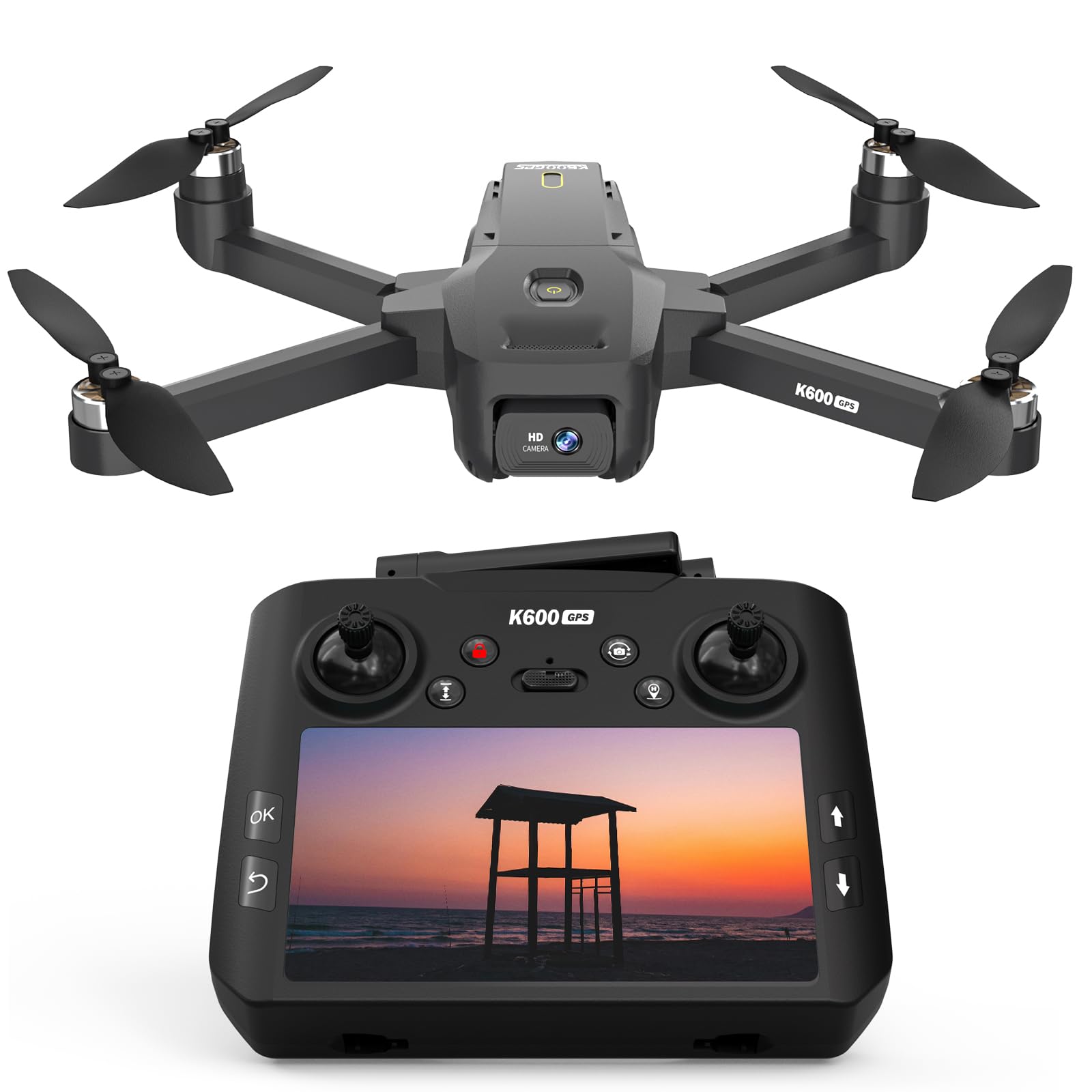
The K600GPS provides a 4.5-inch screen built into the controller for less than half the cost of most competitors—a useful feature for beginner pilots who want to see the live feed without a phone. The drone weighs under 249 grams and uses brushless motors (12,000 RPM) for better stability than the brushed motors found in true toy drones.
The 1080P 90-degree adjustable camera is paired with EIS stabilization, though the resolution and sensor size are significantly lower than 4K-equipped models. GPS auto-return, follow-me mode, waypoint fly, and circle fly are all included. The modular battery uses Type-C charging, and the drone supports up to a 32GB TF card for storage.
The 1080P camera lacks the detail needed for large prints or critical analysis—it is functional for social media and casual family videos. The built-in screen is a helpful teaching tool, but the remote itself is bulkier than a standard controller. The drone is not suitable for windy days due to its light weight and the absence of a mechanical gimbal.
Why it’s great
- Built-in 4.5-inch screen for live view
- Affordable entry to GPS flight features
- Brushless motors for smooth flight
Good to know
- 1080P camera, limited detail for large prints
- No mechanical gimbal for stabilization
FAQ
Is a 3-axis gimbal worth the extra cost in a sub-$500 drone?
Can I fly a sub-249g drone without FAA registration?
How much flight time should I expect from a drone under $500?
Final Thoughts: The Verdict
For most users, the drone with camera under $500 winner is the DJI Mini 4K because it combines a proven mechanical 3-axis gimbal, reliable OcuSync transmission, and strong ecosystem support at a mid-range price. If you want a built-in 1080P screen controller to avoid using a phone, grab the Bwine F7MINI 4K(RC3). And for maximum flight time with three batteries under 249 grams, nothing beats the Ruko 4K UHD Drone.

Mo Maruf
I created WellFizz to bridge the gap between vague wellness advice and actionable solutions. My mission is simple: to decode the research and give you practical tools you can actually use.
Beyond the data, I am a passionate traveler. I believe that stepping away from the screen to explore new environments is essential for mental clarity and physical vitality.