Our readers keep the lights on and my smoothie glass nicely filled. As an Amazon Associate, I earn from qualifying purchases.
Parking your RV in a remote canyon or off-grid campsite often means watching your cell signal drop to zero, turning your smartphone into a useless brick. A booster is the only way to pull a usable signal from a distant tower, converting a dead zone into a place where you can stream, hotspot, and make clear calls.
I’m Mohammad Maruf — the founder and writer behind WellFizz. I’ve spent many hours analyzing frequency band compatibility, antenna gain figures, and real-world customer data to determine which RV signal boosters actually deliver measurable improvements in the field.
This guide breaks down every critical spec and use-case scenario to help you choose the best cell signal booster for rv travel, whether you are a full-time roamer or a weekend camper.
How To Choose The Best Cell Signal Booster For RV
Picking the right RV cell booster is about more than price — you need a system that matches your travel style, your carrier’s spectrum, and the physical layout of your vehicle. A mismatched booster can leave you with zero improvement.
Carrier Frequency Bands
Every carrier broadcasts on specific frequency bands. Verizon relies heavily on Band 13 (700 MHz), while T-Mobile uses Band 12/17 and newer mid-band 5G frequencies. A good RV booster must support the bands your carrier uses in the areas you travel. Check your phone’s field test mode to see which bands your carrier uses at your regular campsites.
Antenna Type: Omni vs. Directional
Omni-directional antennas receive signals from all directions — ideal for moving vehicles where the tower direction constantly changes. Directional antennas (Yagi or log-periodic) focus on a single tower, providing stronger gain but requiring manual aiming. If you park for long stays, a directional antenna almost always outperforms an omni. For driving and quick stops, an omni is more practical.
Gain and Output Power
Measured in decibels (dB), gain indicates how much the booster amplifies the signal. Typical RV boosters offer 50 to 65 dB of max gain. Higher gain pulls weaker signals from farther towers, but real-world improvement depends on noise and antenna placement. Output power (measured in dBm) determines how far the boosted signal reaches inside the RV — important for covering a larger motorhome.
Quick Comparison
On smaller screens, swipe sideways to see the full table.
| Model | Category | Best For | Key Spec | Amazon |
|---|---|---|---|---|
| weBoost Destination RV | Premium | Stationary campsites | 25 ft collapsible pole | Amazon |
| HiBoost Travel 2.0 RV | Premium | Mobile & parked use | 50 dB max gain | Amazon |
| SureCall Fusion2Go 3.0 RV | Premium | Large motorhomes | 2X output power | Amazon |
| weBoost Drive 4G-X OTR | Premium | Semi-trucks & large RVs | 17 in. omni antenna | Amazon |
| HiBoost C30G-5S-BTW | Mid-Range | SUVs & pickup campers | Enhanced magnetic antenna | Amazon |
| Confixpand 5-Band Booster | Mid-Range | Clutter-free dash | Integrated indoor antenna | Amazon |
| Metarepeater MB1 | Mid-Range | Real-time signal monitoring | Color LCD display | Amazon |
| PRACOA 65dB Booster | Mid-Range | Budget-friendly 5G ready | 65 dB high gain | Amazon |
| GAGBK 6-Band Booster | Mid-Range | Entry-level value | 6 frequency bands | Amazon |
In‑Depth Reviews
1. weBoost Destination RV (470159)

The weBoost Destination RV is the most powerful stationary booster available for RVers. It comes with a 25-foot collapsible pole that lifts the directional antenna far above surrounding trees and metal obstructions, dramatically improving line-of-sight to distant towers. The kit includes both AC and DC power supplies, plus a flat window cable for temporary installation without drilling.
Real-world tests show Verizon speeds jumping from below 1 Mbps to 4-9 Mbps, and users report consistent Zoom call quality even in remote forests. The directional antenna requires aiming using the weBoost app or a compass, but the gain payoff is substantial compared to any omni-directional design. The system supports all major US and Canadian carriers on bands 12/17, 13, 5, 4, and 25/2.
Setup takes about 10 minutes once the pole is mounted, though the total package weighs 24 pounds and takes up storage space. Several users noted that the booster needs at least one bar of original signal to amplify — it will not create signal where absolutely zero exists. Works best for long-term campsite setups rather than nightly stops.
Why it’s great
- 25 ft pole gives unmatched height for pulling distant signals
- Includes both AC and DC power supplies for any campsite
- Real 5G support across all major US carriers
Good to know
- Heavy — 24 pounds adds to gear weight
- Directional antenna must be aimed manually per campsite
- No improvement if your site has zero cell signal
2. HiBoost Travel 2.0 RV

HiBoost’s Travel 2.0 RV kit balances portability and power with a 50 dB max gain and an omni-directional outdoor antenna that works while driving. The included 13-foot indoor antenna cable lets you position the interior antenna near your couch, bed, or desk depending on where you park. A dedicated Signal Supervisor app provides real-time signal monitoring and placement tips.
Customer feedback highlights strong performance in mountain regions like the Rockies and high desert, with many users seeing a jump from one bar to four bars after proper installation. The system supports bands 12, 13, 5, 25, and 4, making it compatible with Verizon, AT&T, and T-Mobile. The 3-year warranty and US-based tech support are notable advantages at this price tier.
Some users reported that the Bluetooth connection for the monitoring app was occasionally unreliable, and a few found the omni antenna less effective in very weak signal zones. A directional antenna swap improved performance for those in deep-rural spots. The kit is best for RVers who alternate between highway driving and extended parking.
Why it’s great
- Monitoring app helps dial in antenna placement
- Long indoor cable gives flexible interior positioning
- 3-year warranty with responsive US support
Good to know
- Bluetooth app connection can be inconsistent
- Omni antenna may underperform in ultra-weak zones
- Setup can take a few hours with drilling required
3. SureCall Fusion2Go 3.0 RV

SureCall’s Fusion2Go 3.0 RV stands out for its 2XP Technology, which delivers double the output power of comparable boosters. This translates to better coverage inside large motorhomes and travel trailers where signal needs to travel further from the indoor antenna. The kit includes an omni-directional external antenna and a whip-style indoor antenna that mount easily on standard RV roofs.
Users moving from aluminum-sided RVs report a marked improvement in web surfing and streaming where previously the metal shell blocked all signal. The booster works with all major US carriers and supports 5G phones. The metal housing is built to last, and the unit is assembled in the USA.
The trade-off is that the boosted signal is strongest only within four to five feet of the indoor antenna — if your RV is long, you may need to reposition the interior antenna or use it as a hotspot relay. Some early units required a replacement, but tech support handled the swap. The Fusion2Go is ideal for RVers who need raw power in a metal-constructed vehicle.
Why it’s great
- 2X output power improves coverage in large RVs
- Durable metal housing built for rough travel
- Supports 5G voice and data on modern phones
Good to know
- Signal range is limited to a few feet from the indoor antenna
- Some units needed replacement during initial testing
- Best for aluminum or metal-sided RVs
4. weBoost Drive 4G-X OTR (470210)

The weBoost Drive 4G-X OTR is engineered for large vehicles like semi-trucks and fifth-wheel RVs. Its 17-inch omni-directional antenna provides significantly more surface area for signal capture than compact magnetic antennas, which translates into 20-30 dB stronger signal pull in independent tests. The kit includes a 3-way CB antenna mount and a mast extension for permanent roof installation.
Users driving through remote areas like Teton Canyon or Mesa Verde found that the OTR antenna delivered usable data speeds where their phone showed zero bars. The system is designed for multi-user coverage, so everyone in the cab can enjoy improved voice and data. The booster consumes less battery power, adding up to two hours of talk time compared to running the phone at full power.
Installation is more involved than smaller kits — the large antenna requires a sturdy mount and careful cable routing. The system does not support 5G bands natively, focusing instead on rock-solid 4G LTE. This is the right choice for full-time truck campers and RVers who prioritize reliable 4G data over bleeding-edge 5G compatibility.
Why it’s great
- 17-inch omni antenna dramatically increases signal capture
- Multi-user coverage for everyone in the vehicle
- Up to 2 hours extra talk time due to lower phone power draw
Good to know
- No native 5G band support
- Large antenna requires permanent mounting effort
- Needs at least a weak signal to amplify
5. HiBoost C30G-5S-BTW Car Booster
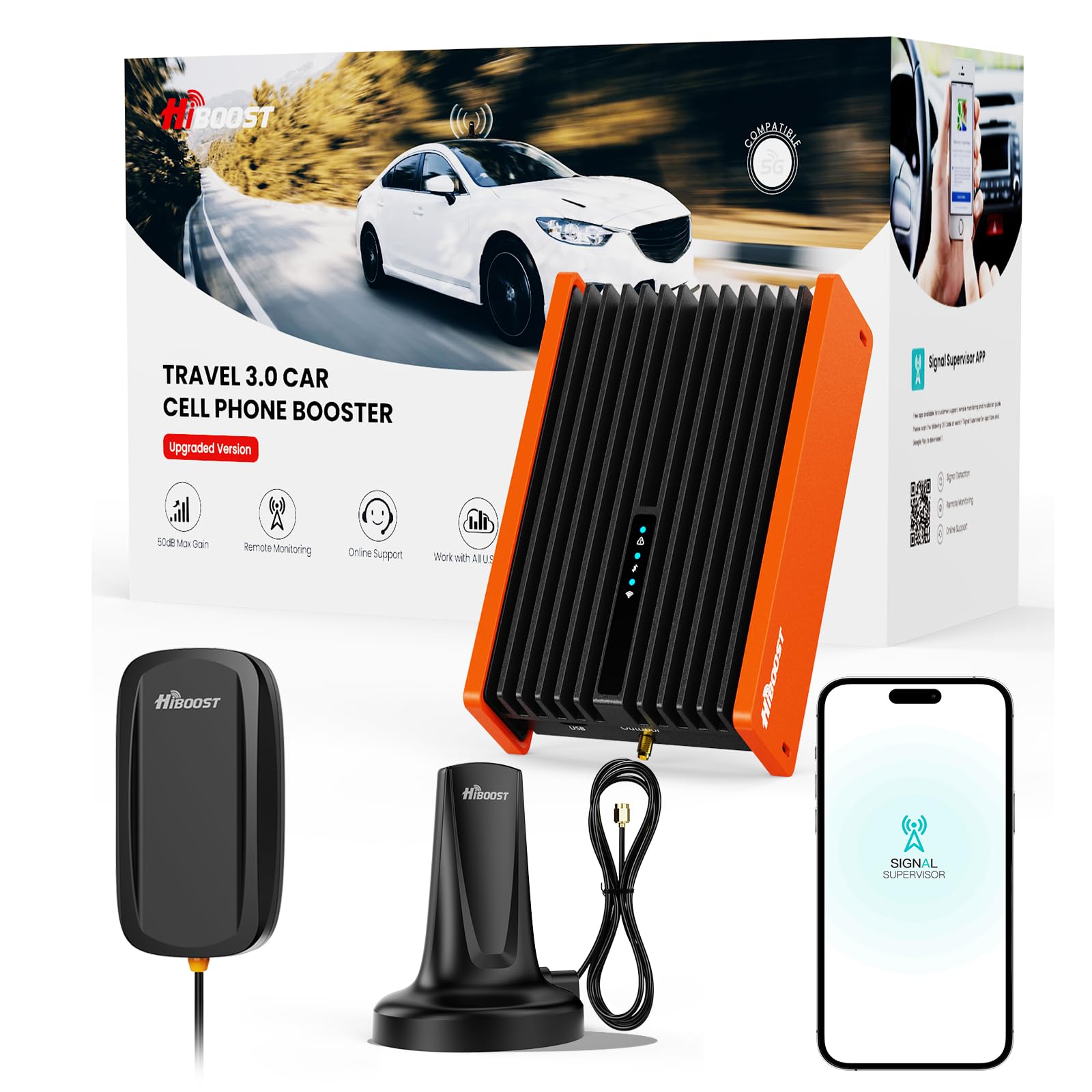
HiBoost’s C30G-5S-BTW brings a honeycomb briquette heat dissipation design that improves cooling by 30%, allowing the booster to maintain peak output during long driving days. The entire system uses precision-grade 50Ω RF connectors to minimize signal loss between the antenna and the amplifier. The outdoor magnetic antenna is dustproof, oilproof, and waterproof with strong magnets that stay attached at highway speeds.
Customers testing with T-Mobile 5G UC in weak areas saw a jump from no signal to full bars, and the booster performed well with Verizon, AT&T, and Boost Mobile. The Signal Supervisor app provides live status and installation guidance. The amplifier itself is compact enough to fit under a seat or in a glovebox.
The power cord may be slightly short for larger vehicles, and a few users noted that antenna separation in small cabs can cause oscillation. The 13-foot external cable and 9.8-foot internal cable give decent placement flexibility. This booster suits SUV campers and smaller RV setups where heat management and compact size matter.
Why it’s great
- Honeycomb heat sink prevents thermal throttling
- 50Ω RF connectors reduce signal transmission loss
- Rugged magnetic antenna withstands weather and vibration
Good to know
- Power cord may be too short for large cabs
- Small vehicle layout can cause signal oscillation
- Premium price for the performance tier
6. Confixpand 5-Band Integrated Booster

Confixpand eliminates the separate indoor antenna with a 2-in-1 design that integrates the interior antenna directly into the 170x110x25mm amplifier unit. This reduces installation steps by roughly half and keeps your dashboard free of extra cables. The booster provides 50±3 dB downlink gain and works across bands 12, 13, 5, 25, and 66 for compatibility with all major carriers.
The fiberglass omni-directional outdoor antenna is built for off-road abuse — it withstands high winds and brush scrapes without damage. A multi-color LED indicator gives real-time feedback on signal quality without needing a separate app. The unit runs on a 5V/7.5W DC supply via cigarette lighter or USB.
Several users noted that the integrated design means you cannot place the indoor antenna away from the amplifier, which limits flexibility in very large RVs. A few customers reported only modest improvement in weak signal areas. This booster is best for RVers who prioritize a clean, simple install over maximum placement options.
Why it’s great
- Integrated indoor antenna eliminates clutter
- Rugged fiberglass antenna handles off-road conditions
- LED indicator shows signal quality at a glance
Good to know
- Indoor antenna is fixed to the amplifier body
- May only provide modest gains in very weak zones
- Supports 5G sub-6 but not mmWave
7. Metarepeater MB1 Car Booster
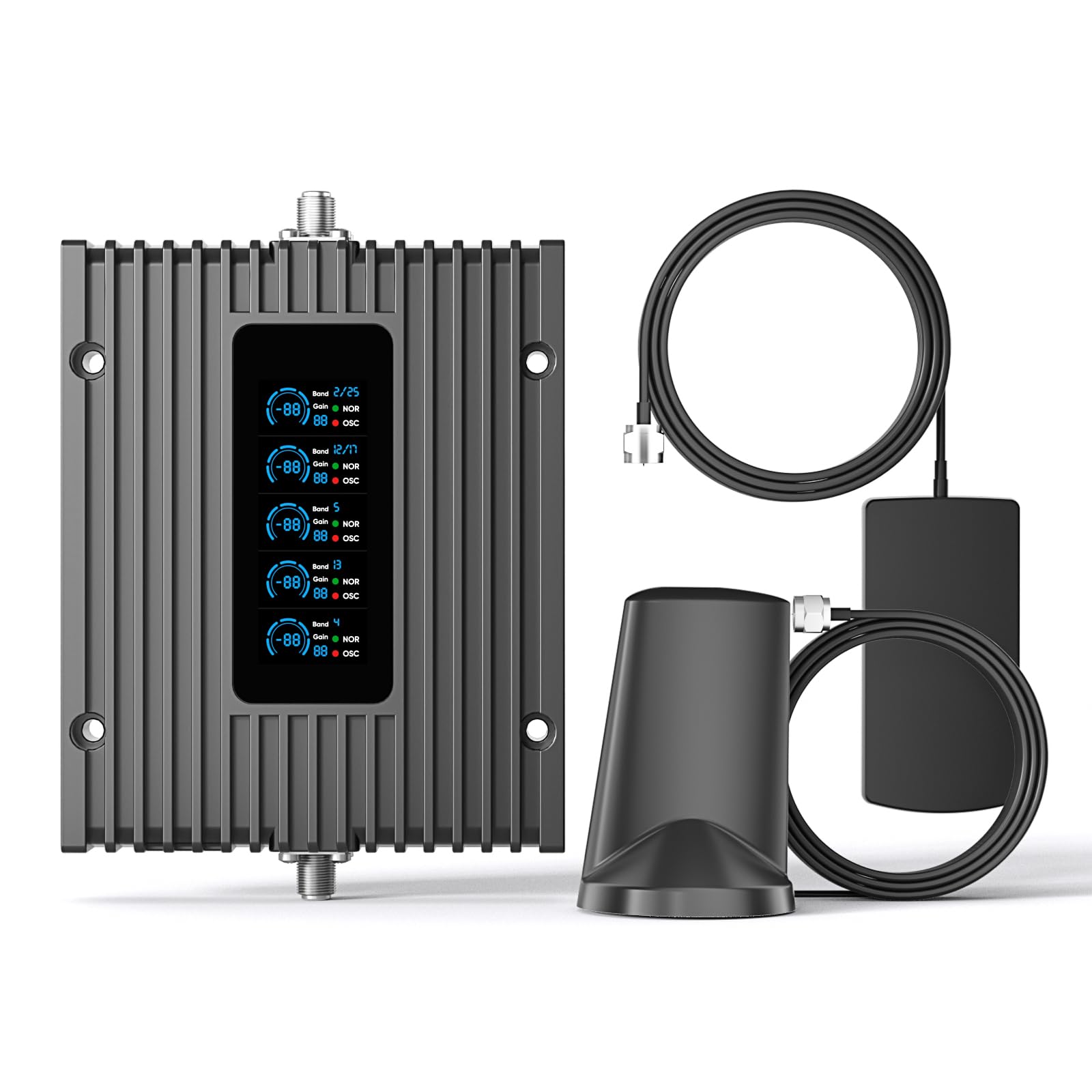
The Metarepeater MB1 features a large color LCD display that shows real-time gain levels for each of its five supported frequency bands (12/17, 13, 5, 2/25, and 4). This is a unique visual tool for diagnosing which carrier bands are providing the strongest signal at any given location. The outdoor antenna uses a 360° omni-directional design, so you never need to aim it — ideal for moving vehicles.
Users report improvements from -140 dBm to -126 dBm, enabling calls where none were possible before. The installation requires no drilling, with magnetic mounts for both antennas. The booster supports all US carriers and delivers 4G LTE and 5G signal for multiple devices simultaneously.
The included cables — external and internal — are relatively short, limiting where you can mount the amplifier. Some users wished for a right-angle 12V adapter to fit tighter spaces. The antenna’s paint coating is not the most durable. This is a good pick for tech-savvy RVers who want visual feedback on their signal environment.
Why it’s great
- LCD shows live gain per band for signal analysis
- 360° omni antenna requires no aiming
- No-drill magnetic installation saves time
Good to know
- Cables are short, limiting placement flexibility
- Antenna paint can scratch or wear over time
- Not effective in all remote locations
8. PRACOA 65dB Car RV Booster
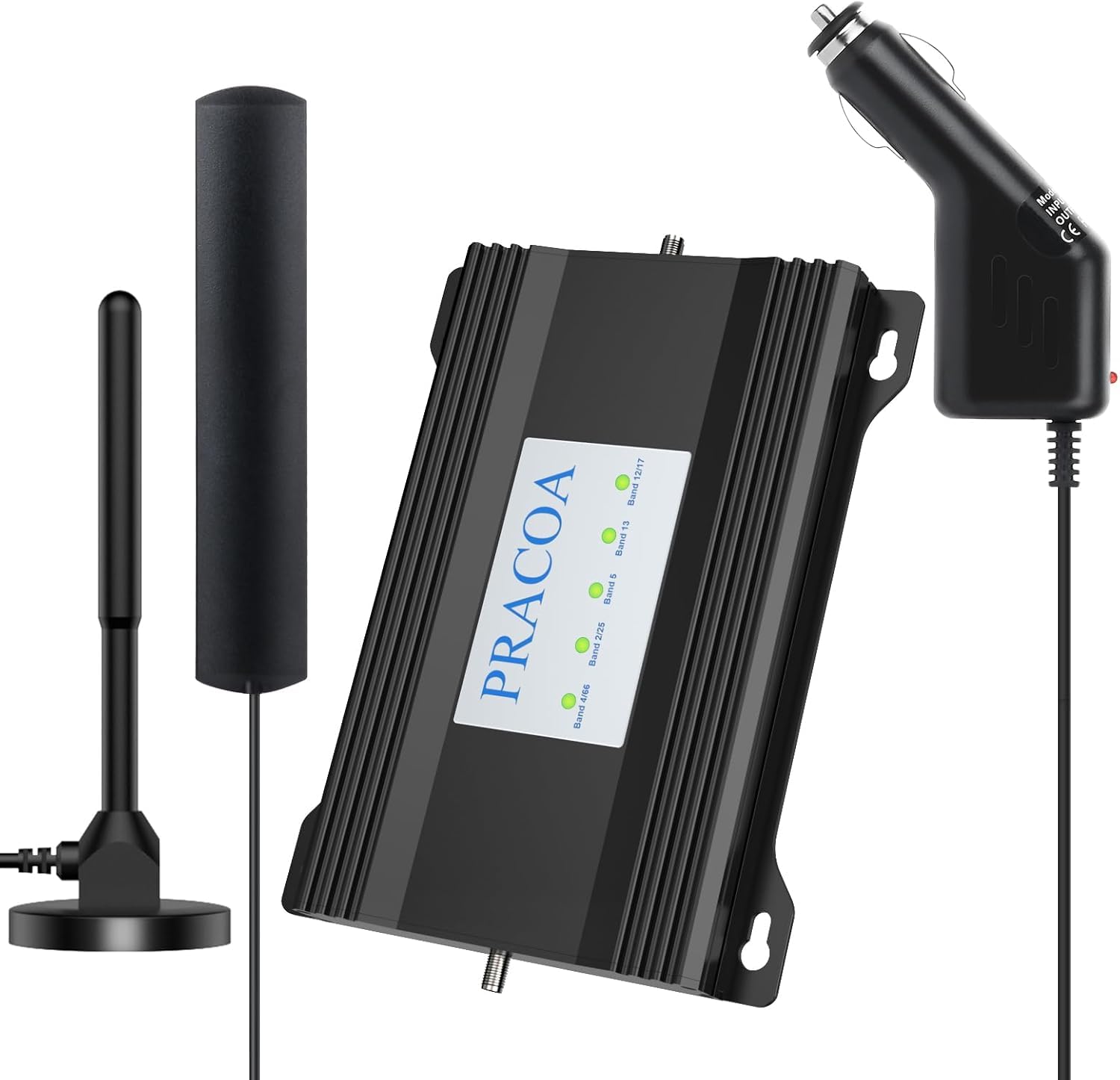
The PRACOA booster delivers 65 dB of gain — one of the highest gain figures in its price tier — and supports eight frequency bands including Band 66 for extended coverage. The kit includes a 10-foot indoor patch antenna and a 16-foot outdoor magnet antenna. Automatic Gain Control, Inactivity Mode, and Oscillation Elimination help the system self-adjust as driving conditions change.
Users in low-signal areas report a jump from 2 bars to 4 bars after installation, with one RF engineer measuring a real improvement from -112 dBm to -98 dBm, resulting in 180 Mbps download speeds on T-Mobile n25. The booster is FCC approved and comes with a 3-year warranty.
Setup is not fully plug-and-play — the indoor and outdoor antennas need 20-25 feet of separation to prevent feedback. The indoor patch antenna has a relatively weak radiation pattern, and the newest 5G bands are not supported. For the price, it’s a solid entry into RV signal boosting for budget-conscious travelers.
Why it’s great
- 65 dB high gain for pulling weak distant signals
- Supports Band 66 for additional carrier coverage
- Self-adjusting AGC reduces oscillation issues
Good to know
- Requires careful antenna separation to avoid feedback
- Indoor antenna radiation pattern is limited
- Does not support newest 5G frequency bands
9. GAGBK 6-Band Booster
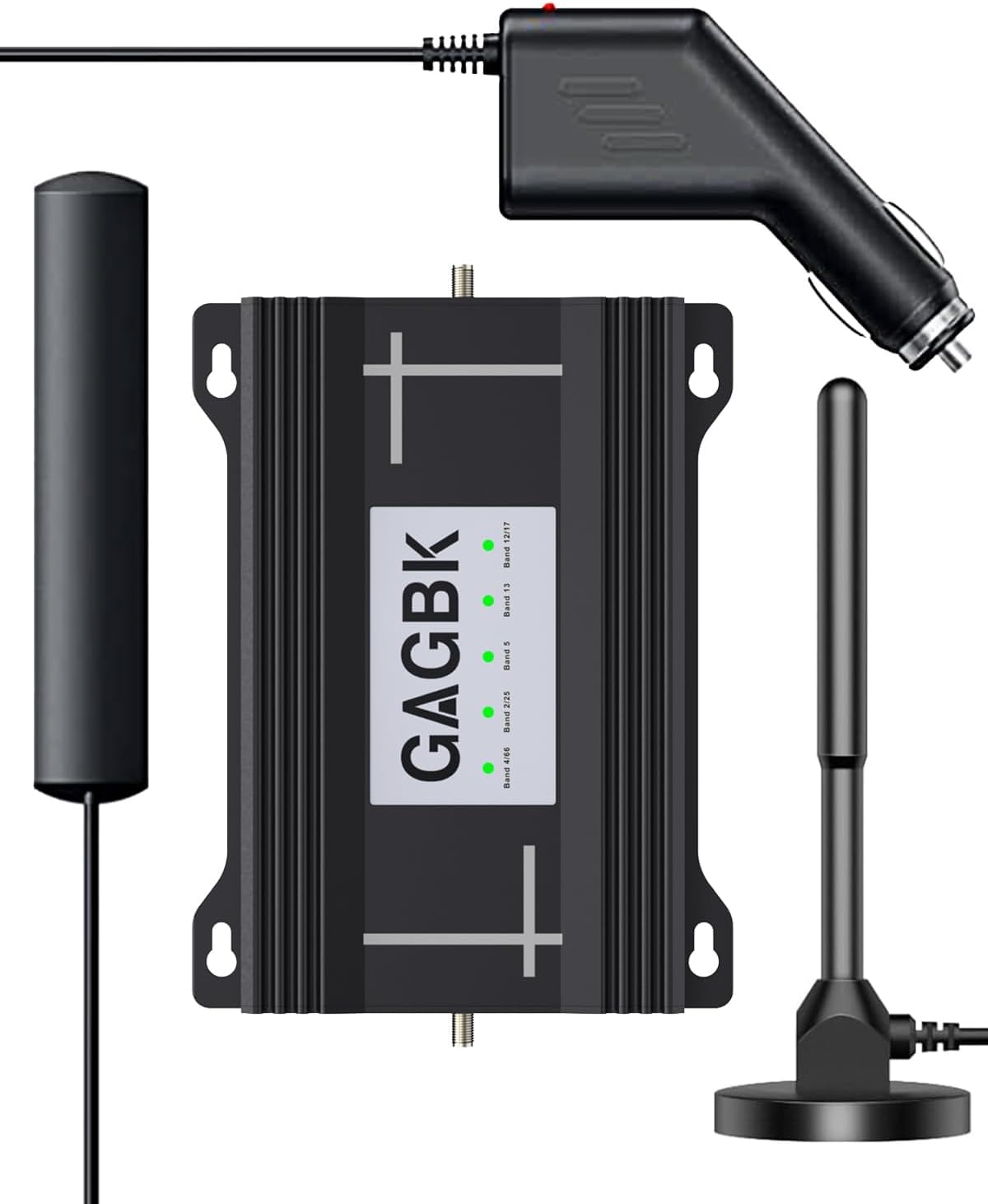
The GAGBK booster covers six frequency bands — 2, 4, 5, 12, 13, 17, 25, and 66 — and matches the 65 dB gain of the PRACOA unit at a similar price point. It is designed for use in RVs, trucks, vans, and boats, with a claimed communication distance of 5-8 miles under ideal conditions. Automatic Gain Control and Oscillation Elimination keep the system stable.
Customer reviews show that it works well for users on the Boost network who previously had to go outside to make calls — now phones work indoors reliably. The kit includes a magnetic outdoor antenna and a patch indoor antenna with RG174 cables.
Some users noted that the indoor antenna needs to be physically near the phone for maximum effect, and a few returned the unit because it did not meet their expectations for signal gain in their specific location. The 3-year warranty offers peace of mind. This booster is a reasonable starting point for RVers who want a low-cost solution for mild signal issues.
Why it’s great
- Affordable entry price for basic signal boosting
- 6-band coverage works with most US carriers
- 3-year warranty for long-term reliability
Good to know
- Indoor antenna must be close to the phone for full effect
- Not all users experienced significant improvement
- Setup requires careful reading of instructions
FAQ
Can an RV cell booster work if I have zero bars of signal?
Will a cell booster drain my RV battery quickly?
Do I need a directional or omni-directional antenna for my RV?
Final Thoughts: The Verdict
For most users, the best cell signal booster for rv winner is the weBoost Destination RV because its 25-foot directional pole system pulls usable signal from towers that other boosters cannot reach. If you want a mobile-friendly setup that works while driving, grab the HiBoost Travel 2.0 RV. And for budget-conscious travelers needing a basic signal lift, nothing beats the value of the PRACOA 65dB Booster.

Mo Maruf
I created WellFizz to bridge the gap between vague wellness advice and actionable solutions. My mission is simple: to decode the research and give you practical tools you can actually use.
Beyond the data, I am a passionate traveler. I believe that stepping away from the screen to explore new environments is essential for mental clarity and physical vitality.