Our readers keep the lights on and my smoothie glass nicely filled. As an Amazon Associate, I earn from qualifying purchases.
The common dress shoe is a masterpiece of style that is often an enemy to the arch. The hard, unforgiving footbed of loafers, oxfords, and ballet flats offers zero shock absorption, turning a day at the office or a night on the town into a session of foot fatigue. The solution is not to abandon your favorite footwear, but to upgrade what’s inside it with a dedicated aftermarket insole designed to fit without the squeeze.
I’m Mohammad Maruf — the founder and writer behind WellFizz. My focus is on analyzing the material science and dimensional engineering of wellness accessories to identify which products genuinely solve the space constraints inherent in narrow-top, low-profile dress shoes.
This guide breaks down the specific specs that matter for tight footwear, from arch height and length profile to material breathability and adhesive grip. I have sorted through the market to present the best dress shoe insoles that deliver targeted support without forcing you into a larger shoe size.
How To Choose The Best Dress Shoe Insoles
Shopping for dress shoe insoles is a very different pursuit than buying a thick gel insert for a running sneaker. The primary constraint is vertical volume: most dress shoes have a low heel counter and a tight toe box. Insert a standard orthotic, and your foot will slide out or the shoe will no longer close. The following criteria help you find a slim, performance-oriented insole that stays hidden while actually working.
Prioritize the 3/4 Length Profile
Full-length insoles are the primary cause of the “shoe squeeze” problem. A 3/4 length insole stops before the toe box, leaving your toes free to splay naturally. This design fits seamlessly into loafers, oxfords, and pumps without requiring you to size up. The only trade-off is that it may shift forward if the shoe has no heel grip or adhesive backing.
Match Arch Height to Your Foot
The whole point of an insole is arch support. If your arch is low (flat feet), a high-rigid plastic support will feel like a rock under your foot and cause pain. If you have a high arch and you use a flat cushioned insole, you will get zero relief. Look for adjustable or pre-molded arch supports that match your specific profile—low, medium, or high. The metric to check is the arch rise in millimeters (e.g., 26mm is a medium support).
Material Breathability and Moisture Wicking
Dress shoes often lack ventilation, leading to sweaty feet and odor. Leather tops (sheepskin, goatskin) naturally wick moisture and resist bacteria growth, making them ideal for sockless wear. Synthetic foam or fabric can trap heat. If you plan to wear these insoles daily, prioritize a natural leather top layer with a perforated design for airflow.
Quick Comparison
On smaller screens, swipe sideways to see the full table.
| Model | Category | Best For | Key Spec | Amazon |
|---|---|---|---|---|
| Spenco Rx Thinsole | Premium | Moldable firm arch support | Heat-moldable plastic arch | Amazon |
| Pedag Holiday | Mid-Range | Thin leather orthotic for low shoes | Sheepskin with metatarsal pad | Amazon |
| OUOKK Low Arch Support | Mid-Range | Heavy duty support for flat feet | 26mm TPU arch support | Amazon |
| Florsheim Comfortech Ortholite | Mid-Range | Moisture-wicking OEM replacement | Non-slip padded Ortholite foam | Amazon |
| HANDARTE Leather Sockless | Budget | Sockless wear in loafers | Full-grain goatskin with carbon | Amazon |
In‑Depth Reviews
1. Spenco Rx Thinsole 3/4 Length
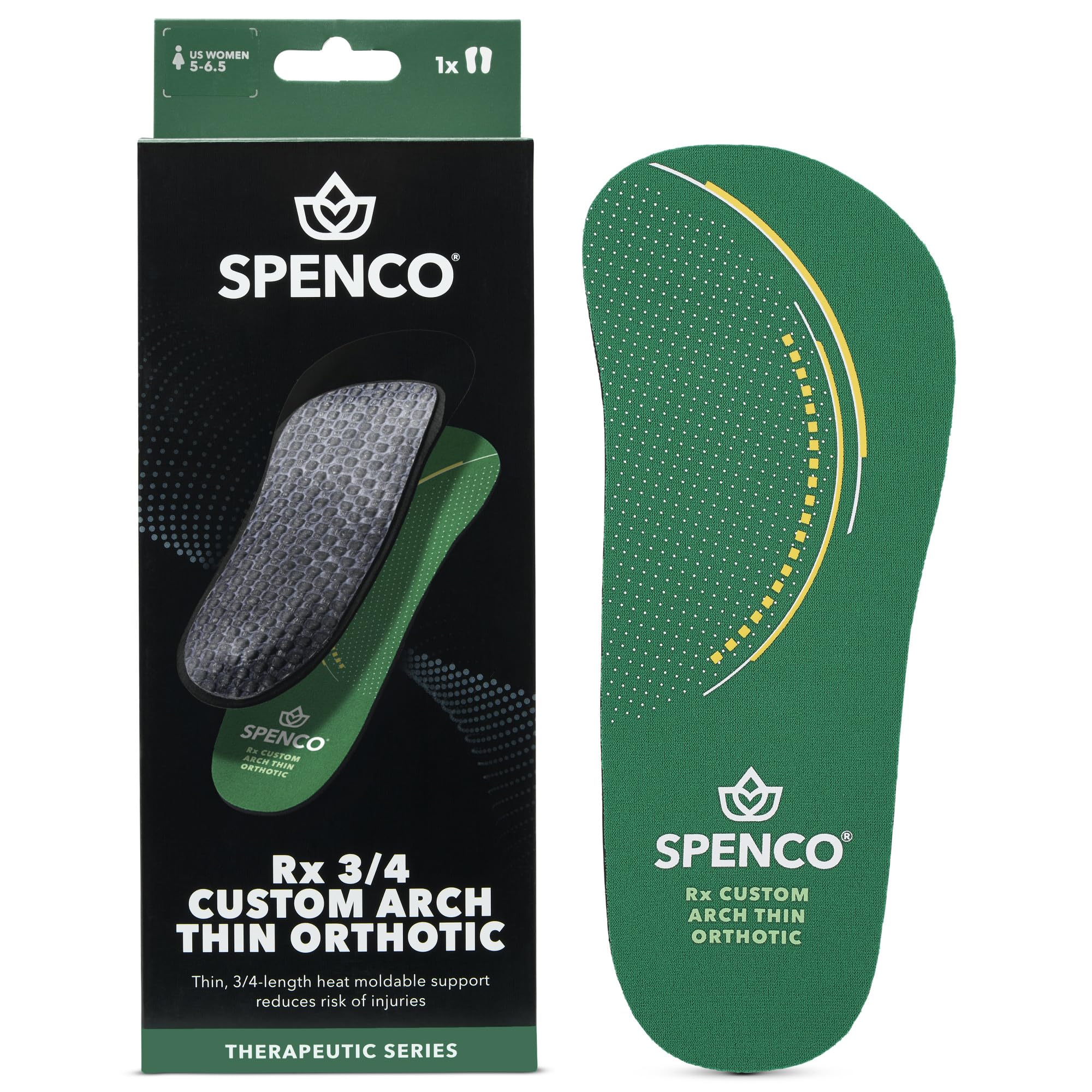
The Spenco Rx Thinsole defines this category because it solves the fundamental tension between support and thinness. It features a firm orthotic shell that is surprisingly low-profile—it measures under 6mm at the ball of the foot—yet offers a full rigid arch that can be heat-molded at home for a custom fit. For the dress shoe user with flat feet or plantar fasciitis, this is the closest you get to a podiatrist-grade orthotic without the bulk that would require a half-size larger shoe.
The 3/4 length profile ends cleanly before the toes, allowing natural toe splay. The 4-way stretch top fabric prevents friction blisters, a common issue when wearing nylon dress socks. User feedback spanning over a decade shows that these units, when heated in a standard oven at 200°F for a few minutes, conform perfectly to individual arch shapes, providing stability that eliminates heel pain and knee strain during long hours on hard floors.
The only structural limitation is its rigid plastic base. It does not offer significant metatarsal padding, so users with neuroma or ball-of-foot pain may need additional cushioning. Also, the new version includes a glued foam layer underneath that can make the insole too thick for very snug sneakers; many long-term users prefer trimming this foam to improve fit. Despite this, the Spenco remains the most versatile, scientifically-backed slim insole available.
Why it’s great
- Heat-moldable arch adjusts to your foot shape for custom support
- Exceptionally durable; many users report 5+ years of daily use
- Thin 3/4 length fits in most oxfords, loafers, and boots
Good to know
- Does not include a metatarsal pad for ball-of-foot relief
- Glued foam layer can make the insole slightly too thick for tight sneakers
2. Pedag Holiday 3/4 Length Sheepskin

The Pedag Holiday is the quiet champion of the low-profile insole world, crafted from real lambskin leather and built on a hard plastic orthotic base. Its defining feature is the integrated metatarsal pad—a raised bump behind the ball of the foot that relieves pressure on the metatarsal heads. For anyone suffering from Morton’s neuroma or general ball-of-foot pain in tight leather loafers, this pad makes a difference that no flat cushion can match.
At under 3mm thick at the toe edge, this 3/4 length insole is among the thinnest on the market, designed for shoes that have almost no vertical tolerance—think Italian oxfords, ballet flats, and driving moccasins. The sheepskin top is remarkably soft against bare skin, making it ideal for sockless wear. The APMA Seal of Acceptance confirms its medical-grade design for plantar fasciitis and overpronation. Users consistently report 10+ years of daily use, which is a testament to the German craftsmanship.
The main drawback is the arch height: it is specifically designed for a medium-to-low arch. Users with very high arches report that the support is not aggressive enough. Additionally, the hard plastic base has a sticky spot (a peel-off adhesive) that holds the insole in place, but once you remove the adhesive liner, you cannot easily transfer the insole between shoes. Planning to buy a pair for your primary shoes is recommended.
Why it’s great
- Integrated metatarsal pad provides targeted relief for neuroma
- Ultra-thin sheepskin construction fits the lowest-profile dress shoes
- Extraordinary durability lasting over a decade in many cases
Good to know
- Arch height is moderate and may be insufficient for high arches
- Adhesive backing prevents easy swapping between shoes
3. OUOKK Low Arch Support 3/4 Length
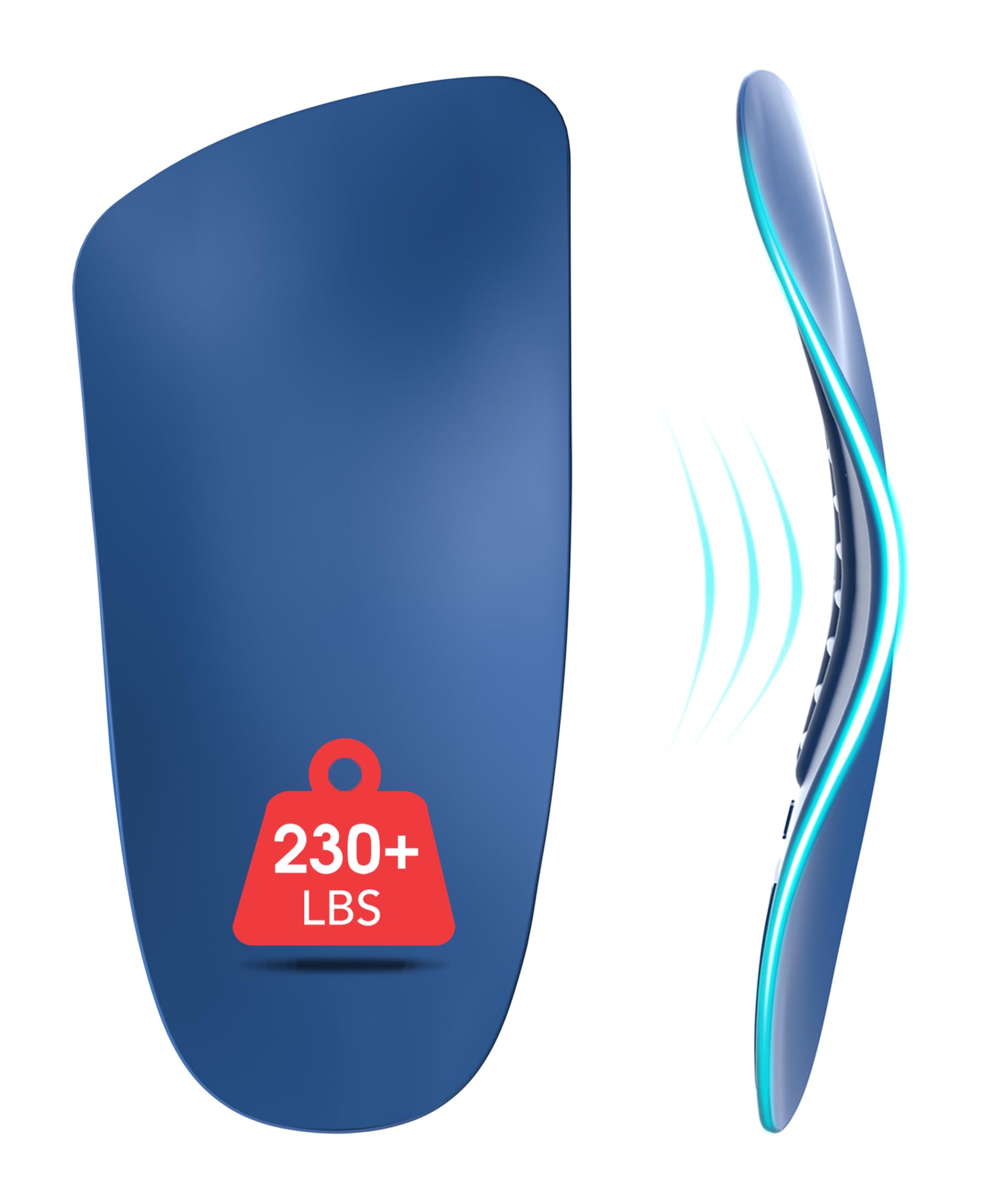
The OUOKK insole targets the specific demographic of dress shoe wearers who have flat feet or fallen arches and need a rigid, aggressive arch post. With a 26mm thermoplastic polyurethane (TPU) arch support, this 3/4 length unit is more substantial than the Pedag while still remaining thin enough to fit most dress shoes. It is explicitly designed for heavy-duty support, rated for users over 230 pounds, making it a solid option for larger frames that require structural reinforcement inside slim footwear.
The medial arch post is firm and unyielding—this means it will not compress or flatten over time. For those with overpronation or posterior tibial tendon issues, this insole corrects the foot position, reducing knee and lower back strain. The top cover has a foot massage texture that helps with circulation, and the thin edges are designed to save vertical space, so it fits into shoes that would reject a standard orthotic. User feedback highlights noticeable relief from plantar fasciitis within a few days of consistent wear.
The firmness can be a negative for users with neutral or high arches, as the support is too high and unadjustable. The rigid TPU base also makes a slight clicking sound on hard floors if the insole is not fully seated. Furthermore, it does not have an adhesive backing, so some users report the insole sliding forward during walking, particularly in shoes with a slick factory footbed.
Why it’s great
- Aggressive 26mm TPU arch support ideal for flat feet and overpronation
- Heavy-duty build supports users over 230 pounds without collapsing
- Thin edges preserve vertical space in tight dress footwear
Good to know
- Too high and rigid for neutral or high-arched users
- May slide forward in shoes without an adhesive backing
4. Florsheim Mens Comfortech Ortholite

The Florsheim Comfortech is essentially an OEM replacement insole designed to fit the exact footbed of Florsheim dress shoes, but it works admirably as an aftermarket option. It uses Ortholite foam, which is an open-cell polyurethane formulation that compresses very little over time compared to standard EVA. The top layer has a non-slip texture that prevents your heel from sliding down inside the shoe, solving the common “heel lift” problem that occurs when you remove the factory insole and replace it with a slick orthotic.
At roughly 4mm at the heel, this insole is slightly thicker than the Pedag, but the taper toward the toe keeps it thin enough for most oxfords and derbies. The foam wicks moisture effectively and dries quickly after a day of wear, reducing bacterial odor. Users note that it makes lace-up dress shoes fit tighter, which is beneficial for those with narrow feet. For loafers, however, the extra thickness can make the shoe feel too snug, so it is best suited for lace-front shoes.
The biggest limitation is cushion depth. While the Ortholite foam is comfortable, it does not provide significant arch support. It is more of a cushioned replacement for a worn-out sock liner than a medical orthotic. Users with high arches or plantar fasciitis will find this insufficient. The heel thickness also requires loosening the laces on some models to avoid pressure on the achilles tendon.
Why it’s great
- Ortholite foam provides long-lasting cushion without collapsing
- Non-slip top prevents heel lift and keeps the foot secure
- Designed to fit Florsheim footbeds perfectly but fits most dress shoes
Good to know
- Lacks significant arch support for plantar fasciitis relief
- May be too thick for slip-on loafers without tightening
5. HANDARTE Leather Sockless Insoles
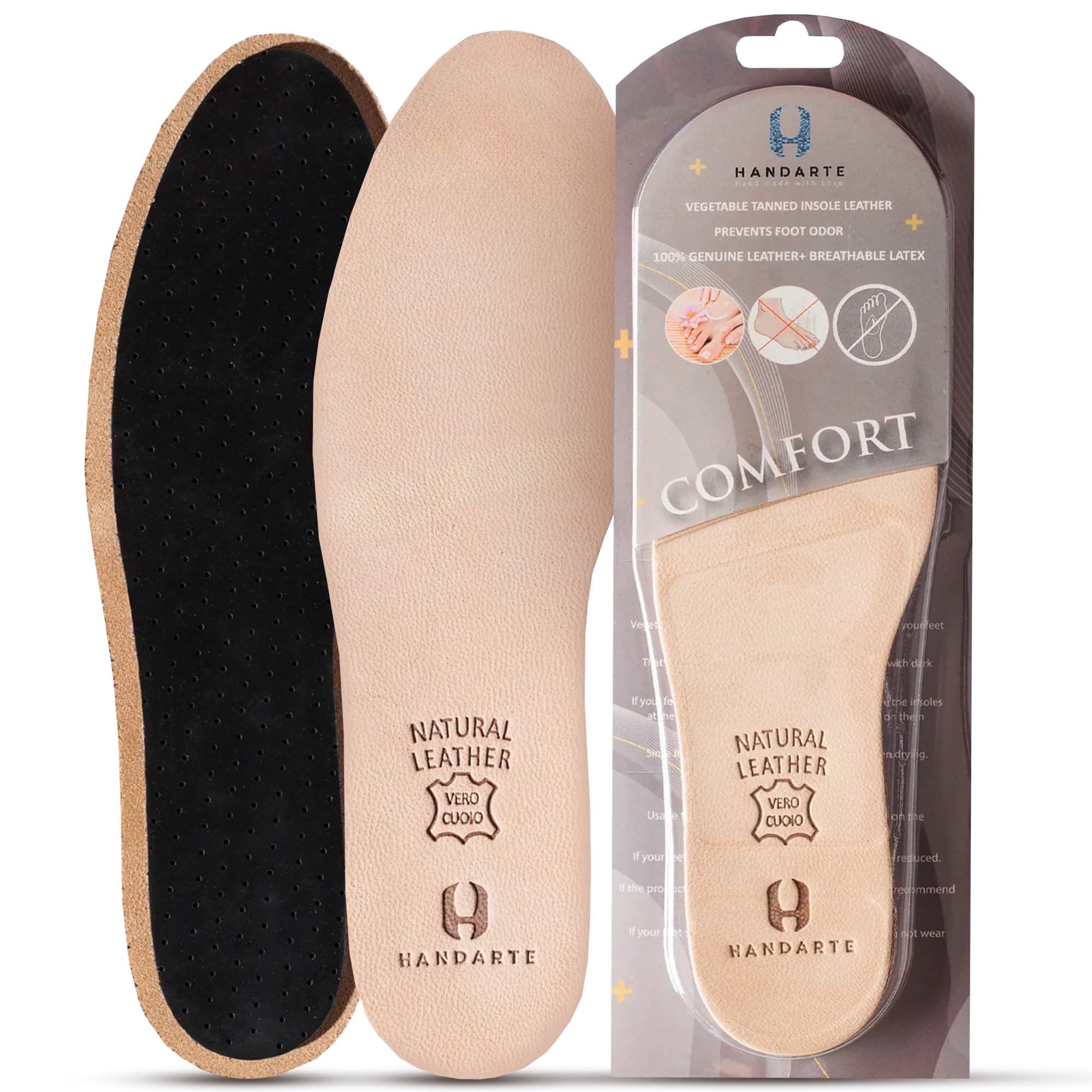
The HANDARTE insole takes a different approach: it prioritizes moisture control and odor management over structural support. Made from 100% full-grain vegetable-tanned goatskin, this is the thinnest insole in the group, measuring well under 2mm at the heel. It is designed for sockless wear—the leather absorbs sweat rapidly, and the perforated design ensures air circulation, while an activated carbon layer neutralizes foot odor. For the business traveler who rotates through multiple pairs of leather loafers without socks, this is a hygiene upgrade.
The goatskin is pliable and conforms to the contours of your foot over the first few wears. The anti-slip suede backing keeps the insole from migrating during the day. Many users report that it eliminates the “extra space” problem in dress shoes worn without socks, providing a snugger fit without adding bulk. For users with tight cowboy boots or size-specific loafers, this insole fits without requiring any trimming, as the sizing is spot-on for the labeled shoe size.
The trade-off is evident: this insole provides almost no arch support or heel cushioning. It is a thin leather sheet with a minimal foam core. Users requiring correction for plantar fasciitis, flat feet, or high arches will be disappointed. It also does not have a metatarsal or heel pad. Its purpose is purely comfort and sweat management, not orthotic correction. For that reason, it is best used as a supplement to a supportive orthotic or for very short wear times.
Why it’s great
- Thinnest profile available—fits the tightest low-cut shoes perfectly
- Goatskin leather with activated carbon provides excellent odor control
- Ideal for sockless wear in loafers and driving shoes
Good to know
- No significant arch support; not for foot pain correction
- Minimal foam padding offers little shock absorption
FAQ
Will dress shoe insoles make my shoes too tight?
Can I use dress shoe insoles in loafers without socks?
How do I know if I need low, medium, or high arch support?
Are heat-moldable insoles worth the extra cost?
Final Thoughts: The Verdict
For most users, the best dress shoe insoles winner is the Spenco Rx Thinsole because it offers the strongest arch support in the thinnest package with heat-moldable customization. If you want a natural leather top with a metatarsal pad for neuroma relief, grab the Pedag Holiday. And for heavy-duty flat foot support in a slim 3/4 length design, nothing beats the OUOKK Low Arch Support.

Mo Maruf
I created WellFizz to bridge the gap between vague wellness advice and actionable solutions. My mission is simple: to decode the research and give you practical tools you can actually use.
Beyond the data, I am a passionate traveler. I believe that stepping away from the screen to explore new environments is essential for mental clarity and physical vitality.