Our readers keep the lights on and my smoothie glass nicely filled. As an Amazon Associate, I earn from qualifying purchases.
Few things in life are as frustrating as turning the key and hearing nothing but a click — or worse, silence. A deeply discharged battery doesn’t have to mean a trip to the auto parts store for a costly replacement. The right charger restores lost cranking amps, reconditions tired lead plates, and keeps your vehicle ready to roll.
I’m Mohammad Maruf — the founder and writer behind WellFizz. I’ve logged dozens of hours analyzing battery chemistry, charge profiles, and real user experiences to separate the chargers that genuinely revive dead cells from those that simply maintain a surface charge.
After comparing recovery speeds, pulse-repair capabilities, and compatibility with modern AGM and lithium chemistries, I’ve narrowed down the field to the six most dependable units. This guide covers the best charger for dead car battery options across every realistic use case and budget tier.
How To Choose The Best Charger for Dead Car Battery
Selecting the right charger depends entirely on the battery’s depth of discharge, its chemistry, and how much time you have. A 0.75-amp maintainer will nurse a battery back to life over a weekend, while a 20-amp unit can do the same job in hours. Below are the three critical factors to weigh before buying.
Amperage and Recovery Speed
Amperage determines how quickly a charger pushes current into the battery. For a completely dead battery — one reading below 10.5 volts — a 10-amp or higher charger is the only practical option. A 750mA or 1.5-amp unit may eventually bring the voltage back, but you might wait two days to get a start. Conversely, too much current too quickly can heat a small battery excessively, which is why multi-rate chargers with adjustable amp settings are ideal for mixed-fleet households.
Pulse Repair and Desulfation
Sulfation is the leading cause of early battery failure. When a battery sits discharged, lead sulfate crystals harden on the plates, reducing capacity. Chargers with desulfation or pulse-repair modes send high-frequency bursts into the cells to break down those crystals, recovering lost capacity. This feature is essential if you are buying a charger for a battery that has been dead for weeks or months — it can save a battery that a standard charger would declare unrecoverable.
Chemistry Compatibility
Not all chargers support all battery types. Standard lead-acid (flooded) batteries tolerate a slightly higher voltage than AGM or gel cells. Lithium (LiFePO4) batteries require a completely different charge profile and will be damaged by a charger designed for flooded batteries. If your vehicle uses an AGM or lithium battery, confirm the charger explicitly lists that chemistry in its compatibility chart. Using the wrong profile reduces battery lifespan or, in lithium’s case, can trigger the battery’s internal protection circuit.
Quick Comparison
On smaller screens, swipe sideways to see the full table.
| Model | Category | Best For | Key Spec | Amazon |
|---|---|---|---|---|
| CRAFTSMAN 12A | Mid-Range | Fast dead-battery revival with diagnostics | 12A charge rate + built-in battery tester | Amazon |
| Schumacher SC1446 | Premium | Manual control for deeply dead batteries | 200A engine start + 135-min timer | Amazon |
| NOCO Boost GB40 | Premium | Portable emergency jump-starts | 1000A peak + 12V power bank | Amazon |
| Huiaipaic 20-Amp | Mid-Range | High-speed charging with LiFePO4 support | 20A 12V / 10A 24V + pulse repair | Amazon |
| CRAFTSMAN 1.5A | Budget | Long-term maintenance of stored vehicles | 1.5A + desulfation reconditioning | Amazon |
| Battery Tender Junior | Budget | Compact maintainer for powersports | 750mA float mode + spark-proof | Amazon |
In‑Depth Reviews
1. CRAFTSMAN 12A 4-in-1 Battery Charger CMXCESM258
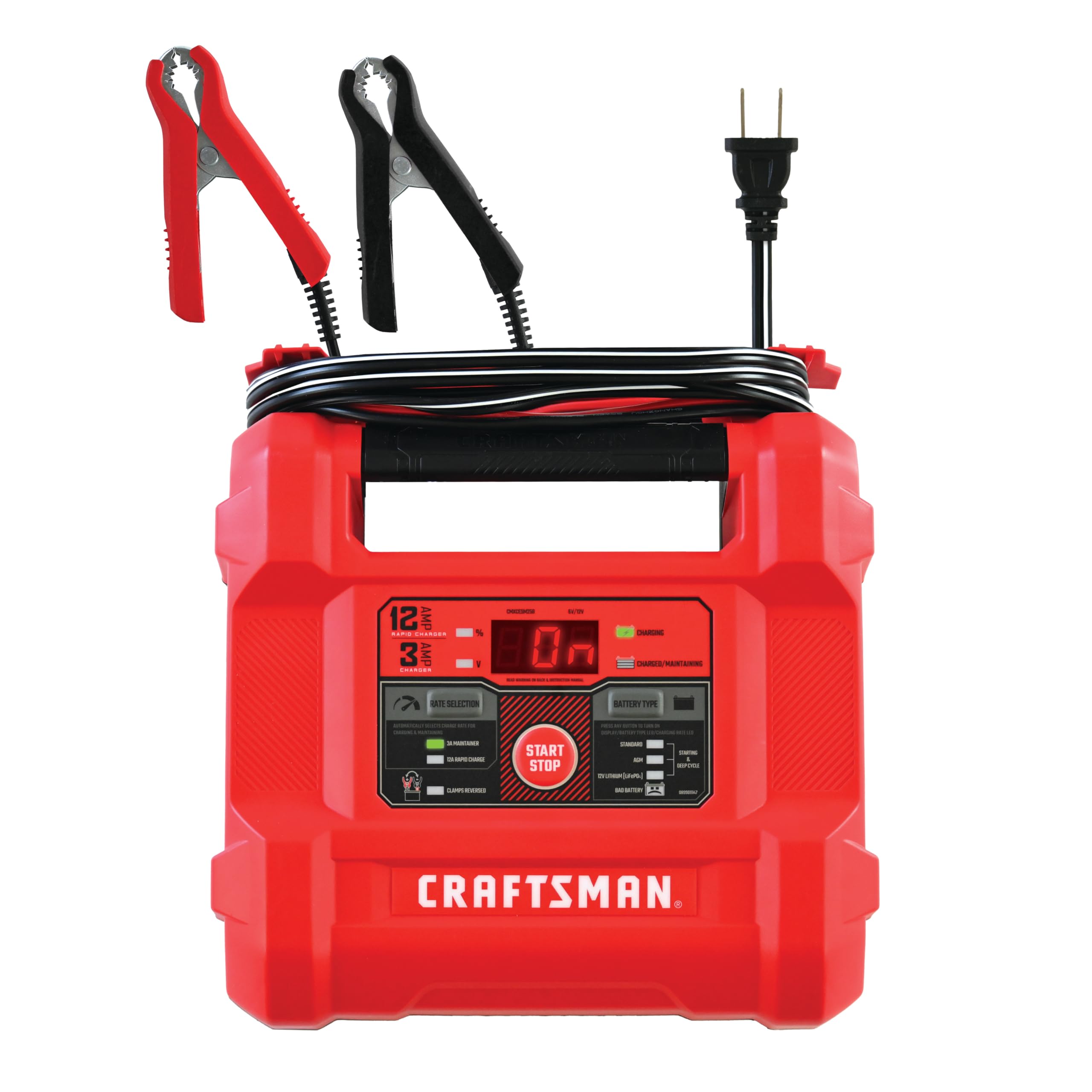
The CRAFTSMAN 12A hits the sweet spot between charging speed and feature depth. It delivers a genuine 12-amp charge rate on 12-volt batteries, which means a deeply discharged car battery goes from non-responsive to cranking in roughly three to five hours. The built-in battery tester gives you instant feedback on whether the battery can hold a charge or needs replacement — a practical time-saver that removes guesswork.
Beyond raw speed, the unit supports AGM, lithium (LiFePO4), and deep-cycle chemistries, making it a true cross-fleet tool. The desulfation mode helps reclaim batteries that have been sitting too long, and the reverse-polarity protection prevents accidental damage during rushed hook-ups. At 3.4 pounds, it’s light enough to move between vehicles without straining, yet the clamps feel solid and the 6-foot power cord reaches comfortably across most garage layouts.
Users report reliable cold-weather performance even at -20°F, and the 3-amp maintainer setting is perfect for keeping seasonal vehicles topped off. The only minor trade-off is the larger footprint compared to a compact maintainer, but the integrated battery tester alone justifies the extra shelf space.
Why it’s great
- 12-amp charge rate revives dead batteries in hours, not days
- Built-in battery tester provides instant health diagnostics
- Compatible with AGM, lithium, and deep-cycle batteries
Good to know
- Larger unit requires dedicated shelf or bench space
- No manual timer override for specialty charging sessions
2. Schumacher Electric SC1446 Wheeled Charger

The Schumacher SC1446 is the manual-control heavyweight for situations where automatic chargers refuse to cooperate. Many smart chargers fail to detect a battery that has dropped below three or four volts, leaving you stranded. This unit’s 200-amp engine-start setting bypasses the detection problem entirely, delivering the raw current needed to wake a completely dead battery and start the vehicle immediately.
The 135-minute timer gives you precise control over charge duration — a feature that seasoned mechanics and hobbyists prefer when they want to apply a high-voltage boost for desulfation without damaging the battery. The analog amp meter provides visible feedback on the charge rate, so you can watch the current taper as the battery recovers. The heavy-duty steel case, retractable handle, and solid wheels make it surprisingly maneuverable despite weighing nearly 30 pounds.
Owners confirm it excels on deeply discharged farm and marine batteries, and the 40-amp boost mode is ideal for quickly adding enough surface charge to vehicles that have sat all winter. The main drawback is the manual-only operation — you cannot set it and walk away without the timer running out, so it demands more attention than a fully automatic unit.
Why it’s great
- 200-amp engine start wakes batteries too dead for smart chargers
- Manual timer prevents overcharging on unattended sessions
- Wheels and handle make a 30-pound unit easy to move
Good to know
- Not suitable for lithium or sensitive AGM batteries
- Timer requires active monitoring; no automatic float mode
3. NOCO Boost GB40 Jump Starter

The NOCO Boost GB40 redefines what a charger for dead car battery can be by removing the extension cord entirely. This 2.4-pound lithium jump box packs 1000 peak amps, enough to start a 6.0-liter gas or 3.0-liter diesel engine instantly. The spark-proof clamps and reverse-polarity protection make it safe for even first-time users — you cannot make a dangerous connection if the clamps touch or if you attach them backwards.
Beyond jump-starting, the integrated USB-C power bank can charge a smartphone or tablet multiple times, and the 100-lumen LED flashlight with SOS and strobe modes turns this into a full emergency kit. The IP65-rated housing shrugs off dust and rain, so it’s ready for roadside conditions. Recharging the internal lithium cells takes about three hours via USB-C, which is far faster than most competitors.
The real-world limitation is self-discharge — owners report that the GB40 can drain completely after several months of storage if not periodically recharged. It is best suited as a carry-along emergency tool rather than a long-term garage solution. For vehicles larger than a half-ton truck, the 1000-amp rating may struggle; the GB150 or a higher-capacity model is a better match for diesel pickups with dual batteries.
Why it’s great
- Delivers 1000A instantly — no AC outlet needed
- UltraSafe design prevents sparks and reverse polarity
- Compact enough to store in a glove box or center console
Good to know
- Battery self-discharges over months; needs periodic recharging
- 1000A may struggle with large diesel or dual-battery setups
4. Huiaipaic 20-Amp Smart Charger
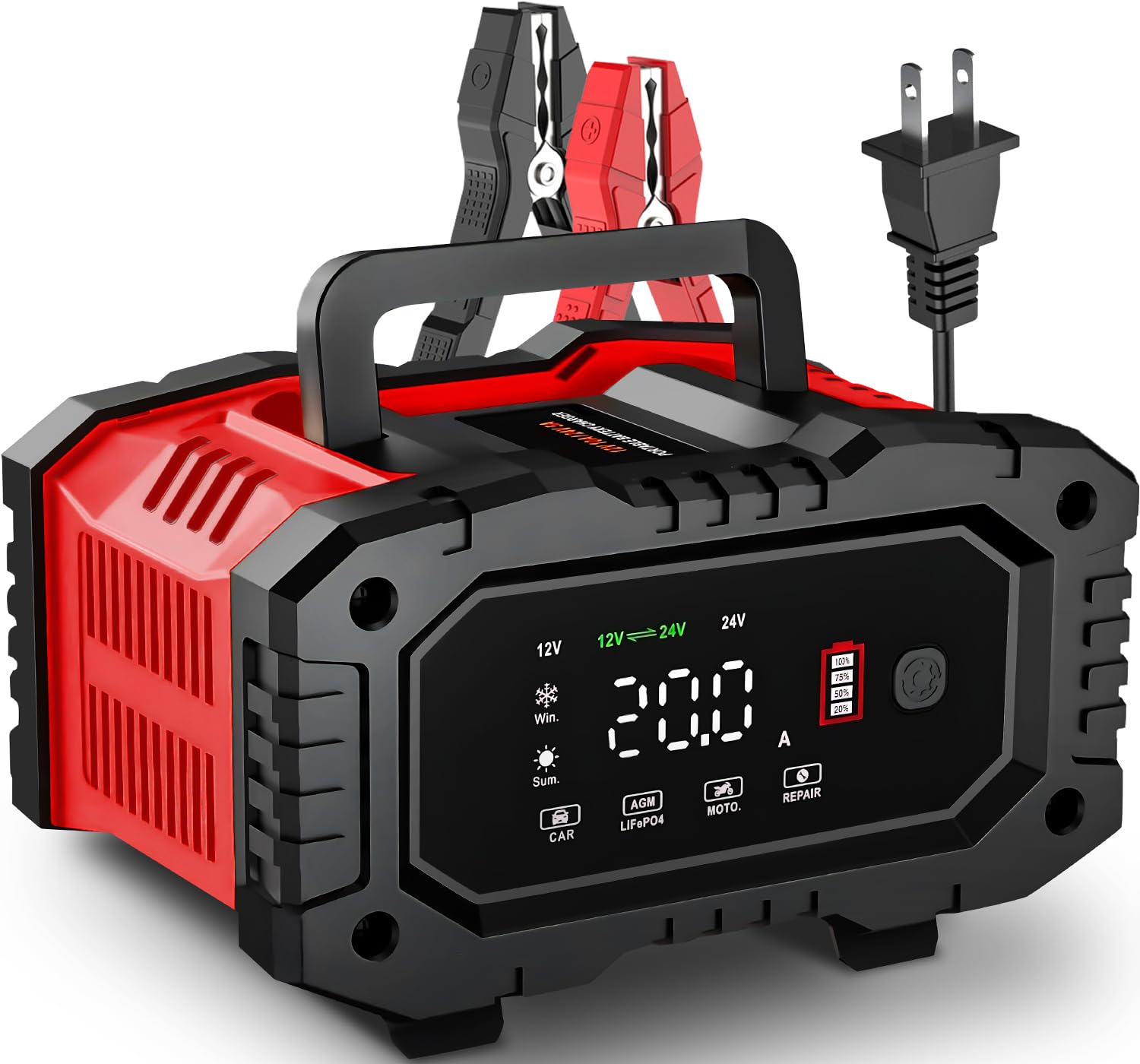
The Huiaipaic 20-Amp charger delivers one of the highest charge rates in its class at an entry-level price point. It pushes 20 amps into a 12-volt battery, cutting recovery time to a fraction of what a 1.5-amp or 10-amp unit requires. A battery that reads 8 volts can be back above 12.5 volts inside four to five hours, making this the fastest everyday AC-powered option in this lineup.
The pulse-repair mode uses high-frequency bursts to break down sulfation, and several owners report reclaiming batteries that standard chargers had given up on. The unit also supports LiFePO4 chemistry, which is a rare find at this price and opens up compatibility with modern AGM and lithium batteries. The large LCD displays voltage, current, percentage, and temperature, while the foldable handle and clip organizer keep the workspace tidy.
The display is difficult to read in direct sunlight, making outdoor troubleshooting a bit of a guessing game unless you set the charge mode beforehand. The manufacturer explicitly states the repair mode cannot revive a truly dead battery or repair one that is physically damaged, so expectations for the pulsing feature should be realistic. Still, for the price, the combination of 20-amp speed and dual chemistry support is hard to beat.
Why it’s great
- 20-amp charge rate revives dead batteries in hours
- Pulse repair mode helps recover sulfated batteries
- Supports LiFePO4 in addition to lead-acid chemistries
Good to know
- LCD screen is hard to read in bright daylight
- Repair mode cannot fix physically damaged or fully dead cells
5. CRAFTSMAN 1.5A 3-in-1 Charger CMXCESM259

The CRAFTSMAN 1.5A is the budget-friendly maintenance companion that also includes desulfation reconditioning — a feature often reserved for more expensive units. At 1.5 amps, it is not designed to resurrect a stone-dead battery in a hurry, but it excels at keeping seasonal vehicles ready and can slowly nurse a partially discharged battery back to full health overnight.
The 3-in-1 functionality (charge, maintain, recondition) covers the most common battery care scenarios for powersports equipment, lawn tractors, and cars that sit for weeks. The auto-detection system negotiates 6-volt and 12-volt batteries without a manual switch, and the reverse-polarity protection eliminates the worry of connecting clamps backwards. The included quick-connect ring terminals are a welcome addition, allowing permanent mounting on batteries with hard-to-reach posts.
Users note that the unit’s 1.5-amp output means a deeply dead battery can take a full day or more to reach starting voltage. It is best paired with a dedicated storage battery or a vehicle that gets driven occasionally, rather than a full-recovery scenario. The wall-mountable design and compact footprint keep the installation tidy, though the short 5-foot output cables can be limiting on larger vehicles.
Why it’s great
- Desulfation reconditioning extends battery life
- Works with both 6V and 12V batteries automatically
- Compact, wall-mountable design saves bench space
Good to know
- 1.5-amp output is slow for reviving deeply dead batteries
- Short output cables limit reach on full-size trucks and SUVs
6. Battery Tender Junior 021-0123

The Battery Tender Junior is the long-standing benchmark for maintainers, trusted by powersports enthusiasts for years. At 750mA, its charge rate is the slowest in this lineup — a fully dead 50Ah car battery would take multiple days to reach full charge. But the Junior was never designed for speed. Its job is to apply the correct four-stage charge profile (initialization, bulk, absorption, float) and then hold the battery at a precise float voltage indefinitely.
The spark-proof circuitry and automatic reversed-hookup detection make it exceptionally safe for permanent installation on motorcycles, ATVs, and lawn equipment. The included ring-terminal harness lets you leave the connection attached to the battery, so hook-up takes seconds. The 12-foot output cord provides excellent reach for garage setups, and the two-color LED keeps you informed of charge status at a glance.
Owners consistently report that batteries maintained by the Junior last five to eight years — a huge improvement over the typical three-year lifespan of an unused battery. The main limitation is that the 750mA rate means it cannot deliver a meaningful charge to a deeply dead automotive battery in a single evening. It is a champion maintainer, but a poor choice as a primary recovery charger for a fully discharged car battery.
Why it’s great
- Four-stage float charging extends battery life significantly
- Spark-proof design is safe for permanent installation
- Compact size fits in tight spaces on motorcycles and ATVs
Good to know
- 750mA rate is too slow to revive a fully dead car battery quickly
- No desulfation or reconditioning mode for heavily sulfated cells
FAQ
Can a 750mA maintainer actually revive a completely dead car battery?
What does the desulfation mode actually do to my battery?
Why does my automatic smart charger say error when I connect a dead battery?
Is it safe to leave a car battery charger connected indefinitely?
Final Thoughts: The Verdict
For most users, the charger for dead car battery winner is the CRAFTSMAN 12A 4-in-1 because it combines fast 12-amp recovery, a built-in battery tester, and desulfation reconditioning in one affordable unit. If you need portable emergency starting without a wall outlet, grab the NOCO Boost GB40. And for reviving batteries so dead that even smart chargers refuse to start, nothing beats the manual control of the Schumacher SC1446.

Mo Maruf
I created WellFizz to bridge the gap between vague wellness advice and actionable solutions. My mission is simple: to decode the research and give you practical tools you can actually use.
Beyond the data, I am a passionate traveler. I believe that stepping away from the screen to explore new environments is essential for mental clarity and physical vitality.