Our readers keep the lights on and my smoothie glass nicely filled. As an Amazon Associate, I earn from qualifying purchases.
The difference between a usable 3D scan and a messy point cloud often comes down to the quality of the hardware—and budget models used to mean sacrificing accuracy for affordability. Today’s cheap 3D scanners bridge that gap, offering structured light and laser hybrid tech at prices that no longer demand a second mortgage.
I’m Mohammad Maruf — the founder and writer behind WellFizz. I’ve spent countless hours cross-referencing accuracy specs, frame rates, and connectivity protocols across the most talked-about sub- models to separate the real workhorses from the frustrating toys.
After evaluating dozens of data sheets and real user experiences, I’ve curated a definitive list of the best cheap 3D scanner options that actually deliver reliable mesh data without breaking your bank.
How To Choose The Best Cheap 3D Scanner
Shopping for a budget-conscious scanner means balancing resolution, scan volume, and surface compatibility. The wrong pick leads to endless calibration errors and unusable mesh files.
Accuracy vs. Precision — What Actually Matters
Accuracy tells you how close the scanned mesh is to the real object’s dimensions. Precision describes repeatability. For 3D printing functional parts, look for 0.1mm accuracy or better. For figurines or artistic models, 0.05mm is ideal. Many budget models advertise “0.02mm” but achieve that only on ideal matte white surfaces under controlled lighting.
Surface Handling Without Spray
Reflective, transparent, and very dark objects are the Achilles’ heel of cheap structured light scanners. Multi-line laser options (like infrared VCSEL) handle these better without requiring anti-glare spray. If you plan to scan car parts or glossy items frequently, prioritize a model with proven dark-surface performance.
PC Requirements Are Non-Negotiable
A sub- scanner tethered to an underpowered laptop will stutter and drop tracking. Most mid-range models recommend an i7 Gen8+ CPU with 16GB RAM and a dedicated GPU. Wireless models offload processing to the device itself, which is a game-changer for laptop users with older hardware.
Quick Comparison
On smaller screens, swipe sideways to see the full table.
| Model | Category | Best For | Key Spec | Amazon |
|---|---|---|---|---|
| Creality Otter | Wireless | Large objects, outdoor use | 20 fps, 4-lens stereo vision | Amazon |
| Shining 3D Einstar (wired) | Handheld | Hair, body, automotive | 14 fps, 0.1mm point distance | Amazon |
| Revopoint POP3 Plus | Wi-Fi 6 | Medium objects, full-color | 18 fps, 0.05mm fused distance | Amazon |
| Revopoint INSPIRE 2 | Hybrid | Challenging surfaces, wireless | 11 laser lines, 0.03mm precision | Amazon |
| Creality Ferret Pro | Wireless | Beginners, portability | 105g, Wi-Fi 6, 0.1mm accuracy | Amazon |
| 3DMakerpro Seal Lite | Desktop | Small-format, high detail | 10 fps, 0.02mm accuracy | Amazon |
| Shining 3D Einstar Vega | Standalone | Untethered, portable studio | Built-in 32GB RAM, 512GB SSD | Amazon |
In‑Depth Reviews
1. Creality CR-Scan Otter

The Creality Otter stands out for its dual-lens system that covers objects from a 10mm coin up to a 2-meter car bumper without swapping hardware. Using eight infrared LEDs and four stereo depth cameras, it maintains tracking on dark metal surfaces like car tires and black trim without needing any anti-glare spray.
Wireless operation via the Otter Scan Bridge works with iOS and Android, though you’ll want a Snapdragon 8 Gen 1+ chipset for smooth performance. The 24-bit full-color RGB camera delivers accurate texture mapping even in low-light garages, and the onboard calibration board boosts point cloud consistency.
Where the Otter stumbles is in pure marker-less texture tracking — it really wants those sticky dots for large featureless panels. The Creality software has matured significantly, but some users report occasional lockups on Windows systems with less than 16GB RAM.
Why it’s great
- Scans 10mm to 2m objects without lens changes
- No spray needed for most dark or metallic surfaces
- High 20 fps frame rate reduces scan time
Good to know
- Texture tracking is unreliable without markers
- Bridge accessory reduces frame rate to 8-9 fps
- Requires patience with calibration prompts
2. Shining 3D Einstar (wired)
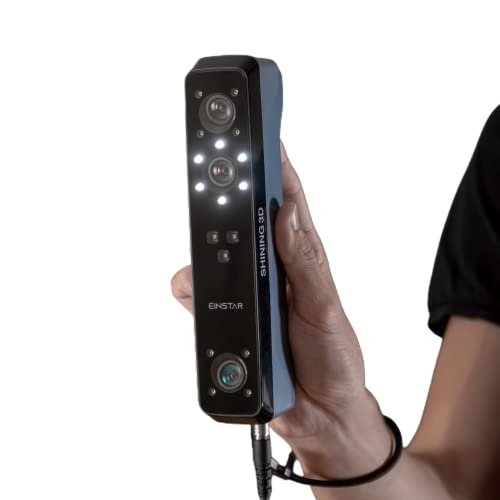
The Einstar’s three infrared VCSEL projectors combined with two stereo depth cameras create a dense point cloud that handles hair, dark clothing, and even outdoor semi-shade better than most scanners under . The “Hair Mode” toggle is not a gimmick — it genuinely captures individual strands for full-head human scans.
At 14 fps and a 0.1mm point distance, it’s not the fastest scanner on this list, but the EXstar software’s intelligent alignment compensates with robust tracking. Turn on the data quality indicator and you’ll see live feedback on coverage gaps, reducing rescans on complex automotive parts like bumpers and interior trim.
The main drawback is the single USB tether — there’s no wireless option, and the cable management can be awkward. The ergonomic grip is comfortable for extended sessions, but the fixed-height tripod included in the package is too low for standing scans of large objects.
Why it’s great
- Excellent hair and dark-surface capture without spray
- Data quality indicator prevents wasted scan sessions
- Point cloud density rivals far more expensive units
Good to know
- Wired only — no mobile or wireless operation
- Requires tracking dots on flat featureless planes
- Learning curve for distance and speed control
3. Revopoint POP3 Plus

The POP3 Plus takes the already capable POP 3 and adds optical zoom (1.5x and 2x magnification) for 30% more point cloud detail on small objects. The new photolithographic calibration board keeps accuracy within 20 microns, and the 9-axis IMU stabilizes scans during handheld passes — making shaky hands much less of a problem.
Scanning at up to 18 fps over Wi-Fi 6 or USB-C, it handles medium objects from 20mm to 2 meters. The Revo Scan software is intuitive, with in-depth tutorials and a global marker tracking mode that dramatically improves alignment on large assemblies. Full-color texture capture uses flash LED lighting for accurate pixel mapping even in dim rooms.
The biggest frustration reported is inconsistent results on simple geometries — some users nail their first scan, while others struggle for hours with calibration. Revopoint’s support team is responsive, often offering live troubleshooting, but the product should work out of the box for the price tier.
Why it’s great
- Optical zoom reveals fine surface detail
- 9-axis IMU reduces scan failures from hand shake
- Free Revo Scan software with frequent updates
Good to know
- Some units require calibration tweaks before first good scan
- Black and shiny surfaces benefit from spray
- Full-color resolution limited by RGB camera sensor
4. Revopoint INSPIRE 2
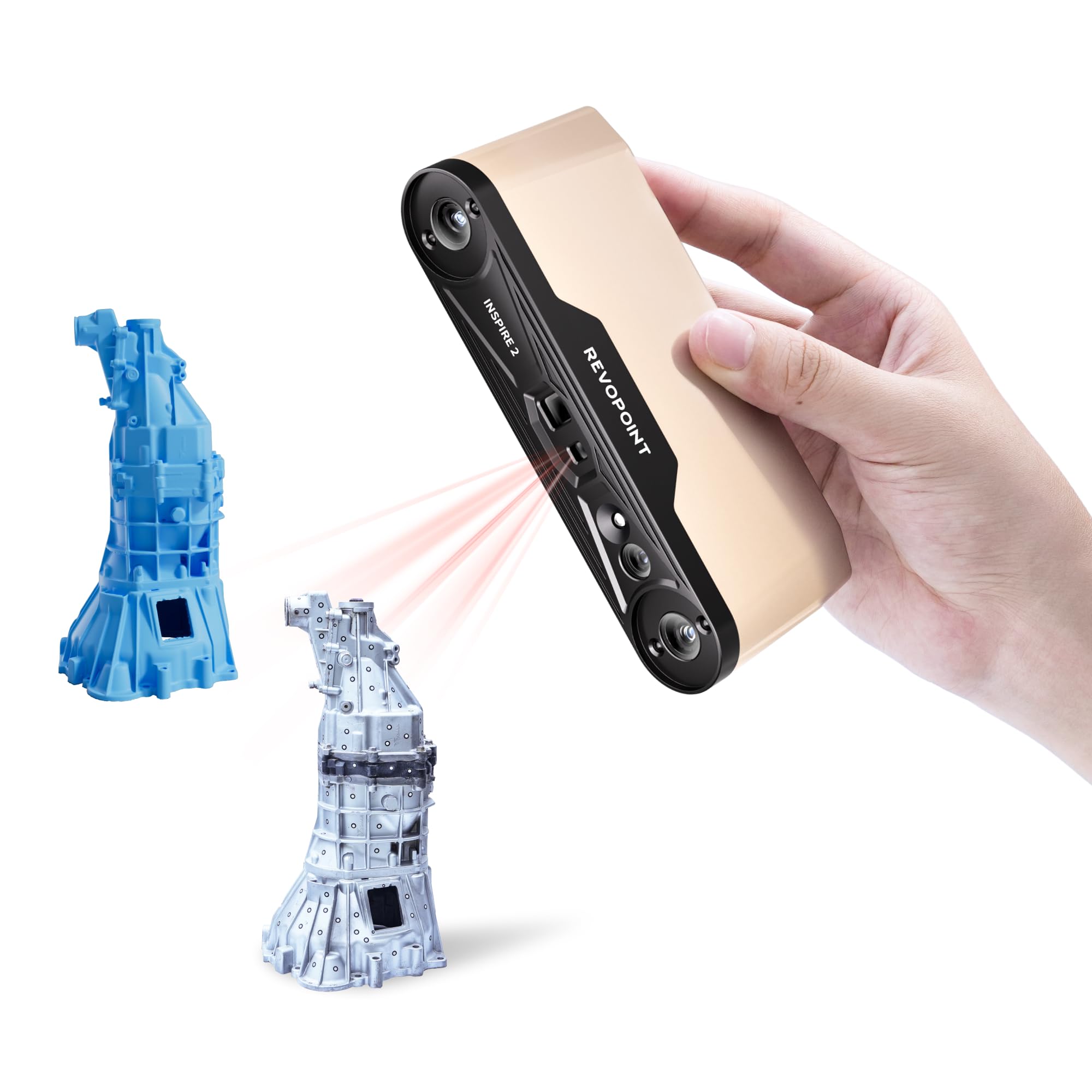
The INSPIRE 2 combines structured light with 11 infrared laser lines, giving it two distinct scanning modes. Use structured light for matte objects with fine color texture, then switch to multi-line laser for reflective or dark surfaces — all without changing hardware. The adjustable optical zoom (1.5x and 2x) projects narrower light to capture mixed-geometry surfaces like circuit boards.
Outdoor performance is rated up to 20,000 lux, which translates to reliable scans under a shaded porch on a bright day. The calibration board improves point cloud accuracy by 75% compared to the original INSPIRE, and the 0.03mm precision is genuinely usable for reverse engineering small components.
The sticky dots included for calibration markers have a reputation for peeling off mid-scan, so keep spares handy. The Revo Metro software is powerful but has a steep learning curve — expect a few hours of calibration and practice before achieving reliable tracking.
Why it’s great
- Dual scanning modes cover matte and reflective surfaces
- Adjustable optical zoom captures tiny detail
- 75% accuracy boost over previous generation
Good to know
- Calibration markers (dots) lose adhesion quickly
- Revo Metro software has a steep learning curve
- Requires powerful PC with RTX 3060 or better
5. Creality Ferret Pro

At just 105 grams, the Ferret Pro is the most portable entry-level scanner here. The Wi-Fi 6 bridge enables wireless scanning with Android and iPhone 11+ devices, making it ideal for fieldwork or capturing reference objects at trade shows. Anti-shake tracking and 0.1mm accuracy are respectable for a device this light, and the 24-bit full-color capture brings life to figurines and artifacts.
The kit comes complete with tripod, power bank, phone holder, and carrying case — everything you need to start scanning out of the box. It handles objects from 50mm to 2 meters reasonably well, though surface detail on very small items under 30mm is soft compared to dedicated desktop units.
Where the Ferret Pro shows its budget roots is in software polish. The Creality app lacks the advanced post-processing tools found in Revo Scan or EXstar, and some users find the calibration process cumbersome. Reflective and transparent surfaces are a struggle without spray, and the fixed tripod height can be limiting.
Why it’s great
- Ultra-light 105g build for one-handed scanning
- Full kit in box — tripod, battery, phone mount
- Wireless operation via Wi-Fi 6 bridge
Good to know
- App software lacks advanced editing features
- Struggles with reflective, transparent, and very dark objects
- Small-object detail is limited below 30mm
6. 3DMakerpro Seal Lite
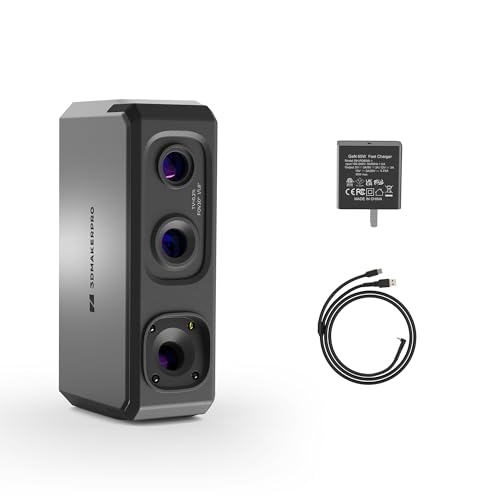
The Seal Lite uses a blue LED structured light source with a 400-500nm wavelength to project finer fringes than traditional white light, achieving 0.02mm accuracy on small objects between 10mm and 300mm. This makes it the go-to choice for scanning jewelry, coins, gears, and dental models where sub-millimeter fidelity is non-negotiable.
Scan-back and anti-shake features help stabilize results at 10 fps, but the tethered operation to a high-power PC via 65W charger is a constraint — you can’t take this into the field. JMStudio software provides lifetime free updates and supports OBJ, STL, PLY, and ASC exports, with visual tracking and error correction that beginners appreciate after the initial learning curve.
The manual alignment tool is surprisingly good for fixing misaligned frames, but the need for spray on shiny or black items is non-negotiable. The 65W power draw also means battery-powered laptops may struggle; you’ll want a wall outlet nearby.
Why it’s great
- 0.02mm accuracy for precise small-object scanning
- Blue LED light captures fine edges and dents
- Lifetime free JMStudio software updates
Good to know
- Tethered to PC via 65W — no wireless option
- Shiny and black surfaces require anti-glare spray
- Steep learning curve for tracking speed and distance
7. Shining 3D Einstar Vega

The Einstar Vega is the only truly standalone option here — it packs an 8-core 2.4GHz CPU, 32GB RAM, and 512GB SSD directly into the scanner body. No laptop, no tether, no external processing. It’s a complete mobile scanning studio.
Two scanning technologies coexist: Fast Mode using VCSEL for medium-to-large objects (up to 20 fps) and HD Mode using MEMS for smaller, detail-critical scans (up to 15 fps). The 48MP RGB texture camera captures high-quality color data, and the hybrid alignment system combines marker tracking with feature matching for stable results on car doors and furniture.
The drawbacks are significant for the price tier. Battery life is adequate but not all-day, and the unit struggles with black and shiny surfaces just like most infrared scanners. The on-unit processing means fewer editing tools compared to PC software like Revo Scan, and the 5GB cloud storage for wireless transfer fills up quickly.
Why it’s great
- Completely standalone — no PC required
- Built-in 512GB SSD for local storage
- Fast Mode captures large objects in under 10 minutes
Good to know
- Still needs spray for black and shiny surfaces
- Battery lasts just over an hour per charge
- On-unit editing is less capable than PC software
FAQ
Can a cheap 3D scanner achieve the same accuracy as a professional unit?
What computer specs do I need for a tethered cheap 3D scanner?
Do I need scanning spray for every scan?
Final Thoughts: The Verdict
For most users, the best cheap 3D scanner winner is the Creality CR-Scan Otter because it combines wireless operation, dual-lens versatility for objects from coins to cars, and reliable dark-surface capture without spray. If you need the highest small-object detail on a budget, grab the 3DMakerpro Seal Lite with its 0.02mm blue LED accuracy. And for untethered fieldwork where a laptop is not an option, nothing beats the Shining 3D Einstar Vega.

Mo Maruf
I created WellFizz to bridge the gap between vague wellness advice and actionable solutions. My mission is simple: to decode the research and give you practical tools you can actually use.
Beyond the data, I am a passionate traveler. I believe that stepping away from the screen to explore new environments is essential for mental clarity and physical vitality.