Our readers keep the lights on and my smoothie glass nicely filled. As an Amazon Associate, I earn from qualifying purchases.
A snoring partner, a neighbor’s late-night TV, or the dull roar of a construction site—disposable earplugs are the first line of defense for your sleep and sanity, but not all foam plugs deliver the same seal or comfort. Many users assume any pair with a high decibel rating will work, only to find them painfully stiff or prone to slipping out mid-sleep.
I’m Mohammad Maruf — the founder and writer behind WellFizz. I’ve spent hundreds of hours analyzing decibel attenuation data, foam density formulations, and user fit reviews to separate the truly effective disposable earplugs from those that only look good on a spec sheet.
This guide breaks down five top contenders by real-world fit, certified noise reduction, and long-wear comfort so you can finally find a pair that stays put and actually works. We’ve tested the specs and customer feedback to identify the truly best disposable earplugs for sleeping, studying, and loud environments.
How To Choose The Best Disposable Earplugs
Buying foam earplugs is deceptively simple. You want the highest NRR number, right? In practice, an earplug that does not fit your ear canal shape or is made from hard, fast-expanding foam will provide little real-world protection. Here are the three factors that actually matter.
Noise Reduction Rating (NRR) in Real Context
NRR is a lab measurement. In real life, you can subtract about 7 dB from the rating for typical insertion. An NRR of 33 likely provides around 26 dB of effective reduction. Look for plugs with a minimum of 31 NRR, but prioritize models where the foam expands slowly enough to reach deep into the canal without bouncing back out.
Foam Density and Expansion Speed
Soft, slow-rebound foam (often called “low-pressure” foam) molds to the unique shape of your ear canal without creating painful pressure points. This is critical for side sleepers who press their ears into a pillow all night. Denser foams block more noise but can cause soreness within two hours.
Shape and Contour for Comfort
Most disposable earplugs are cylindrical or bell-shaped. A pre-shaped, contoured plug (tapered or with a bell end) fits the natural anatomy better and resists backing out as you move. Straight cylindrical plugs often require deeper insertion to achieve a seal, which can irritate the ear canal.
Quick Comparison
On smaller screens, swipe sideways to see the full table.
| Model | Category | Best For | Key Spec | Amazon |
|---|---|---|---|---|
| Honeywell RWS-53008 | Bell-Shaped Foam | Maximum noise reduction | NRR 33, closed-cell foam | Amazon |
| Mack’s Maximum Protection | Low-Pressure Foam | Side sleepers & all-night wear | NRR 33, Comfy Cush foam | Amazon |
| 3M EPQS-80B-SIOC | Slow-Expand Foam | Gentle fit for sensitive ears | NRR 32, resealable bag | Amazon |
| VOISEN 150 Pairs | Bulk Value Pack | High volume & family use | NRR 32, 150 pairs | Amazon |
| Flents Protechs | Contoured Foam | Extended wear & latex-free | NRR 32, ergonomic shape | Amazon |
In‑Depth Reviews
1. Honeywell Safety Products Pre-Shaped Foam Earplugs, 60 Pair Tube (RWS-53008)

These Honeywell earplugs hold the highest NRR rating of 33 dB among single-use disposables, and their pre-shaped bell design is engineered to match the inner ear contour and resist backing out. The closed-cell polyurethane foam skin prevents dirt buildup and makes them smoother to insert than open-cell alternatives.
Customers consistently report that these are the best earplugs they have used in over two decades, particularly for drowning out snoring and loud environments. A small number of users note that the deep insertion required for a full seal can cause discomfort or slight pain, with some trimming the tip by a few millimeters to solve it.
The 60-pair tube is ideal for regular use, though the tube packaging is less portable than a bag. If you want the absolute highest certified noise reduction and a proven track record in industrial settings, this is the gold standard.
Why it’s great
- Highest NRR 33 rating available
- Closed-cell foam resists dirt and wear
Good to know
- May require trimming for smaller ear canals
- Tube packaging is bulkier than a pouch
2. Mack’s Maximum Protection Soft Foam Earplugs – 40 Pair, 33 dB Highest NRR
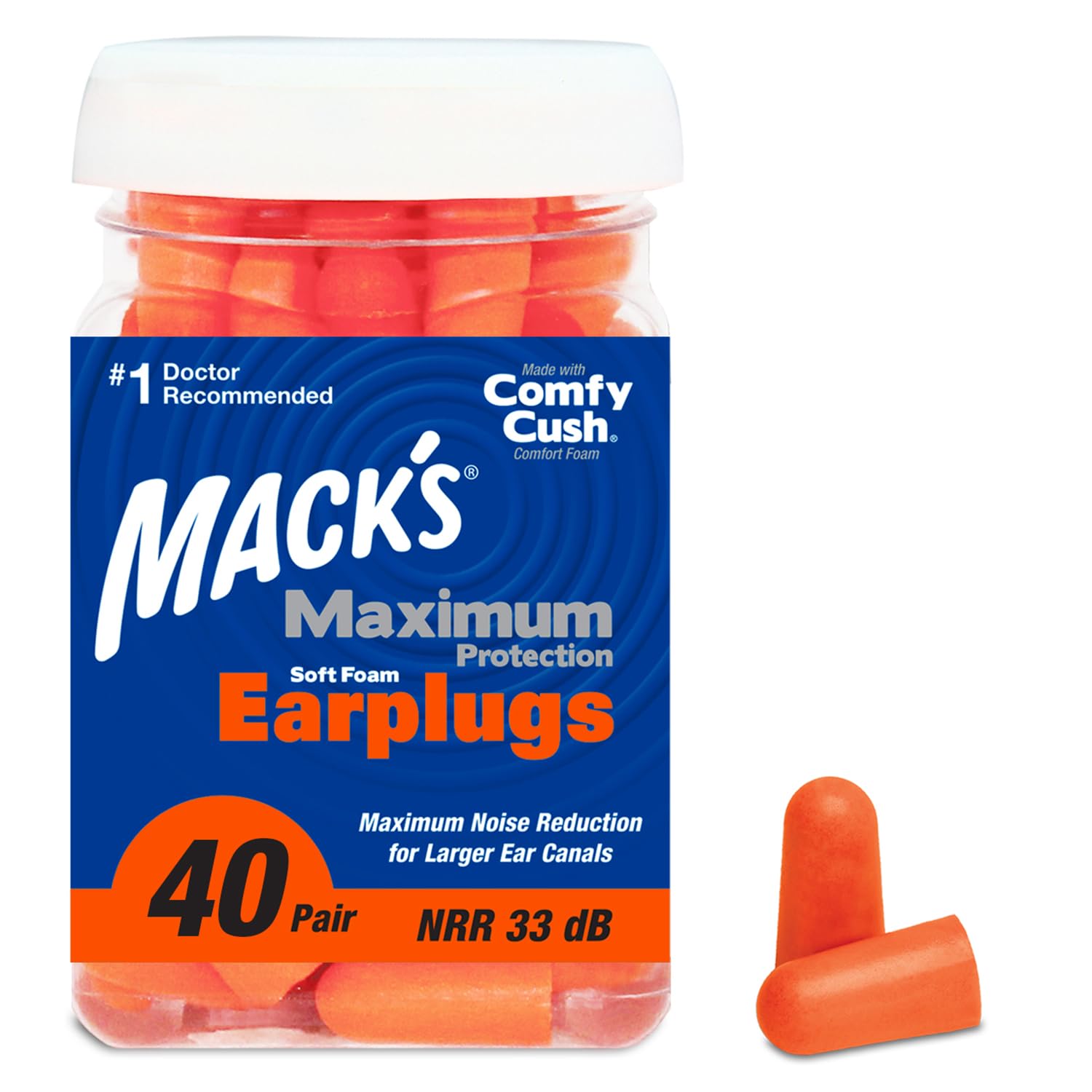
Mack’s uses their exclusive Comfy Cush foam formulation to achieve the same NRR 33 rating as the Honeywells but with noticeably lower internal pressure inside the ear canal. This makes them a better choice for side sleepers who keep plugs in for eight or more hours without waking up with sore ears.
Many users report switching from other brands specifically because these stay in place all night, are easy to insert, and are the most consistent in size from pair to pair. The plastic jar with a flip-open top is far more convenient than a cardboard box or tube for bedside use.
It is worth noting that these plugs are designed for larger ear canals, so users with very narrow ear passages may need to roll them into a thinner cylinder before insertion. They are made in the USA by the most doctor-recommended earplug brand, which adds an extra layer of trust for medical use.
Why it’s great
- Low-pressure foam for all-night comfort
- Flip-top jar for easy bedside access
Good to know
- Better suited for medium to large ear canals
- Not the cheapest per pair in multi-count packs
3. 3M Disposable Earplugs For Quiet, Studying & Sleep, 80 Pairs (EPQS-80B-SIOC)

3M’s light blue earplugs are designed with a pliable, slow-expanding foam that conforms gradually to the ear canal without the aggressive pushback of stiffer foams. This makes them extremely forgiving for first-time users or anyone who finds most earplugs too firm. The NRR 32 rating is only one decibel below the maximum, so the noise-blocking trade-off is negligible.
Customer feedback emphasizes that these are among the most comfortable disposable earplugs for long wear, with many wearing them for ten-plus hours without crinkling, flaking, or causing ear pain. The resealable bag is practical for travel and storage, though some users point out occasional quality control inconsistency in plug size within the same bag.
For side sleepers specifically, 3M’s softer foam reduces the pressure that hard plugs create when the ear is mashed into a pillow. If your priority is a gentle, irritation-free seal over the absolute highest dB attenuation, this is a top-tier option.
Why it’s great
- Exceptionally soft foam for sensitive ears
- Slow expansion prevents seal breakage
Good to know
- Some bags contain plugs of inconsistent size
- Resealable bag is less protective than a hard case
4. VOISEN 150 Pairs Foam Ear Plugs, 32dB NRR, Orange
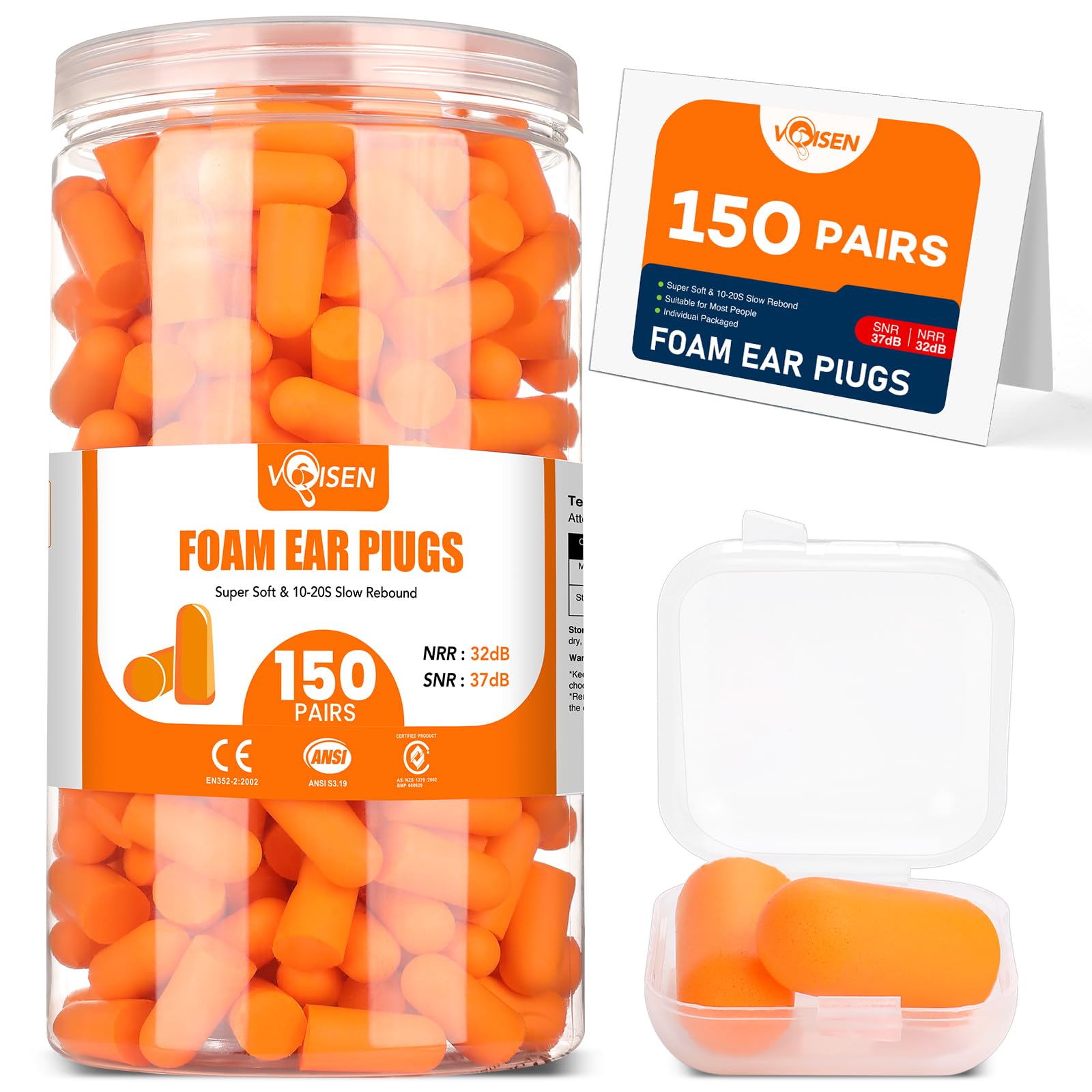
VOISEN enters the ring with the highest pair count in this roundup—150 pairs of orange slow-rebound foam earplugs rated at an NRR of 32 dB. The foam is soft and designed to expand slowly, which helps first-time users achieve a proper fit without the foam springing out before the seal locks in.
Buyers consistently note that these work well for motorcycle riding, workshop environments, and sleeping, with the high count making them a clear choice for families or shared workspaces. Some reviewers mention that the quality is decent but not premium—they do the job of reducing noise effectively without breaking the bank.
Each pair comes in a storage box, which helps keep the plugs clean between uses. These are not the most luxurious earplugs in terms of foam density, but for pure quantity and consistent performance at a very low per-pair cost, they are hard to beat.
Why it’s great
- 150 pairs in one purchase—best for bulk use
- Soft slow-rebound foam fits most ear shapes
Good to know
- Not as dense as premium industrial-grade plugs
- Storage box is small for the sheer volume of pairs
5. Flents Protechs Disposable Foam Ear Plugs, Contoured for Comfort, NRR 32, Beige, 50 Pair

The Flents Protechs are ergonomically contoured to match the natural curves of the ear, which reduces pressure points during extended wear. The beige color is discreet, and the NRR 32 rating provides solid hearing protection for construction, shooting, and sleep. The foam is latex-free, an important spec for users with latex allergies or sensitive skin.
Reviewers frequently mention that these plugs are easier to insert and slightly softer than the brand’s own green “Quiet Comfort” model, while still delivering effective noise blocking. A small number of users find them too large for very small ear canals, but most find the tapered shape comfortable for all-day use.
These are a strong choice if you need a latex-free disposable earplug that prioritizes ergonomic shape over brute-force density. The 50-pair count is a good middle ground—enough for daily use without committing to a 150-pair bulk pack that takes years to finish.
Why it’s great
- Latex-free material for allergy-safe use
- Contoured shape reduces ear pressure
Good to know
- May be slightly bulky for very narrow ear canals
- Not the highest NRR at 32 dB
FAQ
What NRR rating is best for sleeping?
How do I insert foam earplugs correctly?
Are disposable earplugs safe to reuse?
Why do earplugs hurt my ears when sleeping on my side?
Can disposable earplugs cause ear infections?
Final Thoughts: The Verdict
For most users, the best disposable earplugs winner is the Honeywell RWS-53008 because it offers the highest NRR 33 certification, a proven industrial history, and a bell shape that seals reliably. If you want maximum all-night comfort without ear pain, grab the Mack’s Maximum Protection. And for bulk coverage at the lowest per-pair cost, nothing beats the VOISEN 150 Pairs.

Mo Maruf
I created WellFizz to bridge the gap between vague wellness advice and actionable solutions. My mission is simple: to decode the research and give you practical tools you can actually use.
Beyond the data, I am a passionate traveler. I believe that stepping away from the screen to explore new environments is essential for mental clarity and physical vitality.