Our readers keep the lights on and my smoothie glass nicely filled. As an Amazon Associate, I earn from qualifying purchases.
A fresh, consistent grind transforms morning coffee from a routine caffeine hit into a genuinely rewarding cup. The difference between a blade grinder that pulverizes beans unevenly and a burr grinder that produces uniform particles is night and day—and that uniformity directly controls the balance of bitterness, acidity, and body in your brew.
I’m Mohammad Maruf — the founder and writer behind WellFizz. I’ve spent hundreds of hours comparing burr geometry, grind retention figures, and motor noise levels across the most popular domestic grinders to separate genuine performance from marketing claims.
This guide cuts through the noise to help you find the best domestic coffee grinder for your specific brewing style, whether you pull daily espresso shots or make pour-over by the carafe.
How To Choose The Best Domestic Coffee Grinder
Choosing a grinder for home use involves more than just picking a brand you recognize. The burr type, number of grind settings, motor speed, and retention all impact the quality of your grounds and the longevity of the machine. Before you browse, understand the three key factors that separate an average grinder from a great one.
Burr Material and Geometry
Conical steel burrs are the standard for domestic grinders because they produce consistent particle sizes with less heat generation than flat burrs. Look for stainless steel burrs with a hardness rating above HRC 50—softer steel wears faster and leads to uneven grinding over time. The larger the burr diameter, the faster and more consistent the grind, but larger burrs also increase the overall footprint of the grinder.
Adjustment Mechanism and Step Count
More grind settings give you finer control, but the mechanism matters just as much. Stepped adjustment rings provide tactile clicks that lock in place, making repeatability easy. Stepless designs offer infinite variability but require more practice to return to a specific setting. For espresso, look for at least 30 distinct steps or a stepless mechanism that can be dialed in with 0.1-second timer increments.
Static Control and Retention
Static electricity causes grounds to cling to the chute and container, creating mess and wasted coffee. Grinders with an anti-static treatment, a grounds bin made from dissipative plastic, or a metal body that grounds static charge will keep your counter cleaner. Low retention (under 0.5 grams) ensures that almost no stale grounds from yesterday’s grind end up in today’s fresh batch.
Quick Comparison
On smaller screens, swipe sideways to see the full table.
| Model | Category | Best For | Key Spec | Amazon |
|---|---|---|---|---|
| 1Zpresso J Manual | Manual Premium | Espresso & Pour-Over Precision | 48mm steel burr, 30 clicks per rotation | Amazon |
| Tuni G1 | Electric Premium | Quiet Precision Dosing | 40mm burr, 48 settings, 450 RPM | Amazon |
| Aromaster Burr Grinder | Electric Mid-Range | Low Retention & Static-Free Workflow | 48 settings, anti-static plastic bin | Amazon |
| SHARDOR Conical Burr | Electric Mid-Range | Touchscreen Dosing & Portafilter Use | 40mm burr, 51 settings, 0.1s timer | Amazon |
| OXO Brew Compact Conical | Electric Compact | Counter-Space Saving & Ease of Use | 15 settings + 29 micro-adjusts, 50g cap | Amazon |
| TIMEMORE Chestnut C2S | Manual Mid-Range | Lightweight Travel & Backup Grinder | 38mm burr, 36 levels, full metal body | Amazon |
| Alpaca Ventures Manual | Manual Entry-Level | Budget-Friendly Fresh Grind | 420 stainless burr, 12 settings | Amazon |
In‑Depth Reviews
1. 1Zpresso J Manual Coffee Grinder

The 1Zpresso J uses a 48mm stainless steel conical burr that produces highly uniform particle sizes, making it a strong contender for espresso lovers who want grind quality comparable to grinders costing three times as much. The 30-click adjustment per rotation gives you fine enough control to dial in a bottomless portafilter without needing stepless micro-adjustments. All-metal construction except the top cover and rubber grip gives it a dense, premium feel that resists wobble during grinding.
Grinding is fast and surprisingly effortless even at fine espresso settings, with most single doses taking between 20 and 40 seconds. The foldable handle tucks in with a push-and-twist motion, which prevents tipping when set down and makes storage easy. Tool-free disassembly simplifies cleaning, and the included dual-bristle brush reaches into the burr chamber effectively.
The only real limitation is capacity—the grinder holds roughly 25-30 grams, so you need to grind in batches for a full French press or larger drip pot. Some users with smaller hands find the body diameter slightly wide for a comfortable grip, but the torque curve is smooth and the handle length provides enough leverage to avoid fatigue.
Why it’s great
- 48mm burr delivers elite grind consistency for espresso and pour-over
- Fast grinding speed reduces daily workflow time
- Tool-free disassembly and included brush simplify maintenance
Good to know
- Capacity limited to roughly 25-30 grams per load
- Body diameter may feel slightly wide for smaller hands
2. Tuni G1 Conical Burr Coffee Grinder

The Tuni G1 brings quiet, low-speed grinding to the electric category with a 40mm conical burr running at just 450 RPM. Low RPM minimizes both noise and heat, preserving delicate aromatic oils in the bean. The 48 grind settings cover everything from Turkish fine to French press coarse, and the 0.5-second timer increments let you dial in doses precisely for consistent batch-to-batch results.
The patented anti-static system works well—grounds fall cleanly into the 75-gram dosing cup with minimal clinging. The detachable portafilter holder accommodates 54-58mm baskets, so you can grind directly into your espresso machine’s portafilter. The ivory stainless steel finish resists fingerprints, and the brush clipped to the bean hopper lid keeps the chute clear between uses.
Grind retention is impressively low at around 0.1 to 0.2 grams, meaning almost no stale grounds carry over to the next batch. For light-roast espresso beans, some users add a DIY shim to the burr carrier to get an extra 8 clicks of fine adjustment. At this price point, the combination of quiet operation, low retention, and clean workflow is hard to beat.
Why it’s great
- 450 RPM burr speed keeps noise and heat very low
- Low retention design wastes almost no coffee
- Detachable portafilter holder fits 54-58mm baskets
Good to know
- Light roasts may require a DIY shim for extra fine adjustment
- Dosing cup capacity of 75g is modest for large batches
3. Aromaster Burr Coffee Grinder
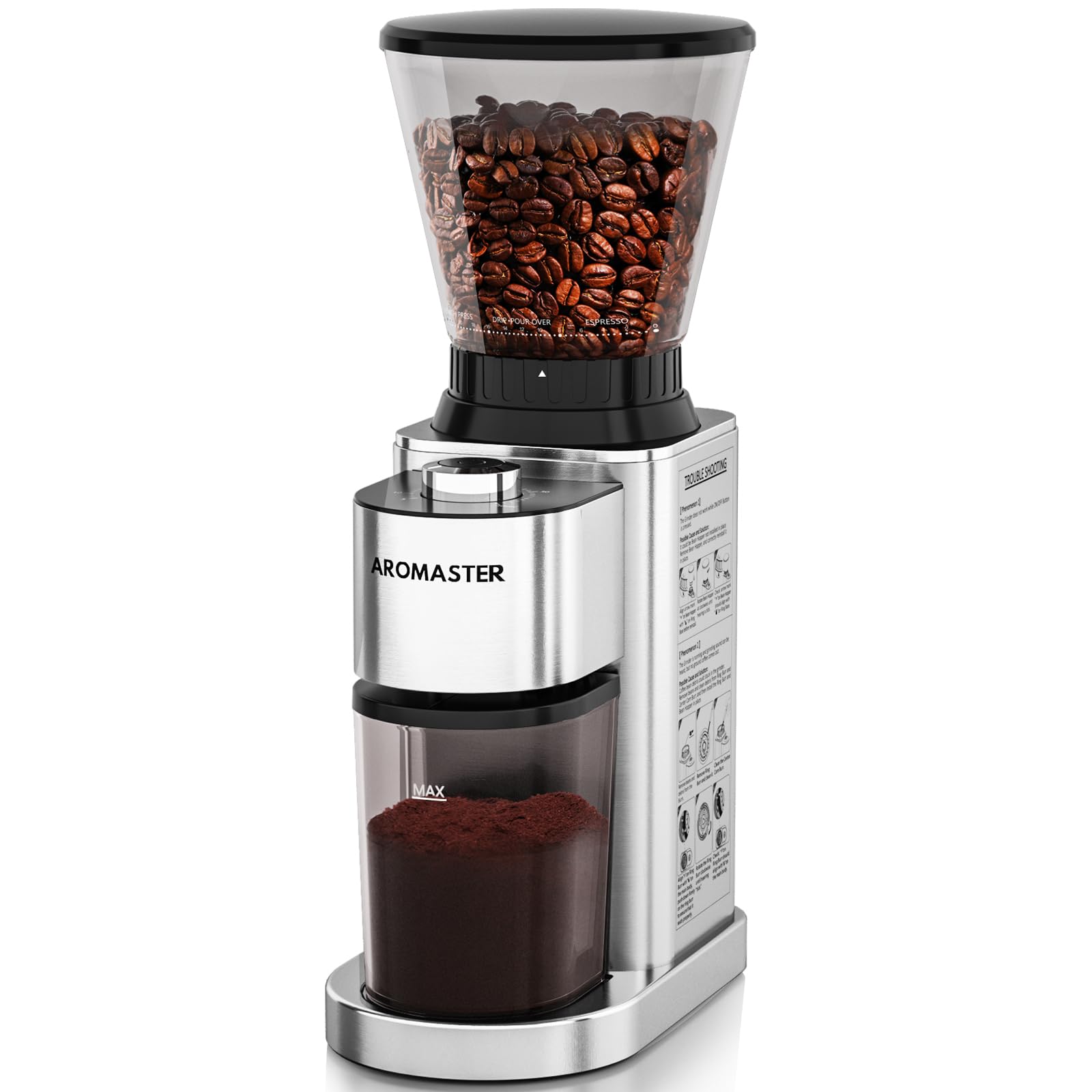
The Aromaster grinder focuses on the two things home brewers complain about most: static mess and inconsistent grind timing. The 48 grind settings provide a wide enough range to handle espresso, drip, pour-over, and French press, while the timed dosing mechanism lets you set and repeat exact portions. The anti-static system uses dissipative plastics that prevent grounds from clinging to the collection bin, keeping your counter clean after every use.
Stainless steel burrs produce uniform grinds with minimal fines, and the controlled motor speed helps avoid overheating the beans during longer grinding sessions. The smoke-tinted bean hopper blocks UV light from degrading the beans before grinding, a thoughtful touch for daily drivers. Grind adjustment is tactile and holds position well, so you don’t drift off your setting mid-week.
Cleaning requires some care because the burr chamber has tight corners that collect fines, and the plastic components feel less robust than all-metal alternatives. The 3-year replacement warranty adds peace of mind for a mid-range purchase. If you value a mess-free workflow and reliable timed dosing, this model delivers strong day-in, day-out performance.
Why it’s great
- Effective anti-static design eliminates most grounds mess
- 48 settings cover every popular brew method
- 3-year warranty offers long-term coverage
Good to know
- Cleaning tight burr chamber corners is slightly finicky
- Plastic components feel less premium than metal-bodied grinders
4. SHARDOR Conical Burr Espresso Coffee Grinder

The SHARDOR CG018 brings a modern touchscreen interface to the crowded electric grinder segment, with 51 grind settings that span espresso to French press. The 40mm stainless steel conical burr runs at 165 watts, which is enough torque to power through light roasts without stalling. The precision electronic timer lets you adjust grind time in 0.1-second increments, so you can micro-manage your dose down to the tenth of a second for repeatable results.
The portafilter cradle is a real time-saver for espresso users—you can grind directly into your portafilter without a separate dosing cup step. Anti-static technology keeps the grounds chamber relatively clean, and the included grounds residual cleaner tool pushes out the last bits of coffee from the chute. The dosing ring also helps contain stray grounds when grinding into a basket.
After over a year of use, many owners report consistent grind quality with no jams or mechanical failures. The hopper clips can be fragile if over-tightened, and the portafilter holder sags slightly under heavier baskets, but these are minor issues given the performance level. For entry-level espresso setups like the Breville Bambino Plus, this grinder provides enough fine adjustment to produce proper extraction pressure.
Why it’s great
- Touchscreen with 0.1-second timer increments for precise dosing
- Portafilter cradle enables direct grinding for espresso workflow
- Good grind consistency after long-term use
Good to know
- Portafilter holder sags slightly under heavy baskets
- Hopper clips are somewhat fragile if overtightened
5. OXO Brew Compact Conical Burr Coffee Grinder

The OXO Brew Compact uses a 15-setting stepped adjustment ring with 29 micro-adjustment positions between each main step, giving you 44 effective settings without complicating the user interface. This design lets you switch between brew methods rapidly while still having enough granularity for fine-tuning pour-over grind size. The stainless steel conical burrs produce consistent grounds with minimal fines, and the machine stands just 11 inches tall with a 4-inch footprint, making it one of the most counter-friendly electric grinders available.
Grinding is noticeably quiet—described by users as a low growl rather than the high-pitched whine of many blade-style grinders. The hopper holds up to 50 grams, enough for about 6 cups of coffee, so most households won’t need to refill mid-week. The upper and lower burrs are removable for cleaning, which helps prevent oil buildup that can stale subsequent batches.
Some users note that static causes fine specks to cling to the exterior, though a light water spritz on the beans before grinding eliminates the issue. The plastic hopper and body feel sturdy but are less reassuring than an all-metal build. For small kitchens where counterspace is at a premium and quiet operation matters, this model strikes an excellent balance between size and performance.
Why it’s great
- Very compact footprint fits easily under low cabinets
- Quiet grinding reduces early-morning kitchen noise
- Removable burrs simplify thorough cleaning
Good to know
- Static cling can cause stray specks on the counter
- Plastic construction feels less premium than metal designs
6. TIMEMORE Chestnut C2S Manual Coffee Grinder

The TIMEMORE C2S is an upgraded version of the popular C2, swapping the older top cap design for a full metal unibody that eliminates the cracking problem some C2 units experienced. The 38mm stainless steel conical burr is CNC-machined with a hardness rating between 55 and 58 HRC, which means it will hold its edge through years of daily use. The dual bearing positioning keeps the central shaft aligned during rotation, producing uniform grounds across all 36 adjustment levels.
Grinding is smooth and requires noticeably less effort than cheaper manual grinders thanks to the bearing-assisted handle rotation, which keeps spinning even after you release your hand. The 52mm body diameter is comfortable to grip, and the 25-gram capacity covers most single-serve needs without being overbuilt for travel. The included carrying bag and brush make it easy to take on camping trips or pack for office use.
Adjusting the grind size requires rotating the inner nut, which some users find less convenient than an external collar. The mechanism holds its setting well once dialed in, but frequent changes between fine and coarse can be tedious. For anyone who wants a durable, lightweight manual grinder as a backup or travel companion, the C2S delivers reliable consistency in a portable package.
Why it’s great
- Full metal unibody design fixes the C2’s top cap durability issue
- Bearing-assisted handle makes grinding smooth and easy
- Lightweight and portable with included carrying bag
Good to know
- Grind adjustment via inner nut is less convenient than external collar
- Capacity limited to around 24 grams per load
7. Alpaca Ventures Premium Manual Coffee Grinder

The Alpaca Ventures manual grinder brings an affordable entry point into conical burr grinding without resorting to ceramic burrs. The 420 stainless steel burr resists rust and delivers consistent grind quality across 12 adjustable settings, covering espresso, pour-over, drip, and French press. The dual-bearing design and lengthened stainless steel handle make cranking easier than typical budget manual grinders, reducing the effort required for a full 50-second grinding session at medium settings.
Disassembly is tool-free with a simple twist motion that separates the body, burr, and canister for thorough cleaning. The included brush fits inside the burr chamber to sweep out retained grounds. At just one pound, the grinder is light enough for camping or office use without feeling flimsy, and the aluminum body provides reasonable structural rigidity.
The 12-step adjustment is coarser than the 30-plus settings on premium manual grinders, so dialing in espresso requires more trial and error. Some users report that the adjustment dial can feel loose if the handle isn’t held in position during adjustment. For those entering the manual grinding world on a budget, this grinder offers a functional step up from blade grinders without the commitment of a premium price tag.
Why it’s great
- Affordable entry to conical burr grinding over blade-based alternatives
- Tool-free disassembly simplifies cleaning and maintenance
- Dual-bearing handle reduces cranking effort
Good to know
- Only 12 grind steps limit fine espresso dial-in precision
- Lacks a rubber base for grip during grinding
FAQ
Can a manual grinder produce consistent espresso grinds?
How often should I clean the burrs on a domestic grinder?
What is the real difference between 12 and 48 grind settings?
Final Thoughts: The Verdict
For most users, the best domestic coffee grinder winner is the 1Zpresso J Manual because its 48mm burr and 30-click adjustment with a solid metal build deliver espresso-grade consistency in a manual package that needs no counter space. If you want a quiet electric option with low retention and a clean workflow, grab the Tuni G1. And for a budget-friendly entry into conical burr grinding without the noise of electric motors, the TIMEMORE Chestnut C2S is a travel-ready all-metal alternative that punches above its price point.

Mo Maruf
I created WellFizz to bridge the gap between vague wellness advice and actionable solutions. My mission is simple: to decode the research and give you practical tools you can actually use.
Beyond the data, I am a passionate traveler. I believe that stepping away from the screen to explore new environments is essential for mental clarity and physical vitality.