Our readers keep the lights on and my smoothie glass nicely filled. As an Amazon Associate, I earn from qualifying purchases.
The gap between your smartphone’s headphone jack and a dedicated portable audio player isn’t subtle — it’s a chasm of noise floor, weak amplification, and missing micro-detail. A proper digital audio player (DAP) wraps a high-performance DAC, a clean amplifier stage, and expandable storage into a pocket-sized chassis that exists for one purpose: playback fidelity. Whether you are sideloading lossless FLAC files or streaming hi-res via Tidal, a dedicated device frees your phone’s battery and delivers a sound signature no phone can match.
I’m Mohammad Maruf — the founder and writer behind WellFizz. I’ve spent hundreds of hours dissecting DAC chip implementations, amplifier topologies, battery endurance benchmarks, and real-world format compatibility across the portable audio market to build this guide.
From budget-friendly entry-level DAPs to flagship audiophile transports, this guide covers the best portable audio players for every listening scenario. Use the reviews and spec comparisons below to find the exact match for your headphones, storage needs, and preferred listening environment.
How To Choose The Best Portable Audio Player
Selecting the right DAP requires matching your headphone impedance, preferred file format, and daily usage pattern to a device’s DAC implementation, amplifier output, and software ecosystem. Prioritize these criteria before comparing feature lists.
DAC Chip and Amplifier Topology
The digital-to-analog converter (DAC) determines the player’s maximum resolution, dynamic range, and noise floor. Single-chip designs like the WM8965 offer clean conversion for entry-level use, while quad-matrix setups using CS43198 chips provide superior channel separation and lower distortion. Pair the DAC with an amplifier that delivers sufficient current for your headphones — planar magnetic and high-impedance dynamic drivers benefit from balanced outputs rated above 500mW per channel.
Native Format Support and Streaming Access
Native DSD support up to DSD256 or DSD512 and PCM decoding up to 768kHz ensure bit-perfect playback of high-resolution files. If you rely on streaming services, look for a player running a full Android OS (version 11 or later) with access to the Play Store, or a proprietary OS that deeply integrates with Qobuz, Tidal, and Spotify. Bluetooth codec support — LDAC, aptX HD, and UAT — preserves audio quality during wireless listening.
Storage Capacity and Battery Endurance
Local storage options range from 32GB to 128GB internally, but expandable microSD slots (supporting up to 2TB) are essential for large lossless libraries. Battery life varies widely — players with smaller screens and non-Android operating systems often exceed 24 hours, while streaming-heavy Android DAPs typically deliver 8-12 hours of mixed use. Desktop mode, which bypasses the internal battery when connected to power, is a valuable feature for long listening sessions at home.
Quick Comparison
On smaller screens, swipe sideways to see the full table.
| Model | Category | Best For | Key Spec | Amazon |
|---|---|---|---|---|
| MECHEN M30 | Entry-Level DAP | Budget hi-res listening | 25-hour battery, 64GB card | Amazon |
| Mighty 3 | Streaming Companion | Screen-free offline streaming | 8-hour battery, 8GB storage | Amazon |
| HIFI WALKER H2 | Mid-Range DAP | Wired hi-res with Bluetooth | 128GB card, ESS DAC, aptX | Amazon |
| JadeAudio/FiiO JM21 | Android DAP | Streaming and local playback | 700mW balanced, 12.5h battery | Amazon |
| HiBy R4 | Android DAP | Quad-DAC with streaming | 4500mAh, 2TB expandable | Amazon |
| FiiO M21 | Premium DAP | Desktop mode, high power | 950mW balanced, quad DAC | Amazon |
| Sony NW-A306 | Compact Premium | All-day portable listening | 36-hour FLAC, 113g weight | Amazon |
| EVERSOLO DMP-A6 Gen 2 | Desktop Streamer | Home hi-fi streaming hub | DSD512, dual-mono ESS DAC | Amazon |
| Sony NW-WM1AM2 | Flagship DAP | Reference-grade portable audio | S-Master HX, 128GB internal | Amazon |
In‑Depth Reviews
1. HIFI WALKER H2
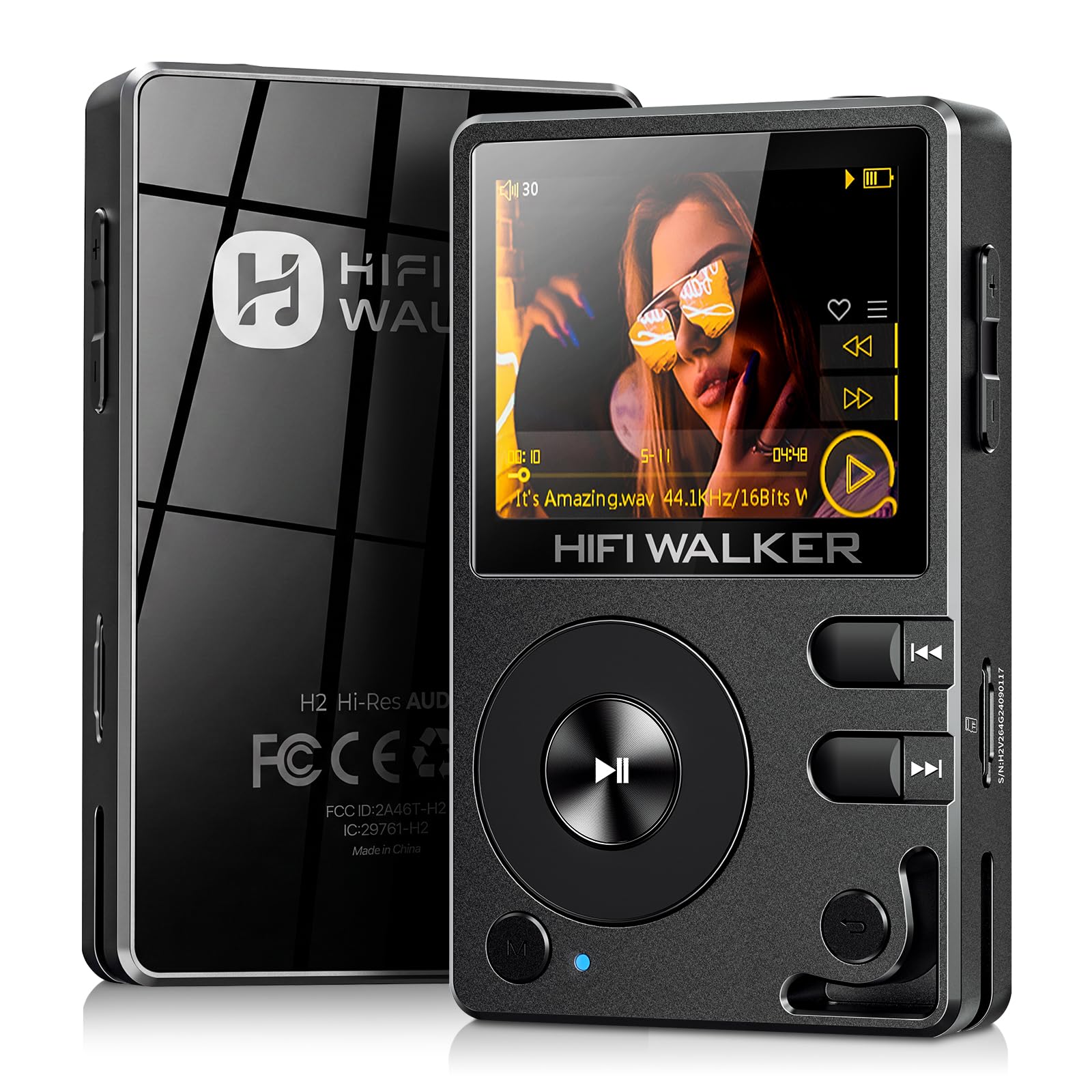
The H2 employs the ESS ES9018K2M DAC with 32-bit/384kHz decoding and native DSD128 support, delivering a 107dB SNR and 0.008% THD. The 70mW output at 32 ohms drives most over-ear headphones cleanly, while the ALPS scroll wheel provides tactile navigation through FLAC, WAV, DFF, and APE files. The pre-installed 128GB microSD card holds around 10,000 compressed tracks or roughly 2,000 hi-res FLAC albums.
Bluetooth 5.2 with Qualcomm aptX supports two-way operation — the H2 works as a transmitter for wireless headphones or as a receiver for a phone or laptop streaming source. The USB DAC mode bypasses a computer’s internal audio, cleaning up the signal path for critical listening. The CNC-machined zinc alloy shell adds durability without adding bulk, keeping the player pocket-friendly.
Battery life reaches 14 hours with wired headphones and drops to around 10 hours over Bluetooth — adequate for a workday commute but not class-leading. The UI has a learning curve, especially the music scan function (hold the M button), and the screen is functional rather than vivid. For listeners who prioritize sound quality over streaming apps, the H2 delivers audiophile-grade playback at a fraction of flagship prices.
Why it’s great
- ESS DAC with native DSD128 support
- Two-way Bluetooth 5.2 with aptX
- USB DAC function for PC audio
- Sturdy zinc alloy build
Good to know
- UI requires learning for music scanning
- No touchscreen or streaming apps
- Battery life drops significantly via Bluetooth
2. JadeAudio/FiiO JM21

The JM21 is the first portable DAP to pair the Snapdragon 680 processor with a fully balanced audio architecture using dual Cirrus Logic CS43198 DACs and dual SGM8262 operational amplifiers. The result is a balanced output of 700mW per channel, giving it enough headroom to drive high-impedance studio headphones and planar magnetics without strain. The 4.4mm balanced output is complemented by a standard 3.5mm single-ended jack, offering flexibility across headphone types.
The custom Android 13 open-source system allows direct installation of streaming apps including Spotify, Apple Music, Tidal, and Qobuz. The DAPS digital audio purification system, paired with a fifth-generation FPGA and dual femtosecond crystal oscillators, ensures bit-perfect audio output from any app — a critical feature for listeners who want lossless streaming without upsampling artifacts. The 4.7-inch IPS LCD touchscreen makes navigation intuitive, and the 32GB internal storage is expandable via microSD up to 2TB.
Battery life averages 12.5 hours under mixed usage, and the player supports both Wi-Fi and Bluetooth with LDAC for high-quality wireless streaming. Some users report idle battery drain of roughly 25% over 11 hours, so power management during standby is worth monitoring. The included case and screen protector add immediate protection, though the lack of a printed manual frustrates new users. For the balance of streaming capability and raw output power, the JM21 is a strong all-around contender.
Why it’s great
- 700mW balanced output drives demanding headphones
- Android 13 with full Play Store access
- Bit-perfect audio from streaming apps
- Expandable storage up to 2TB
Good to know
- Idle battery drain can be significant
- No printed manual included
- Plastic build may not feel as premium as metal competitors
3. HiBy R4

The HiBy R4 deploys four independent DAC chips in a matrix configuration, paired with 28 high-precision tantalum capacitors and a dedicated Class A headphone amplifier. This architecture delivers exceptionally low noise floors and high dynamic range, making micro-details in complex instrumental passages audible. Native DSD256 and PCM768kHz/32bit support, combined with MQA 16X unfolding, ensure compatibility with virtually every hi-res format available.
Running Android 12 on an SD665 octa-core processor with 3GB of RAM, the R4 handles streaming apps like Spotify, Tidal, and Pandora without lag. The 4.7-inch LCD screen shows album art and track metadata cleanly, and the physical FN keys provide quick access to screen rotation and key lock. Storage is expandable up to 2TB via microSD, accommodating even the largest lossless libraries. Bluetooth 5.0 supports LDAC, aptX HD, and UAT codecs for high-quality wireless playback.
The 4500mAh battery lasts roughly 11 hours under mixed use, though intensive streaming with Wi-Fi active can reduce that figure. Some users have reported unit failures where the device bricks during charging — a risk that appears isolated but worth noting. The TPU case and pre-applied screen protectors mitigate daily wear. For audiophiles who need a fully featured Android DAP with quad-DAC precision, the R4 offers a compelling feature set at a mid-range price point.
Why it’s great
- Quad-DAC design with Class A amplifier
- Native DSD256 and MQA 16X unfolding
- Android 12 with Play Store access
- 2TB expandable storage
Good to know
- Battery life around 11 hours with streaming
- Reported bricking issue in some units
- Touchscreen less responsive than modern smartphones
4. Sony NW-A306

The NW-A306 delivers the longest battery life in its class — up to 36 hours of 44.1kHz FLAC playback — thanks to a rigid aluminum frame, gold solder connections, and Sony’s S-Master HX digital amplifier technology. The chassis is precision-engineered to reduce electrical noise, and the compact design weighs just 113 grams, making it the most pocket-friendly hi-res DAP available. DSD formats up to 11.2MHz are supported natively, and 360 Reality Audio adds spatial immersion for compatible tracks.
The Android operating system enables Wi-Fi streaming from services like Tidal and Qobuz, though the Sony Music app is noticeably slower than third-party alternatives like VLC or Poweramp. File transfer via Sony’s proprietary software is slow; a USB-C to microSD card reader is recommended for loading music libraries. The volume output is capped for US and EU models to comply with regional regulations, which may limit performance with high-impedance headphones above 80 ohms.
Bluetooth connectivity is reliable with LDAC support, and the player works well as a source for car audio systems. The AMOLED display is vibrant, though the device boots slowly and the music app can feel sluggish compared to phone-based players. Listeners who prioritize marathon battery life and extreme portability over raw amplifier power will appreciate the NW-A306’s focus on endurance and build quality.
Why it’s great
- Exceptional 36-hour battery life
- Ultra-light 113g aluminum build
- DSD up to 11.2MHz and 360 Reality Audio
- Reliable Bluetooth with LDAC
Good to know
- Volume capped for US/EU models
- Sony Music app is slow; third-party apps recommended
- File transfer via Sony software is cumbersome
5. FiiO M21
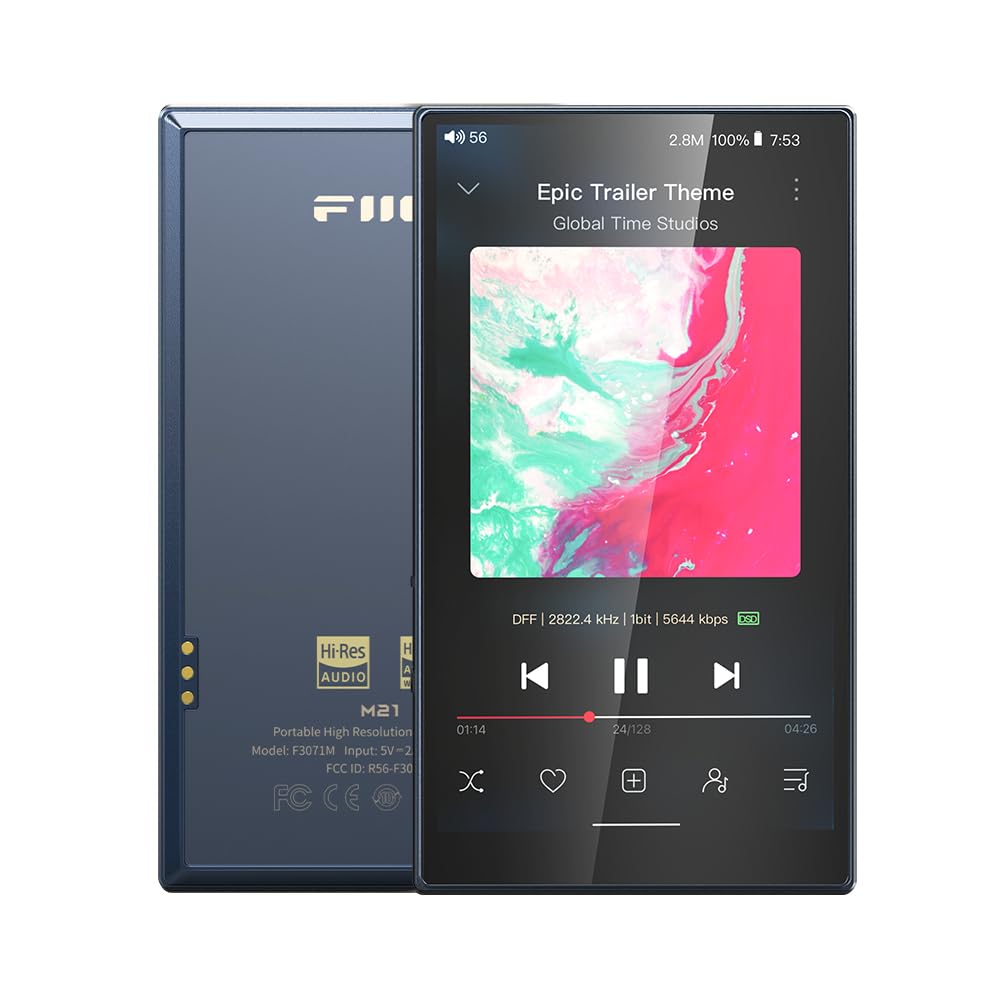
The M21 is the first portable DAP to implement a patented Desktop Mode that runs the device entirely on external power, preserving the internal battery’s lifespan during extended home listening sessions. The quad CS43198 DAC matrix — a 4-channel, 8-path fully differential design — is paired with a two-stage amplifier that handles voltage amplification and current boosting separately, achieving a balanced output of 950mW per channel. That headroom comfortably drives demanding headphones like the FiiO FT1 or Sennheiser HD 660S2.
Android 13 runs on a Snapdragon 680 processor with 4GB of RAM and 64GB of internal storage, expandable via microSD. The 4.7-inch LCD touchscreen is responsive, and the included case and screen protector offer immediate protection. Dual 3.5mm and 4.4mm outputs support both single-ended and balanced connections, and SPDIF output reduces jitter by 70% compared to standard digital transports — a meaningful upgrade for listeners who use external DACs or active speakers.
Battery life in regular mode is around 10 hours with balanced output, but Desktop Mode eliminates battery drain entirely when plugged in. Some users have reported Wi-Fi antenna failures after several months, and the FiiO Music app has minor issues with shuffle implementation. For listeners who split time between portable and desktop listening, the M21’s Desktop Mode and high output power justify the premium over mid-range competitors.
Why it’s great
- Desktop Mode preserves battery lifespan
- 950mW balanced output for demanding headphones
- Quad CS43198 DAC with 2-stage amplification
- Low-jitter SPDIF output
Good to know
- Wi-Fi antenna failure reported in some units
- FiiO Music app shuffle issues
- Battery life around 10 hours in portable mode
6. Mighty 3
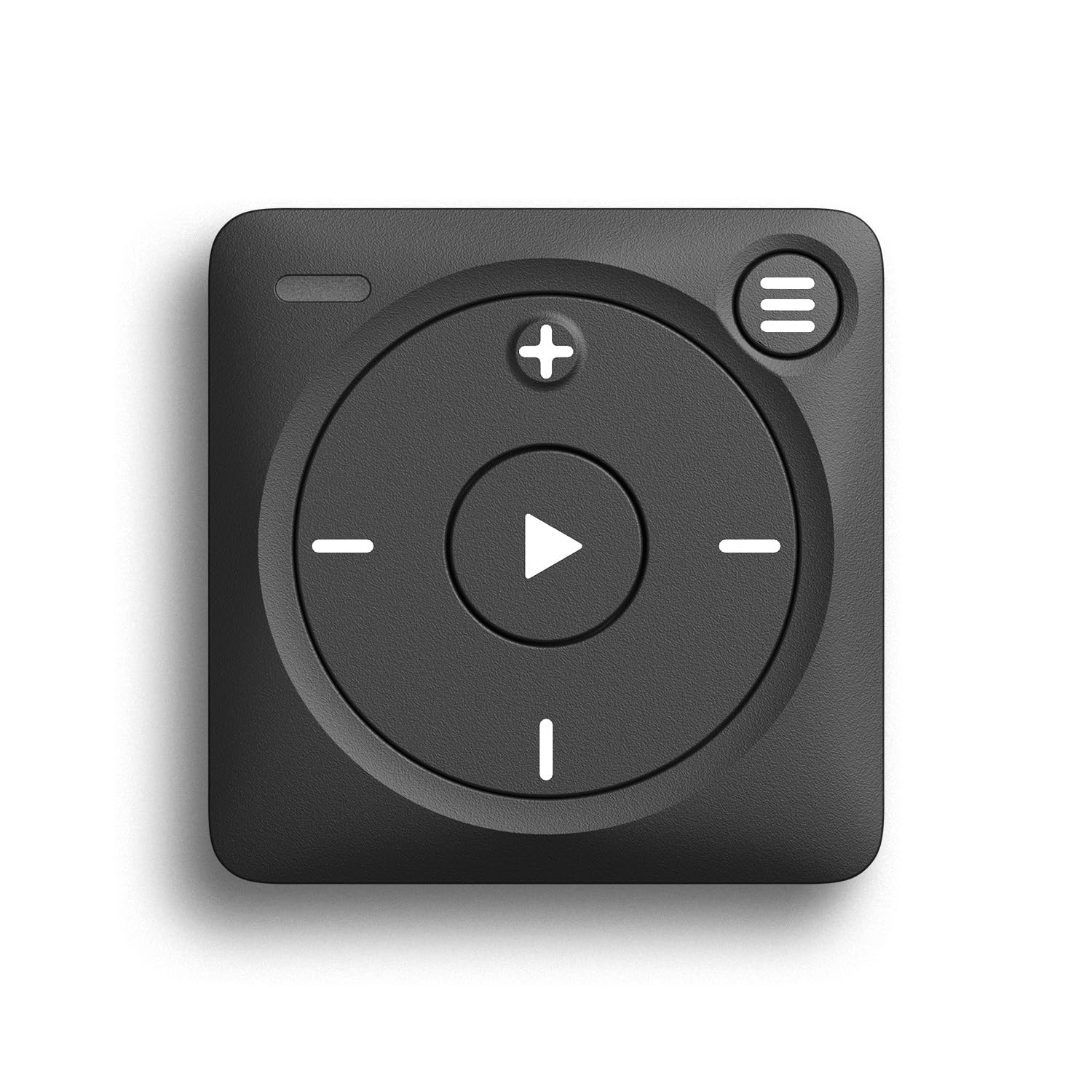
The Mighty 3 is a screen-free streaming companion that downloads playlists from Amazon Music Unlimited or Amazon Music Prime for offline playback. The 8GB internal storage holds roughly 1,000 songs, and the device is IPX4 rated for sweat and splash resistance — suitable for gym sessions or outdoor runs. It connects to both Bluetooth and wired headphones via a 3.5mm jack, and the built-in clip secures it to clothing or a waistband.
Setup requires the free Mighty mobile app to sync playlists over Wi-Fi from a phone. Once loaded, the player operates completely offline for up to 30 days before needing a re-sync. The Stay Fresh feature automatically refreshes playlists during charging, eliminating manual updates. The 108dB SNR DAC delivers clean audio, though the lack of an equalizer limits sound customization. Important note: Spotify support ends April 21, 2027 due to platform changes, making Amazon Music the primary streaming ecosystem for this device.
Battery life averages 8 hours, which covers long workouts or a week of bedtime listening. The small footprint — roughly the size of a matchbox — makes it unobtrusive. Bluetooth range is adequate for phone-free listening but may cut out if the player is worn on a waistband while the headphones are at ear level. For parents wanting a screen-free music solution for kids or athletes who want to leave their phone behind, the Mighty 3 serves a specific niche well.
Why it’s great
- Screen-free design reduces distractions
- IPX4 water resistance for workouts
- Works with Amazon Music offline
- Ultra-compact and clip-on
Good to know
- Spotify support ending in 2027
- No equalizer or sound customization
- Bluetooth range can be inconsistent
7. Sony NW-WM1AM2

The NW-WM1AM2 is Sony’s flagship portable audio player, built around the proprietary S-Master HX digital amplifier and DSEE Ultimate upscaling engine. The aluminum frame uses large solid polymer capacitors and gold-plated internal wiring to minimize electrical interference, resulting in a black background with exceptional instrument separation and soundstage depth. Native DSD file support and high-resolution audio compatibility make it a reference-tier source for critical listening.
The 128GB internal storage is double that of most competitors, and the microSD slot adds further expansion for massive lossless libraries. However, the device runs a heavily customized Android 11 that feels dated — boot times are slow, the Walkman app can be sluggish with large libraries (particularly with 900GB of FLAC on a 1TB card), and the processor struggles with high-bitrate files compared to newer Snapdragon-based DAPs. The volume output is also underwhelming for over-ear headphones, often requiring near-maximum volume with high-impedance models.
Build quality is superb, with a precise tactile feel and a responsive touchscreen. The battery life falls well short of Sony’s 40-hour claim — real-world usage delivers roughly 8-12 hours, depending on file format and streaming activity. The microSD slot design is finicky, and the Walkman player may not recognize a card loaded via PC without reformatting. For purists who value timbral realism and analog-like smoothness above streaming features or raw power, the WM1AM2 remains a benchmark.
Why it’s great
- S-Master HX delivers smooth, analog-like playback
- Excellent soundstage and instrument separation
- 128GB internal storage plus microSD expansion
- Premium aluminum build quality
Good to know
- Battery life (8-12 hours) far below claimed 40 hours
- Sluggish Android 11 with dated processor
- Underpowered for high-impedance over-ear headphones
- Software and file management can be frustrating
8. EVERSOLO DMP-A6 Gen 2
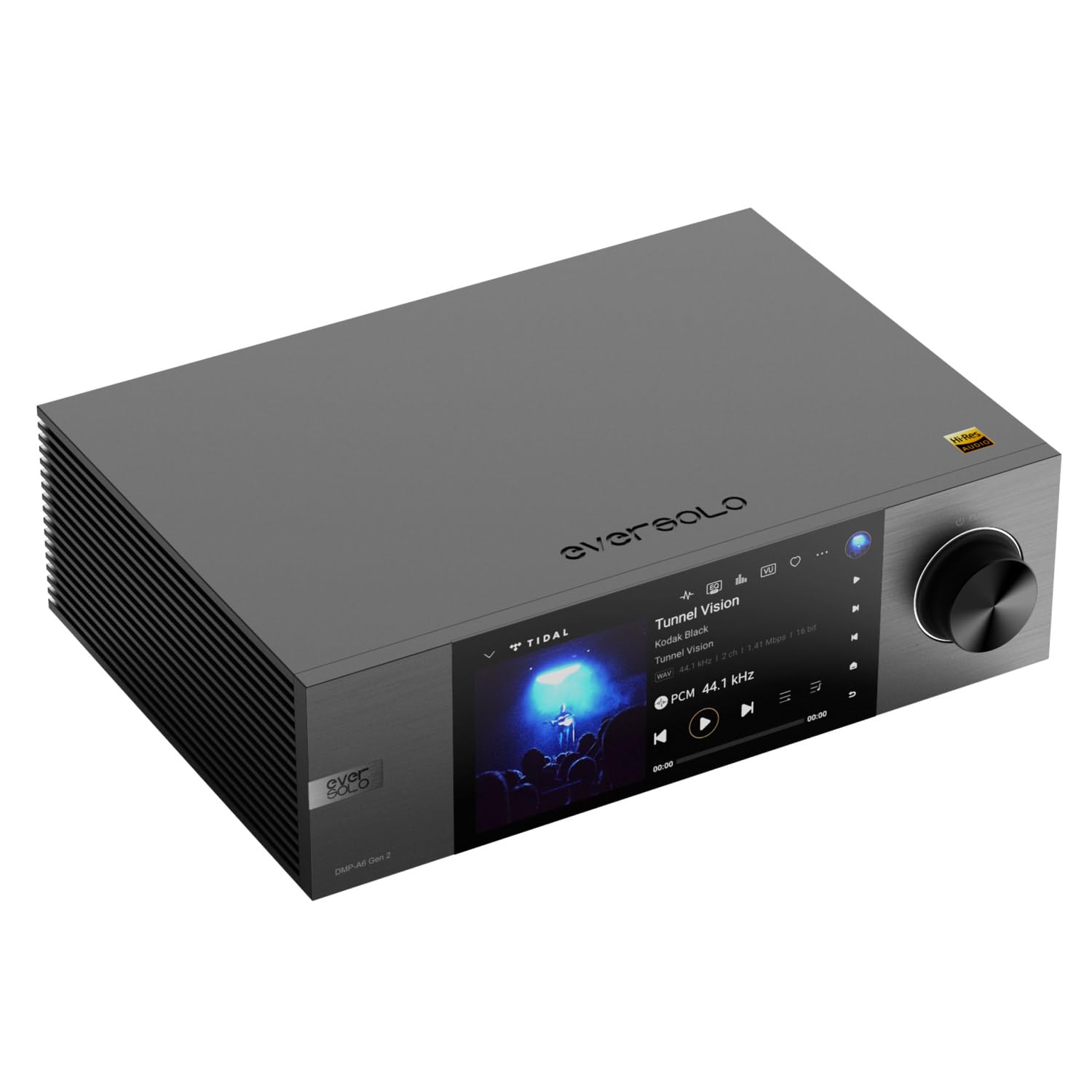
The DMP-A6 Gen 2 is a Wi-Fi-enabled music streamer and DAC rather than a portable player — its form factor is designed for a desktop or audio rack, not a pocket. The newly upgraded linear power supply operates with noise levels below 40 microvolts, and the dual-mono ESS DAC implementation supports native DSD512 and PCM up to 768kHz. The 6-inch LCD touchscreen serves as the primary interface, complementing a dedicated mobile app for both Android and iOS.
The EOS audio engine provides direct high-resolution output from deeply integrated streaming services including Tidal, Qobuz, Highresaudio, and Presto Music. Roon Ready, Tidal Connect, and Spotify Connect protocols allow seamless integration with existing digital ecosystems. The device also functions as a fully featured DAC with coaxial, optical, USB-C, and HDMI ARC inputs — HDMI ARC is particularly useful for connecting a TV to eliminate extra cables. The balanced XLR and single-ended RCA outputs can be used simultaneously for bi-amping setups.
Storage is handled by an internal NVMe drive bay, allowing direct library storage without relying on a NAS. Some users report UI responsiveness issues, particularly with the mobile app when browsing UPnP servers. The lack of an included remote control at this price point is a notable omission, but the screen and app provide full functionality. For listeners building a dedicated home audio system around streaming and hi-res local files, the DMP-A6 Gen 2 is a versatile and sonically transparent hub.
Why it’s great
- Dual-mono ESS DAC with native DSD512 support
- HDMI ARC input for TV audio integration
- Deep integration with Tidal, Qobuz, and Roon
- Internal NVMe storage bay
Good to know
- Not portable — designed for desktop/rack use
- Mobile app can be laggy with UPnP servers
- No remote control included
- Some reported power failure issues after several months
9. MECHEN M30
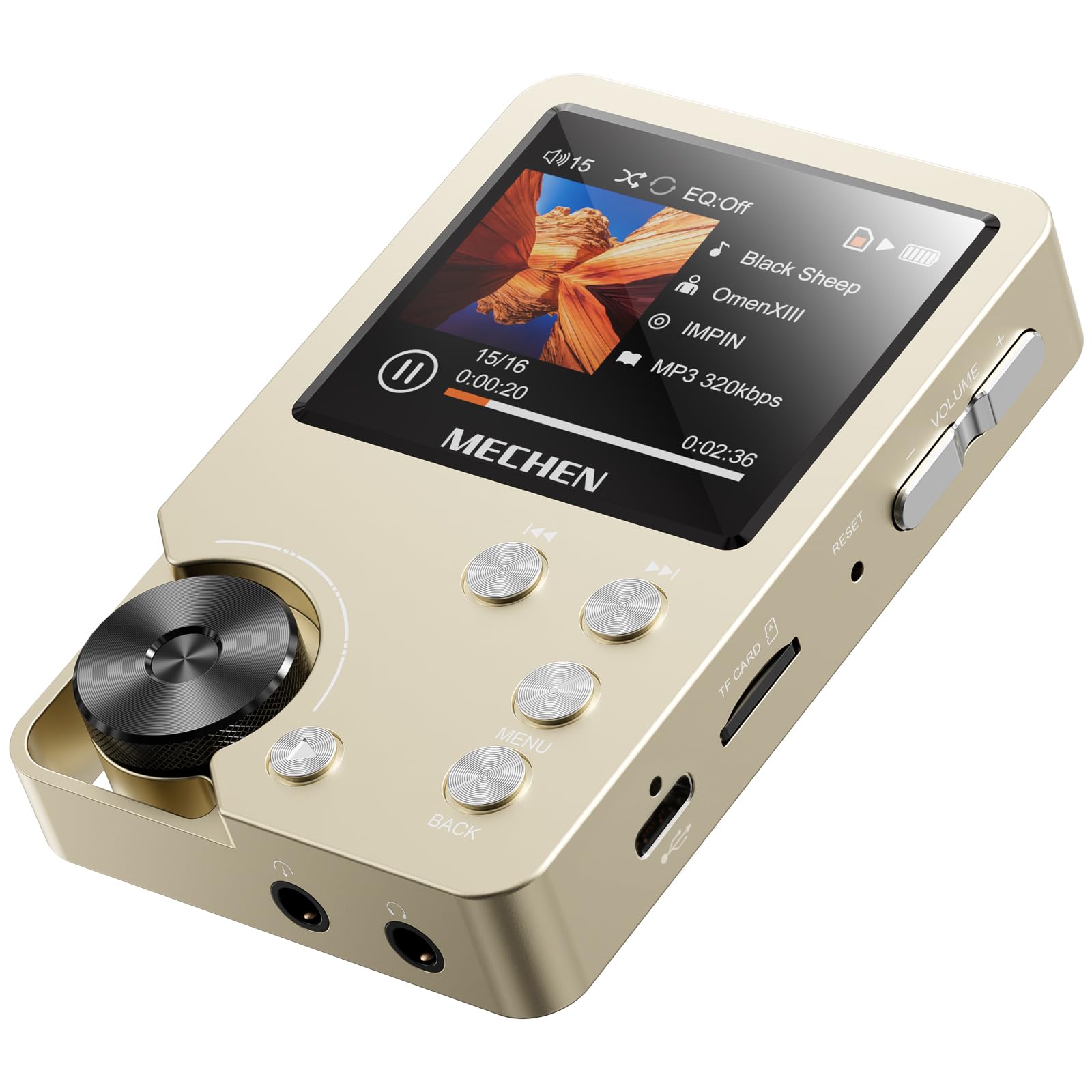
The M30 uses a WM8965 DAC paired with a TPA6530 power amplifier from Texas Instruments, delivering clean lossless playback for MP3, FLAC, WAV, APE, and DSD128 files. The 2.0-inch LCD screen displays lyrics and track metadata, and the CNC-machined aluminum alloy shell resists fingerprints while remaining lightweight at 153 grams. A pre-installed 64GB microSD card provides immediate storage for roughly 1,000 FLAC albums or thousands of MP3 files.
The scroll wheel control allows rapid track navigation, and independent menu and return buttons with a one-key lock screen make operation straightforward without a touchscreen. The 1,500mAh battery charges fully in 2 hours and provides up to 25 hours of continuous playback — excellent endurance for a device at this price tier. The compact dimensions (2.2 x 0.6 x 3.5 inches) fit easily into any pocket or bag.
Notable omissions include Bluetooth connectivity, which limits headphone options to wired use only. The included USB-C cable is only 6 inches long, and some users report the need for a firmware update to fix gapless playback and file ordering. For budget-conscious listeners who want a durable, no-frills device for long listening sessions with wired headphones, the M30 delivers reliable hi-res performance at an entry-level price.
Why it’s great
- 25-hour battery life for marathon listening
- Includes 64GB microSD card
- Sturdy aluminum alloy build
- Lossless playback with DSD128 support
Good to know
- No Bluetooth — wired headphones only
- May need firmware update for gapless playback
- Included USB-C cable is very short
FAQ
Do I need a separate portable audio player if I already use a smartphone?
What does the balanced output do differently from a standard 3.5mm jack?
How much storage do I need for a lossless music library?
Final Thoughts: The Verdict
For most users, the best portable audio player is the JadeAudio/FiiO JM21 because it balances 700mW balanced output with Android 13 streaming and exceptional bit-perfect audio from apps like Tidal and Qobuz. If you want marathon battery life and ultra-portable build, grab the Sony NW-A306. And for audiophiles building a home system around high-resolution streaming and DSD playback, nothing beats the EVERSOLO DMP-A6 Gen 2.

Mo Maruf
I created WellFizz to bridge the gap between vague wellness advice and actionable solutions. My mission is simple: to decode the research and give you practical tools you can actually use.
Beyond the data, I am a passionate traveler. I believe that stepping away from the screen to explore new environments is essential for mental clarity and physical vitality.