Our readers keep the lights on and my smoothie glass nicely filled. As an Amazon Associate, I earn from qualifying purchases.
Cutting the cord is one of the best decisions you can make for your monthly budget, but the transition hinges on one make-or-break component: the antenna. A weak or poorly chosen model will deliver pixelated images, constant signal drops, and a frustrating return to the cable company. The right one, however, pulls in crisp, uncompressed 1080p or 4K broadcasts from major networks like ABC, CBS, NBC, and Fox with zero monthly fees.
I’m Mohammad Maruf — the founder and writer behind WellFizz. I’ve spent countless hours analyzing reception specs, range claims, build quality, and real-world user feedback across dozens of over-the-air antennas to separate the genuinely effective units from the marketing hype.
This guide covers seven of the top-performing OTA options on the market, ranging from compact indoor amplifiers to rugged outdoor Yagi designs, so you can identify the best broadcast tv antenna for your specific location and viewing needs.
How To Choose The Best Broadcast TV Antenna
Selecting the right antenna starts with mapping the broadcast towers in your area using a tool like the FCC’s DTV Reception Maps. Your distance from the towers, the terrain between them and your home, and whether you have a clear line of sight all dictate whether you need a simple indoor model or a high-gain outdoor array. Ignoring these factors is the leading reason antennas underperform.
Directional vs. Omnidirectional
A directional Yagi antenna concentrates its receiving power in one direction, making it ideal for homes 40+ miles from a single cluster of towers. An omnidirectional antenna picks up signals from all directions without adjustment, which works well in urban areas where towers surround the home but typically offers less gain and shorter effective range than a directional design.
VHF and UHF Compatibility
Many budget antennas claim long range but only capture UHF channels (channels 14-51). If your local stations broadcast on VHF (channels 2-13), especially VHF-Low (channels 2-6), you need an antenna with dedicated VHF elements. The RCA ANT751E and the Channel Master Omni+ 50 both explicitly support VHF reception, while some ultra-flat indoor panels may struggle with VHF signals.
Amplification and Filtering
An amplifier boosts signal strength, which helps overcome long cable runs and splitters. But if you live within 15 miles of broadcast towers, an amplifier can overload the TV tuner with too strong a signal, causing dropouts. A 4G/LTE filter is critical if you live near a cell tower, as mobile data signals can bleed into the UHF band and wipe out certain channels. The 1byone outdoor antenna includes a built-in 4G/LTE filter for this exact reason.
Quick Comparison
On smaller screens, swipe sideways to see the full table.
| Model | Category | Best For | Key Spec | Amazon |
|---|---|---|---|---|
| PBD Amplified Outdoor | Motorized Outdoor | Homes needing remote direction control | 360° motorized rotation, dual TV outputs | Amazon |
| 1byone Omni-Directional | Omni Outdoor | Urban areas with towers in all directions | 360° reception, built-in 4G LTE filter | Amazon |
| Mohu Leaf Amplified | Indoor | Apartment dwellers, single-TV homes | 0.04″ thickness, Jolt Switch amp | Amazon |
| Winegard FL5500A | Indoor | Metro areas, discreet window placement | Ultra-thin, dual-color design | Amazon |
| PIBIDI UHD-8903 | Outdoor Yagi | Rural fringe reception | Extended receiving elements | Amazon |
| RCA ANT751E | Outdoor/Attic | Attic installations, strong VHF needed | Yagi design, snap-lock elements | Amazon |
| Channel Master Omni+ 50 | Omni Outdoor | Multi-directional urban/suburban use | Separate UHF/VHF dipoles | Amazon |
In‑Depth Reviews
1. PBD Amplified Outdoor TV Antenna

The PBD is the most feature-rich antenna in this lineup, combining a motorized 360° rotator, a built-in amplifier, and dual TV outputs into a single weatherproof package. Users consistently report huge channel gains—one reviewer jumped from 15 channels to over 80 after installation 25 miles from Detroit. The included 40-foot RG6 cable and mounting pole make attic or eave installation straightforward.
What sets the PBD apart is the remote-controlled rotation, which lets you fine-tune direction from your couch when wind shifts a tower’s signal or you want to scan for a different station cluster. The amplifier handles long cable runs cleanly, and the unit supports NEXTGEN TV (ATSC 3.0) for future-proofing. Customer service, including live channel mapping, earns consistent praise even from buyers who experienced minor hardware issues.
At a mid-range price point, this antenna delivers premium-level versatility. The only practical downside is the permanently attached coaxial cable, which makes adding a 90-degree adapter impossible if space is tight. But for most homes, the motorized rotation and dual-TV support make this the single best value in the category.
Why it’s great
- Remote-controlled 360° rotation for precise signal alignment
- Dual TV outputs with no splitter needed
- Comes with lifetime support and detailed channel mapping
Good to know
- Permanently attached coax prevents use of 90-degree adapters
- Requires 12V power supply for the rotator motor
2. 1byone Outdoor TV Antenna 360° Omni-Directional

The 1byone outdoor antenna takes a completely different approach from directional models: it receives signals from all 360 degrees simultaneously, removing the need for any pointing or adjustment. In Manhattan testing, one user pulled in 60 channels including CBS, NBC, Fox, and PBS with crisp HD pictures. The built-in Smart Pass amplifier and 4G/LTE filter are critical for urban environments where cell tower interference is common.
Installation is tool-free, and the kit includes a 32-foot RG6U cable, mounting hardware, and flame-retardant construction. The omni-directional design makes it especially effective for RVs, where the vehicle’s orientation changes constantly. Users in suburban settings 20-30 miles from towers report reliable reception of major networks after placing it in a second-story window or attic.
The trade-off for omnidirectional convenience is maximum range. Some reviewers noted that the antenna struggles beyond 40 miles and that outdoor exposure can lead to water ingress around the preamp if not sealed. Two buyers reported failed units after 1-2 years outdoors, so attic mounting is recommended for longevity. Within its effective radius, however, it’s one of the simplest antennas to deploy.
Why it’s great
- Zero adjustment needed after initial placement
- Built-in LTE filter blocks cell tower interference
- Flame-retardant, moisture-resistant housing
Good to know
- Effective range is lower than directional Yagi designs
- Preamp area requires sealing to prevent water damage outdoors
3. Mohu Leaf Amplified Indoor TV Antenna

The Mohu Leaf Amplified is the most popular indoor antenna in the category for good reason: its 0.04-inch profile disappears on a wall or window while the Jolt Switch amplifier lets you toggle signal boost on the fly. Users replacing basic antennas routinely report channel counts jumping from 21 to 47, with all major networks coming in crystal clear. The multi-directional elements pick up UHF and Hi-VHF signals from both the front and back of the panel.
The 12-foot coaxial cable and USB-powered amplifier make placement easy, and the warm grey finish blends into most interiors. One brick-home owner in Texas reported reliable reception across four rooms after window placement. The amplifier’s USB power draw is minimal and can tap directly into your TV’s USB port, eliminating an extra wall outlet.
Where the Leaf falls short is VHF-Low reception (channels 2-6). Several reviewers noted that their older rabbit-ear designs outperformed it on specific low-VHF stations. Additionally, the included push pins are flimsy—buy standard push pins for mounting. For urban and suburban users within 30 miles of towers who prioritize a clean look, however, this antenna remains the gold standard for indoor use.
Why it’s great
- Nearly invisible design with professional aesthetics
- Switchable amplifier for real-time signal optimization
- USB-powered, no extra wall outlet needed
Good to know
- Weak on VHF-Low channels (2-6)
- Included push pins are low quality
4. Winegard FL5500A FlatWave Indoor HDTV Antenna
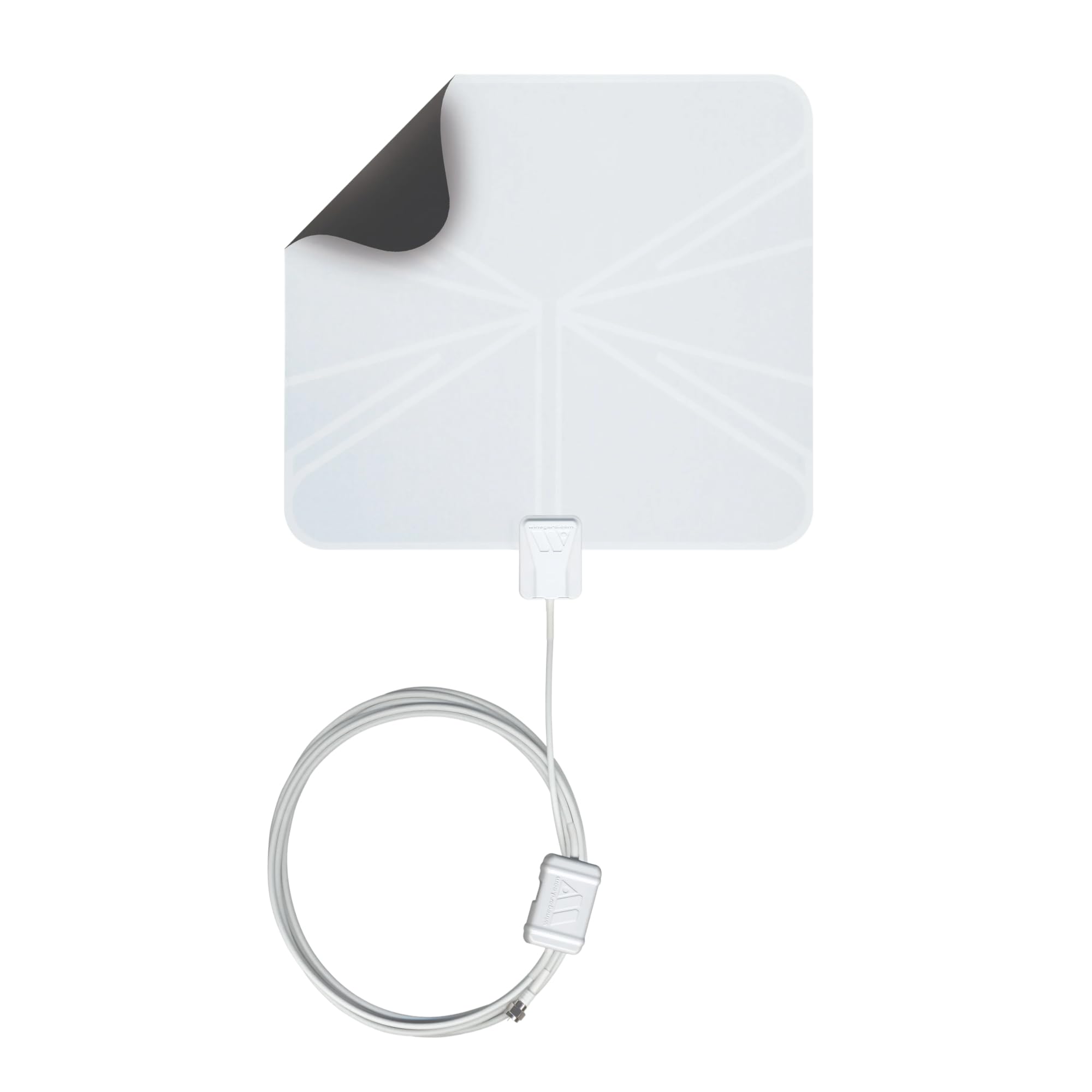
Winegard’s 65-year reputation in antenna design shows in the FL5500A’s thoughtful engineering. The ultra-thin panel has a reversible black/white design so you can match your wall color, and the included Winegard app uses your phone’s compass to guide you to the optimal mounting location. In Chicago testing 35-40 miles from towers, a user pulled in 40 of 67 possible channels with the amplifier engaged.
The amplifier’s 3-foot power cord and 18.5-foot coax cable offer decent placement flexibility, and the panel works well behind picture frames without degrading reception. One reviewer in South Philly taped it to a first-floor ceiling and locked 22 channels from towers 10-15 miles away. The dual-sided design means you can keep the black side facing the window for maximum signal absorption.
The fixed coaxial cable is the primary limitation—you cannot swap it for a shorter run or attach a 90-degree adapter for tight spaces. Several users also noted the amplifier doesn’t significantly help with weak distant stations; it mainly cleans up existing signals. For metro users within 40 miles who want a discreet indoor antenna with professional brand backing, the Winegard FlatWave delivers consistent, dependable performance.
Why it’s great
- Reversible black/white design blends with decor
- Winegard app helps locate optimal placement
- Works behind picture frames without reception loss
Good to know
- Coaxial cable is permanently attached
- Amplifier limited to close-range signal cleanup
5. PIBIDI UHD-8903 Outdoor TV Antenna

For viewers in deep rural territory, the PIBIDI UHD-8903 is a dedicated Yagi-style antenna with extended receiving elements designed to pull in weak signals from 40 to 100 miles away. A user in a fringe zone 65 miles from Eugene and 55 miles from Portland reported 64-86 channels after mounting it on an old dish coax, blowing past the 15-50 channels their previous antennas managed. The elements are largely pre-assembled, so setup takes under 30 minutes.
The construction includes lightning protection and a weather-resistant housing, though buyers should still ground the mast per local code. Multiple rural reviewers emphasize that both VHF and UHF reception is strong across the board, with no noticeable pixelation on distant signals. The antenna’s larger surface area compared to compact omni models is the physical reason for its superior fringe performance.
There is no built-in rotator or amplifier, both of which you would need to add for the absolute outer edge of its 200-mile advertised range. One user described the range claim as optimistic, noting it works “OK” but not the full distance. For genuine rural cord-cutters within 60-80 miles of towers, however, the PIBIDI offers the best dollar-per-channel ratio among outdoor Yagi options.
Why it’s great
- Extended dipole elements capture distant signals
- Quick assembly with pre-attached components
- Effective on both VHF and UHF bands
Good to know
- No rotator or amplifier included
- 200-mile range claim requires ideal conditions
6. RCA ANT751E Outdoor Yagi Antenna

The RCA ANT751E has earned a cult following among attic installers for its strong VHF-Low support and compact Yagi design. Attic-mounted users consistently report signal strengths of 80-100% on major networks without any external amplifier. One owner 25 miles from towers in a foothill area picked up all 51 available channels with both VHF and UHF stations locked in solid. The snap-lock UHF reflector and pre-assembled elements make installation nearly tool-free.
Durability is a genuine strength: the metallic construction withstands outdoor exposure better than plastic-panel antennas, and several users have mounted it on masts with no performance degradation after years of weather. The included mast clamp and mounting hardware are substantial, though you must purchase a grounding block and coax cable separately. The free RCA Signal Finder app helps align the antenna toward the broadcast cluster.
The main caveat is that some users report the antenna primarily favors UHF and may require careful positioning to lock in VHF-Low channels 2 through 6. Coax cable is also not included, adding a small extra cost. For those willing to run a cable and install a grounding block, the RCA ANT751E delivers the best raw signal strength per dollar at mid-range pricing.
Why it’s great
- Excellent VHF and UHF reception from attic installations
- Snap-lock assembly for quick setup
- Rugged metallic construction for outdoor durability
Good to know
- Coaxial cable not included in the package
- Requires grounding block for safe outdoor installation
7. Channel Master Omni+ 50

Channel Master engineered the Omni+ 50 with separate UHF and VHF dipoles that can rotate independently, a smart design that improves signal reception compared to fixed-element omnidirectional antennas. Users report signal-to-noise ratios jumping from 70% to 98% and pixelation essentially eliminated during storms. The 28.75-inch length accommodates larger elements than typical compact omni models, translating to better VHF-Low pickup—one reviewer successfully locked channel 2 and channel 6.
The mounting bracket is compatible with roof, attic, RV, and existing satellite mounts, making it unusually versatile. Build quality is immediately noticeable: the materials feel denser and more substantial than mid-range competitors. In flat Florida terrain with towers under 35 miles, a user pulled in 53 stations after easy assembly. The omni-directional 360° pattern means no aiming adjustment is needed after initial mount.
The price is the highest in this roundup, though still reasonable for the construction quality. The 50-mile range is conservative and honest—most users get excellent reception within that radius but will need a preamp for distant fringe stations. No amplifier or coax cable is included. For homeowners who want a premium, no-adjustment outdoor antenna that receives VHF-Low signals reliably, the Omni+ 50 justifies its premium price tag.
Why it’s great
- Independent UHF/VHF dipoles for superior reception
- No aiming required with true omnidirectional pattern
- Premium build quality with weather-resistant materials
Good to know
- No amplifier or coax cable included
- 50-mile range suits suburban use, not rural fringe
FAQ
Can a single antenna feed two televisions?
What is NEXTGEN TV (ATSC 3.0) compatibility?
How do I know if I need an amplifier?
Why does my antenna work better in the attic than outside?
How do I find where my local broadcast towers are located?
Final Thoughts: The Verdict
For most users, the best broadcast tv antenna winner is the PBD Amplified Outdoor because its motorized rotation and dual TV outputs solve the two biggest pain points of over-the-air TV: signal alignment and multi-TV distribution. If you want the sleekest indoor option without sacrificing channel count, grab the Mohu Leaf Amplified. And for rural viewers hunting distant signals, nothing beats the raw VHF/UHF gain of the RCA ANT751E in an attic mount.

Mo Maruf
I created WellFizz to bridge the gap between vague wellness advice and actionable solutions. My mission is simple: to decode the research and give you practical tools you can actually use.
Beyond the data, I am a passionate traveler. I believe that stepping away from the screen to explore new environments is essential for mental clarity and physical vitality.