Our readers keep the lights on and my smoothie glass nicely filled. As an Amazon Associate, I earn from qualifying purchases.
Posterior Tibial Tendon Dysfunction (PTTD) is a progressive condition that transforms a simple step into a gamble with pain and instability. The tendon that supports your arch gradually loses its ability to hold the foot’s structure, leading to a collapsed arch, rolling ankles, and a gait that worsens over time. The right brace doesn’t just squeeze the joint — it counteracts the specific pronation forces that accelerate PTTD, providing a rigid or semi-rigid cradle that preserves your ability to walk, work, and stay active.
I’m Mohammad Maruf — the founder and writer behind WellFizz. I’ve spent hundreds of hours dissecting orthopedic brace specifications, analyzing customer feedback for long-term durability signals, and cross-referencing medical guidelines to identify which designs actually address posterior tibial tendon insufficiency versus generic ankle swelling.
This guide evaluates seven braces specifically suited for managing PTTD symptoms, focusing on arch support, pronation control, and everyday wearability. Whether you’re in the early stages or post-surgical recovery, finding the right ankle brace for pttd can make the difference between steady progress and recurring setbacks.
How To Choose The Best Ankle Brace For PTTD
PTTD demands a brace that actively resists hindfoot valgus and midfoot collapse — not just a compression sleeve that hides symptoms. Three design factors separate effective PTTD management from wasted money.
Arch-Lift & Pronation Wedge
The most critical feature is a built-in mechanism that lifts the arch and controls over-pronation. Look for an integrated air cell, a rigid plastic stirrup with a medial wedge, or a figure-8 strap that pulls the arch upward. Without this lift, the brace merely wraps the instability rather than correcting it.
Rigidity vs. Mobility Trade-Off
PTTD braces fall along a spectrum: soft compression knits with contoured pads (low rigidity, high comfort for mild cases), semi-rigid shells with inflatable arch bladders (moderate rigidity, good for moderate progression), and rigid hinged designs (maximum control for late-stage or post-surgical). Match the stiffness to your daily activity — too much rigidity can cause muscle atrophy, too little accelerates collapse.
Shoe Compatibility & All-Day Wear
A brace that doesn’t fit inside your footwear will end up in a drawer. Ultra-thin profiles (1.5mm fabric) work with snug athletic shoes, while padded air-cuff designs may only fit roomy sneakers or boots. Measure your shoe volume and choose a brace whose bulk matches your primary footwear. A brace worn inconsistently cannot slow PTTD progression.
Quick Comparison
On smaller screens, swipe sideways to see the full table.
| Model | Category | Best For | Key Spec | Amazon |
|---|---|---|---|---|
| Aircast 02PLR Airlift PTTD | Premium | Moderate-to-late-stage PTTD with arch collapse | Adjustable arch air cell | Amazon |
| BioSkin TriLok Ankle Brace | Premium | Pronation control with FootLok arch-lift | Figure-8 stirrup + FootLok strap | Amazon |
| Med Spec ASO Ankle Stabilizer | Mid-Range | Mild PTTD and peroneal tendonitis | Lace-up + figure-8 straps | Amazon |
| Fitomo Figure 8 Compression Support | Mid-Range | Daily wear with removable stabilizers | Triple-Lock + removable splints | Amazon |
| Fitomo 1.5mm Ultra Thin Brace | Value | Ultra-low-bulk for tight shoes | 1.5mm Microfiber + silicone grip | Amazon |
| ZOELION Auto-Adaptive Ankle Brace | Value | Adjustable support with side pads | Auto-adaptive side stabilizer pads | Amazon |
| Bauerfeind MalleoTrain Ankle Support | Premium | Mild PTTD with maximum comfort | Viscoelastic massage pads | Amazon |
In‑Depth Reviews
1. Aircast 02PLR Airlift PTTD Ankle Brace
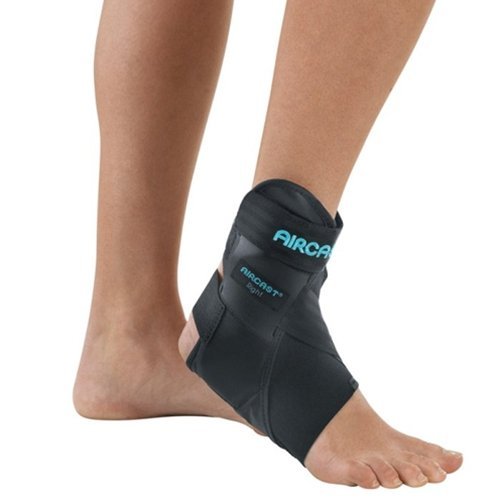
The Aircast Airlift is one of the few braces engineered specifically for PTTD, not adapted from a general sprain stabilizer. Its defining feature is a rear-entry air cell positioned under the medial arch that you pump to your preferred lift height. This actively counteracts medial arch collapse, the primary mechanical driver of PTTD progression. The anatomically shaped rigid shells wrap the malleoli and calcaneus, providing frontal-plane stability that prevents the heel from drifting into valgus during stance phase.
Orthopedists frequently prescribe this for stage I and early stage II PTTD because the adjustable air bladder allows gradual lift increases as the tendon weakens, without needing a whole new brace. Users with high arches and chronic instability reported feeling significantly less fatigue in the braced foot compared to the unbraced side. The two-strap rear entry design is straightforward — no laces, no complex weaving — which improves compliance during daily wear.
The two main drawbacks are the pump mechanism itself, which some users found stiff and slightly finicky to inflate evenly, and the bulk. The rigid shells demand a roomy shoe or boot; don’t expect to fit this inside slim sneakers. One reviewer experienced the air pouch shifting position during walking, requiring mid-day readjustment. For moderate-to-late-stage PTTD where arch support is non-negotiable, this brace delivers targeted relief that generics cannot match.
Why it’s great
- Adjustable arch air cell customizes lift as PTTD progresses
- Rigid shells prevent hindfoot valgus during walking
- Easy rear-entry, two-strap design for quick daily application
Good to know
- Air pump mechanism can be tricky to inflate evenly
- Bulky shell requires spacious footwear or work boots
- Some users report the air cell shifts position over several hours
2. BioSkin TriLok Ankle Brace

BioSkin’s TriLok combines three stabilization mechanisms — a figure-8 wrap, a stirrup strap, and a unique FootLok component that extends under the arch to provide active lift. For PTTD patients, the FootLok is the standout feature: it pulls the navicular bone medially, directly opposing the tendon’s failing function.
Podiatrists often recommend the TriLok for patients with severe supination or over-pronation who need arch support in a package that still fits inside standard athletic shoes. The 0.45-inch thickness and low-profile nylon/Lycra fabric allow it to slide into most trainers and even steel-toed work boots, according to user reports. One reviewer recovering from a lateral malleolus fracture noted pain dropped from 8 to 4 within 24 hours of first wear, which speaks to the effectiveness of its load-redistributing strap geometry.
The setup has a learning curve — first-time users must watch the strap path diagram to get the FootLok properly positioned. The outer fabric is somewhat slippery, making flip-flops or sandals unusable. Sizing is finicky: measure carefully and consider ordering half to one size larger if you have significant swelling. For mild-to-moderate PTTD where you need arch lift without the bulk of an air-cuff, the TriLok offers a smart, low-profile compromise.
Why it’s great
- FootLok arch strap actively lifts the navicular bone
- Thin profile fits most sneakers, boots, and court shoes
- Three-strap system provides targeted pronation control
Good to know
- Strap configuration requires careful learning of the setup
- Outer Lycra is slippery and does not work with open footwear
- Sizing can run small; measure and size up if in doubt
3. Bauerfeind MalleoTrain Ankle Support

The MalleoTrain is the most comfortable brace in this lineup — a distinction that matters for PTTD because a brace you actually wear is infinitely more effective than one left in the box. Rather than rigid shells or inflatable bladders, Bauerfeind uses a seamless compression knit with two anatomically contoured viscoelastic pads that sit directly over the medial and lateral malleoli. These pads massage the tendons during movement, improving proprioception and reducing effusion without the bulk of traditional stabilizers.
This is a soft-tissue brace, not a rigid orthosis, so it is best suited for mild PTTD (stage I or early II) where the arch has not yet collapsed into a fixed deformity. Users recovering from fractures, chronic sprains, or mild tendinopathy report significant pain reduction and improved gait symmetry. The open instep comfort zone prevents pressure on the dorsal foot, and the pull-on closure means no straps to fiddle with — just slide it on like a high-tech sock. Machine-washability adds long-term value.
The MalleoTrain cannot correct moderate-to-severe valgus deformity because it lacks a rigid medial column or inflatable lift. For advanced PTTD, it functions as an adjunct to a more supportive brace — excellent for sleeping or low-activity periods but insufficient for weight-bearing pronation control. The premium pricing reflects German manufacturing and medical-grade materials. For those in early PTTD who prioritize all-day comfort and will walk under 5,000 steps daily, this is the best soft-support option.
Why it’s great
- Medical-grade compression knit with zero bulky hardware
- Viscoelastic pads massage tendons and reduce swelling
- Machine-washable and fits discreetly under socks
Good to know
- No rigid support for moderate-to-advanced PTTD pronation
- Pull-on design requires good ankle flexibility to don
- Premium pricing; best for mild cases or nighttime wear
4. Med Spec ASO Ankle Stabilizer
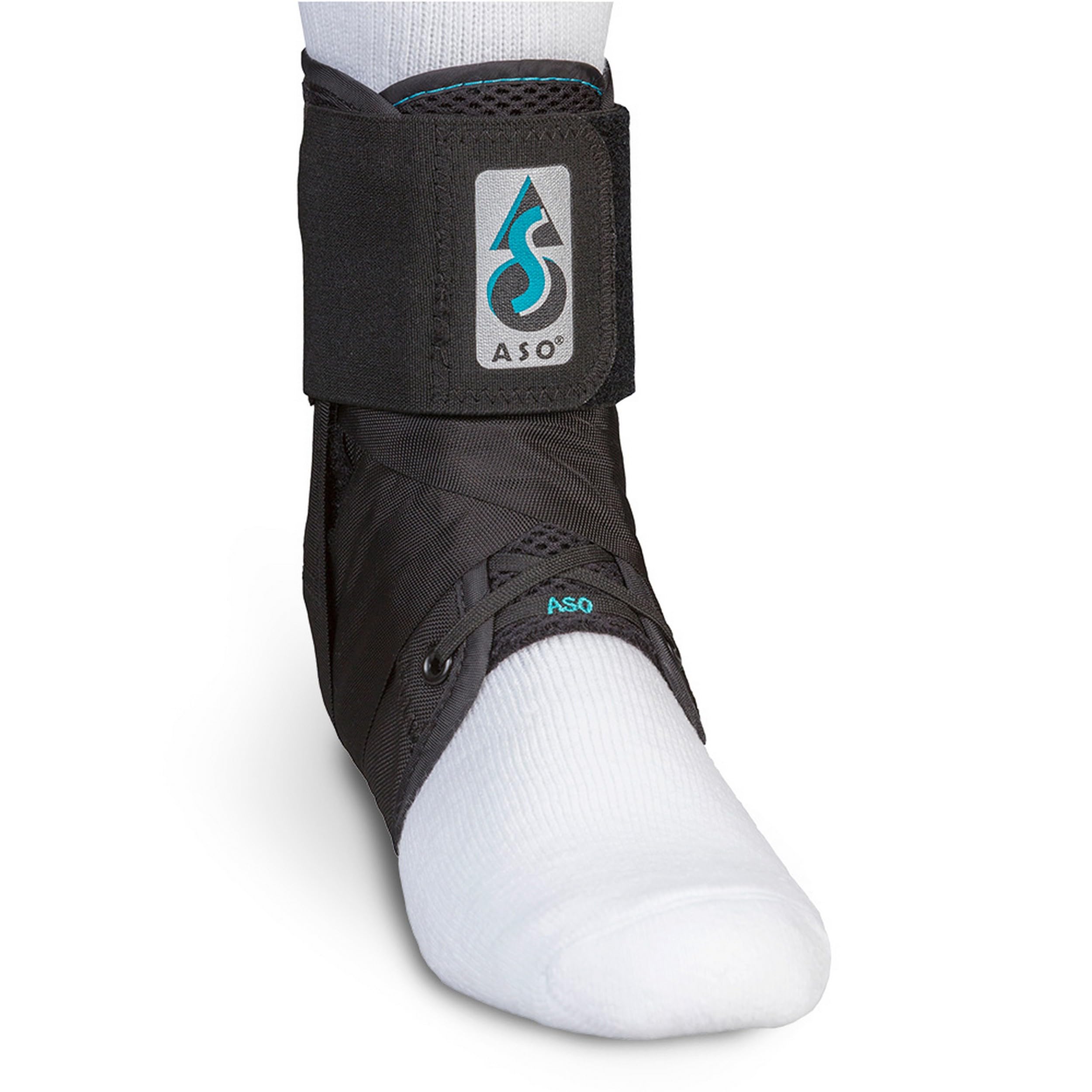
The Med Spec ASO is the brace you’ll see in every athletic trainer’s bag and many physical therapy clinics. For PTTD, the lace-up chassis provides circumferential compression that stabilizes the midfoot, while the two figure-8 straps lock the calcaneus and resist inversion/eversion. The CoolFlex padding and nylon construction resist stretching even after months of daily tension.
Users recovering from Grade 2 sprains and peroneal tendonitis consistently report that the ASO provides the closest feel to an athletic tape job without the waste and time commitment. The lace design allows minute tension adjustments across the dorsum, which is ideal for PTTD patients whose swelling fluctuates throughout the day. The bilateral sizing (works on either foot) simplifies purchasing if you need to alternate sides. One reviewer noted that the rigid lace panel limits heel rise to about one-third, which helps control excessive pronation during gait.
The ASO has no dedicated arch-lift mechanism — no air cell, no FootLok. It relies on compression and strap tension to indirectly support the arch, which works well for mild PTTD but is insufficient for stage II or III where direct arch elevation is needed. The brace also adds noticeable volume inside shoes; wearers with size 9 or smaller may struggle to fit it into snug athletic footwear. For early-stage PTTD combined with general ankle instability, the ASO remains the gold-standard all-around stabilizer.
Why it’s great
- Clinician-trusted lace-up design for precise compression
- Figure-8 straps effectively lock the heel against rolling
- Durable nylon construction resists stretching over months
Good to know
- No dedicated arch-lift mechanism for direct PTTD support
- Added bulk can feel tight inside low-volume shoes
- Lace-up system takes longer to apply than strap-only braces
5. Fitomo Figure 8 Compression Support
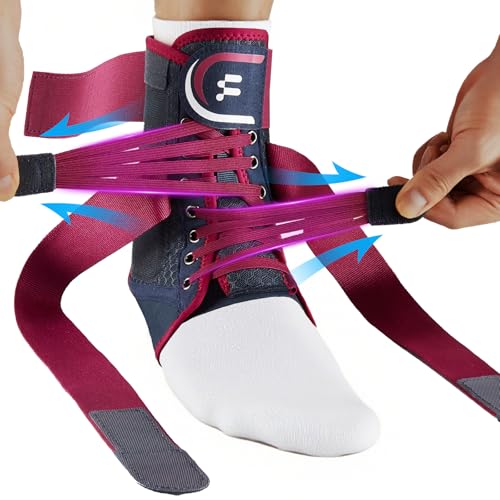
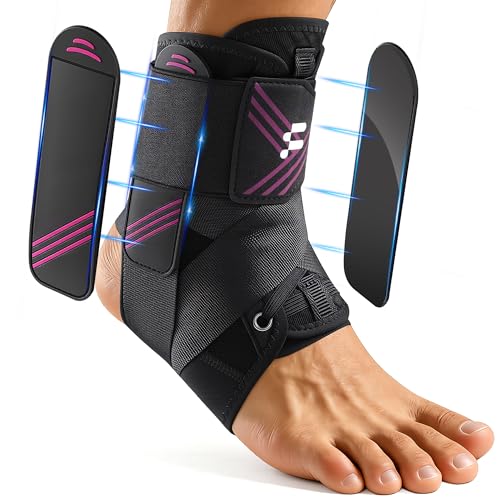
Fitomo’s mid-range entry uses a Triple-Lock system that combines a top compression strap, dual removable side stabilizers, and cross straps that mimic the figure-8 configuration. The key differentiator for PTTD is the removable stabilizers: you can wear the brace with full rigidity during high-activity periods (walking, stairs, sports) and remove them for sedentary office wear or sleeping, giving you two support levels in one product. The figure-8 strap allows fine-tuned compression that can be tightened more aggressively on the medial side to oppose pronation forces.
Customer feedback from post-ORIF ankle recovery and stroke-related inversion shows that this brace works well for conditions involving collapse — exactly the biomechanical pattern of PTTD. One reviewer noted it replaced a bulky AFO while still providing enough control for confident walking. The rose color option (available in black as well) and low weight (0.19 kg) make it a discreet daily wear. FSA/HSA eligibility adds financial flexibility for those with medical spending accounts.
The plastic splints are relatively thin and may bend over time under heavy weight-bearing loads from larger individuals. Several users noted that sizing runs large — if your ankle circumference is borderline, consider sizing down for a snug fit. The brace works best for mild-to-moderate PTTD where you need adjustability across different activities. For a single-pocket solution that adapts between gym and desk, this Fitomo model offers solid versatility.
Why it’s great
- Removable side stabilizers allow activity-specific support levels
- Figure-8 strap provides fine medial compression control
- Lightweight at 0.19 kg with FSA/HSA eligibility
Good to know
- Thin plastic splints may weaken under heavy daily loads
- Sizing tends to run large; measure and consider sizing down
- Single brace per pack — no pair option for bilateral PTTD
6. Fitomo 1.5mm Ultra Thin Ankle Brace
The 1.5mm Ultra Thin from Fitomo is the slimmest brace in this guide — its entire fabric thickness is barely thicker than a pair of dress socks. For PTTD patients who wear snug athletic shoes, work boots, or even slim casual sneakers, this eliminates the “my shoe doesn’t fit anymore” excuse that kills compliance. The three-layer system (inner silicone grip, figure-8 strap, flexible support panel) provides dynamic stabilization that moves with the ankle rather than resisting it rigidly. The visible ventilation grid promotes airflow that prevents the moisture buildup common during all-day wear.
This brace excels for early-stage PTTD where the primary need is proprioceptive feedback and mild pronation resistance rather than structural correction. Users rated the stability as excellent for a brace this thin, with the figure-8 design providing noticeable support against rolling during walking and light hiking. The low-bulk design fits seamlessly into all shoe types — running shoes, basketball sneakers, and even some women’s flats — which makes it easy to wear throughout the workday without drawing attention.
The 1.5mm fabric provides minimal resistance against significant hindfoot valgus or advanced arch collapse. If you have stage II PTTD with visible flatfoot deformity, this brace will feel like a gentle reminder rather than a corrective device. Some users found the strap configuration slightly complicated to apply correctly the first few times — the figure-8 path requires attention to avoid bunching. For mild PTTD and daily wear where invisibility matters most, the Ultra Thin delivers exactly what it promises.
Why it’s great
- 1.5mm profile fits virtually any shoe without tightness
- Figure-8 strap provides solid pronation resistance for its thickness
- Ventilated grid keeps feet dry during all-day wear
Good to know
- Too minimal for moderate-to-advanced PTTD correction
- Figure-8 strap path takes practice to apply smoothly
- Single brace per pack; no volume discount for pair buyers
7. ZOELION Auto-Adaptive Ankle Brace
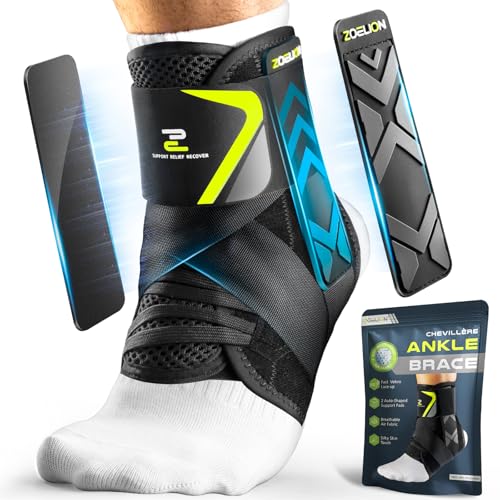
ZOELION’s entry focuses on what they call “Nu-Form Auto-adaptive Stabilization” — flexible plastic pads on the medial and lateral sides that contour to your ankle shape without digging into the bone. For PTTD, the medial pad provides targeted resistance against the collapsing arch during weight-bearing, while the lateral pad balances stabilization. The Triple-lock system combines an inner ankle wrap, figure-8 stabilizing straps, and a wide top closure that locks the calcaneus in place. The hook-and-loop lace system replaces traditional shoelaces for quick on-and-off — a genuine convenience improvement.
Reviewers consistently highlight the brace’s ability to prevent ankle rolling, with one user specifically citing nerve damage as their reason for purchase. The 600+ micro-vents keep the foot ventilated during extended wear, and the open-heel design allows full range of motion for plantarflexion and dorsiflexion. The slim low-bulk fit reportedly slides into most shoes, including sandals, which is unusual for a brace with built-in stabilizer pads. ZOELION backs the product with a 180-day after-sales policy, indicating confidence in durability.
The auto-adaptive pads are flexible rather than rigid, which means they provide moderate pronation resistance but cannot fully correct a fixed valgus deformity. Some users found the support adequate but not exceptional for the price tier — it hits a solid middle ground rather than excelling in any single dimension. Sizing requires careful circumference measurement, and the instruction recommends sizing up for wide feet or active swelling. For PTTD patients needing a budget-friendly entry point that still offers medial pad support and easy daily application, the ZOELION is a competent starter option.
Why it’s great
- Medial auto-adaptive pad resists arch collapse directly
- Hook-and-loop lace system for ultra-fast daily application
- 180-day after-sales policy adds purchase confidence
Good to know
- Flexible pads provide moderate rather than rigid correction
- Support level is “good but not great” per some user reviews
- Size up for swelling or wide feet to avoid pressure points
FAQ
Can an ankle brace stop PTTD from getting worse?
Should I wear an ankle brace for PTTD during sleep?
What’s the difference between a PTTD brace and a regular ankle stabilizer?
How tight should a PTTD ankle brace feel?
Can I play sports with a PTTD ankle brace?
Final Thoughts: The Verdict
For most users, the ankle brace for pttd winner is the Aircast 02PLR Airlift because its adjustable arch air cell directly addresses the progressive nature of posterior tibial tendon dysfunction, and the rigid shell provides reliable valgus control during daily walking. If you want a slim, low-profile option that fits inside all shoes without hardware, grab the Fitomo 1.5mm Ultra Thin. And for mild PTTD where all-day comfort and machine-washable materials matter most, nothing beats the Bauerfeind MalleoTrain.

Mo Maruf
I created WellFizz to bridge the gap between vague wellness advice and actionable solutions. My mission is simple: to decode the research and give you practical tools you can actually use.
Beyond the data, I am a passionate traveler. I believe that stepping away from the screen to explore new environments is essential for mental clarity and physical vitality.