Our readers keep the lights on and my smoothie glass nicely filled. As an Amazon Associate, I earn from qualifying purchases.
Choosing an all-purpose fertilizer should be a simple upgrade to your garden routine, but the wrong bag of granules can burn tender roots, imbalance soil microbes, or force leafy growth at the expense of fruit. The difference between a modest harvest and a bumper crop often comes down to the NPK ratio and the source of those nutrients — synthetic salts act fast but leach quickly, while slow-release organics feed the soil ecosystem over weeks.
I’m Mohammad Maruf — the founder and writer behind WellFizz. I spent countless hours cross-referencing NPK profiles, reading OMRI listings, and stacking customer yield reports against manufacturer claims to separate the truly balanced blends from the overpriced dust.
This guide compares five proven formulas so you can confidently choose the best all purpose fertilizer that matches your garden’s needs, whether you grow tomatoes in raised beds or houseplants on a sunny windowsill.
How To Choose The Best All Purpose Fertilizer
An all-purpose fertilizer needs to support foliage, flowers, and fruit without forcing one type of growth at the expense of the others. The key variables are the NPK ratio, the nutrient source, and the form factor that fits your watering routine.
NPK Ratio — The Three Numbers That Matter
The first number (nitrogen) drives green leaves and stems. The second (phosphorus) supports root development and blooms. The third (potassium) improves overall plant health and disease resistance. A perfectly balanced formula like 4-4-4 works for most gardens, while a blend like 3-4-4 or 4-6-2 tilts slightly toward root and fruit support.
Organic vs. Synthetic Sources
Organic granules derived from fish bone meal, blood meal, kelp, and greensand feed the soil microbiome and release nutrients slowly over weeks. Synthetic water-soluble formulas deliver an immediate nitrogen spike but can burn roots if over-applied and don’t build long-term soil fertility.
Granules vs. Liquid Concentrate
Granular fertilizers are measured by the scoop and worked into the soil surface, releasing nutrients gradually with each watering. Liquids are diluted into a watering can and absorbed instantly, making them ideal for container plants or a quick mid-season boost. Choose granules for long-term garden beds and liquids for potted plants or targeted feeding.
Quick Comparison
On smaller screens, swipe sideways to see the full table.
| Model | Category | Best For | Key Spec | Amazon |
|---|---|---|---|---|
| Jobe’s Organics All Purpose | Organic Granules | Large garden beds and long seasons | 16 lb bag, 4-4-4 NPK | Amazon |
| Farmer’s Secret Tomato Booster | Liquid Concentrate | Fast tomato production boost | 32 oz, 3:8:7 Ratio | Amazon |
| Maxsea All Purpose 16-16-16 | Water-Soluble | Hydroponics and container gardens | 1.5 lb, 16-16-16 NPK | Amazon |
| Down To Earth All Purpose 4-6-2 | Organic Granules | Tomatoes, peppers, and herbs | 5 lb, 4-6-2 NPK | Amazon |
| Espoma Garden-tone 3-4-4 | Organic Granules | Cool & warm season vegetables | 8 lb (2 packs), 3-4-4 | Amazon |
In‑Depth Reviews
1. Jobe’s Organics Granular All Purpose Fertilizer

The Jobe’s Organics Granular formula delivers a balanced 4-4-4 NPK across a generous 16-pound bag that covers large garden beds without running out mid-season. The granules are dark, friable, and spread cleanly through a hand-crank spreader, so there is no dusty cloud when you broadcast it over soil.
Customer reports show consistent, rapid budding on squash, cucumbers, and peppers after mixing a steeped liquid solution from the granules, and the same product perked up shrubs and trees within weeks. The 16-pound weight makes it a premium value in terms of coverage per dollar, though the upfront cost is higher than smaller bags.
The pungent smell is milder than raw manure but still noticeable for the first day after application. For gardeners who want a single, organic bag that handles everything from lawn to tomatoes without mixing multiple amendments, this is the most versatile choice on the list.
Why it’s great
- Top-tier 16 lb bag covers huge areas
- OMRI listed for certified organic gardens
- Slow-release granules won’t burn plants
Good to know
- Noticeable odor for the first few days
- Requires reapplication every 2-3 weeks
2. Farmer’s Secret Tomato Booster Fertilizer
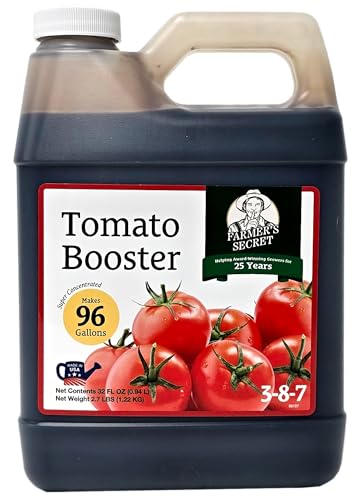
Farmer’s Secret shifts the NPK balance to 3:8:7, prioritizing phosphorus and potassium to push tomato plants into heavy fruiting rather than excessive leaf growth. This super-concentrated liquid requires only two teaspoons per gallon of water, making the 32-ounce bottle stretch through an entire growing season for a medium-sized garden. The formula is fortified with humic acid, iron, and calcium, which helps prevent common issues like blossom end rot when used alongside proper soil preparation.
Users report noticeable results within a week: seedlings perk up immediately after the first diluted feeding, and mature tomato plants produce dense, heavy fruit that busts out of cages. Some customers needed a separate cal-mag supplement when blossom end rot appeared, suggesting the calcium level may need support in low-calcium soils.
The liquid format is ideal for gardeners who want precise control over feeding strength and prefer watering-can application over granular broadcasting. For anyone focused on a specific tomato harvest rather than general garden maintenance, this is a targeted powerhouse.
Why it’s great
- Super-concentrated — small bottle lasts months
- Fortified with iron, calcium, and humic acid
- Visible results in under a week on seedlings
Good to know
- Best for tomatoes, less suited for general use
- May require additional calcium in some soils
3. Maxsea All Purpose Plant Food 16-16-16

Maxsea delivers a true balanced 16-16-16 NPK ratio in a water-soluble granule that dissolves completely for both soil drenching and hydroponic systems. The high-nitrogen count makes it exceptionally potent — a little goes a very long way, and the formula includes a full spectrum of micronutrients including sulfur, boron, copper, iron, manganese, molybdenum, and zinc. The seaweed granules contain over 60 trace elements, giving plants a broad nutritional foundation that granular-only blends often miss.
Gardeners report that Maxsea produced six-foot pepper plants, monster-sized tomatoes, and tripled blueberry size compared to previous seasons. The seaweed-based formula is gentle enough for finicky begonias and aroid mixes when diluted properly, though undiluted or over-concentrated applications will burn carnivorous plants quickly.
This is a premium tool for the precise feeder — you need to measure carefully, especially with seedlings or sensitive species. For hydroponic growers and container gardeners who want a single, complete water-soluble fertilizer, Maxsea is difficult to beat.
Why it’s great
- Complete 16-16-16 NPK with full micronutrients
- Works in hydroponics and soil-based systems
- Promotes massive growth in peppers and tomatoes
Good to know
- Will burn carnivorous plants if over-diluted
- Requires careful measuring for seedlings
4. Down To Earth All Natural Organic All Purpose Mix 4-6-2

The Down To Earth All Purpose Mix uses a 4-6-2 NPK formula that leans toward phosphorus for strong root establishment and flower production, making it ideal for tomatoes, peppers, herbs, and flowering ornamentals. The ingredient list reads like a soil-building recipe: fish bone meal, blood meal, feather meal, rock phosphate, langbeinite, greensand, humates, and kelp meal. OMRI listed and free of synthetic chemicals, this gentle granular blend works safely on transplants and container plants without burning tender roots.
Gardeners report that pale, flimsy tomato transplants turned dark green and sturdy within two weeks of application, and the 5-pound box lasts an entire season for a medium raised-bed garden. The smell is earthy but strong — users note that the fish-based odor lingers for a few days before dissipating.
This is a budget-friendly organic option that doesn’t cut corners on ingredient quality. The 4-6-2 ratio is slightly tilted from a perfect all-purpose balance, so it works best for gardens where fruit and flower production is the priority over leafy greens.
Why it’s great
- Rich blend of 8 natural ingredients
- OMRI listed for organic gardening
- Gentle enough for sensitive transplants
Good to know
- Strong fish-based smell lasts a few days
- Higher phosphorus ratio less ideal for leafy greens
5. Espoma Organic Garden-tone 3-4-4

Espoma’s Garden-tone brings a 3-4-4 NPK analysis with an added 5% calcium, which directly supports cell wall strength in tomatoes, peppers, and squash. The formula is enhanced with Espoma’s proprietary Bio-tone microbes, which colonize the root zone to improve nutrient uptake and soil biology. The 2-pack provides 8 pounds of granules — enough to feed a substantial vegetable patch monthly through the full growing season.
Long-time Espoma users report that the switch from generic fertilizers to Garden-tone produced visibly thicker stems, brighter blooms, and more abundant harvests in potatoes, peas, sunflowers, and sweet peppers. The smell is strong — several reviewers describe it as “stinking to high heaven” — but they also call it the best fertilizer they have ever used.
The 3-4-4 ratio is slightly lower in nitrogen, which helps prevent excessive foliage at the expense of fruit. This makes Garden-tone a smart choice for cool-season vegetables like lettuce and kale as well as warm-season crops, all within a single bag.
Why it’s great
- Bio-tone microbes improve soil health
- Added calcium supports fruit quality
- Works across cool and warm season crops
Good to know
- Strong odor that lingers after application
- Lower nitrogen may require supplement for heavy leaf feeders
FAQ
Can I use a tomato-specific fertilizer on all my plants?
How often should I apply granular all-purpose fertilizer?
Will a high-nitrogen fertilizer hurt my tomato plants?
Final Thoughts: The Verdict
For most users, the best all purpose fertilizer winner is the Jobe’s Organics Granular All Purpose because its 4-4-4 NPK, OMRI certification, and giant 16-pound bag make it the most versatile single bag for everything from lawn to vegetable beds. If you want targeted tomato production with fast results, grab the Farmer’s Secret Tomato Booster. And for hydroponic growers or precise container feeding, nothing beats the complete micronutrient profile of the Maxsea 16-16-16.

Mo Maruf
I created WellFizz to bridge the gap between vague wellness advice and actionable solutions. My mission is simple: to decode the research and give you practical tools you can actually use.
Beyond the data, I am a passionate traveler. I believe that stepping away from the screen to explore new environments is essential for mental clarity and physical vitality.