Our readers keep the lights on and my smoothie glass nicely filled. As an Amazon Associate, I earn from qualifying purchases.
Dropping a few hundred dollars on a portable emulator only to find the screen washes out in sunlight, the processor chokes on GameCube titles, or the promised battery life vanishes after the first charge is a familiar pain. The market for Android handhelds has matured into a landscape where the gap between a sluggish toy and a genuine pocket powerhouse is defined by precise hardware choices — display panel type, chipset architecture, active cooling, and controller quality.
I’m Mohammad Maruf — the founder and writer behind WellFizz. After analyzing dozens of spec sheets, customer reports, and real-world performance feedback across the entire price range of Android-based portable gaming consoles, I’ve built this guide around the devices that actually deliver on their promises rather than just looking good in marketing renders.
This guide separates the truly capable from the merely adequate by examining the processor, display, battery, and build quality that define the best android handheld gaming experience available today.
How To Choose The Best Android Handheld
Choosing an Android handheld is not like picking a mainstream console. The ecosystem is fragmented across chipsets, display technologies, and software polish. The wrong choice means paying for hardware that overheats or for a screen that ruins retro pixel art. Here are the three critical factors to evaluate before you buy.
Processor and GPU — The Emulation Ceiling
The system-on-chip (SoC) determines what you can actually play. Entry-level chips like the RK3566 handle PlayStation 1, N64, and PSP reliably but choke on GameCube and PlayStation 2. Mid-range options like the Unisoc T820 or Dimensity 1100 push into PS2 territory with some compromises. Premium chips like the Snapdragon 865, 8 Gen 2, or the Dimensity 8300 run PS2 at full speed, handle some Switch emulation, and support advanced features like upscaling and texture packs. Always check emulator compatibility databases before settling on a chipset.
Display Panel — AMOLED vs IPS and Resolution
Pixel density and color accuracy matter deeply for retro games. A 640×480 IPS panel at 3.5 inches is fine for 4:3 content but lacks the vibrancy for modern Android games or PSP titles. AMOLED panels at 1080p on 5.5-inch screens deliver deep blacks and punchy colors that make pixel art pop and modern games look crisp. However, AMOLED consumes more power at higher brightness, so battery life varies significantly between panel types at similar capacities.
Controls, Cooling, and Battery Life
Hall effect analog sticks eliminate drift over time — a feature worth paying for. Active cooling fans are non-negotiable for PS2 and GameCube emulation; passive heatsinks lead to throttling after 30 minutes. Battery life on a 5000mAh cell can range from 4 hours under heavy load to 12 hours on retro titles. Devices with 5500mAh or larger batteries, combined with efficient 6nm or 4nm chips, offer the best endurance for travel and long sessions.
Quick Comparison
On smaller screens, swipe sideways to see the full table.
| Model | Category | Best For | Key Spec | Amazon |
|---|---|---|---|---|
| AYN Odin 2 Portal Pro | Premium | High-end PS2/Switch emulation | Snapdragon 8 Gen 2 | View on Amazon |
| Retroid Pocket 5 | Premium | OLED gaming + cloud streaming | Snapdragon 865 | View on Amazon |
| Anbernic RG557 | Premium | PS2/Wii emulation on AMOLED | Dimensity 8300 | View on Amazon |
| ASUS ROG Ally | Flagship | AAA Windows gaming handheld | Ryzen Z1 Extreme | View on Amazon |
| Retroid Pocket 4 Pro | Mid-Range | PS2/GameCube in a pocket size | Dimensity 1100 | View on Amazon |
| Anbernic RG556 | Mid-Range | GameCube/PS2 on large AMOLED | Unisoc T820 | View on Amazon |
| Anbernic RG406V | Mid-Range | 4-inch compact PS2 performer | Unisoc T820 | View on Amazon |
| Anbernic RG353V | Entry-Level | Retro 2D/PSP gaming on budget | RK3566 | View on Amazon |
| My Arcade Atari Gamestation Go | Novelty | Arcade/Atari purists on 7-inch | 200 built-in games | View on Amazon |
In‑Depth Reviews
1. AYN Odin 2 Portal Pro
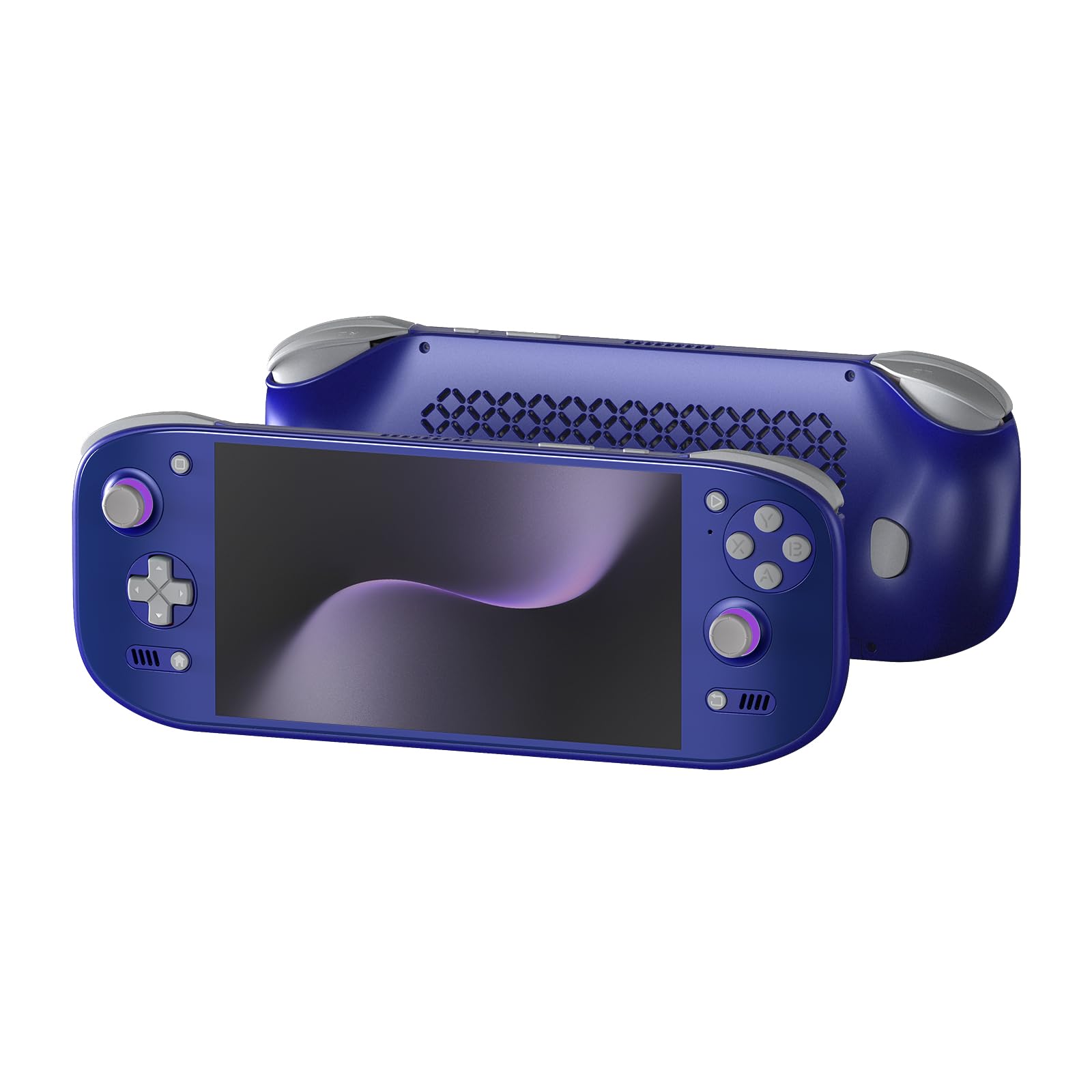
The AYN Odin 2 Portal Pro sits at the top of the Android handheld food chain. Powered by the Snapdragon 8 Gen 2 and Adreno 740 GPU, it delivers the kind of raw compute that makes PS2 emulation at 4K resolution not just possible but smooth. The 7-inch 1080p OLED panel with a 120Hz refresh rate is the brightest and most responsive screen in this class — pixel art looks vibrant, and fast-paced games feel fluid without motion blur.
The 8000mAh battery is a class leader. Real-world endurance hits 4-5 hours on native Android gaming, over 10 hours on GBA emulation, and even under heavy PS2 or Switch emulation you get 3-4 hours. The active cooling system keeps the Snapdragon 8 Gen 2 from throttling during long sessions, and the Xbox-style button layout with ergonomic grips reduces hand fatigue. It comes with 512GB of UFS storage and supports microSD expansion.
No games are preloaded, which is standard for premium devices — you load your own ROMs. The 12GB RAM configuration handles everything thrown at it, though serious users may want the 16GB variant for future-proofing. The only meaningful drawback is the ergonomics — the flat back benefits from an aftermarket grip for larger hands.
Why it’s great
- Snapdragon 8 Gen 2 handles PS2 at 4K and some Switch games
- 7-inch 120Hz OLED display is unmatched in this category
- 8000mAh battery delivers over 10 hours on light emulation
- Active cooling prevents throttling during demanding games
Good to know
- Premium pricing reflects the flagship hardware inside
- Flat ergonomics may require an add-on grip for comfort
- No microSD card or preloaded game library included
2. Retroid Pocket 5

The Retroid Pocket 5 combines a Snapdragon 865 with a gorgeous 5.5-inch OLED screen in a package that fits in a jacket pocket. The OLED panel runs at 1080p and makes both retro pixel art and modern Android games look exceptional — deep blacks and accurate colors are the hallmark here. The Snapdragon 865 is powerful enough to run PS2 and GameCube emulation at 2x resolution without major issues, and it handles Moonlight streaming and Xbox Remote Play with negligible latency.
Battery life from the 5000mAh cell is solid: a full day of general use, or about 4-5 hours under heavy PS2 emulation. Hall effect analog sticks eliminate any worry about drift over time, and the device supports Wi-Fi 6 and Bluetooth 5.1 for seamless online play and accessory pairing. The build quality is excellent for its weight class, with a sleek matte finish that resists fingerprints.
Setup requires some initial work — you need to install your own emulators and load ROMs. The community has strong support with detailed guides. A common complaint is that larger hands may cramp during long sessions, but an optional grip accessory solves this. The speakers get loud but lack depth on the low end.
Why it’s great
- Stunning 5.5-inch OLED screen at 1080p for vibrant visuals
- Snapdragon 865 handles PS2, GameCube, and cloud streaming
- Hall effect sticks eliminate drift permanently
- Pocket-friendly size with premium build finish
Good to know
- No game library preloaded — requires manual emulator setup
- Ergonomics can be tight for people with larger hands
- Speakers are functional but not high-fidelity
3. Anbernic RG557

The RG557 is Anbernic’s most powerful handheld to date, using the Dimensity 8300 processor built on a 4nm process. This chip delivers excellent efficiency alongside raw performance — PS2 and GameCube emulation runs at full speed with headroom for upscaling to 2x or 3x resolution. The 5.48-inch AMOLED screen at 1920×1080 is identical in size and quality to the highly regarded RG556 panel, offering vibrant colors and inky blacks that make retro games look their best.
Battery life is a strong point at 5500mAh, giving around 8 hours of mixed gameplay. The active cooling fan is quiet but effective at preventing the Dimensity 8300 from throttling during extended PS2 sessions. Wi-Fi 6E and Bluetooth 5.3 provide the fastest wireless connectivity in this price range, which improves streaming from a PC and reduces input lag when using wireless controllers.
No games come preloaded, and the initial software setup is more involved than on some competitors — this device rewards users willing to tinker. The plastic build feels solid, but the button layout is slightly cramped for large hands. Some units have reported screen issues after extended use, though this is inconsistent across the batch.
Why it’s great
- Dimensity 8300 on 4nm delivers high efficiency and PS2/GameCube power
- 5.48-inch 1080p AMOLED display is gorgeous and color-accurate
- WiFi 6E and Bluetooth 5.3 for lag-free streaming and peripherals
- 5500mAh battery gives up to 8 hours of real use
Good to know
- Setup is complex — not beginner-friendly out of the box
- Build quality varies between units based on user reports
- No bundled game card or accessories beyond the USB cable
4. ASUS ROG Ally

The ASUS ROG Ally occupies a unique space — it runs Windows 11 natively, meaning it supports Steam, Xbox Game Pass, Epic Games, and every PC launcher without the need for emulator configuration. Under the hood, the AMD Ryzen Z1 Extreme processor with RDNA 3 graphics delivers performance that rivals entry-level gaming laptops. The 7-inch 1080p display runs at 120Hz with variable refresh rate support, making even modern AAA titles playable at medium settings.
Build quality is high, with a white chassis that feels sturdy and a comfortable grip that fits larger hands better than most dedicated retro handhelds. The 512GB SSD provides fast storage access, and the microSD slot allows expansion. The device supports USB-C charging and can dock to an external monitor for desktop use.
Battery life is the primary compromise — Turbo mode drains the 40Wh battery in under 90 minutes during demanding games. Silent mode extends playtime but limits performance significantly. The single USB-C port forces most users to carry a hub for peripherals. This is not a device for emulation purists; it is a full PC gaming handheld that happens to also run Android emulators via Windows.
Why it’s great
- Ryzen Z1 Extreme plays AAA PC games natively at 30-60fps
- 7-inch 120Hz VRR display is excellent for fast-paced gaming
- Windows 11 compatibility means no emulator setup needed
- Comfortable ergonomics for larger hands and long sessions
Good to know
- Turbo mode battery life is under 1.5 hours for demanding games
- Single USB-C port requires a hub for multiple peripherals
- Higher price point and heavier weight than dedicated emulators
5. Retroid Pocket 4 Pro

The Retroid Pocket 4 Pro strikes a strong balance between performance and portability. The Mediatek Dimensity 1100, combined with 8GB of LPDDR4X RAM, is capable enough to run PS2 and GameCube games at playable frame rates, though some demanding titles need resolution reductions. The 4.7-inch touchscreen display offers good color reproduction at a resolution that suits 4:3 retro content naturally, avoiding the black bars common on wider screens.
The built-in active cooling fan is a real differentiator at this level — it keeps the Dimensity 1100 from throttling during extended gameplay, which directly translates to more consistent emulator performance. The 5000mAh battery delivers about 5 hours of heavy use and significantly more for 8-bit and 16-bit emulation. The device supports Wi-Fi 6 and Bluetooth 5.2, plus video output at 1080p over USB-C.
Setup is not plug-and-play; you need to source your own ROMs and configure emulators. The community support is extensive, so finding guides is easy. Some units have reported microSD slot disconnects, and the flat form factor can cause discomfort during long sessions without a grip accessory. At this price point, however, the performance-to-cost ratio is excellent.
Why it’s great
- Dimensity 1100 with active cooling handles PS2 and GameCube
- 4.7-inch screen is ideal for 4:3 retro content
- Compact and pocketable form factor at just 251g
- WiFi 6 and video output add versatility
Good to know
- PS2 emulation requires some tweaking for demanding titles
- Flat ergonomics may need an aftermarket grip
- Reports of microSD slot reliability issues in some units
6. Anbernic RG556
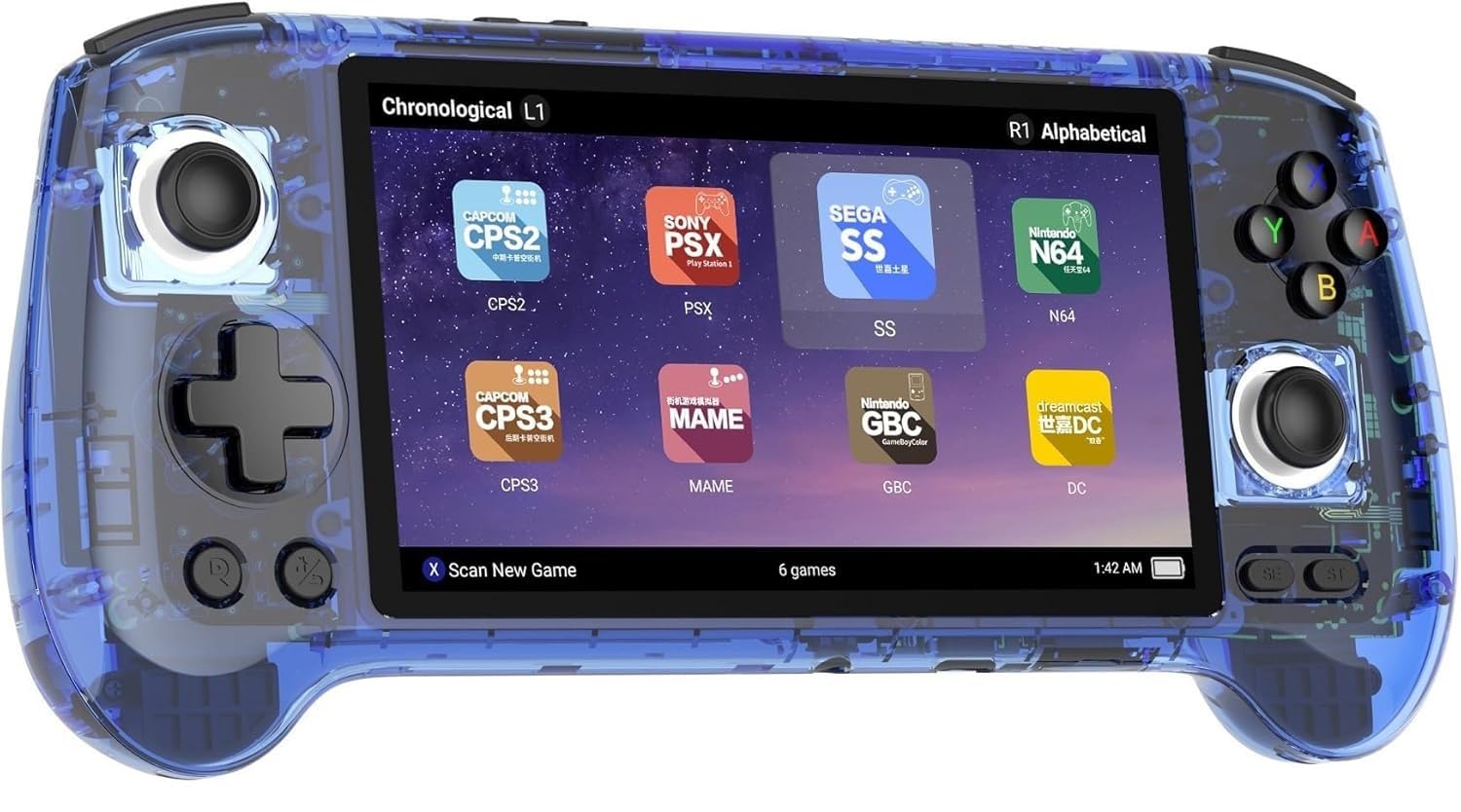
The RG556 from Anbernic is built around its display — a 5.48-inch AMOLED panel at 1920×1080 that produces deep blacks, excellent contrast, and wide color gamut. This screen transforms retro games; pixel art looks vibrant and modern Android games pop in ways IPS panels cannot match. The Unisoc T820 processor and Mali-G57 GPU handle GameCube and most PS2 games at native resolution without major issues, though upscaling beyond 2x can introduce frame drops.
Battery performance is a highlight. The 5500mAh cell delivers up to 12 hours on lighter emulation and around 5 hours of continuous PS2 gameplay. The active cooling fan runs quietly and effectively, preventing the T820 from throttling during extended sessions. Wi-Fi 5 and Bluetooth 4.2 are adequate but feel dated compared to competitors offering Wi-Fi 6.
The device does not come with preloaded games, and the out-of-box software experience needs refinement — the pre-installed emulators lack documentation, and on-screen button overlays default to visible. This device is best suited for users comfortable with Android configuration. Some units have reported screen failures after a few months of use, though this is not universal.
Why it’s great
- 5.48-inch 1080p AMOLED is the best screen in its price tier
- 5500mAh battery delivers 12 hours on retro titles
- Unisoc T820 handles GameCube and PS2 at native resolution
- Active fan cooling maintains consistent performance
Good to know
- WiFi 5 and Bluetooth 4.2 lack the speed of newer standards
- Software setup requires tinkering and third-party guides
- Long-term reliability reports are mixed regarding the screen
7. Anbernic RG406V
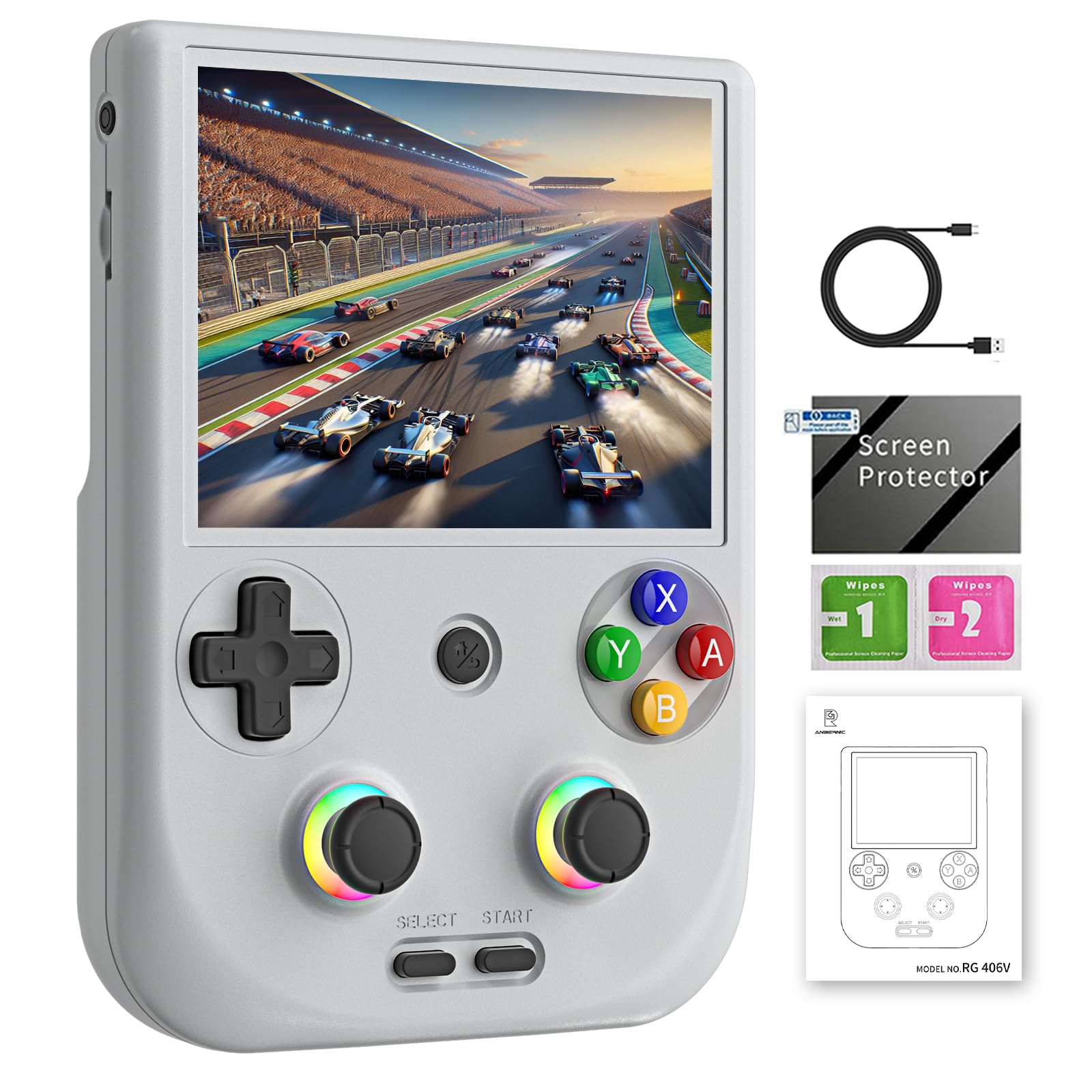
The RG406V takes the same Unisoc T820 processor found in the larger RG556 and packs it into a more compact body with a 4-inch IPS display at 960×720 resolution. This smaller screen is actually an advantage for 4:3 retro content — pixel-perfect scaling for PlayStation 1, SNES, and Sega Genesis looks exceptionally sharp without the interpolation artifacts common on higher-resolution panels. The T820 delivers smooth PS2 and GameCube emulation, though the 720p screen caps the visual upgrades.
The 5500mAh battery is generous for a 4-inch device, yielding over 8 hours of gameplay depending on the emulator load. This is the longest-running device among the T820-based options. Wireless screen casting is a welcome feature for playing on a TV, and the built-in RGB joystick lighting adds personality for those who enjoy custom aesthetics.
Quality control reports are a concern. Some units arrive with screen flickering, ghosting, or missing joystick caps. Customer support varies significantly depending on the seller. The ergonomic design is comfortable for smaller hands, but the weight distribution feels dense compared to larger devices. Setup again requires sourcing your own games and configuring emulators.
Why it’s great
- Compact 4-inch 960×720 IPS screen is perfect for 4:3 retro games
- Unisoc T820 in a small body delivers strong PS2 performance
- 5500mAh battery offers over 8 hours of use
- Wireless screen casting for TV play without HDMI cables
Good to know
- Quality control inconsistencies affect screen and accessories
- Dense weight distribution feels heavier than expected
- No game library included and requires emulator configuration
8. Anbernic RG353V

The RG353V is the entry-level champion for retro gaming. The RK3566 processor is a well-known workhorse that handles PlayStation 1, Nintendo 64, Dreamcast, and most PSP titles with ease. It comes with Android 11 and Linux dual-boot — hold F and press reset to switch. The Linux side offers a more console-like experience, while Android provides access to emulators and streaming apps. The 3.5-inch IPS screen at 640×480 matches the native resolution of 4:3 era games perfectly.
Bundled with a 64GB card containing thousands of preloaded games, this is one of the few devices that works largely out of the box. The 3200mAh battery gives about 5.5 hours of playtime. The transparent purple color option is visually striking and shows off the internal components. Wi-Fi and Bluetooth support Moonlight streaming and wireless headphone use.
The preloaded game library includes many obscure or non-English titles, and the SD card quality is inconsistent — some users receive cards with fewer games than advertised or cards that corrupt after a few weeks. The RK3566 simply does not have the power for PS2 or GameCube, so expectations should be limited to 32-bit and earlier consoles. Despite these limits, the build quality and community support make this a safe entry point.
Why it’s great
- RK3566 delivers solid PS1, N64, and Dreamcast emulation
- Dual boot Android 11 and Linux for flexibility
- Preloaded with thousands of games for immediate play
- Compact and comfortable vertical form factor
Good to know
- Not powerful enough for PS2 or GameCube emulation
- SD card quality and game library count vary significantly
- Battery life is average at around 5.5 hours
9. My Arcade Atari Gamestation Go
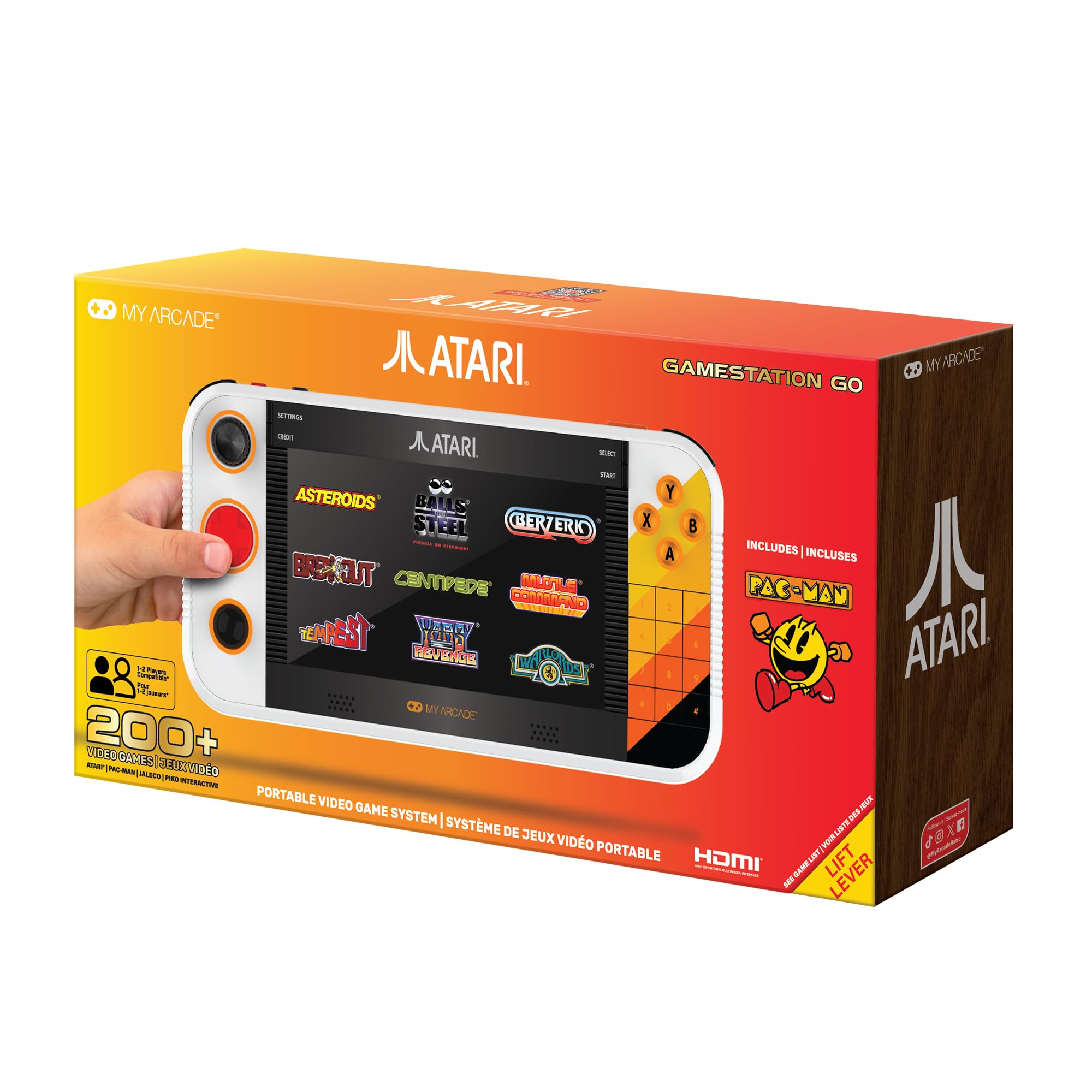
The My Arcade Atari Gamestation Go is less an Android handheld in the traditional emulation sense and more a dedicated retro arcade experience. It is officially licensed by Atari and comes preloaded with over 200 games from the Atari 2600, 5200, and 7800 libraries, plus titles from Jaleco and PIKO Interactive. The 7-inch full color display is the largest in this lineup, making it great for local multiplayer or tabletop play with the built-in kickstand.
The control layout is uniquely comprehensive — it includes a paddle controller, D-pad, trackball, numeric keypad, bumpers, and standard A/B/X/Y buttons. This means every game is playable with its intended control scheme. It connects to a TV via HDMI and supports Wi-Fi for firmware updates. The rechargeable battery is built-in and runs for several hours on a charge.
This device is not a general-purpose emulator. It is designed specifically for Atari-era gaming and does not support adding many non-Atari games without organizing them correctly on a microSD card. The initial firmware had bugs affecting screen ratio and sound, but updates have resolved many issues. It is a niche product best suited for Boomers seeking nostalgia or collectors wanting an officially licensed Atari portable.
Why it’s great
- Official Atari license with 200+ preloaded classic games
- 7-inch display is the largest and great for tabletop play
- Multiple control types (paddle, trackball, D-pad) for authenticity
- HDMI output and Wi-Fi for TV play and updates
Good to know
- Limited to Atari-era games unless you add your own ROMs
- Initial firmware bugs required updates to fix screen and sound
- Not a general-purpose emulator for PS1 or later consoles
FAQ
Can Android handhelds run PlayStation 2 games smoothly?
Do Android handhelds support cloud gaming services like Xbox Game Pass or GeForce Now?
Why do some Android handhelds need user-setup while others work out of the box?
Is a device with a fan better than one without for Android gaming?
Are hall effect analog sticks worth the extra cost?
Final Thoughts: The Verdict
For most users, the best android handheld winner is the AYN Odin 2 Portal Pro because its Snapdragon 8 Gen 2, 120Hz OLED display, and 8000mAh battery create the most complete package for emulation, streaming, and native Android gaming without compromises. If you want a pocket-sized OLED powerhouse that excels at PS2, GameCube, and cloud streaming, grab the Retroid Pocket 5. And for an entry-level retro device that plays thousands of classic games right out of the box, nothing beats the Anbernic RG353V for its price-to-fun ratio.

Mo Maruf
I created WellFizz to bridge the gap between vague wellness advice and actionable solutions. My mission is simple: to decode the research and give you practical tools you can actually use.
Beyond the data, I am a passionate traveler. I believe that stepping away from the screen to explore new environments is essential for mental clarity and physical vitality.