Our readers keep the lights on and my smoothie glass nicely filled. As an Amazon Associate, I earn from qualifying purchases.
Your home can be a chemical cocktail, and you’d never know it by smell. Volatile organic compounds from fresh paint, fine particulates from cooking, and carbon dioxide buildup in a closed bedroom all degrade your focus, sleep, and health without any obvious sign. An AQI monitor pulls back the curtain, giving you real numbers for the invisible threats you breathe every minute.
I’m Mohammad Maruf — the founder and writer behind WellFizz. I’ve spent years researching home health sensors, cross-referencing sensitivity specs, and analyzing the accuracy trade-offs between cheap semiconductor detectors and the kind of laser-based systems that hospitals trust.
After evaluating seven top contenders across price tiers, it’s clear that not all sensors are created equal. This guide breaks down the key specifications to help you find the best aqi monitor for your specific indoor environment, from nurseries to home offices.
How To Choose The Best AQI Monitor
Choosing the right AQI monitor requires you to navigate a lot of sensor jargon. The key is to match the specific pollutants you are worried about with the proper sensor technology housed in the unit.
Sensor Type is Everything
The heart of any AQI monitor is its sensor array. For accuracy, look for laser-based particle sensors for PM2.5/PM10, and a photoacoustic NDIR (Non-Dispersive Infrared) sensor for CO₂. These are significantly more precise and stable over time than cheaper semiconductor-based alternatives. For volatile organic compounds (TVOC) and formaldehyde (HCHO), a dedicated electrochemical sensor is the standard.
Display Readability & Alerts
A clear, at-a-glance display is critical because you should not be squinting at numbers during a healthy morning routine. Look for a color-coded system — green, yellow, orange, red — that communicates air quality in a fraction of a second. Triple alert systems (visual, audible, and app-based) are valuable for catching high CO₂ or particulate spikes before they cause a headache or worsen allergy symptoms.
Data History & Connectivity
A monitor that shows only a live snapshot offers limited usefulness. The real power is in tracking trends. Seek a model with a companion app that stores 24-hour, weekly, or monthly data. This helps you correlate specific activities — like cooking with a gas stove or using a new candle — with a spike in pollutants. Models with data export to CSV are a bonus for those keeping medical logs for doctors.
Power Source & Portability
Consider whether you want a stationary, always-on unit or a portable one you can move between rooms. Hard-wired AC-powered units offer uninterrupted 24/7 monitoring without battery anxiety. Battery-powered monitors with high capacity (2500mAh or more) or ultra-low power displays like e-ink allow you to check air quality in your car, hotel room, or home office without worrying about finding an outlet.
Quick Comparison
On smaller screens, swipe sideways to see the full table.
| Model | Category | Best For | Key Spec | Amazon |
|---|---|---|---|---|
| Temtop M10+ | E-Ink Display | Quiet, long-term bedroom monitoring | Up to 60-day battery life on e-ink | Amazon |
| BREATHE Airmonitor Plus | Professional Grade | Multi-sensor, app-driven analysis | 7-in-1: CO₂, PM1/2.5/10, TVOC, HCHO | Amazon |
| GoveeLife Smart Air Monitor | Smart Home | Smart home integration & data tracking | Photoacoustic NDIR CO₂ sensor with app | Amazon |
| 16-in-1 Large Display | Visual Guide | Easy reading at distance for seniors | 7-inch LED screen with AQI color bar | Amazon |
| LifeBasis 11-in-1 | All-in-One Portable | Budget-friendly full spec coverage | 11 metrics with 2500mAh battery | Amazon |
| EG Air Quality Monitor | VOC Specialist | Targeted formaldehyde & TVOC detection | Industrial-grade laser + electrochemical sensor | Amazon |
| KDWKD 9-in-1 | Entry-Level Multi | Budget pick for general awareness | 9-hour battery for room-to-room use | Amazon |
In‑Depth Reviews
1. Temtop M10+ Indoor Air Quality Monitor & CO2 Meter

The Temtop M10+ is the quiet champion of continuous monitoring. Its e-ink display draws almost no power and eliminates the light pollution that plagues even dimmable LCDs — a genuine advantage for a bedroom unit where you want to read the numbers without waking your partner. The up to 60-day battery life is a category standout; you can move this unit from your home office to your nightstand for weeks without hunting for a USB cable.
On the accuracy front, it uses advanced sensors that produce reliable PM2.5, TVOC, and CO₂ readings that agree closely with higher-end lab-graded equipment. The companion app offers over-the-air firmware updates and a historical log that makes it easy to correlate your morning headaches with that 1400 ppm CO₂ reading in your closed-off bedroom. The buzzer can be fully disabled, keeping the device truly silent.
Design-wise, its metal and plastic housing feels solid but compact, and the lack of a backlight means you will never be distracted by a glowing screen while you sleep. Bluetooth connectivity for the app works well, though it lacks Wi-Fi for remote access. This is the most thoughtful tool for those who prioritize sleep quality and long-term trend data over flashy features.
Why it’s great
- Unmatched 60-day battery life means truly set-and-forget monitoring
- E-ink display is zero light pollution for undisturbed sleep
- Reliable PM2.5, CO₂, and VOC readings confirmed by other sensors
Good to know
- App is limited compared to competitors with full smart home integrations
- No backlight makes it difficult to see in true darkness without a phone flashlight
2. BREATHE Airmonitor Plus Indoor Air Quality Monitor
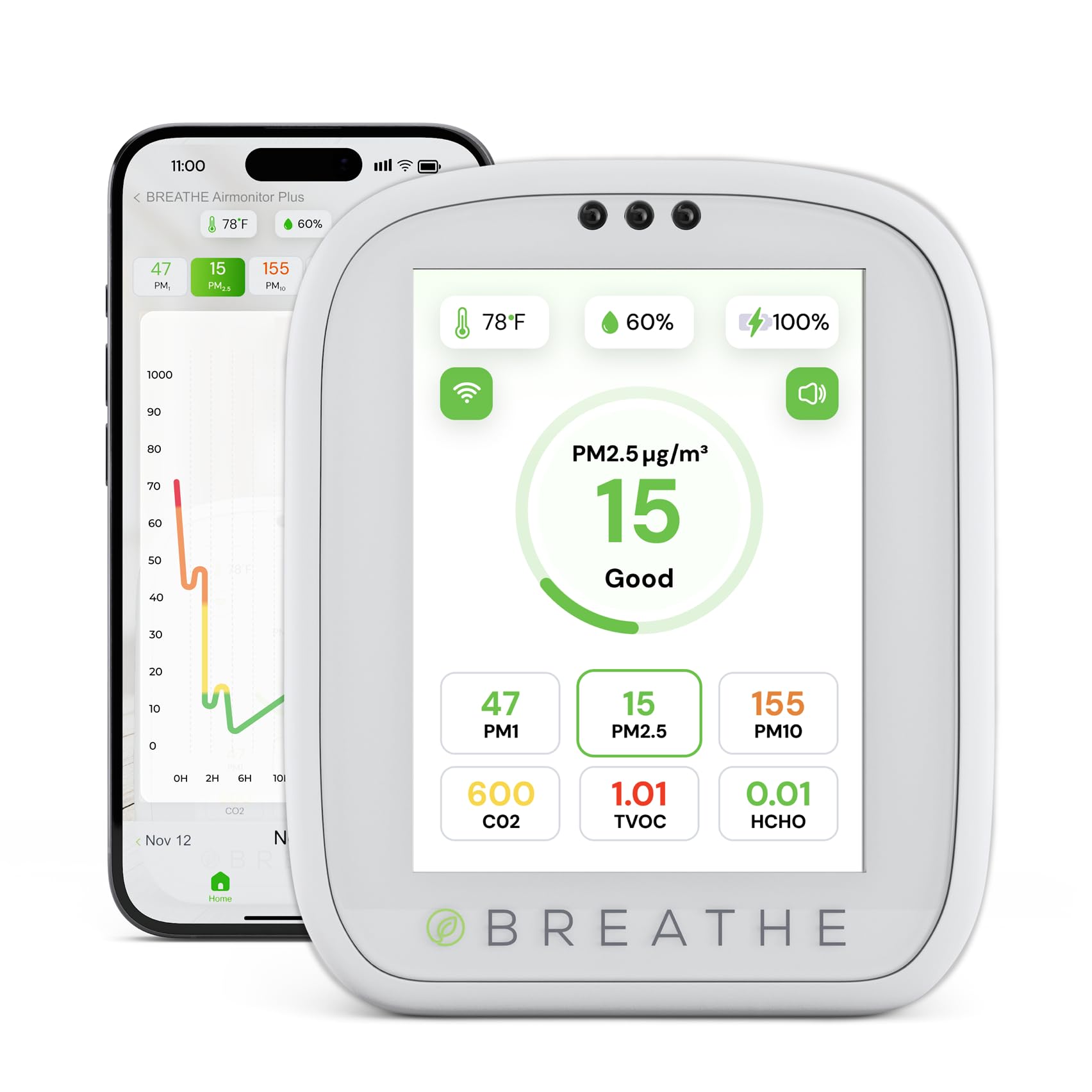
The BREATHE Airmonitor Plus is designed for the data-driven user who wants the full picture. It tracks CO₂, PM1, PM2.5, PM10, VOCs, formaldehyde (HCHO), and temperature/humidity. This is the most complete sensor suite in the lineup. Professional-grade sensor accuracy allows you to identify specific pollution sources — whether it’s your gas stove kicking off a PM2.5 spike or a new piece of furniture outgassing formaldehyde.
The free Breathe Tech app is a highlight, offering 30-day data history and instant alerts that are genuinely configurable. Users have reported that the CO₂ readings are highly accurate, dropping from 4500 ppm in a sealed room to 405 ppm after opening windows. The proximity-activated display is innovative — you wave a hand over the front to wake the screen — though some users found the sensor sensitivity to be hit-or-miss in the dark.
At half a pound, it is the lightest multi-sensor unit we tested, making it easy to pack for hotel rooms. However, its battery life is short, so it requires constant AC power for continuous monitoring. The optical particle counter and electrochemical gas sensor provide lab-quality data, but the automatic self-calibration of the CO₂ sensor can slowly drift readings downwards over time if placed in a consistently high-CO₂ environment, requiring occasional zero-calibration outdoors.
Why it’s great
- Full 7-parameter sensor suite including PM1 and HCHO for professional-grade analysis
- Accuracy corroborated by users comparing readings with HEPA filter runtimes
- Compact and lightweight for easy travel between home and office
Good to know
- Battery life is short; best used plugged into an outlet 24/7
- Auto-calibration can drift readings downward in consistently high-CO₂ homes
3. GoveeLife Smart Air Quality Monitor
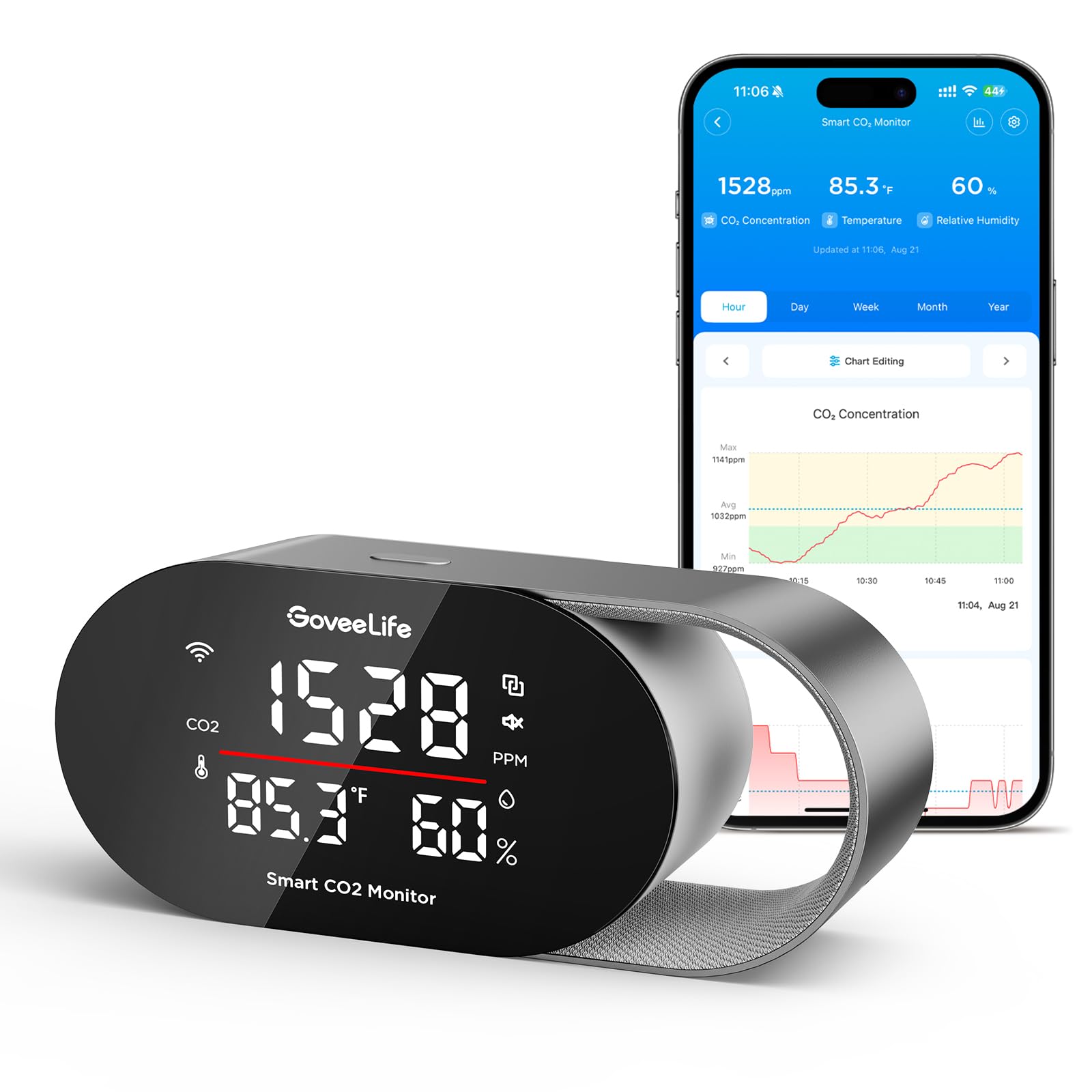
The GoveeLife monitor is the smart home hub’s best friend. Unlike many competitors, it deploys a photoacoustic NDIR CO₂ sensor — a premium technology that delivers higher accuracy and faster response than standard NDIR sensors. With a ±(40ppm + 5%) accuracy rating and a 5-second refresh rate, it catches even quick spikes from a room filling up with people.
Its smart integration is the deepest in this category: it works with Alexa and Google Assistant for voice queries, and can trigger smart plugs to turn on a tower fan or humidifier automatically when CO₂ thresholds are breached. The triple-alert system — buzzer, app push, and email — ensures you know exactly when the air in your home office is tanking your cognitive performance. The app tracks up to two years of data and can export CSV files for medical consultations.
The display is a 4.82-inch tri-color light bar that automatically dims based on your custom day/night schedule. It is AC-powered only, which removes battery anxiety but limits portability. This unit does not measure particulates (PM2.5/PM10), focusing exclusively on CO₂, temperature, and humidity. If your primary concern is ventilation — and preventing that mid-afternoon drowsiness — this is a superb choice. The air purifier incompatibility note is important: GoveeLife correctly states that air purifiers do not remove CO₂, so they cannot be linked as a mitigation action.
Why it’s great
- Photoacoustic NDIR CO₂ sensor provides best-in-class accuracy and speed
- Deep smart home integration with Alexa/Google and auto-triggering of fans/humidifiers
- Two-year data history with CSV export for medical records
Good to know
- No PM2.5 or particulate detection — focused purely on CO₂, temp, and humidity
- AC-powered only; not suitable for portable use in cars or hotels
4. 16 in 1 Air Quality Monitor Indoor with 7″ Large Display
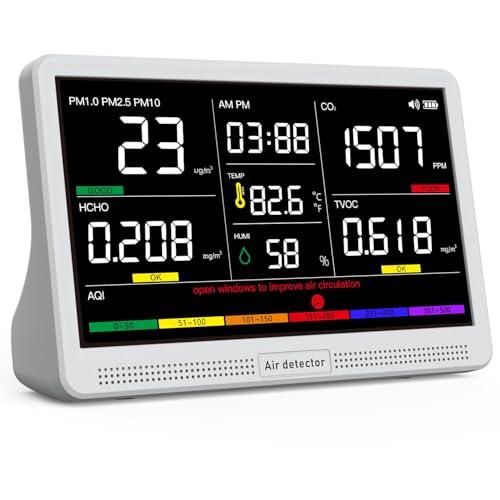
If you or a family member needs to read air quality data from across the room, this 7-inch display unit is unmatched. The bright LED screen shows CO₂, PM2.5, PM1.0, PM10, HCHO, TVOC, temperature, humidity, and a combined AQI score — all on one screen without menu navigation. The AQI color bar spans green to dark red, giving you an instant visual of your current air quality landscape.
It uses external high-precision sensors that claim 0.001 unit accuracy, and the multi-sensor array with enhanced airflow detects subtle changes quickly. The 7 distinct alert buzzers — one for each major parameter — can be a bit overwhelming in a quiet home, but they do have a mute button. Users report it picks up PM from vape smoke and TVOCs from cleaning products within 3-7 seconds, making it a responsive tool for identifying pollution sources.
The 2500mAh battery provides up to 8 hours of cordless use, decent for moving between rooms but not for all-day portable testing. The device is on the larger side (7.9 x 5.6 x 2.9 inches) and heavier than pocket-sized competitors, so it lives best on a desk. Some initial reviews noted that strong cleaning chemicals did not immediately change readings, which might indicate a slower sensor response for certain chemicals, or simply that the unit needed more time to sample. The clock and time-setting features are a nice bonus for bedside table use.
Why it’s great
- 7-inch display is the largest and most readable in the category, ideal for seniors
- Detects PM2.5/PM10/HCHO/TVOC simultaneously with fast 3-7 second response
- Includes 7 AQI alert buzzers for granular hazardous condition warnings
Good to know
- Sensor sensitivity can vary with strong chemicals; may require a longer sample period
- Bulky design is not pocketable; best for stationary home or office use
5. LifeBasis 11-in-1 Air Quality Monitor Indoor

The LifeBasis 11-in-1 is the value champion that doesn’t feel cheap. It tracks 11 parameters including AQI, CO₂, PM1.0, PM2.5, PM10, HCHO, TVOC, particles, temperature, and humidity — a comprehensive suite normally found only in units twice its price. The dual alert system uses color changes (green to red) and an audible ticking sound to warn when any gas concentration exceeds normal limits.
It integrates a NDIR infrared CO₂ sensor, a laser particle sensor, and a semiconductor sensor for TVOC/HCHO — the brass tacks of a high-performance monitor. User reports confirm that the PM2.5 readings closely match the PurpleAir network, and the manual CO₂ calibration feature (holding a button for 5 seconds in fresh air) is a practical tool for maintaining accuracy over time. The flat, pocketable design (0.95 x 2.92 x 6.3 inches) makes it genuinely portable for road trips and hotel use.
The 2500mAh battery delivers 11-12 hours of continuous use on a full charge. While this is solid for daily use, it falls short of the Temtop M10+’s 60-day endurance, so you will be charging this unit more frequently. The LCD screen is clear but not as bright as the 7-inch display of the 16-in-1 unit, and there is no companion app for data logging. For someone wanting a full-spec portable monitor without breaking the budget, this is the prime candidate. One reviewer used it to great effect as a “flatulence alerter” on road trips, validating its sensitivity.
Why it’s great
- 11 parameters for a broad picture of indoor air quality at a value price
- Verified accuracy of PM2.5 against external air quality networks
- Pocketable design with manual CO₂ calibration for long-term reliability
Good to know
- No app or data export — live readings only
- 11-12 hour battery requires regular charging compared to e-ink alternatives
6. EG Air Quality Monitor, Formaldehyde Detector

The EG Air Quality Monitor is a specialist tool designed for targeted detection of formaldehyde (HCHO) and volatile organic compounds (TVOC). It uses a laser particle sensor for PM2.5 and an electrochemical semiconductor sensor for gas detection, giving it a distinct edge over all-in-one units that combine everything in a single sensor array. The built-in fan pulls air into the chamber continuously for real-time measurement.
A standout feature is the included 20+ page eBook on gas and air quality hazards, written by their in-house chemist. This transforms the device from a simple number-reader into an educational tool. Its sensor requires a 30-minute fresh-air calibration out of the box, which users have reported is crucial for obtaining accurate baseline readings. It helped one user identify that new furniture off-gassing was harmless mahogany, while another discovered high formaldehyde levels in a cabinet warehouse that triggered a factory evacuation.
The 2.8-inch color LCD is clear but small, and the 2200mAh battery drains quickly — around two full charge cycles before needing a recharge, according to some user reports. The device also powers off its screen after a period, requiring a 3-minute wait to wake up again for the next reading, which can be inconvenient. If your primary concern is checking for VOC sources and you accept a slightly slower workflow, this monitor provides exceptional chemical-specific accuracy for its price point.
Why it’s great
- Electrochemical HCHO sensor provides targeted formaldehyde accuracy
- Includes comprehensive air quality hazards eBook for deep understanding
- Built-in fan ensures real-time air sampling, not passive diffusion
Good to know
- Battery life is short; screen shuts off frequently, disrupting continuous monitoring
- Must be calibrated in fresh air for 20-30 minutes before first use for accuracy
7. KDWKD Indoor Air Quality Monitor for Home
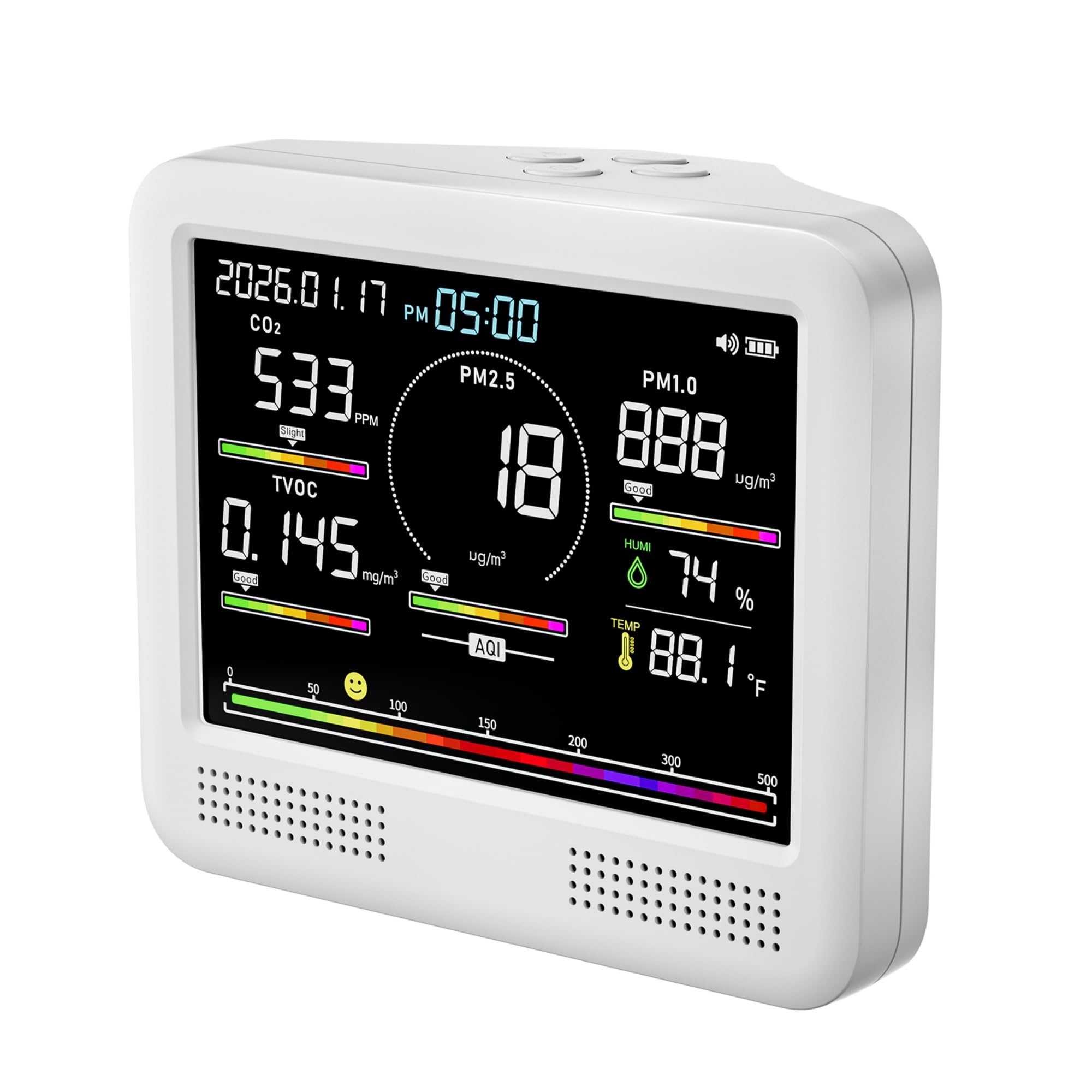
The KDWKD monitor serves as a solid entry point for those new to air quality monitoring. It tracks the core metrics: CO₂, PM2.5, PM10, HCHO, TVOC, temperature, and humidity, all displayed on a clean 5-inch screen. The ABS plastic enclosure is lightweight and functional, making it easy to move from the bedroom to the home office to the hotel room on a weekend trip.
The built-in rechargeable battery offers up to 9 hours of operation, which is sufficient for a full day’s use but falls short of overnight continuous monitoring unless you leave it plugged in. The device has an audible alarm that can be activated for any parameter that exceeds a safe threshold. Users have noted that it is sensitive enough to detect spikes from cooking, candles, and even hairspray, giving you a clear cause-and-effect picture of your daily pollutant exposure.
Where the KDWKD drops off the premium list is sensor precision and build quality. While providing a comprehensive overview, its sensors are less consistent than the NDIR-based units in this guide. It does not connect to an app, so you are limited to live readings only. For a first-time buyer who wants to understand the general health of their home air without committing to a smart-home ecosystem or a high-ticket monitor, this is a very functional, budget-conscious choice.
Why it’s great
- Covers all essential parameters (CO₂, PM2.5, TVOC, HCHO) for general awareness
- 9-hour battery is enough for a full day of portable monitoring
- Sensitive enough to detect particulate spikes from common household activities
Good to know
- No app, data history, or connectivity — live readings only
- Sensor accuracy is less consistent than units with dedicated NDIR sensors
FAQ
What does AQI stand for in a monitor?
Can an AQI monitor detect mold?
How often should I calibrate my CO₂ sensor?
What is a normal CO₂ reading in my bedroom?
Can I use an AQI monitor in my car?
Final Thoughts: The Verdict
For most users, the aqi monitor winner is the Temtop M10+ because it combines high-accuracy sensors with the most practical battery life in its class, all housed in a sleep-friendly e-ink display. If you want deep smart home integration and prefer to automate your ventilation, grab the GoveeLife Smart Air Quality Monitor. And for the most comprehensive sensor suite with professional-grade data analysis, nothing beats the BREATHE Airmonitor Plus.

Mo Maruf
I created WellFizz to bridge the gap between vague wellness advice and actionable solutions. My mission is simple: to decode the research and give you practical tools you can actually use.
Beyond the data, I am a passionate traveler. I believe that stepping away from the screen to explore new environments is essential for mental clarity and physical vitality.