Our readers keep the lights on and my smoothie glass nicely filled. As an Amazon Associate, I earn from qualifying purchases.
Degenerative disc disease slowly erodes the cushioning between your vertebrae, turning simple acts like bending to tie a shoe or sitting through a meeting into a sharp reminder of your condition. A back brace designed specifically for this diagnosis doesn’t just compress your midsection—it provides targeted structural reinforcement that limits the micro-movements aggravating your degenerated discs. Without the right brace, you risk accelerating the wear on adjacent spinal segments while getting zero meaningful relief.
I’m Mohammad Maruf — the founder and writer behind WellFizz. I’ve spent years analyzing medical-grade orthotic hardware, from the density of thermoplastic panels to the tensile strength of pulley systems, to identify what actually stabilizes an unstable lumbar spine without turning your torso into a furnace.
The challenge is that most “lumbar supports” on the market are designed for weightlifters or warehouse workers, not for someone whose vertebrae are literally bone-on-bone. After evaluating dozens of units and cross-referencing real user experiences against material science, I’ve narrowed the field to the five braces that genuinely address the mechanics of degenerative disc disease. This guide will walk you through the options so you can find the best back brace for degenerative disc disease that delivers lasting relief without sacrificing mobility.
How To Choose The Best Back Brace For Degenerative Disc Disease
Picking a brace for DDD isn’t about buying the thickest or the cheapest option. You need a device that restricts the specific movements—forward bending and twisting—that collapse the already narrowed disc space and irritate the surrounding nerves. Here are the three critical factors to evaluate.
Rigid Posterior Support vs. Elastic-Only Compression
Elastic belts from the gym generate intra-abdominal pressure, which helps weightlifters, but they do nothing to stop your lumbar spine from curling into painful flexion. For degenerative disc disease, you need an embedded structural component—aluminum stays, steel springs, or a contoured plastic lumbar panel—that physically prevents your lower back from rounding. The stiffness of these components is measured not in pounds but in how much resistance they provide against a 30-degree forward lean. A brace with four or more stays distributed across the posterior and lateral sides offers the best anti-flexion defense.
Targeted Lumbar Pad Height and Contour
A generic pad that sits too high presses on the thoracic spine; one that sits too low misses the L4-L5 and L5-S1 segments where disc degeneration most often occurs. The ideal brace includes an adjustable or removable lumbar pad that positions directly over the level of your belt line. The pad should have a distinct convex curve that maintains your spine’s natural lordosis, reducing the load on the posterior annulus of the degenerated disc. Pads that are flat or overly soft provide no positional distraction and won’t prevent nerve root irritation.
Material Breathability for Long-Term Wear
DDD is a chronic condition—you will wear this brace for hours at a time, often daily. Neoprene retains heat and moisture, which leads to skin maceration and reduced compliance. Look for 3D-knit mesh, perforated neoprene, or yoga-fabric blends with ventilated panels. The fabric’s moisture-wicking rating and porosity directly correlate to whether you can wear the brace for an eight-hour work shift without needing to remove it due to sweating or itching. A brace that you remove early because it’s uncomfortable provides zero therapeutic value.
Quick Comparison
On smaller screens, swipe sideways to see the full table.
| Model | Category | Best For | Key Spec | Amazon |
|---|---|---|---|---|
| ASPEN Quikdraw PRO | Pulley System | Precise dual-zone compression | Dual PullTab pulley, inelastic back | Amazon |
| NEENCA Bionic Support | Rigid Panel | Herniated disc & DDD stability | 2 bionic bone panels + 4 spring stays | Amazon |
| Fitomo Ultra Thin | Low Profile | Discreet all-day wear under clothes | 0.5 mm seamless yoga fabric | Amazon |
| changenow Ultra Breathable | Work Braces | Heavy physical labor & construction | 4 aluminum stays + removable suspenders | Amazon |
| Neo G Power Straps | Medical Grade | Rehabilitation & heat therapy | Neoprene with removable insert | Amazon |
In-Depth Reviews
1. ASPEN Medical Products Quikdraw PRO Back Brace

The ASPEN Quikdraw PRO is not another elastic wrap—it’s an inelastic back brace that uses a patented pulley system to apply targeted compression across the L1 through L5 vertebrae. For degenerative disc disease, the ability to independently tighten the upper and lower portions of the brace is transformative: you can lock down the segment that hurts most while leaving the rest free for natural movement. The fabric’s zero-stretch characteristic means every ounce of tension you pull through the Dual PullTabs translates directly into spinal stabilization, not fabric deformation, which is exactly what you need when a degenerated disc requires absolute mechanical restraint at the end range of flexion.
Clinically, this brace carries weight—it’s the industry standard in North American trauma centers and rehab facilities, backed by 25 years of research showing that inelastic bracing improves trunk stability more effectively than elastic alternatives. A 10-year user reports the string mechanism has zero stretch even after daily use, and multiple reviews note that it’s been effective for herniated discs, spinal osteoarthritis, and spondylolisthesis, all of which are common comorbidities with DDD. The rear plate is stiff enough to prevent rounding, yet the total weight is just 0.32 kg, making it light enough for seated office wear.
The pulley system is particularly valuable for DDD patients who also have arthritis in their hands or limited grip strength—you can achieve therapeutic compression without needing to yank on side straps. The brace’s overlap design means you should choose one size larger than your pants size to ensure adequate hook-and-loop surface contact. Some users note that the plastic panel can feel prominent against chair backs, but this is a trade-off for the rigidity that stops painful end-range movement.
Why it’s great
- Patented dual-zone pulley system delivers adjustable, no-stretch compression exactly where DDD pain originates.
- Inelastic construction is clinically proven to stabilize the lumbar spine better than elastic braces.
- Ultra-lightweight and breathable fabric allows all-day wear even against bare skin.
Good to know
- Must measure your waist per the size chart—pant size is not accurate for fit.
- The rigid posterior plate may press into the back of office chairs until you find the right seat angle.
2. NEENCA Back Brace with Bionic Support System
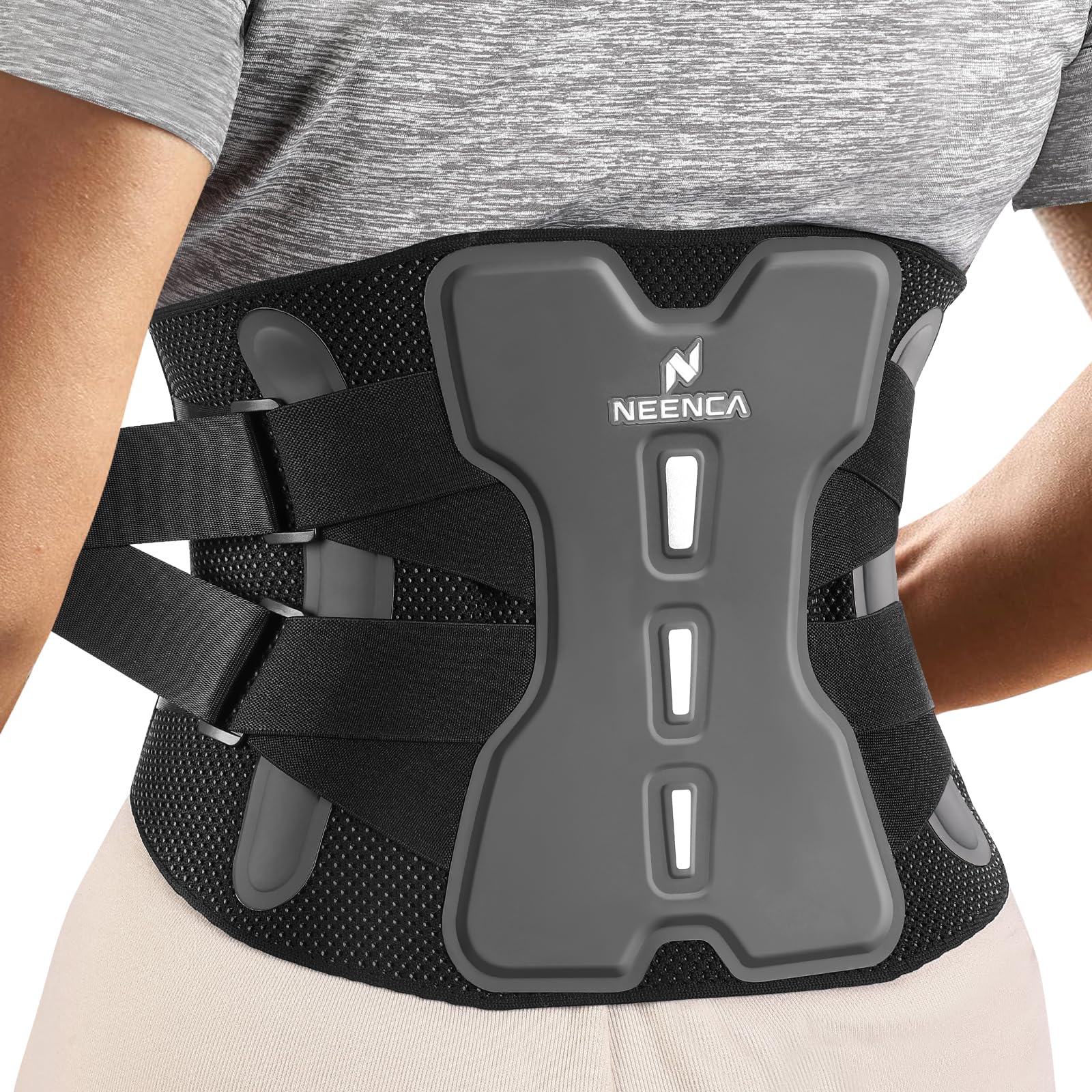
The NEENCA brace brings a proprietary bionic support system that pairs two rigid lumbar panels with four spring stays and two aluminum memory stays, creating a stabilization matrix that closely mirrors the natural biomechanics of the spine. For degenerative disc disease, this six-stay architecture is significant because it disperses the load across the entire posterior compartment rather than concentrating pressure on one isolated point. The dual lumbar pads—shaped like bionic bone segments—maintain the lordotic curve even when you’re seated for long periods, which is the exact posture where DDD sufferers experience the most facet joint loading.
Registered as a Class 2 Medical Device, the NEENCA is doctor-recommended specifically for herniated discs, sciatica, and scoliosis—all conditions that frequently co-occur with disc degeneration. The 3D-knit fabric uses 16-hole air mesh and a velvet inner layer, which addresses the skin irritation problem that plagues neoprene braces. Users with bone-on-bone lumbar conditions report that the plastic curvature support keeps their spine straight even in bed, preventing the nighttime micro-movements that can trigger morning flare-ups. The brace also covers a wide size range—from 25.9 inches up to 65 inches—making it one of the most inclusive options for the DDD population.
The eight adjustable straps provide strong adhesion, but the real differentiator is how the brace handles lateral stability. The two flexible springs on the sides prevent the brace from rolling down when you bend forward, a common failure point in cheaper designs. One trade-off is that the bionic panels are not removable, so the brace has a firmer feel that some users with very mild degeneration may find unnecessary. However, for moderate to severe DDD where segmental instability is the primary pain driver, this level of structural reinforcement is exactly what’s required.
Why it’s great
- Six-stay design (rigid panels + memory stays) provides comprehensive anti-flexion and anti-rotation support.
- 16-hole air mesh fabric with velvet lining prevents heat buildup and skin irritation during extended wear.
- Class 2 Medical Device with wide size inclusivity and strong doctor recommendation for comorbid spinal conditions.
Good to know
- The bionic panels are non-removable, making the brace less flexible for users who want a softer option on lighter days.
- Some users with smaller frames may find the panel length slightly tall for their torso.
3. Fitomo 0.5mm Ultra Thin Back Brace
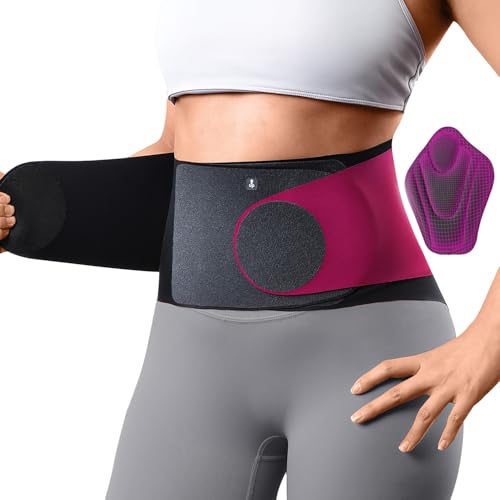
The Fitomo Ultra Thin is constructed from seamless yoga fabric that measures just 0.5 mm in thickness, making it the thinnest brace in this lineup and the only one truly capable of disappearing under a dress shirt or fitted top. For DDD patients who need spinal support during a workday but cannot wear a bulky contraption under their clothing, this design solves the compliance problem. The brace still includes three aluminum stays and a detachable 3D lumbar pad, so even at this slim profile you get mechanical resistance against forward flexion—the primary aggravating movement for degenerated discs.
An actual DDD and herniated disc user confirmed that this brace provided significantly more support and less pain during workouts, noting that the only limitation was reaching maximum tightness. The seamless, tag-free construction eliminates pressure points that cause red marks, and the 80% nylon / 20% spandex blend wicks moisture effectively, making it suitable for hot outdoor work or exercise environments. The removable lumbar pad allows you to dial in the level of posterior contour: wear it with the pad for focused L4-L5 distraction, or remove it for a flatter profile during activities that require more spinal mobility.
The main trade-off for the ultra-thin form factor is that the aluminum stays are lighter-gauge than the steel or bionic panels found on the NEENCA or ASPEN. Users with severe DDD and significant segmental instability may find that the three stays don’t provide enough rigidity to prevent end-range flexion during heavy lifting. However, for mild to moderate disc degeneration, or for days when you need support without the bulk, the Fitomo hits a value sweet spot that no other brace in this category matches.
Why it’s great
- 0.5 mm seamless yoga fabric is virtually invisible under clothing, solving the “bulky brace” problem for office wear.
- Detachable 3D lumbar pad provides targeted L4-L5 support while remaining customizable.
- Three aluminum stays offer meaningful anti-flexion resistance without compromising breathability.
Good to know
- Lighter-gauge stays may be insufficient for severe DDD with significant instability or during heavy lifting.
- Some users with larger waist measurements report wishing for one more inch of tightness at the maximum adjustment.
4. changenow Ultra Breathable Work Back Brace

The changenow brace is engineered for physically demanding labor—warehouse work, construction, and moving—with four upgraded aluminum support bars that conform tightly to the spine’s natural curve. For DDD patients whose jobs require repetitive bending and lifting, this brace’s patent-level strap system provides 360-degree wrap that stabilizes the entire lumbar cylinder rather than just the posterior chain. The 0.21-inch thickness and breathable mesh fabric prioritize airflow, which is critical when you’re wearing the brace under a tool belt or uniform for eight-hour shifts.
Real-world durability data shows this brace lasting roughly four months of five-day-per-week, eight-hour-per-day use before needing replacement, which is reasonable for a work-grade orthotic at this tier. The removable shoulder suspenders add a second retention path—the straps prevent the brace from sliding down when you repeatedly bend from the waist, a common failure mode for belt-only designs. An 80-year-old user with a skeptical doctor reported that the brace made garden work possible again, suggesting that even for advanced degeneration, the mechanical support is sufficient for light-to-moderate activity.
The critical failure pattern to watch for is the hook-and-loop closure on the wide belt: some units have a Velcro adhesion issue where the wide portion does not stay connected, even though the smaller straps work fine. This appears to be a quality-control variation rather than a design flaw, but it means you should verify the closure integrity immediately upon receipt. Additionally, the brace lacks a targeted lumbar pad, so it provides diffuse compression rather than point-specific lordotic support, making it better suited for general DDD discomfort during activity than for targeted disc segment stabilization.
Why it’s great
- Four contoured aluminum stays provide robust anti-flexion support for heavy-duty lifting and bending scenarios.
- Removable suspenders prevent the brace from migrating downward during repeated full-range trunk flexion.
- Highly breathable mesh fabric keeps the user cool during extended wear in hot or physically demanding environments.
Good to know
- Inconsistent Velcro adhesion on the main belt has been reported, requiring immediate quality inspection.
- No dedicated lumbar pad means less targeted support for isolated disc segment relief.
5. Neo G Back Brace with Power Straps
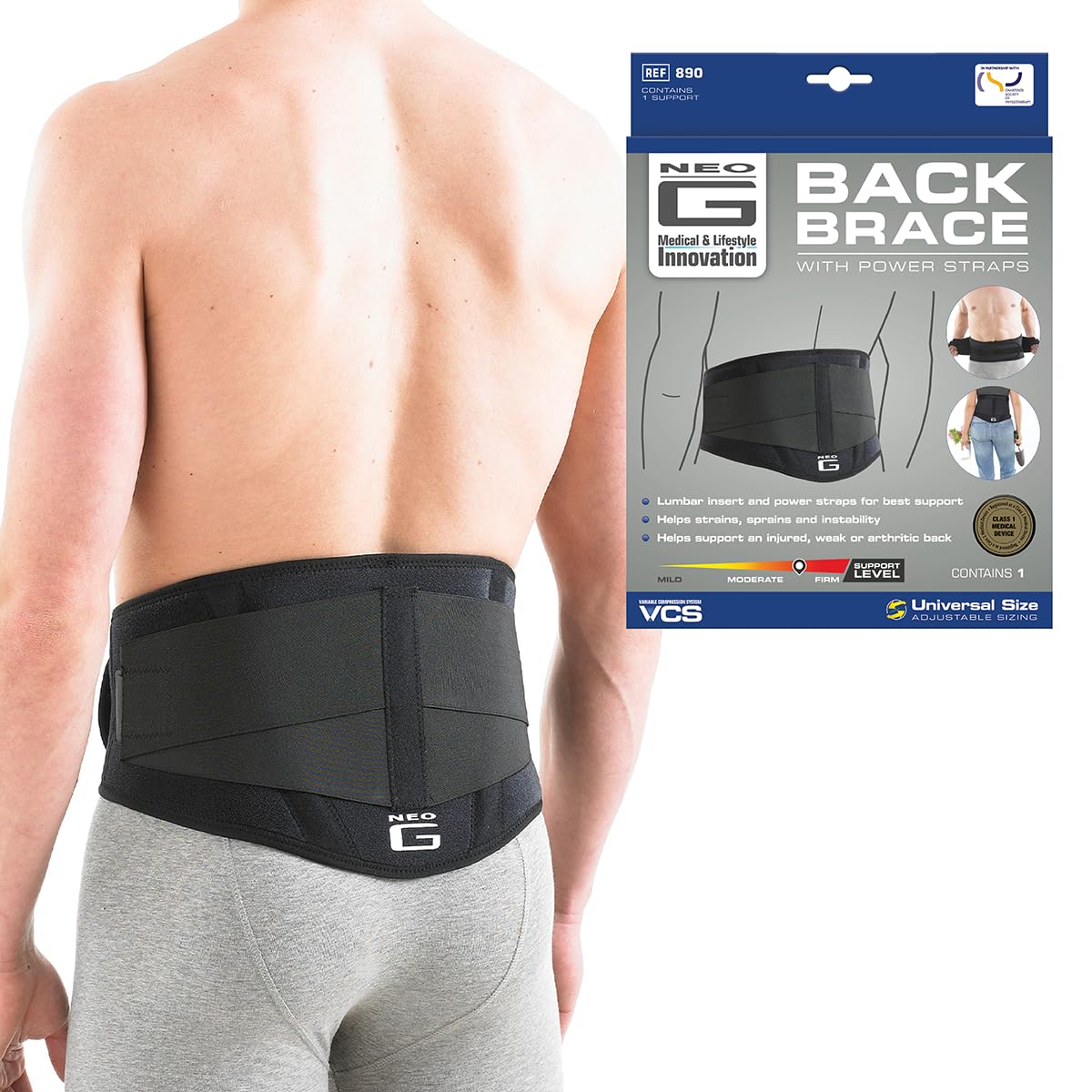
The Neo G brace is registered internationally as a Class 1 Medical Device, including FDA registration in the US, and is the official partner of the Chartered Society of Physiotherapy—the UK equivalent of the American Physical Therapy Association. For DDD patients in the rehabilitation phase, this matters because the brace is designed with heat-therapeutic neoprene that warms stiff, aching, and tired muscles, promoting blood flow to the lumbar region while the Power Straps deliver adjustable compression. The removable insert allows you to tailor the rigidity level, starting with maximum support during acute flare-ups and reducing the insert once the musculature begins to stabilize.
The one-size-fits-most design simplifies purchasing, though users with waist measurements at the extreme ends of the bell curve should double-check fit. The neoprene blend includes natural rubber latex, which is a critical allergen marker—if you have a latex sensitivity, the Neo G is not an option. User feedback consistently praises the build quality and the level of support it provides for lower back strains, spasms, and chronic ache, though some DDD-specific users note that the neoprene can trap heat during extended wear in warm environments, making it more suitable for cooler-weather use or short-duration rehabilitation sessions.
Where the Neo G falls short for advanced DDD is its lack of rigid posterior panels—the support comes from compression and heat rather than mechanical blocking of end-range flexion. For mild degeneration or intermittent flare-ups where the primary goal is muscle relaxation and blood flow, this is an appropriate choice. However, for bone-on-bone disc collapse with significant instability, the absence of aluminum or bionic stays means the brace won’t prevent the forward-slump posture that aggravates the condition. It pairs well with a physical therapy program but is not a standalone solution for advanced structural degeneration.
Why it’s great
- FDA-registered Class 1 Medical Device with backing from the Chartered Society of Physiotherapy for rehabilitation use.
- Heat-retentive neoprene warms the lumbar muscles, increasing blood flow and reducing stiffness during recovery.
- Removable insert allows patients to adjust support level as their rehabilitation progresses.
Good to know
- Contains natural rubber latex, making it unsuitable for anyone with a latex allergy.
- No rigid structural stays means it cannot block end-range flexion in advanced DDD with segmental instability.
FAQ
Can a back brace reverse the effects of degenerative disc disease?
How many hours per day should I wear a DDD brace?
Should I choose a brace with a pulley system or standard side straps?
Final Thoughts: The Verdict
For most users, the best back brace for degenerative disc disease winner is the ASPEN Quikdraw PRO because its inelastic construction and patented dual-zone pulley system deliver clinically effective stabilization without bulk. If you need a rigid, multi-stay brace with a bionic panel system that maintains lordosis even during sleep, grab the NEENCA Bionic Support Brace. And for discreet, low-profile support that disappears under office clothes while still providing meaningful anti-flexion resistance through three aluminum stays, nothing beats the Fitomo Ultra Thin Back Brace.

Mo Maruf
I created WellFizz to bridge the gap between vague wellness advice and actionable solutions. My mission is simple: to decode the research and give you practical tools you can actually use.
Beyond the data, I am a passionate traveler. I believe that stepping away from the screen to explore new environments is essential for mental clarity and physical vitality.