Our readers keep the lights on and my smoothie glass nicely filled. As an Amazon Associate, I earn from qualifying purchases.
Stretchy fabric, a crying newborn, and a countertop full of instructions — the first time you unroll a babywearing wrap, the learning curve hits hard. But once you master that snug, even tension, nothing replaces the feeling of a sleeping infant pressed against your chest while your hands finally get to type, stir, or fold laundry. The problem is that most wraps either sag under a growing baby’s weight or trap heat until both of you are flushed and fussy. The right wrap should disappear from your awareness while keeping your baby secure through every squat and pivot.
I’m Mohammad Maruf — the founder and writer behind WellFizz. I’ve spent the past 15 years studying fabric blends, weight-distribution mechanics, and ergonomic certifications in the baby carrier market to separate the wraps that genuinely support your spine from those that just feel soft out of the box.
In this guide, I walk you through the stretch-factor, weave structure, hip-health certifications, and real-world long-wear comfort data that define the best babywearing wrap for your specific body type and baby’s age.
How To Choose The Best Babywearing Wrap
The babywearing wrap market is deceptively simple — it’s just fabric, right? Yet a ten-dollar difference in price often separates a wrap that distributes weight evenly across your back and shoulders from one that digs into your trapezius within thirty minutes. Focus on these four factors to pick a wrap that grows with your child rather than collecting dust after the newborn phase.
Fabric Construction and Stretch Resistance
A wrap’s weave determines whether it holds tension after a full afternoon of wearing. Pure one-way stretch knits (often seen in budget-tier polyester blends) gradually loosen under load, forcing you to retighten every twenty minutes. Premium wraps use a 4-way stretch — typically a cotton-spandex or cotton-bamboo-spandex blend — that recovers its shape between wears and resists sagging even when your baby hits the 18-pound mark. Look for at least 5% spandex content for reliable shape memory.
Hip Health Certification
The International Hip Dysplasia Institute (IHDI) certifies carriers whose seat allows the baby’s hips to spread into the natural “M” or frog-leg position, with knees higher than the bottom. A wrap that forces straight, dangling legs can interfere with proper hip socket development. Any wrap claiming hip-healthy design should carry explicit IHDI endorsement — not just a pelvic-strap adjustment but a genuine fabric structure that supports the femoral head without compression.
Body Inclusivity and Wrap Length
One-size-fits-all is rarely true for babywearing wraps. A petite 5-foot-2 parent with a 28-inch waist will trail 24 inches of loose fabric if the wrap was designed for a 6-foot frame, creating a tripping hazard and excess bulk. Conversely, a shorter wrap may not provide sufficient chest and back coverage for a plus-size wearer. The best wraps publish a tested waist range (for example, 25 to 58 inches) and offer visual guides for tails adjustment so you can tie a clean knot instead of a wad.
Breathability and Thermal Regulation
Two-parent household temperatures are never under your control — a wrap that feels cozy in air-conditioned indoor air may turn into a sweat trap under summer sun. Cotton wraps are breathable but absorb moisture and stay damp. Bamboo-viscose wraps dissipate heat more efficiently due to the hollow-core structure of bamboo fibers, making them cooler for both wearer and baby. Weight per square yard (GSM) is the spec to watch: lower GSM (under 200) equals lighter, cooler fabric; higher GSM (over 240) equals more durable, warmer support.
Quick Comparison
On smaller screens, swipe sideways to see the full table.
| Model | Category | Best For | Key Spec | Amazon |
|---|---|---|---|---|
| Boppy ComfyFit | Hybrid Wrap | Quick on/off with structured support | Adjustable waist belt + cross-back straps | Amazon |
| Momcozy WeeSnug | Structured Carrier | Newborns needing lumbar support | 100% cotton with visual adjustment scale | Amazon |
| Koala Babycare Cuddle Band | T‑Shirt Wrap | New parents afraid of traditional wrapping | Ring closure prevents slack over 2+ hours | Amazon |
| Boba Original Wrap (Grey) | Stretch Wrap | Long-wear all-day use | 95% cotton, sag‑resistant 4‑way stretch | Amazon |
| KeaBabies Original Wrap | Stretch Wrap | Budget-to-mid-range entry point | Proprietary stretch fabric, IHDI certified | Amazon |
| Moby Basics Wrap | Stretch Wrap | First‑time parents learning to wrap | Ultra‑soft breathable knit, 8‑33 lb range | Amazon |
| Boba Classic Carrier | Soft‑Structure Carrier | Carrying up to 45 lb with back carry | 100% cotton canvas, 4 carrying positions | Amazon |
In‑Depth Reviews
1. Boppy ComfyFit Adjustable Baby Carrier

The Boppy ComfyFit bridges the gap between a stretchy wrap and a structured buckle carrier, wrapping in seconds while still delivering the distributed-weight feel of a woven shell. Its padded waist belt and wide crossable shoulder straps keep the load off your lower back even after an hour of carrying a 20-pound toddler, which is exactly where most pure wraps start to fail.
The fabric blend (88% polyester, 12% spandex) provides 4-way stretch without bagging out, and the adjustable arm straps mean both a size-2 postpartum frame and a plus-size caregiver can share the same carrier without fabric drag on the ground. The JPMA certification and three approved carrying positions (newborn frog, legs-out face-in, and front-face-out) give it a longer usable lifespan than typical stretch wraps that top out at 25 pounds.
Customer feedback highlights its ease of use for plus-size or large-chested women who often find traditional wraps too short or too narrow in the shoulder panel, plus the machine-washable tag and self-stuffing pouch make it a practical daily driver. The trade-off is that the structured belt adds a bit of bulk to pack compared to a simple fabric roll.
Why it’s great
- Padded waist belt eliminates lower-back strain during extended wear
- Crossable shoulder straps adapt to diverse body shapes without fabric trailing on the floor
- Three carrying positions extend usability from 8 pounds through 35 pounds
Good to know
- Belt and straps add bulk compared to a pure fabric wrap for diaper-bag packing
- Limited to front and hip carries — no true back carry position for older toddlers
2. Momcozy Newborn Carrier WeeSnug
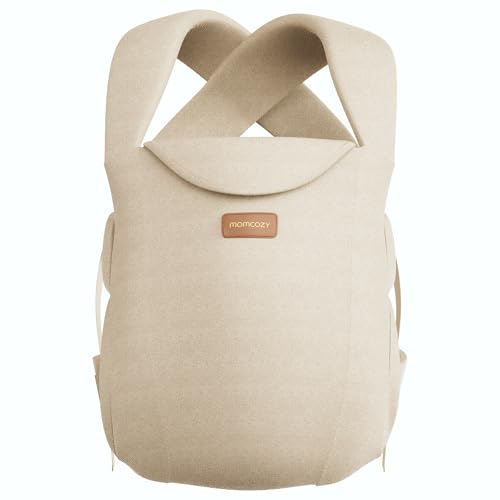
The Momcozy WeeSnug trades traditional wrapping complexity for a structured silhouette that still maintains the soft, hugged feeling of a stretchy wrap. Its standout feature is the two-point lumbar support system — thickened shoulder straps cross in the back and the padded waist belt cinches independently, so the carrier stays locked against your torso even when you bend to pick up a dropped pacifier.
The 100% cotton fabric with a subtle spandex component is breathable enough for indoor summer use, and the unique visual adjustment scale inside the waistband lets you dial in the correct seat width for your baby’s current leg length — a feature that prevents the dreaded “dangling leg” position. The 7-to-25-pound limit keeps it squarely in the newborn-to-first-year sweet spot, though tall babies may outgrow the head support sooner than the weight ceiling suggests.
Reviews consistently note how quickly the baby falls asleep inside the WeeSnug compared to less structured wraps, and the streamlined buckles make it viable for outings where you’ll be taking the baby in and out multiple times. The trade-off is minimal: the structured design is slightly less packable than a fabric-only wrap, but still fits inside a large diaper bag pocket.
Why it’s great
- Visual seat-width scale adjusts to baby’s height for proper hip position from day one
- Padded waist belt and cross-back straps distribute weight to reduce shoulder fatigue
- Quick buckle system eliminates the learning curve of traditional wrap tying
Good to know
- Weight capacity tops out at 25 pounds, limiting use for chunky toddlers
- Tall or 99th-percentile babies may lose neck support before reaching the weight limit
3. Koala Babycare Baby Carrier Wrap Cuddle Band

The Koala Babycare Cuddle Band is the wrap for parents who hate the process — the long tails dragging on the ground, the confusing twists, the constant retightening. This design uses a double-band system with a ring closure that you put on like a T-shirt, tighten two straps, insert the baby, then cinch the support band. The result is a secure seat that does not loosen over a two-hour grocery run, unlike traditional wraps whose stretch fibers gradually settle under load.
The fabric composition (65% polyester, 30% cotton, 5% spandex) is intentionally shorter than standard wraps, which solves the most common complaint from petite caregivers on 5-foot frames: trailing fabric that picks up dirt. The ring closure also makes micro-adjustments possible without unwrapping everything — just pull the slack through the ring. The cradle position is comfortable for newborns, though the broad elastic band can trap heat above 75°F, especially in humid climates.
Customer reports confirm the wrap holds up through repeated washing without pilling or loose threads, and the included pouch and QR video guide make it a low-anxiety option for first-time parents. The main drawback is the 22-pound recommended weight limit, which means you’ll need to transition to a structured carrier before your baby’s first birthday in most cases.
Why it’s great
- Ring closure prevents fabric slack from building up during extended wear
- Shorter length eliminates floor-dragging for petite or short-torso wearers
- Puts on like a T-shirt, reducing the learning curve for new parents
Good to know
- 22-pound limit means limited toddler use
- Polyester-heavy blend can feel sweaty in warm weather
4. Boba Baby Wrap Carrier – Original
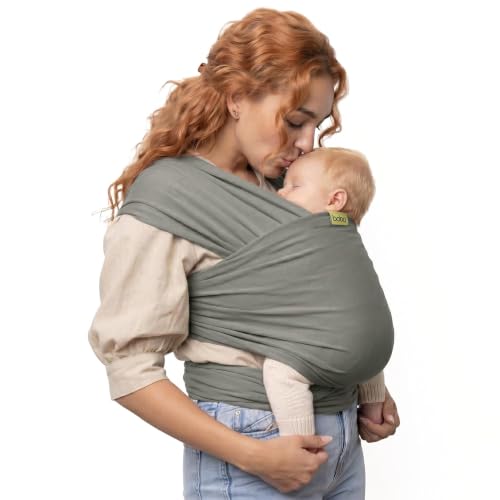
Boba has been in the babywearing game since well before the current stretch-wrap boom, and the Original Wrap’s durability reflects that legacy. Its 95% cotton, 5% spandex blend uses a custom 4-way weave that resists the permanent bagging that afflicts cheaper one-way stretch wraps after a dozen wash cycles. The cotton-rich composition breathes better than polyester-heavy alternatives, though it still runs warm in direct sun — multiple user reviews note it can be a sweatbox during summer errands.
The IHDI “Hip Healthy” certification carries real weight here: the wrap naturally supports the M-position without requiring extra padding or inserts, and the T.I.C.K.S. compliant fabric keeps the baby’s chin clear of the chest. At 5-foot-3 and roughly 150 pounds, the tails leave an 8-to-9-inch excess for a clean finish, and the wrap accommodates bodies up to plus size without the panel pulling too tight across the shoulders.
Any parent considering a stretch wrap for all-day wear (think house cleaning, airport walks, long stroller-free zoo days) will appreciate that the Boba does not need re-tensioning every thirty minutes. The main complaint is the learning curve — the standard wrapping method requires three distinct passes, and a crying baby does not make that easier. But once the muscle memory clicks, it becomes intuitive.
Why it’s great
- Custom 4-way stretch blend resists sagging even after months of daily washing
- IHDI “Hip Healthy” certification ensures natural M-position without extra inserts
- Cotton-rich fabric is breathable and softens with repeated washing cycles
Good to know
- Standard wrapping method has a steep learning curve for first-time parents
- Cotton weave retains heat in high humidity despite breathable claims
5. KeaBabies Baby Wrap Carrier – Original

The KeaBabies Original Wrap enters the conversation as a strong contender for parents who want legitimate ergonomic certification without crossing into premium pricing territory. Its proprietary stretch fabric is soft straight out of the package and requires less breaking-in than 100% cotton wraps. The weight distribution across back and shoulders is noticeably even — a rare quality at this tier, where many budget wraps just dump the load into your lower trapezius.
The IHDI certification is printed on the packaging, not just buried in the product description, and the wrap doubles as a pregnancy support band and postpartum belly binder, giving it utilitarian value beyond babywearing. The versatility is genuine: caregivers report using it for nursing cover functions (though it’s not a dedicated cover) and as a makeshift scarf in a pinch. The fabric does run warm in tropical climates, as noted by verified purchasers in Southeast Asia, and the stretchiness that makes it comfortable for newborns can cause heavier babies to feel less secure than in a less elastic wrap.
For the entry-minded parent who is not yet certain whether babywearing will be a daily habit or a weekend novelty, the KeaBabies provides a low-risk on-ramp with genuine safety backing. It fits all body types through a one-size design, and the machine-washable fabric holds up to repeated spit-up and blowout cycles without pilling.
Why it’s great
- Ergonomically certified by IHDI for healthy hip positioning even at entry-level price
- Proprietary stretch fabric stays soft wash after wash without requiring break-in
- Multipurpose design works as pregnancy support and postpartum belly wrap
Good to know
- Stretchy fabric can feel less secure for babies over 18 pounds
- Warm weather wear leads to rapid heat buildup on both parent and baby
6. Moby Basics Baby Wrap Carrier
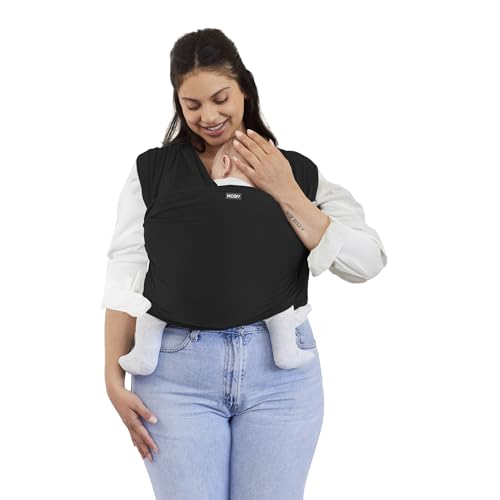
Moby is a household name in the wrap world for a reason — their Basics carrier simplifies the brand’s classic long-tail design into an accessible package that still supports the full range of newborn-to-toddler use (8 to 33 pounds). The fabric is an ultra-soft, slightly stretchy knit that feels like well-worn pajamas right out of the box, making it especially appealing for parents whose babies are sensitive to textured fabrics or who need skin-to-skin contact in the early weeks.
Where this wrap differentiates itself from cheaper alternatives is the even weight distribution across the back, shoulders, and hips. Multiple user reviews from postpartum C-section recoverers specifically call out the Moby Basics as the only carrier comfortable enough for walking while still connected to an IV pole — a level of real-world validation that speaks to the design’s low-pressure ergonomics. The length also accommodates taller parents without leaving an unusable knot of excess fabric at the waist.
The trade-off is that the knit, while cozy, is less sag-resistant than a cotton-spandex 4-way blend. Babies on the upper end of the 33-pound limit may feel like they are sinking slightly over a two-hour period, requiring a quick re-tightening pass. Also, the instructions included in the box are sparse enough that most new users will need a YouTube tutorial to achieve a secure wrap.
Why it’s great
- Ultra-soft knit fabric is gentle on newborn skin and promotes skin-to-skin bonding
- Even weight distribution across back, shoulders, and hips reduces postpartum strain
- Length is generous enough to fit taller caregivers without excess fabric bulk
Good to know
- Knitted fabric loses elasticity under heavy loads, causing baby to settle lower over time
- Printed instructions are thin and most first-timers need video tutorials to get the fit right
7. Boba Baby Carrier Classic – Fox

The Boba Classic Carrier is not a stretch wrap — it’s a soft-structured carrier that shares Boba’s brand DNA but works on an entirely different mechanical principle: buckles, padded waist belt, and a woven canvas panel. It covers the full 7-to-45-pound range without needing an additional infant insert (though it comes with a detachable one for the youngest babies), making it a single-carrier solution for families who want to buy one piece of gear and never think about it again.
The 100% cotton canvas is remarkably breathable compared to synthetic structured carriers, though it still retains some heat on 90-degree days. The multiple pockets (two waist, one chest) eliminate the need for a separate phone-and-key pouch, and the sleeping hood is wide enough to block direct sun without collapsing against the baby’s face. Parents also appreciate the easy-access buckle for breastfeeding — just one click and the shoulder strap releases, letting you slide the baby down without fully removing the carrier.
Where this carrier excels is the back-carry capability. Most stretch wraps cannot safely support a toddler on your back because the fabric lacks the tensile strength to hold them tight against your spine. The Boba Classic, with its structured waist belt and cross-shoulder straps, provides a secure back-carry option that distributes weight evenly and keeps the baby stable while you walk. The main adjustment is that the shoulder straps, designed for a wide range of bodies (5’0″ to 6’3″), can sit too far out on a narrow frame and may require crossing the straps for a better fit.
Why it’s great
- Full 7-to-45-pound range with no separate infant insert required for older babies
- Back-carry capability opens up toddler use without sacrificing security
- Cotton canvas fabric breathes better than polyester-structured competitors
Good to know
- Shoulder straps sit wide, requiring a crossover adjustment for narrow-framed wearers
- Canvas is less stretchy than a wrap, so the initial fit must be precise to avoid pressure points
FAQ
Can I use a stretch wrap for a newborn under 7 pounds?
Which wrap type is coolest for summer babywearing?
How long does it take to learn wrapping with a 4-way stretch wrap?
Can a stretch wrap cause my baby to overheat?
Why does my wrap sag after 30 minutes even though I tied it tight?
Final Thoughts: The Verdict
For most users, the best babywearing wrap winner is the Boppy ComfyFit because it delivers the wrap-like closeness your newborn craves without requiring a degree in knot-tying, and the padded waist belt keeps your back fresh when your baby hits 18 pounds. If you want the simplest possible on-ramp to babywearing and do not mind a shorter usable range, grab the Koala Babycare Cuddle Band. And for extended all-day wear or carrying a toddler on your back, nothing beats the Boba Classic Carrier — the cotton canvas and 45-pound capacity make it a single-carrier solution from birth through the terrible twos.

Mo Maruf
I created WellFizz to bridge the gap between vague wellness advice and actionable solutions. My mission is simple: to decode the research and give you practical tools you can actually use.
Beyond the data, I am a passionate traveler. I believe that stepping away from the screen to explore new environments is essential for mental clarity and physical vitality.