Our readers keep the lights on and my smoothie glass nicely filled. As an Amazon Associate, I earn from qualifying purchases.
The search for a quiet, joint-friendly machine that delivers real cardiovascular conditioning without hogging your living space defines the modern cardio bike buyer. Magnetic resistance systems have nearly eliminated the chain rattle of old gym models, and app connectivity now turns a stationary frame into a structured training partner. Whether you need a recumbent seat for low-impact rehab or a fan-powered flywheel for explosive HIIT intervals, the core decision always comes down to resistance type and frame geometry matching your body.
I’m Mohammad Maruf — the founder and writer behind WellFizz. I analyze exercise equipment specs for a living, comparing flywheel weights, resistance mechanisms, drive systems, and connectivity protocols to separate legitimate engineering from marketing noise.
A long cardio session should leave your legs spent, not your ears ringing, which is why tracking noise levels and drivetrain smoothness matters every bit as much as magnetic or air resistance when you search for the best cardio bike.
How To Choose The Best Cardio Bike
A cardio bike is a long-term investment in your home gym. Three factors determine whether your purchase will feel right after six months of regular use: the resistance system, the frame geometry and adjustability, and the connectivity ecosystem. Ignoring any one of these usually leads to buyer’s remorse, either from noise complaints, joint discomfort, or workout boredom.
Resistance Type — Magnetic vs. Air vs. Direct-Drive
Magnetic resistance uses magnets that move closer to or farther from a metal flywheel, creating frictionless drag. The result is whisper-quiet operation (often below 25 dB) and consistent tension across a wide range of levels. Air resistance uses a fan blade: the harder you pedal, the more wind resistance you create. Air bikes deliver unlimited, instant-intensity resistance ideal for HIIT, but they are significantly louder. Direct-drive smart trainers (like the Wahoo KICKR CORE) replace the rear wheel entirely, using electromagnetic resistance inside the trainer unit for the most accurate power measurement and simulation of real road gradients.
Frame Fit and Seat Adjustability
Your height and inseam length determine whether a bike’s seat and handlebar range can accommodate safe knee extension. Look for bikes with four-way adjustable seats (vertical and horizontal travel) and at least two-way adjustable handlebars. If the seat post or handlebar stem can’t align your knee over the pedal spindle at the bottom of the stroke, you risk patellar pain. The manufacturer’s listed minimum and maximum rider heights are a starting point, but the seat-to-pedal distance range is the real spec to check. Recumbent bikes, with their bucket seats and backrests, bypass most of these concerns but limit maximum resistance and calorie burn per minute compared to upright models.
Smart Features and App Compatibility
A Bluetooth or ANT+ connection lets your bike communicate with apps like Zwift, Rouvy, Peloton, or the brand’s own training platform. Some bikes display resistance levels, cadence, and power output on a built-in console; others rely entirely on your tablet or phone. If structured training or virtual riding matters to you, prioritize bikes with auto-resistance control (the app changes the bike’s resistance for you) and power measurement accuracy within a few percent. If you just want a manual knob and a basic time/distance readout, those extras are unnecessary cost.
Quick Comparison
On smaller screens, swipe sideways to see the full table.
| Model | Category | Best For | Key Spec | Amazon |
|---|---|---|---|---|
| Schwinn Fitness IC4 | Mid-Range | App Integration & Value | 100 Magnetic Levels | Amazon |
| Garmin Tacx Neo 2T | Premium | Realistic Road Feel | 32 Neodymium Mag. Resist. | Amazon |
| Wahoo KICKR CORE 2 | Premium | Zwift & Virtual Shifting | WiFi + ANT+ Connection | Amazon |
| 3G Cardio Elite UB | Premium | Commercial-Grade Upright | 16 Magnetic Levels | Amazon |
| 3G Cardio Elite RB X | Premium | Luxury Recumbent Comfort | 16 Magnetic Levels | Amazon |
| Wenoker Air Bike | Mid-Range | Full-Body HIIT Training | Unlimited Air Resistance | Amazon |
| Yesoul S3 | Budget | App-Based Spinning | 100 Resistance Levels | Amazon |
| Merach MR-S38 | Budget | Ultra-Quiet Home Use | Under 25 dB Noise | Amazon |
| YPOO BC720 | Budget | Infinite Resistance Range | Under 20 dB Noise | Amazon |
In‑Depth Reviews
1. Schwinn Fitness IC4 Indoor Cycling Bike

The Schwinn IC4 hits the sweet spot between a connected smart bike and a traditional spin bike. Its 100 micro-adjustable magnetic resistance levels give you fine-grained control from a gentle warm-up to a simulated 12% climb, and the belt drive keeps the ride nearly silent. The full-color backlit LCD console tracks heart rate, speed, distance, RPM, and calories, while the included Bluetooth connectivity lets you pair with Peloton, Zwift, or the JRNY app for structured classes. Dual-sided pedals accept SPD cleats or standard toe cages, so you can ride with cycling shoes or sneakers.
The frame is built around a 40-pound flywheel that delivers smooth momentum, and the adjustable race-style seat and multi-position handlebars accommodate riders from about 5’2″ to 6’4″. The 330-pound weight capacity is solid for a home bike. It also includes a set of 3-pound dumbbells stored in caddies on the frame, a water bottle holder, a tablet mount, a USB charging port, and transport wheels. At 112 pounds, it’s heavy enough to feel planted during standing sprints.
The main drawback is that the console’s speed and calorie readouts can skew high compared to a Garmin chest strap or power meter. Riders who rely on precise power data may want an external sensor. A few owners also note that the electronic resistance adjustment can loosen over time, requiring a manual tweak to the magnetic pulley. Overall, the IC4 delivers high build quality and broad app compatibility at a price well below dedicated smart bikes. It’s the most versatile cardio bike for riders who want multiple workout styles from one machine.
Why it’s great
- Whisper-quiet magnetic belt drive with 100 micro-adjustable levels
- Dual-sided pedals (SPD clips + toe cages) suit cleated or casual riders
- Works with Peloton, Zwift, and JRNY out of the box
Good to know
- Console speed and calorie data can read high vs. external sensors
- Electronic resistance knob may need occasional re-tightening
- Heavy 112-pound frame requires two people for initial setup
2. Garmin Tacx Neo 2T Smart Trainer

The Tacx Neo 2T is not a bike — it’s a direct-drive smart trainer that replaces your road bike’s rear wheel, turning your own frame into a cardio machine. Its 32 neodymium magnets generate up to 2,200 watts of resistance with zero need for calibration, and the electromagnetic system simulates road gradients, downhill momentum, and even surface textures like cobblestones. The dynamic inertia feature adjusts the flywheel speed based on your simulated weight and gradient, so descents feel real. It’s also foldable for storage, which is rare in this category.
Setup involves installing a compatible cassette on the trainer’s freehub and securing your bike’s rear dropouts. The Neo 2T connects via ANT+, Bluetooth, and WiFi, and it works seamlessly with Zwift, TrainerRoad, Rouvy, and the Tacx training app. The built-in power meter is accurate to within roughly 1%, so you don’t need a separate crank or pedal-based power sensor. Noise is impressively low — most riders report hearing only tire tread hum and breathing. The included front wheel support and 1-month Tacx Premium subscription get you started immediately.
The downside is that the Neo 2T costs roughly the same as a complete mid-range exercise bike, and you still need a road bike to use it. The setup requires careful cassette spacer alignment — a misaligned freehub can create excessive noise. A few users also note that the unit’s weight (47.4 pounds) makes it less portable than claimed, though the folding legs help. For the dedicated cyclist who wants the most realistic indoor training experience available, the Neo 2T is unmatched.
Why it’s great
- Simulates road surface textures and dynamic inertia for real-world feel
- No calibration ever required — self-calibrating electromagnetic resistance
- Folds compactly for storage between rides
Good to know
- Requires you to own a compatible road or mountain bike with a cassette
- Cassette spacer alignment is critical to avoid drivetrain noise
- Premium price bracket — budget for a Zwift or TrainerRoad subscription
3. Wahoo Fitness KICKR CORE 2 ZWIFT COG and Click
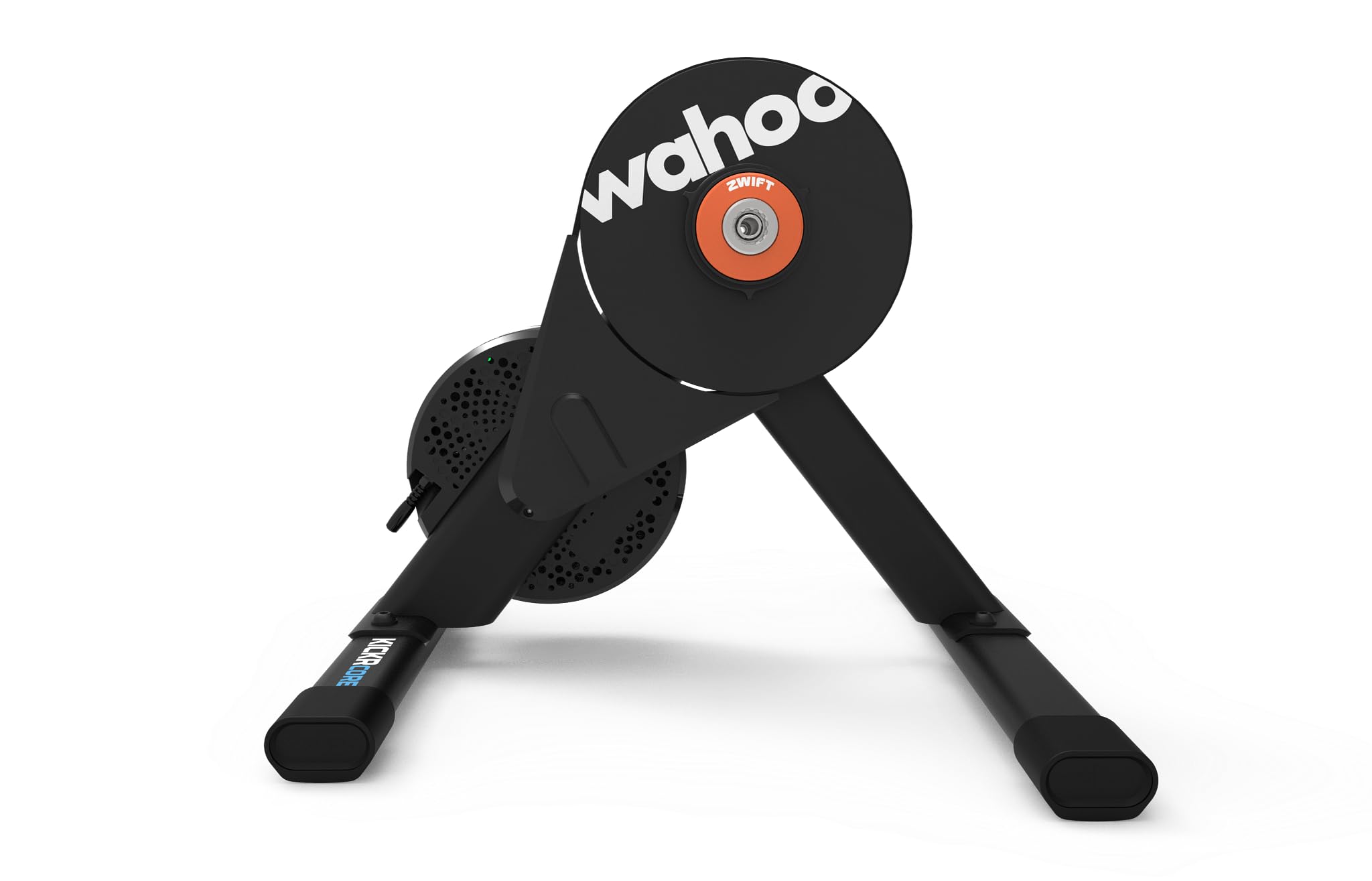
The Wahoo KICKR CORE 2 is a direct-drive smart trainer that simplifies indoor cycling by including the Zwift Cog and Click virtual shifting system. Instead of a physical derailleur and cassette, the Cog is a single gear that works with any bike’s drivetrain, and the Click buttons let you shift gears virtually inside Zwift. This eliminates chain alignment issues and cassette wear. The integrated WiFi provides faster pairing and automatic firmware updates, while ANT+ and Bluetooth keep it compatible with most training apps.
The ride feel is classic KICKR — smooth, stable, and accurate for ERG mode intervals or free-ride simulation. The unit supports up to 20 virtual gears and delivers a max resistance of around 1,800 watts, enough for sprint training. Setup is straightforward: mount your bike, plug in the power adapter, and pair with Zwift or another app. The trainer is relatively quiet, though some vibration noise is audible at high wattage. The included Zwift Click remote clips to your handlebars for gear changes without taking your hands off the bar.
The main criticism is that the virtual shifting requires an active Zwift subscription (/month) and may not work with other training platforms unless they support the protocol. A few users experienced failed shifts after firmware updates, though these issues resolved with re-pairing. The KICKR CORE 2 is a compelling choice for Zwift-centric riders who want a clean, cassette-free setup, but the subscription lock-in is real.
Why it’s great
- Zwift Cog eliminates cassette wear and drivetrain noise
- Integrated WiFi ensures reliable firmware updates and app pairing
- Stable, accurate resistance suitable for structured training and racing
Good to know
- Virtual shifting requires an active subscription to Zwift
- Some vibration noise at high power outputs
- Firmware update glitches can temporarily disable shifting
4. 3G Cardio Elite UB Upright Bike

The 3G Cardio Elite UB is a commercial-grade upright bike designed for riders who want a traditional seated cycling position with a generous weight capacity and a compact footprint. Its magnetic resistance system offers 16 levels that adjust via a smooth dial, and the belt drive keeps the ride whisper quiet. The oversized cushioned seat adjusts four ways — up/down and forward/back — to accommodate users from 5′ to 6’5″, with a 350-pound weight limit. The frame is built from alloy steel and weighs 91 pounds, giving it the stable, planted feel of a gym-class bike.
The console includes 12 pre-programmed workouts and 3 heart rate-controlled programs, plus manual goal modes for time, distance, calories, and wattage. Handheld pulse sensors and a wireless chest strap (included) provide heart rate input. The FreeSync FTMS Bluetooth connectivity allows pairing with third-party fitness apps like Zwift, Kinomap, or Peloton, though the bike does not auto-adjust resistance via app — you still turn the knob manually. The tablet shelf accommodates most devices, and the front-mounted transport wheels make relocation manageable.
The biggest downside is the lack of auto-resistance control, which limits the immersive experience for app-based training. The console display is functional but not as sharp as modern LCD screens. A few owners report that the pedals feel narrow for larger feet, though the included straps keep feet secure. For a rider who wants a rock-solid upright bike with no subscription fees and a lifetime frame warranty, the Elite UB is a buy-it-for-life choice.
Why it’s great
- Commercial-grade steel frame with 350-lb weight capacity
- Oversized seat with 4-way adjustability fits tall and short riders
- No subscription required — 12 built-in programs and Bluetooth app pairing
Good to know
- No auto-resistance control for app-based workouts
- Pedals are on the narrow side for larger foot sizes
- Console is functional but lacks modern high-def graphics
5. 3G Cardio Elite RB X Recumbent Bike

The 3G Cardio Elite RB X is a premium recumbent bike built for long, low-impact cardio sessions. Its oversized cushioned seat tilts five positions and slides forward/back through 25 positions, accommodating riders from 5′ to 6’5″ with up to 350 pounds. The Airflow Mesh Flex backrest conforms to your spine while keeping your back cool, and the low step-through design makes mounting and dismounting easy — especially valuable for users with hip or knee limitations.
The magnetic resistance system offers 16 levels controlled by a dial on the console, and the belt drive is virtually silent. The console mirrors the Elite UB’s layout: 12 pre-programmed workouts, 3 heart rate programs, and manual goal modes. FreeSync FTMS Bluetooth connectivity lets you pair with apps like Zwift or Kinomap, though resistance remains manual. The included wireless chest strap and handheld pulse sensors provide heart rate feedback. The 115-pound frame rolls easily on built-in wheels through standard doorways.
The main limitation is the same as the upright sibling: no auto-resistance means less immersion with virtual training apps. The narrow Q-factor (distance between pedals) is ergonomically excellent but may feel tight for riders with wide hips. At 49 inches long, the RB X is compact for a recumbent but still requires dedicated floor space. For anyone recovering from knee replacement or managing lower back issues, the Elite RB X offers gym-quality comfort and durability without a recurring subscription.
Why it’s great
- 4-way adjustable oversized seat with ventilated mesh backrest
- Low step-through design ideal for mobility-limited users
- Lifetime frame warranty and commercial-grade construction
Good to know
- Manual resistance only — no auto-adjust via app
- Narrow Q-factor may feel tight for wider body frames
- Requires about 4 feet of floor length plus rear clearance
6. Wenoker Stationary Bike (Air Bike with Smart APP)
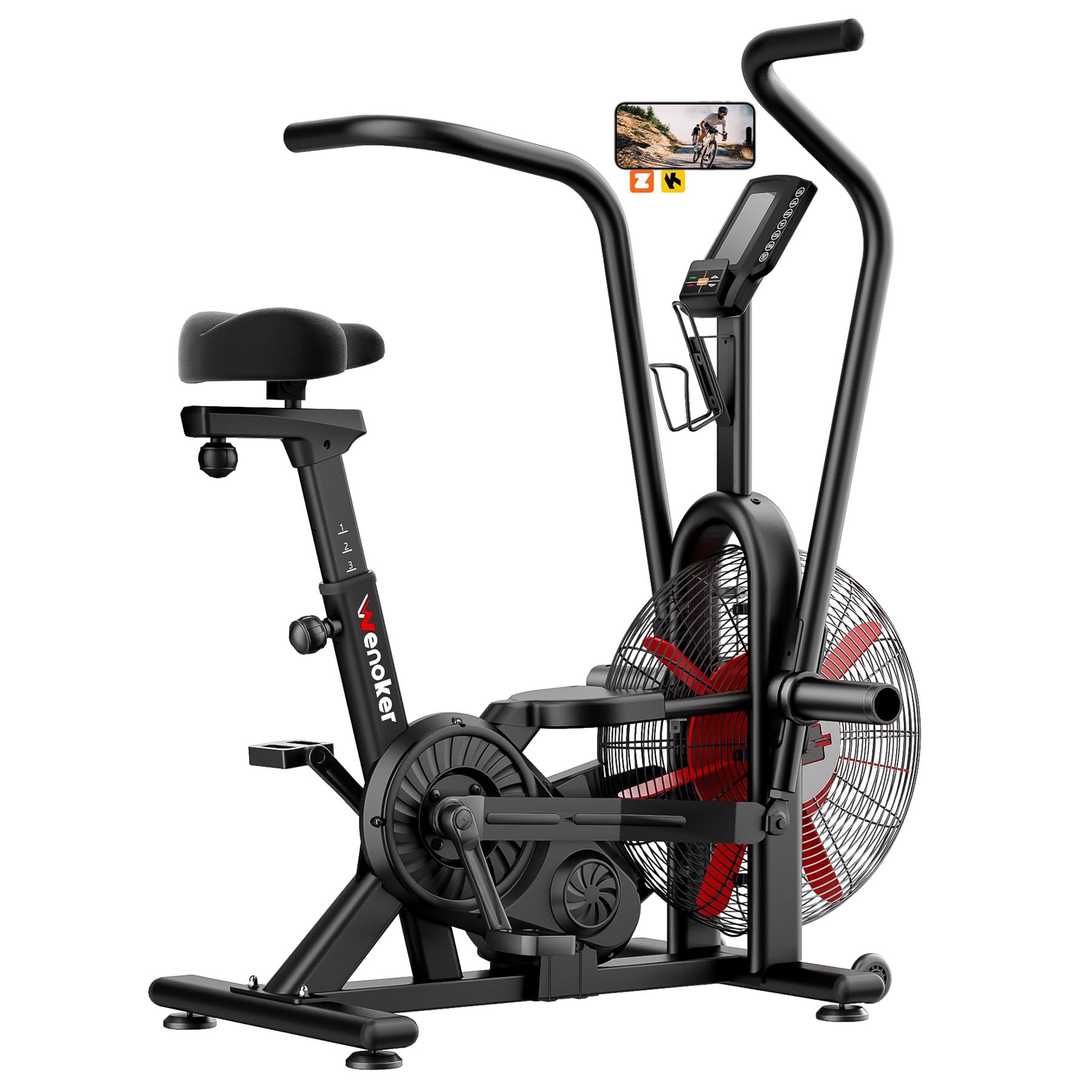
The Wenoker air bike uses a fan-based resistance system: the harder you pedal, the more air resistance you generate. This creates a linear intensity curve that rewards explosive effort, making it ideal for HIIT training. The dual-action handlebars move in sync with the pedals, engaging your arms, shoulders, and core for a full-body workout. When you want to isolate your upper body, the built-in foot pegs let you stop pedaling while continuing to push and pull the arms.
The heavy-duty steel frame supports up to 350 pounds, and the belt drive keeps the fan noise at a reasonable level — quieter than a chain-driven air bike but still audible during sprints. The built-in monitor tracks time, distance, calories, heart rate, and interval programs, and the Smart app provides access to workout tutorials, virtual routes, and progress logs. The adjustable cushioned seat, anti-slip pedals, and grip-textured handlebars improve comfort during longer sessions. Transport wheels and a device holder add convenience.
The trade-off is that air resistance provides less fine-grained control than magnetic systems — you cannot set a specific resistance level and hold it regardless of cadence. The fan blades generate a cooling breeze, which is welcome during intense intervals but means the bike is not silent. A few users report that the seat post can slip if not tightened carefully. For athletes who want a full-body cardio tool that scales with their effort, the Wenoker delivers exceptional value.
Why it’s great
- Unlimited progressive air resistance scales with your effort
- Dual-action handlebars and foot pegs for full-body or upper-body isolation
- Smart app integration with workout tutorials and virtual routes
Good to know
- Air resistance is inherently louder than magnetic bikes
- No ability to lock a specific resistance level independent of cadence
- Seat post can slip if the quick-release lever is not fully tightened
7. Yesoul S3 Exercise Bike

The Yesoul S3 is a compact magnetic spin bike that prioritizes app integration and a small footprint. It offers 100 resistance levels controlled by a manual knob, and the belt drive keeps the ride quiet enough to use while others sleep. The bike connects via Bluetooth to the Yesoul Fitness app, which hosts hundreds of on-demand classes, live rides, and scenic routes. The 10-inch tablet mount positions your device at eye level, and the app displays cadence, resistance level, distance, and calories in real time.
The carbon steel frame supports up to 350 pounds and is rated for riders between 4’9″ and 6’2″. The seat adjusts vertically and horizontally, and the handlebars adjust vertically, allowing for a reasonable fit range. The included SPD-compatible pedals accept both cleated cycling shoes and standard sneakers via the toe cages on the reverse side. The resistance knob doubles as an emergency brake — push down to stop the flywheel instantly. Transport wheels and a water bottle holder are included.
The main compromises are the lack of a built-in console (all metrics display through the app) and the seat comfort — several riders replace the saddle after a few weeks. The handlebars lack horizontal adjustment, which can force longer-armed riders into a stretched position. The Yesoul S3 is a solid entry-level smart bike for app-based cyclists who don’t mind relying on their tablet for stats, but serious riders may want a wider seat and more handlebar adjustability.
Why it’s great
- 100 levels of magnetic resistance with ultra-quiet belt drive
- Yesoul app provides hundreds of live and on-demand classes
- 350-lb capacity and compact 4′ x 2′ footprint
Good to know
- No built-in display — all metrics require the app on a tablet
- Stock seat is uncomfortable for rides over 30 minutes
- Handlebars lack forward/back adjustment for longer torso riders
8. Merach Magnetic Exercise Bike MR-S38
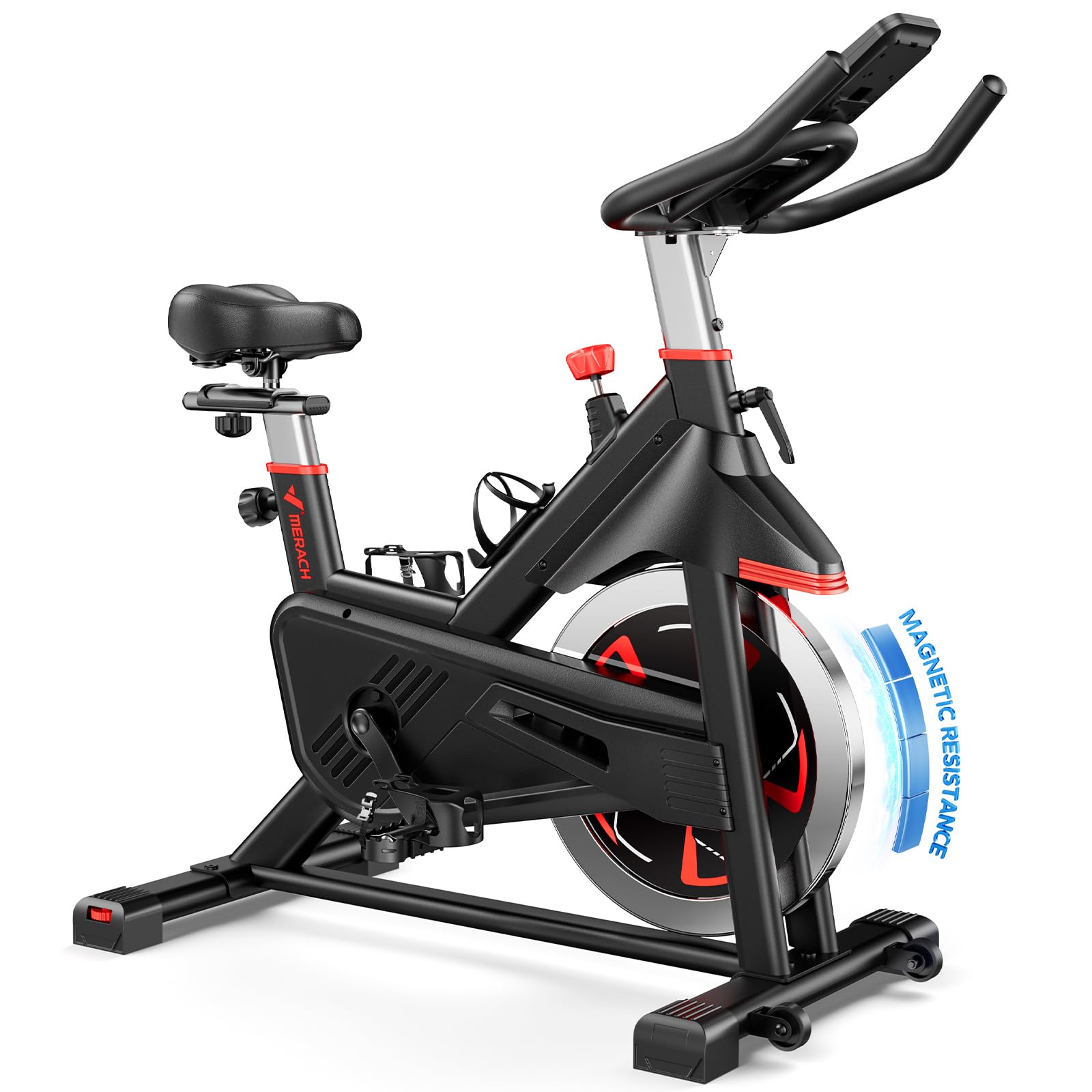
The Merach MR-S38 is a budget-friendly magnetic bike that delivers exceptional noise control and a solid, stable ride. Independent tests place the operating noise below 25 dB, making it one of the quietest options in its price tier. The belt drive and ABS pulley eliminate chain slap, and the 40-pound flywheel provides smooth, consistent momentum. The stainless steel dual-triangle frame supports up to 300 pounds and remains rigid during standing efforts.
The bike pairs with the Merach app via Bluetooth, which tracks resistance level, distance, time, and calories, and syncs with Apple Health and Google Fit. The 16 resistance levels are displayed only inside the app — there is no console on the bike itself. The high-density foam seat includes dual-spring suspension to reduce saddle soreness, and the aluminum alloy pedals offer good grip with adjustable toe cages. The 2-way handlebar and 4-way seat adjustments accommodate riders from 4’8″ to 6’2″.
The absence of a built-in display is the biggest limitation — you must have your phone or tablet nearby to monitor resistance. The lowest resistance level is not zero, which may bother riders who want a completely unloaded warm-up. A few users with average-sized male feet find the pedal cages too small. For someone who wants a whisper-quiet cardio bike for early-morning or late-night sessions without breaking the bank, the MR-S38 is a strong contender.
Why it’s great
- Remarkably quiet operation measured under 25 dB
- 40-pound flywheel delivers smooth, stable momentum
- Merach app tracks data and syncs with Apple Health and Google Fit
Good to know
- Resistance levels only visible in the app — no console on bike
- Lowest resistance setting is not completely zero drag
- Pedal toe cages are a tight fit for larger feet
9. YPOO BC720 Exercise Bike
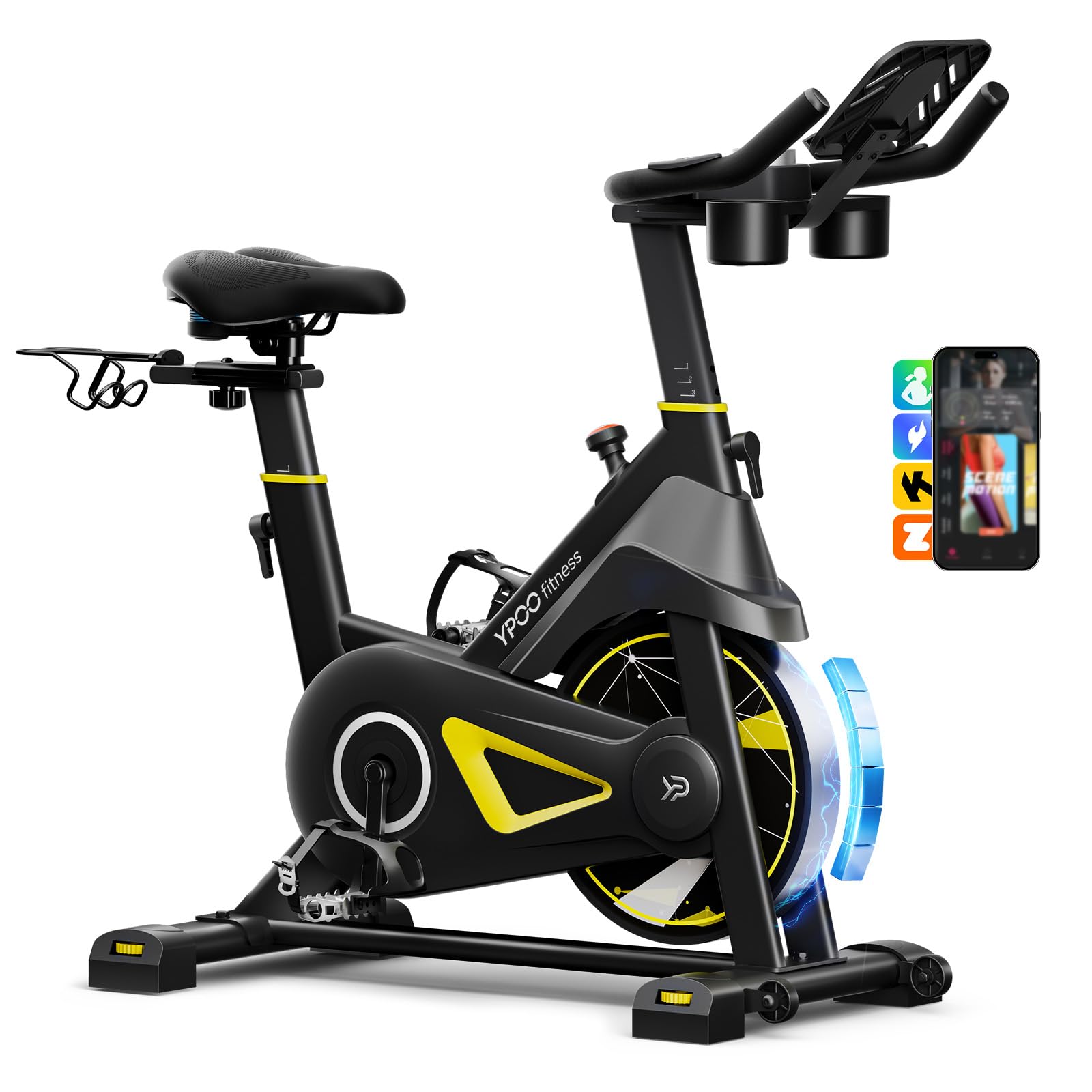
The YPOO BC720 targets riders who demand near-silent operation and a comprehensive feature set at a budget-friendly price point. The magnetic resistance system, combined with industrial-grade bearings and a maintenance-free belt drive, keeps noise below 20 dB — quieter than a library whisper. The 0-100% infinite resistance adjustment lets you dial in anything from a flat recovery spin to a steep simulated climb, all without friction or mechanical wear.
The frame uses a dual-triangle and H-frame structure rated for 330 pounds, providing a stable platform for riders from 5’1″ to 6’5″. The seat adjusts in four directions, and the handlebars adjust vertically, allowing most users to find a comfortable riding position. The included ypoofit app supports structured training courses, and the bike is also compatible with Kinomap and Zwift for virtual riding. The backlit LCD console tracks time, speed, distance, calories, and heart rate, so you don’t need a phone for basic metrics. Add-ons like a dumbbell rack, large tablet holder, dual water bottle holders, and transport wheels round out the package.
The main caveat is that the seat comfort is inconsistent — some riders find the high-density foam saddle adequate, while others replace it immediately. The calorie counter on the console tends to overestimate, which is common at this level. A few users report that the bike can tip slightly if a heavy rider is aggressive with standing sprints, though the frame itself feels solid. For the price, the YPOO BC720 delivers remarkable silence and versatility.
Why it’s great
- Exceptional noise control measured under 20 dB
- 0-100% infinite magnetic resistance with smooth belt drive
- Compatible with ypoofit, Kinomap, and Zwift apps
Good to know
- Stock saddle comfort is hit-or-miss for longer rides
- Console calorie data runs high compared to chest strap measurements
- Lightweight frame can feel slightly unstable during max-effort standing sprints
FAQ
Can I use a cardio bike with Zwift without a subscription?
How much space does a recumbent bike like the 3G Cardio Elite RB X need?
What is the difference between SPD and toe cage pedals on a cardio bike?
Why does my exercise bike seat hurt after 20 minutes?
How accurate are the calorie readouts on a magnetic exercise bike?
Final Thoughts: The Verdict
For most users, the best cardio bike winner is the Schwinn Fitness IC4 because it combines 100 levels of magnetic resistance, dual-sided pedals, Bluetooth connectivity with multiple apps, and a sturdy frame at a mid-range price point that doesn’t require a monthly subscription for basic use. If you want a silent magnetic bike with a built-in console and commercial-grade build, grab the 3G Cardio Elite UB. And for explosive, full-body HIIT training, nothing beats the Wenoker Air Bike.

Mo Maruf
I created WellFizz to bridge the gap between vague wellness advice and actionable solutions. My mission is simple: to decode the research and give you practical tools you can actually use.
Beyond the data, I am a passionate traveler. I believe that stepping away from the screen to explore new environments is essential for mental clarity and physical vitality.