Our readers keep the lights on and my smoothie glass nicely filled. As an Amazon Associate, I earn from qualifying purchases.
The anxiety of a fluttering heartbeat or a sudden dizzy spell sends thousands of people to emergency rooms every year — only to be told their rhythm was perfectly normal by the time they were seen. An at-home EKG monitor solves this problem by capturing a medical-grade snapshot of your heart’s electrical activity the moment symptoms appear, giving you a record to share with your cardiologist. Unlike a pulse oximeter or basic heart-rate watch, these devices trace the actual P-QRS-T waveform of your heartbeat, allowing clinicians to identify arrhythmias like Atrial Fibrillation, Bradycardia, and Tachycardia from the comfort of your living room.
I’m Mohammad Maruf — the founder and writer behind WellFizz. My research into personal cardiac monitors has focused on parsing FDA clearance documentation, sampling-rate specs, and real-world accuracy data to separate devices that deliver clinically useful traces from those that produce artifact-heavy noise.
Whether you are managing a known condition or simply want the ability to check your heart rhythm on demand, finding the right device comes down to understanding lead configuration, data storage, and subscription requirements. This guide breaks down the nine most compelling options for anyone searching for a reliable best at home ekg monitor.
How To Choose The Best At Home EKG Monitor
A personal EKG monitor is a medical investment, not a gadget impulse buy. Three factors separate a helpful device from a drawer-collector: lead configuration, data quality metrics, and the true cost of ownership including subscriptions.
Single-Lead vs. Multi-Lead Capture
The vast majority of consumer EKG monitors record a Lead I trace using two contact points (usually both thumbs or one thumb and the device body on the chest). This is enough to detect AFib and gross rate abnormalities. Some premium units offer multi-lead views, which give clinicians a more complete picture of the heart’s electrical axis and can help localize the origin of certain arrhythmias. For routine AFib screening, a quality single-lead device with a fast sampling rate often suffices. For complex symptoms, a wearable multi-lead chest strap provides richer diagnostic data over 24 hours.
Sampling Rate and Artifact Rejection
A monitor’s sampling rate (measured in samples per second or Hz) dictates how faithfully it reproduces the EKG waveform. Consumer devices with rates around 250 to 300 Hz capture enough detail for rhythm identification but can generate motion artifact if the user has hand tremors or dry skin. Look for products with a high common-mode rejection ratio (CMRR) — above 60 dB indicates the device filters out electrical noise from muscle activity and ambient interference. Real-world accuracy depends less on marketing claims and more on consistent skin contact and a stable resting position during measurement.
Subscription Economics and Data Portability
Some EKG monitors require a monthly or annual subscription to access stored readings, generate PDF reports, or unlock AFib detection algorithms. A few devices even restrict the free-tier experience to the point of near-uselessness. Before committing, verify whether the free app lets you export raw trace data or a full PDF to share with your doctor. Hardware pricing alone can be misleading — a device plus a year of mandatory subscription may cost more than a premium monitor with a one-time fee. Prioritize units that store at least 100 readings locally and offer free Bluetooth or USB data transfer to PC or smartphone.
Quick Comparison
On smaller screens, swipe sideways to see the full table.
| Model | Category | Best For | Key Spec | Amazon |
|---|---|---|---|---|
| Bioheart | Chest Strap | 24/7 Continuous Rhythm | 48h battery, multiple strap sizes | Amazon |
| KardiaMobile Card | Wallet Card | On-Demand Spot Check | 2,000 EKG battery life | Amazon |
| EMAY Portable ECG | Standalone Monitor | Portable Screen + PC Export | 1.8″ display, USB + Bluetooth | Amazon |
| Withings ScanWatch Light | Hybrid Smartwatch | Discreet Daily Wear + EKG | ~30 day battery, analog style | Amazon |
| OMRON Platinum BP Monitor | Upper Arm BP + EKG | Blood Pressure + AFib Screen | 200 readings/user, dual user | Amazon |
| Withings BPM Connect | Connected BP Cuff | Wi-Fi Sync + Trend Charts | 6-month rechargeable battery | Amazon |
| Wellue Checkme O2 Ultra | Wrist Oximeter | Overnight O2 + Pulse Trending | 100-hour continuous use | Amazon |
| CONTEC PM10 | Finger Touch ECG | Budget-Friendly Single-Lead | 250 dots/s sampling rate | Amazon |
| Manhero Pulse Oximeter | Continuous Pulse Ox | Overnight SpO2 + HR Alarms | 500-set data storage | Amazon |
In‑Depth Reviews
1. Bioheart
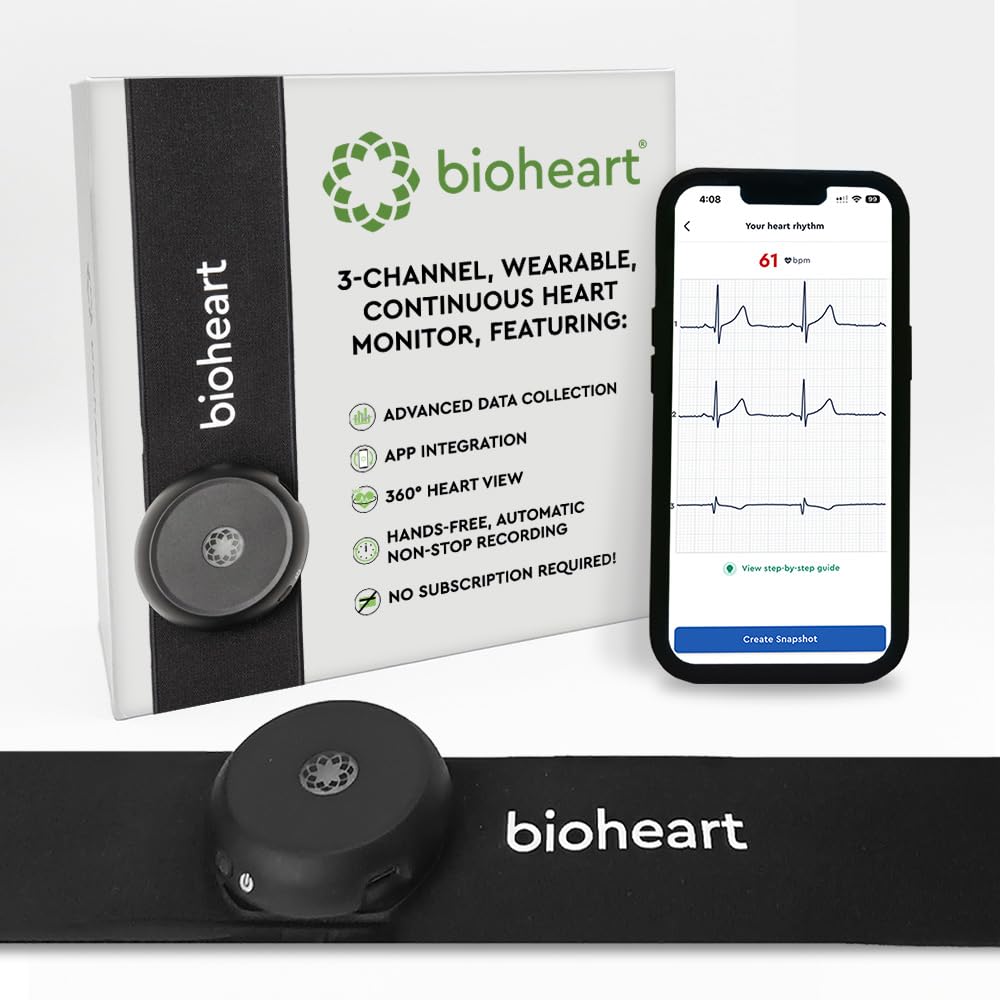
The Bioheart chest strap represents a different philosophy from spot-check thumb devices: it records every single heartbeat over 48 hours, creating a continuous rhythm strip that can capture paroxysmal AFib that happens only during sleep or exercise. Trusted by over 2,500 cardiologists, the device uses a breathable washable fabric strap available in three sizes (Small 25.5″–35.5″, Medium 29.5″–41.3″, Large 40.3″–63.0″), eliminating the need for sticky gels or wires. A TIME Magazine Best Invention of 2022, it streams live heart activity to your smartphone via Bluetooth and allows PDF report sharing with your physician without requiring a prescription to purchase.
The AI-driven app provides real-time insights on advanced metrics, but the subscription model is the critical disclosure: the first month is included, but accessing the full snapshot history and detailed analysis requires a monthly membership. Users with larger chests reported that the medium strap fits well with adjustments, and initial setup takes roughly ten minutes. The sheer volume of continuous data makes manual review necessary if artifact appears during vigorous movement — the device performs best during rest and sleep for clean diagnostic traces.
For those needing 24/7 arrhythmia surveillance rather than occasional spot checks, the Bioheart delivers a level of clinical detail that no wallet-sized or finger-touch monitor can match. The trade-off is the ongoing subscription and the need to wear a chest strap continuously, which some users find less comfortable than a wrist-based alternative. If your cardiologist wants to see what your heart does over a full day-night cycle rather than a single 30-second snapshot, this is the most capable consumer-available tool on the list.
Why it’s great
- Continuous 48-hour rhythm recording captures intermittent arrhythmias
- FDA-cleared clinical accuracy trusted by thousands of cardiologists
- Comfortable breathable strap with three size options for varied body types
Good to know
- Monthly subscription required for full data access after first month
- Motion artifact during exercise can degrade trace quality
- Chest strap form factor may feel intrusive for all-day wear
2. KardiaMobile Card
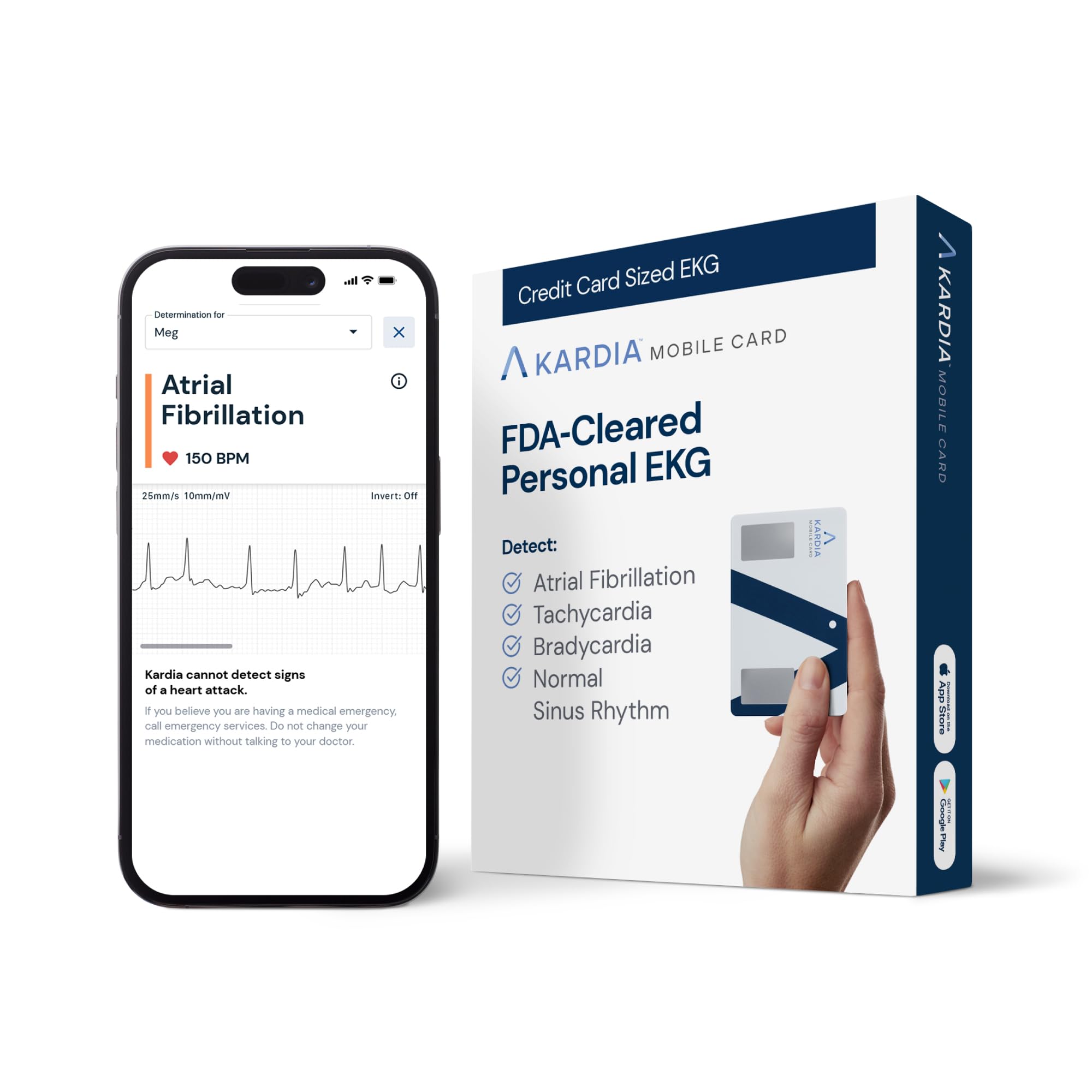
The KardiaMobile Card by AliveCor is the most portable FDA-cleared single-lead EKG monitor on the market — literally credit-card-sized and designed to slide into a wallet slot. It records a medical-grade 30-second EKG by simply placing two thumbs on the sensors, detecting AFib, Bradycardia, Tachycardia, and Normal Sinus Rhythm without needing WiFi, a computer, or even a power cord. The built-in lithium-ion polymer battery lasts for a minimum of 2,000 EKGs (roughly two years of regular use), and the device automatically shuts off after 10 seconds of inactivity to conserve power.
As the #1 cardiologist-recommended personal EKG brand with over 350 million EKGs recorded, the KardiaMobile Card benefits from a mature algorithm that reduces artifact when used on a flat surface. Some users noted that the power button requires a firm press and that hand tremors can introduce artifact — placing the card on a table rather than holding it in the air solves this. The free Kardia app stores and displays waveforms, but the deepest analytical features (premium reports, unlimited cloud storage) require an optional KardiaCare subscription. A handful of users reported frustration with the subscription upsell during setup, though the free tier remains functional for basic recording and PDF export.
The trade-off for the wallet-friendly form factor is the single-lead limitation: you get only a Lead I view, which is sufficient for AFib detection but cannot provide the multi-axis information a 12-lead hospital EKG offers. The device is also not tested for use with pacemakers or ICDs. For daily carry peace of mind — recording an EKG the instant symptoms strike — this is the most practical and most widely trusted option on the market.
Why it’s great
- Slips into any wallet for true on-the-go availability
- Clinically validated AFib detection from 30-second thumb recording
- Battery supports over 2,000 EKGs without recharging
Good to know
- Subscription upsell can push total cost higher over time
- Single-lead only — cannot replace multi-lead diagnostic EKG
- Not compatible with pacemakers or ICDs per manufacturer
3. EMAY Portable ECG Monitor

The EMAY EMG-6L stands out for its rare combination of a standalone 1.8-inch display and zero subscription requirements. While most portable EKG monitors require a smartphone to view the waveform, the EMAY shows the live trace and heart rate directly on its metal-bodied device, then syncs via Bluetooth or USB to its companion app for storage and PDF export. This makes it an excellent option for users who do not want to rely on a phone for every measurement or who prefer a dedicated screen for immediate visual confirmation of their rhythm.
Weighing only 80 grams and measuring 4 by 1.7 by 0.5 inches, the EMAY is slightly larger than the KardiaMobile Card but still pocket-friendly. Its rechargeable lithium battery provides roughly 2 to 3 hours of active use, translating to hundreds of 30-second recordings. A cardiology reviewer with 30 years of experience noted that the trace quality rivals devices costing fifty times more, provided the user makes proper skin contact — wetting the skin slightly improves signal conduction, especially in dry environments. The micro-USB charging port is a minor drawback in an era of USB-C dominance.
The EMAY records Lead I signals only and is not recommended for use with implanted pacemakers, similar to most consumer EKG devices. The app supports case review, setting time stamps, and uploading data to share with physicians. For buyers who want a no-subscription, display-equipped portable monitor with strong build quality, the EMAY delivers an exceptional value-to-performance ratio that avoids the recurring-cost trap.
Why it’s great
- Built-in screen shows EKG trace without needing a phone
- Metal-body build feels premium and durable
- No subscription fees — free app and PDF export
Good to know
- Micro-USB charging instead of USB-C
- Not recommended for pacemaker/ICD users
- Limited to Lead I single-channel recording
4. Withings ScanWatch Light

The Withings ScanWatch Light is a hybrid smartwatch that looks like a classic analog timepiece while housing an EKG sensor, heart rate monitor, step tracker, and sleep analysis. Its stainless steel case and fluoroelastomer band appeal to users who want medical-grade tracking without the overtly digital or bulky appearance of a smartwatch. The battery life is exceptional for a device with continuous optical heart rate monitoring — roughly one month between charges, compared to the daily charging needed by most full-featured smartwatches.
The EKG function works by touching the crown with the opposite hand while wearing the watch, generating a single-lead trace visible in the Health Mate app. The watch also tracks overnight heart rate trends and can detect irregular rhythms during sleep. Reviewers consistently praised its sleek design and comfortable fit, with one user specifically noting it does not look like a smartwatch at all. However, the initial app pairing process can be finicky, and some users reported that switching to a new phone required contacting customer support with a copy of their driver’s license to regain access — a significant inconvenience.
The ScanWatch Light does not offer continuous rhythm monitoring like the Bioheart chest strap; it captures on-demand EKGs and passive heart rate trends. It is also one of the pricier options on this list, though it competes against fitness smartwatches rather than dedicated EKG monitors. For someone who wants a beautiful everyday watch that can also provide clinical-grade EKG spot checks and overnight heart rate data without requiring daily charging, this is the most elegant solution available.
Why it’s great
- Analog watch design hides advanced health monitoring
- Roughly 30-day battery eliminates daily charging
- Water-resistant and comfortable for all-day wear
Good to know
- Phone-switch process can be frustrating and slow
- No continuous EKG — only on-demand and passive HR trends
- Higher upfront cost compared to dedicated EKG monitors
5. OMRON Platinum Blood Pressure Monitor
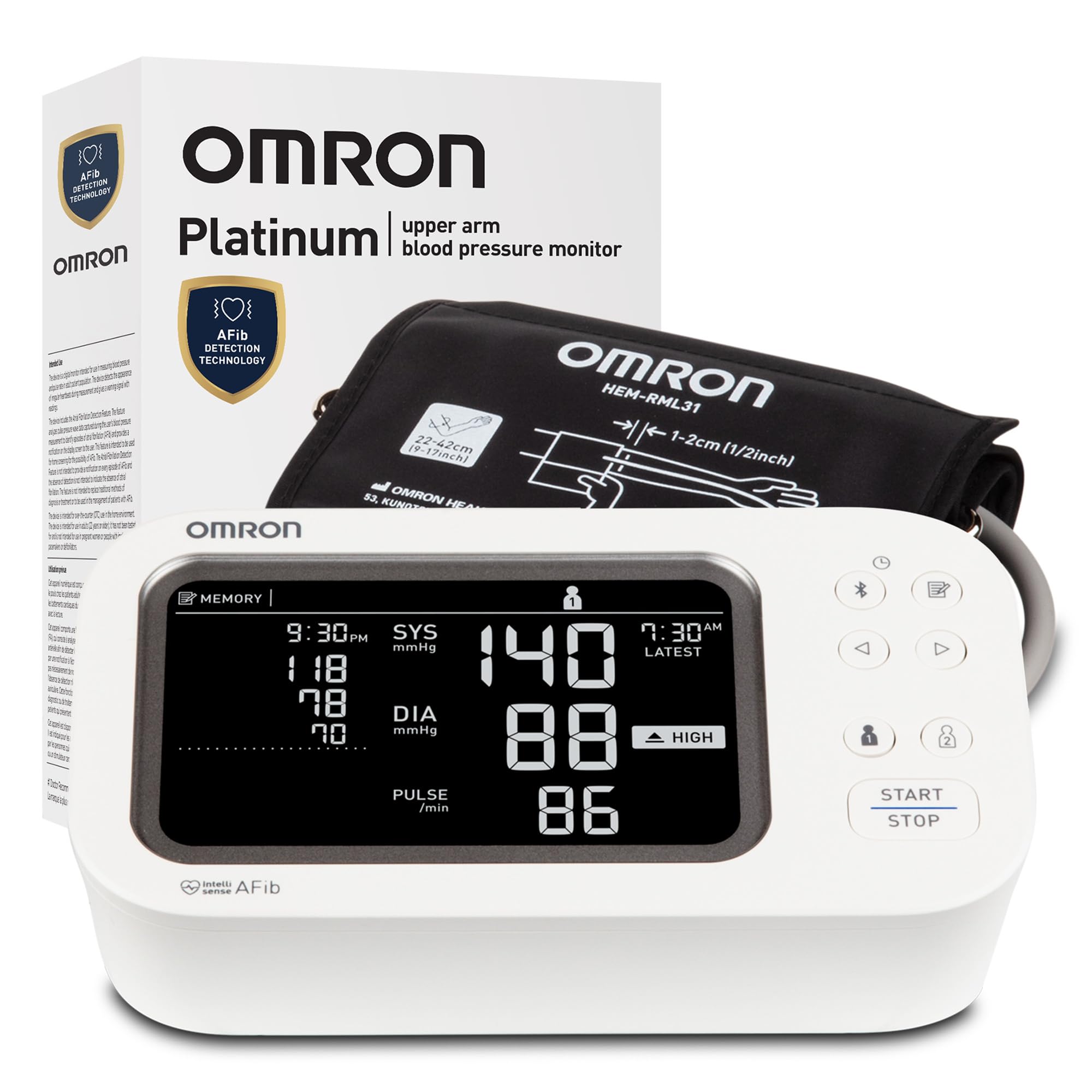
The OMRON Platinum is first and foremost a premium upper-arm blood pressure monitor, but its AFib Detection Technology makes it a valuable EKG screening tool as well. Every time you check your blood pressure, the device analyzes your heart rhythm for Atrial Fibrillation — the most common type of serious arrhythmia — and flags any irregularities. This dual-purpose approach means users who already need daily BP monitoring get an automated EKG screen without extra steps or a separate device. The wide-range D-ring cuff fits arms 9 to 17 inches, and the monitor stores up to 100 readings per user for two people plus a guest mode.
Bluetooth connectivity to the free OMRON connect app enables unlimited data storage, trend tracking, and report sharing with your doctor via Apple Health and Google Fit integration. The High Morning Average Indicator alerts users to blood pressure spikes linked to higher cardiovascular risk — a feature that pairs naturally with AFib detection for a comprehensive heart health picture. Reviewers consistently called it accurate and easy to use, with readings matching doctor’s office measurements. The dual power option (four AA batteries included or AC adapter) ensures continuous operation even if batteries die.
The limitation is obvious: you only get an EKG assessment when you inflate the cuff, making this a spot-check device rather than continuous monitoring. The app also has regional restrictions (US and Canada only) and some Android compatibility issues reported. For anyone managing hypertension who also wants regular AFib screening in a single familiar workflow, the OMRON Platinum is the most practical and clinically validated option by the #1 doctor-recommended brand.
Why it’s great
- Combines BP monitoring with automatic AFib detection
- High Morning Average Indicator for cardiovascular risk
- Dual-user storage with 100 readings per user
Good to know
- EKG assessment only during BP readings — not continuous
- App compatibility issues with some Android phones
- Regional restrictions limit use outside US/Canada
6. Withings BPM Connect

The Withings BPM Connect elevates the home blood pressure monitor into a fully connected heart health station with Wi-Fi and Bluetooth sync to the Health Mate app. Its color-coded feedback display — green for normal, yellow for elevated, red for high — gives immediate context without opening an app, making it ideal for elderly users or anyone who prefers glanceable results. The rechargeable battery lasts up to six months, and the cuff is compact enough to roll up for travel. The device measures systolic, diastolic, and pulse while also providing an irregular heartbeat detection feature similar to OMRON’s AFib screening.
Accuracy comparisons against a clinical WelchAllyn ProBP showed the Withings systolic within 2 points and pulse within 1 to 3 beats, though diastolic was off by an average of 4 to 5 points — acceptable for home trending but not lab-grade. The cuff screen faces outward during use, which some reviewers found awkward to read while inflating. The initial Bluetooth pairing process frustrated several users, and the LED display on the white model can be difficult to read in bright light. Customer support for returns was described as difficult, particularly for opened BP devices.
Unlike the OMRON Platinum, the BPM Connect does not offer a dedicated dual-user memory partition — instead, it relies on the app’s multi-profile feature. It also does not provide an explicit AFib detection algorithm beyond a general irregular heartbeat flag. For tech-savvy users who want automatic Wi-Fi data uploads, sleek industrial design, and deep app integration with trend graphs and PDF export, the Withings BPM Connect delivers a polished experience that justifies its premium positioning.
Why it’s great
- Wi-Fi sync means readings upload automatically without phone nearby
- Color-coded results give instant feedback at a glance
- Compact roll-up cuff design for easy travel storage
Good to know
- Initial Bluetooth setup can be troublesome
- Diastolic accuracy showed slight deviation vs clinical units
- Difficult return policy for opened medical devices
7. Wellue Checkme O2 Ultra
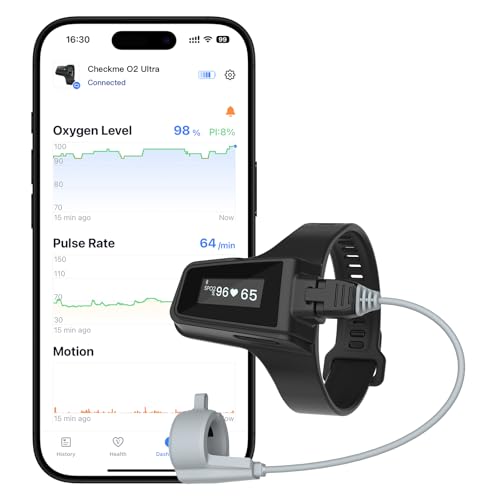
The Wellue Checkme O2 Ultra is a wrist-worn pulse oximeter that tracks SpO2 and pulse rate continuously for up to 100 hours on a single two-hour charge. While it is not a traditional EKG monitor — it does not trace the P-QRS-T waveform — it provides continuous heart rate data with audible and vibrating alarms when levels fall below user-set thresholds. This makes it a powerful tool for overnight monitoring, especially for individuals with sleep apnea or nocturnal arrhythmias who need to correlate symptoms with oxygen desaturation events.
The device syncs via Bluetooth to the Vihealth APP, which displays real-time data and stores up to four sets of 12-hour recordings for trend analysis. Customizable alarm thresholds (adjustable on both the device and app) let users set safety nets for low SpO2 (below 90%) or low heart rate (below 50 BPM), with vibration reminders that are less disruptive than audible beeps. The ergonomic design fits comfortably overnight, though some users noted that the rubber strap clip is prone to catching on clothing and that the display cannot be rotated, making it oriented upside-down when worn on the right wrist.
It is important to note that the Wellue is explicitly labeled as not a medical device — it is intended for sports and aviation use. This means its readings should be considered trend data rather than diagnostic-grade measurements. For users who want overnight heart rate and oxygen tracking with customizable alarms and long battery life, the Checkme O2 Ultra fills a specific gap that spot-check EKG monitors cannot address: continuous passive surveillance during sleep.
Why it’s great
- 100-hour continuous battery for multi-night tracking
- Audible and vibrating alarms for low SpO2 or HR
- Bluetooth sync with detailed trend data export
Good to know
- Not a medical device — intended for sports/aviation only
- Display cannot be rotated for right-wrist wear
- Rubber strap clip can snag and fall off
8. CONTEC Portable ECG/EKG Monitor PM10

The CONTEC PM10 is a budget-friendly finger-touch EKG monitor that offers a 1.77-inch color TFT-LCD screen and one-touch activation. It records ECG data and heart rate via finger pad sensors and stores results that can be synced to a PC or mobile app via Bluetooth. With a 250 dots/s sampling rate and ±1 bpm accuracy for heart rate measurement, its raw specs are competitive for the entry-level price point. The rechargeable lithium battery supports up to 500 measurements per charge, and the device weighs only 60 grams — truly pocket-portable.
However, the PM10’s real-world performance suffers from inconsistent user experience. Multiple reviewers reported excessive artifact that showed false arrhythmias like vtach, making the trace unreliable for clinical decision-making. The documentation is poorly translated English, and customer support is based in China, making troubleshooting difficult for non-technical users. Some users could not get the device working at all due to confusing setup instructions. While the hardware has potential, the software and support infrastructure are clearly behind the more refined competition from AliveCor and EMAY.
For a technically adept user who is willing to experiment with placement and skin contact to get clean traces, the PM10 can provide basic rhythm screening at a very accessible price. But for someone who wants reliable, out-of-the-box results or needs to share data confidently with a cardiologist, the extra investment in the KardiaMobile Card or EMAY is justified. The CONTEC is a functional device hobbled by poor user guidance and support.
Why it’s great
- Color TFT-LCD display shows live ECG waveform
- 500 measurements per charge for extended use
- Ultra-light 60g build for true pocket portability
Good to know
- Excessive artifact can produce false arrhythmia readings
- Poorly translated manual and China-based support
- Inconsistent setup success across different users
9. Manhero Continuous Pulse Oximeter
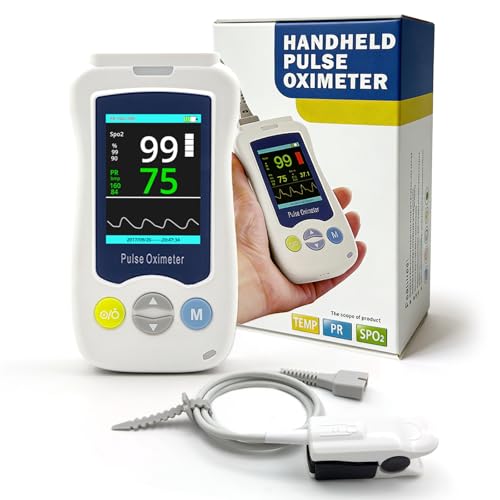
The Manhero Continuous Pulse Oximeter is a handheld device designed for overnight SpO2 and heart rate monitoring with customizable alarms for critical thresholds. It records both point-test spot checks and continuous trend tests, storing up to 500 data sets for long-term tracking. The measurement range of 70-99% SpO2 with ±1% accuracy and heart rate from 30-240 BPM with ±1 BPM precision meets medical-grade performance standards, though the device itself is positioned for home health use rather than clinical diagnosis. The large HD screen remains readable in low light, making it suitable for bedside use during sleep.
The device offers flexible power via Micro USB, rechargeable battery, or three AA batteries, though batteries are not included. Reviewers noted that the instructions are somewhat unclear and that the alarm system — while useful — requires deliberate threshold setting to avoid false alerts. The finger probe is comfortable for extended wear, and the silent mode eliminates beeping for undisturbed sleep. The unit’s primary limitation for EKG purposes is that it measures pulse rate and oxygen saturation rather than cardiac electrical activity — it cannot generate an EKG waveform or detect AFib directly.
For users whose main concern is overnight oxygen levels and heart rate rather than rhythm analysis, the Manhero provides professional-grade continuous monitoring at a budget-friendly price point. The 500-set storage and customizable alarms make it a practical tool for sleep apnea management or post-surgery recovery monitoring. Buyers should be aware, however, that this is a pulse oximeter, not an EKG monitor — it answers different questions than the other devices on this list.
Why it’s great
- Continuous overnight tracking with customized threshold alarms
- 500-set data storage for long-term trend analysis
- Large HD display readable in dark rooms
Good to know
- Pulse oximeter, not an EKG — no waveform or AFib detection
- Instructions are unclear and lack detail
- AA batteries not included despite requirement
FAQ
Can an at-home EKG monitor detect a heart attack?
Do I need a doctor’s prescription to buy an at-home EKG monitor?
How often should I record an EKG with my home monitor?
Final Thoughts: The Verdict
For most users, the best at home ekg monitor winner is the KardiaMobile Card because it combines genuine FDA-cleared AFib detection, unmatched portability (credit-card size fits in a wallet), and a 2,000-reading battery that lasts years — all without requiring a prescription or WiFi. If you want an on-device screen and no subscription fees at all, grab the EMAY Portable ECG Monitor. And for 24/7 continuous rhythm surveillance that captures every beat during sleep and activity, nothing beats the Bioheart chest strap, provided you accept the monthly subscription for full data access.

Mo Maruf
I created WellFizz to bridge the gap between vague wellness advice and actionable solutions. My mission is simple: to decode the research and give you practical tools you can actually use.
Beyond the data, I am a passionate traveler. I believe that stepping away from the screen to explore new environments is essential for mental clarity and physical vitality.