Our readers keep the lights on and my smoothie glass nicely filled. As an Amazon Associate, I earn from qualifying purchases.
Finding a 3D printer that reliably produces durable, safe, and detailed toys for kids without constant tinkering, failed prints, or toxic fumes is the single biggest headache for families entering desktop additive manufacturing. The difference between a printer that becomes a creative hub and one that collects dust comes down to three things: material safety, print speed, and the quality of the beginner experience.
I’m Mohammad Maruf — the founder and writer behind WellFizz. I’ve spent years analyzing hardware specifications for home and school 3D printers, focusing on safety certifications, layer resolution, and ecosystem maturity to separate family-friendly machines from hobbyist tools that need constant adjustment.
After evaluating dozens of models against criteria like enclosed build chambers, food-safe filament compatibility, and print volume dimensions, I have assembled the definitive analysis of today’s 3d printer for toys market to help you choose the right machine for your home.
How To Choose The Best 3D Printer For Toys
Selecting a 3D printer for toy making means balancing safety, speed, and simplicity. You want a machine that produces smooth, strong parts without exposing your family to hazardous materials or requiring hours of troubleshooting.
Print Technology: FDM vs. Resin
Fused Deposition Modeling (FDM) printers melt plastic filament layer by layer, making them ideal for toys due to durable PLA and PETG materials that are non-toxic and easy to sand. Resin printers use liquid photopolymer cured by UV light, offering incredible detail for miniatures but requiring ventilation and careful handling of uncured resin, which is a skin irritant. For most households making toys, an FDM printer with a partially enclosed frame is the safest, most practical choice.
Safety Features to Prioritize
Look for machines with enclosed or semi-enclosed designs that prevent contact with hot nozzles and moving parts. Certifications like TÜV Rheinland or ISO 16000 for filament emissions matter. Filaments labeled as “kid-safe” or “PLA+” with minimal odor and low warping give you peace of mind when children are near the machine.
Ease of Use: Auto-Leveling and Setup
Auto bed leveling eliminates the manual calibration that frustrates beginners. Fully assembled printers that require only connecting a spool and loading filament drastically reduce the time from box to first toy. App-based slicing with pre-loaded model libraries lets kids start printing without needing a computer.
Print Volume and Speed
A build volume of at least 100 x 100 x 100 mm allows for action figures and small puzzles, while 180 x 180 x 180 mm handles larger toys like articulated dinosaurs or blocks. Print speeds above 200 mm/s keep projects under an hour, maintaining a child’s engagement from design to finished product.
Quick Comparison
On smaller screens, swipe sideways to see the full table.
| Model | Category | Best For | Key Spec | Amazon |
|---|---|---|---|---|
| Bambu Lab A1 Mini Combo | FDM | Multicolor toys and fast family projects | 10,000 mm/s² acceleration, ≤48 dB | Amazon |
| Bambu Lab P1S | FDM | Enclosed printing for advanced filaments | 500 mm/s, 20,000 mm/s² acceleration | Amazon |
| Anycubic Kobra X Multicolor | FDM | Multicolor without manual filament swaps | 600 mm/s, 19-color max palette | Amazon |
| AOSEED X-Maker Joy AI+ | FDM | Kids-first AI-powered toy creation | 0.05 mm precision, TÜV certified | Amazon |
| ELEGOO Mars 5 Ultra | Resin | High-detail miniatures and figurines | 9K LCD, 18 μm XY resolution | Amazon |
| Phrozen Sonic Mighty 8K | Resin | Larger resin action figures and prototypes | 8K LCD, 28 μm XY resolution | Amazon |
| Anicubic Photon Mono 4 Ultra | Resin | Beginner resin printing for small toys | 10K LCD, 120 mm/h speed | Amazon |
| Entina Tina2 Plus | FDM | Budget-friendly fast FDM printing | 250 mm/s, ceramic hotend | Amazon |
| Entina Tina2C Mini Bundle | FDM | Entry-level value with included filament | 4-color PLA included, auto leveling | Amazon |
In‑Depth Reviews
1. Bambu Lab A1 Mini Combo

The Bambu Lab A1 Mini Combo delivers the most polished out-of-box experience available today for families wanting to print colorful toys. Its 10,000 mm/s² acceleration and active flow rate compensation produce smooth, high-quality layers on small action figures and fidgets without the ghosting or stringing that plagues slower machines. The AMS Lite system gives you native multicolor printing — a huge advantage for toy projects like articulated dragons or multi-part vehicles that would otherwise require manual filament swaps mid-print.
Setup takes about twenty minutes right out of the box, with full-auto calibration handling Z-offset, bed leveling, and vibration compensation. The ≤48 dB noise level means it can run in a child’s room during bedtime without disturbance. Bambu Studio slicer and the cloud-based app give parents remote monitoring capabilities, while the compact footprint fits easily on a standard desk. The 1-Clip quick-swap nozzle simplifies switching between PLA and PETG for different toy types.
Owners report the A1 Mini produces consistently reliable first layers with excellent bed adhesion using the flexible PEI plate. The glue stick is only needed for very tall or narrow prints. Some users note that multicolor printing generates more filament waste in purge towers, but the time savings from not swapping colors manually more than compensates. The enclosed AMS unit keeps filament dry, reducing brittle prints common in humid environments.
Why it’s great
- True plug-and-play with full-auto calibration
- Native multicolor without manual swaps
- Quiet enough for a child’s bedroom
- Compact footprint, great for desks
- Excellent layer quality at high speed
Good to know
- Multicolor purge towers waste some filament
- Not enclosed, so advanced materials need care
- Customer support can be slow on complex issues
2. Bambu Lab P1S

The Bambu Lab P1S is the enclosed workhorse that families who want to print toys in advanced materials like ABS or ASA — or need a larger 260 mm³ build volume — will appreciate immediately. The CoreXY motion system hits 500 mm/s with 20,000 mm/s² acceleration, making short work of large articulated toys or multi-part playsets that would occupy smaller printers for hours. The fully enclosed body keeps heat stable for warping-prone filaments and prevents small hands from accessing the hot end during operation.
Setup requires about 30 minutes, with auto bed leveling that compensates for slight irregularities in the build surface. The dual-gear extruder handles TPU for flexible toy parts like wheels or soft animal figures without jamming. Owners praise the P1S for producing prints with sharp details and minimal layer lines right out of the box, even on fast speeds. The Bambu Studio software ecosystem includes MakerWorld for finding pre-designed toy models quickly.
The main trade-off is that the P1S is larger and heavier than many entry-level printers at 38.9 pounds, so it needs a sturdy table. The single-filament setup works fine for monochrome toys, but adding an AMS unit is required for multicolor printing. Some users report that TPU can be finicky on this machine, requiring slower print speeds than PLA. The enclosed chamber also means you should ventilate the room when printing ABS due to fumes.
Why it’s great
- Enclosed for safety and advanced filaments
- Large 260 mm³ build volume
- Blazing fast with excellent accuracy
- Auto leveling and filament detection
- Strong community with MakerWorld
Good to know
- Heavy and needs a sturdy desk
- Multicolor requires additional AMS purchase
- TPU can be challenging to dial in
3. Anycubic Kobra X Multicolor
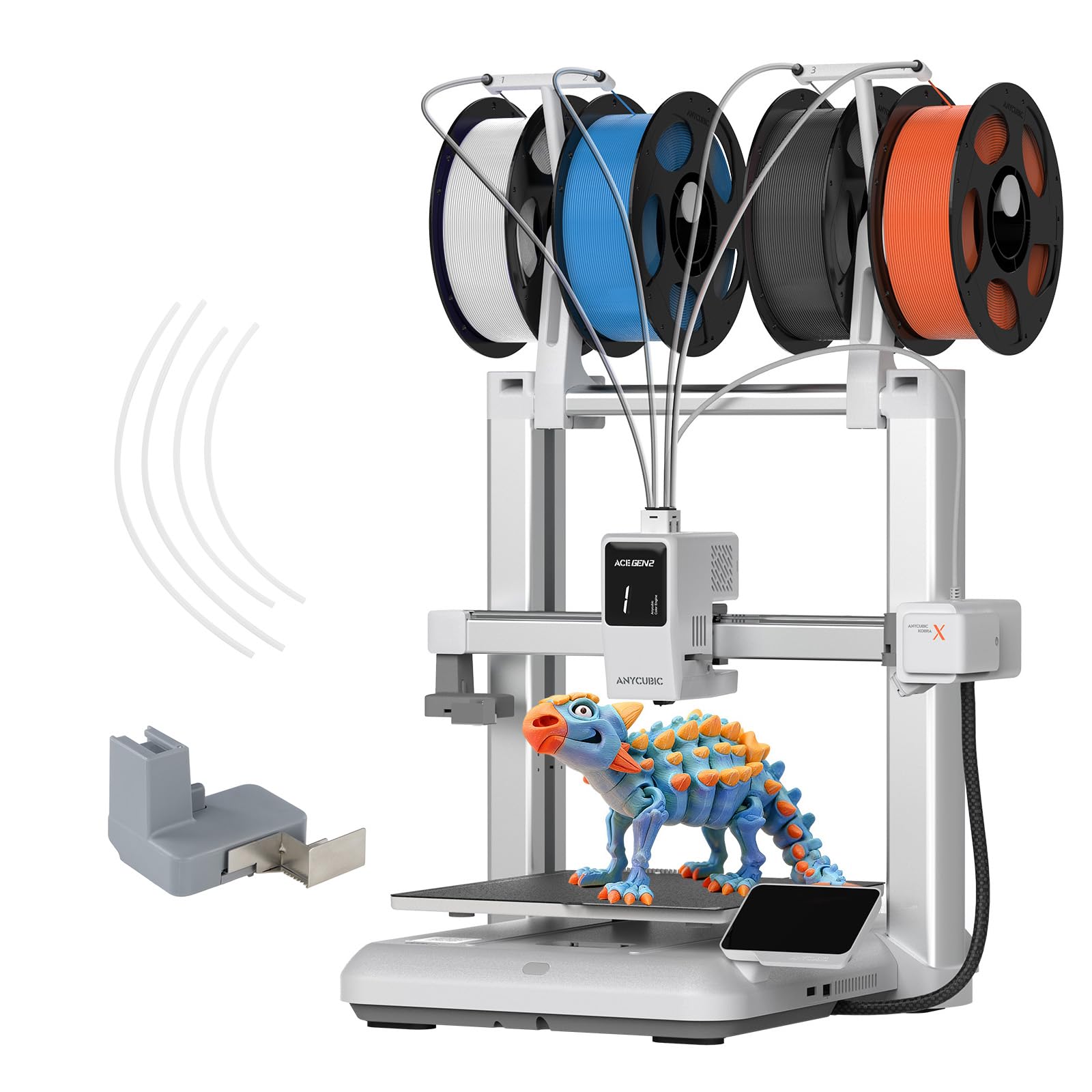
The Anycubic Kobra X brings native multicolor printing to the mid-range without requiring an external unit. With four colors built in and the ability to expand to nineteen with additional ACE Pro units, this FDM printer lets kids print characters with separate colors for skin, hair, clothing, and accessories in a single run. The 600 mm/s max speed, combined with vibration compensation, produces smooth layers on toys like articulated snakes or puzzle cubes without visible layer shifting.
LeviQ 3.0 auto bed leveling uses 49 calibration points to ensure the first layer sticks perfectly, reducing the frustration of failed prints that waste time and filament. The hardened steel nozzle handles PLA, PETG, TPU, and even abrasive filaments for toys that need extra durability. The Anycubic app includes a library of 10,000 pre-sliced models, so kids can choose and print directly from a tablet without touching a slicer. The top-mount spool holder frees up desk space.
Users consistently report that the Kobra X delivers reliable, high-quality multicolor prints with minimal stringing. The magnetic bed plate makes removing finished toys easy with a simple flex. Some early units had quality control issues with filament sensors, but Anycubic has joined the Amazon Replacement Parts Program for quick fixes. The app interface could be more intuitive, and the phone app sometimes lacks settings that the desktop slicer offers.
Why it’s great
- Integrated multicolor without separate AMS
- Very fast 600 mm/s print speed
- 49-point auto leveling for first layer success
- Hardened steel nozzle for abrasive filaments
- Large model library in the app
Good to know
- Mobile app lags behind desktop features
- Quality control on sensors can vary
- Not fully enclosed for safety
4. AOSEED X-Maker Joy AI+
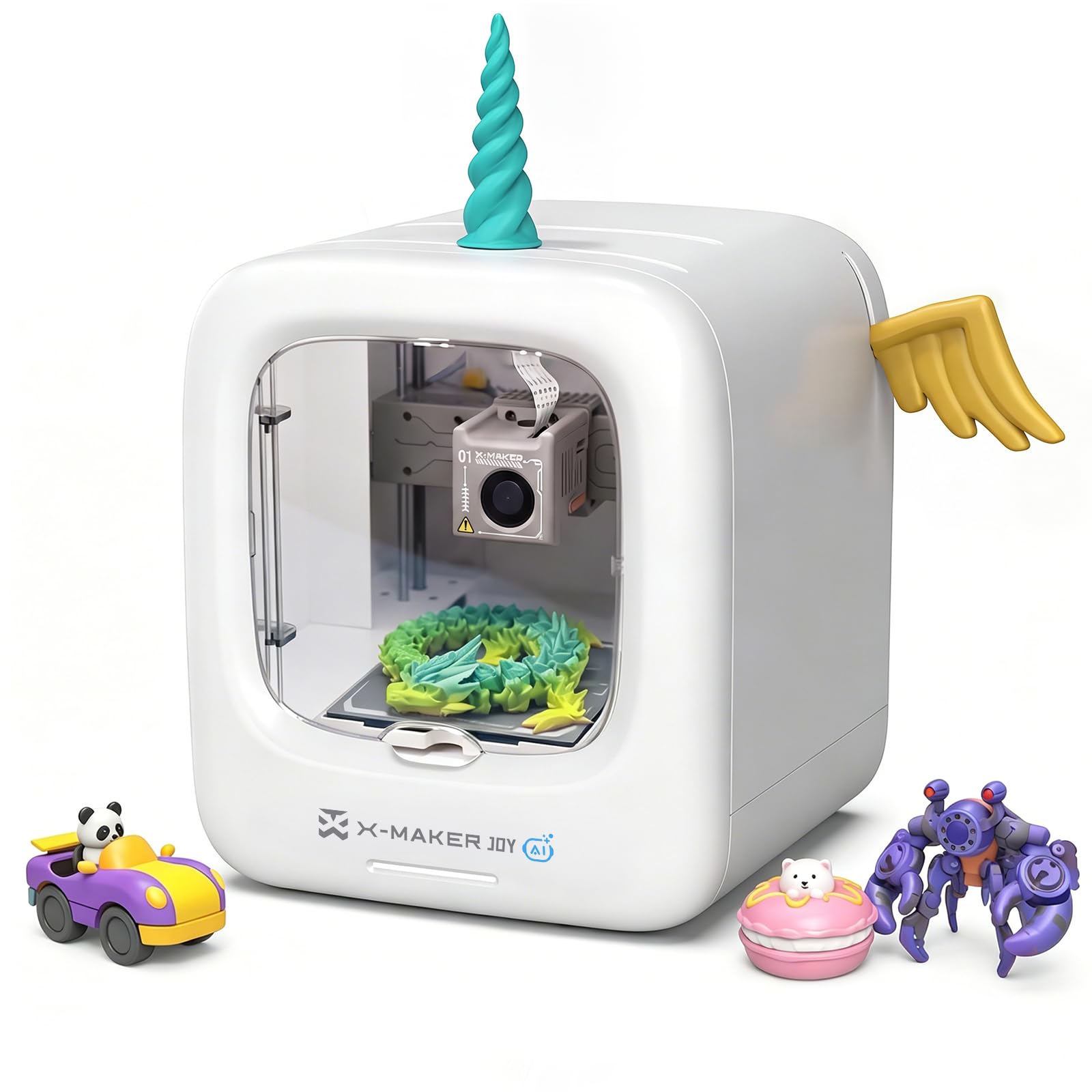
The AOSEED X-Maker Joy AI+ is designed specifically for children, with an enclosed, pinch-resistant frame and TÜV Rheinland ISO 16000-tested PLA filament that reduces fume exposure. Its AI Doodle feature lets kids draw or describe a toy idea, and the printer generates a printable 3D model from voice, text, or image prompts — no CAD skills are needed. With 8,000+ pre-loaded toy models and 17 themed design modules, children can print characters, accessories, and fidgets without needing a computer.
Print speeds of 220–250 mm/s (peaking at 400 mm/s) mean a small toy like a fidget spinner finishes in about twenty minutes, keeping young attention spans engaged. The precision of 0.05 mm layer height ensures smooth surfaces on articulated figures and detailed miniatures. The built-in camera creates time-lapse videos automatically, letting parents share the creative journey. The leveling-free platform eliminates one of the biggest frustration points for new users.
Some users report that very small or thin printed parts can be fragile and break easily if the print orientation isn’t optimized. The 1 kg of included PLA is a generous starter but runs out faster than expected if the whole family is printing daily. The magnetic build plate sometimes requires a gentle flex to release stubborn prints. The app’s AI model generation is impressive but occasionally produces geometry that needs manual tweaking in the slicer.
Why it’s great
- AI-generated models from text or drawings
- Safety-certified enclosed design for kids
- Leveling-free setup out of the box
- Fast small-toy prints in ~20 minutes
- Built-in camera for time-lapse videos
Good to know
- Thin parts can be fragile
- Included filament runs out quickly
- AI models sometimes need slicer tweaks
5. ELEGOO Mars 5 Ultra
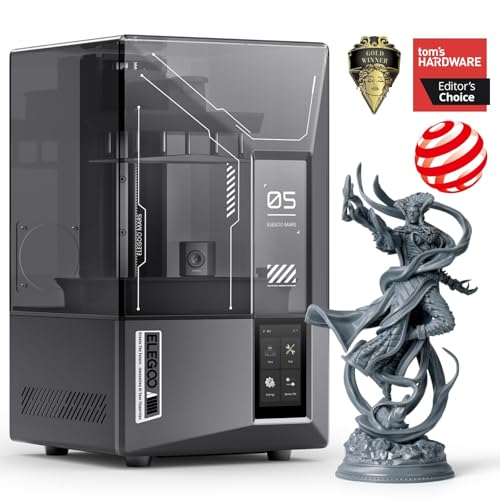
The ELEGOO Mars 5 Ultra is a resin printer that hits a sweet spot for toy makers who want miniature-level detail — think Warhammer-scale figures, dollhouse accessories, or intricate jewelry for dress-up play. The 9K monochrome LCD with 18 μm XY resolution reproduces pores, panel lines, and tiny facial features that FDM printers cannot match. The tilt release technology accelerates print speeds to 150 mm/h while reducing the peeling forces that cause deformation in delicate parts.
Smart features include automatic leveling with a mechanical sensor, residue detection to protect the LCD screen, and an AI camera that monitors for print failures like detached models or resin shortages. The WiFi connectivity allows control from the ELEGOO app, and cluster printing support lets you run multiple units from one device — useful for classrooms or Scout troops. The inclusion of a Chitubox Pro subscription simplifies slicing for beginners.
Resin printing inherently requires ventilation, gloves, and careful cleanup, making it less suitable for unsupervised children. The build plate is small at 6.04 × 3.06 × 6.49 inches, so it’s limited to small toys and parts. Some users report that the lid lacks hinges and can be awkward to remove. The camera resolution is low, and large prints can block the view. Cleaning up uncured resin takes discipline, especially with younger kids nearby.
Why it’s great
- Exceptional 9K detail for miniatures
- Tilt release tech for fast, reliable prints
- AI camera monitors for failures
- Automatic leveling and residue detection
- Chitubox Pro subscription included
Good to know
- Resin printing requires ventilation and PPE
- Small build plate limits toy size
- Lid is awkward and detaches fully
- Camera blocked by large prints
6. Phrozen Sonic Mighty 8K

The Phrozen Sonic Mighty 8K offers the largest resin build volume on this list at 8.6 × 4.8 × 9.3 inches, making it the top choice for printing sizable action figures, full-doll sets, or large decorative toys in a single piece. The 10-inch monochrome LCD with 28 μm XY resolution captures sharp surface details without visible pixelation, even on curved surfaces. The reinforced dual linear rails keep Z-axis motion stable throughout long 6+ hour prints, ensuring layers align perfectly.
This machine is built for creators who want professional-grade toys at home. The smart firmware optimizes exposure consistency and thermal management, reducing failure rates that waste expensive resin. It works seamlessly with both Lychee and Chitubox Pro slicers, giving experienced users fine control over supports and orientation. The solid construction at 31.5 pounds minimizes vibration that can blur detail in tall prints. A flexible build plate is a common upgrade to make removing cured models easier.
The Sonic Mighty 8K is not a beginner toy printer — it demands a dedicated workspace with ventilation, and the learning curve for resin calibration is steeper than FDM. The camera advertised is largely non-functional for real monitoring, so you cannot rely on it for remote checking. The pour groove on the vat is shallow, making resin transfer messy. Phrozen resins work best out of the box, and third-party resins may need tested exposure settings.
Why it’s great
- Large build volume for resin action figures
- Sharp 8K detail with 28 μm XY resolution
- Stable dual linear rail Z-axis
- Compatible with Lychee and Chitubox Pro
- Solid build reduces vibration artifacts
Good to know
- Not beginner-friendly; requires resin experience
- Needs dedicated ventilation workspace
- Camera is essentially non-functional
- Shallow pour groove on resin vat
7. Anycubic Photon Mono 4 Ultra

The Anycubic Photon Mono 4 Ultra delivers the highest pixel density on this list with a 10K screen (9024 × 5120 resolution) and 17 × 17 μm pixel size, making it capable of reproducing microscopic detail on toys like 15mm-scale miniatures or detailed jewelry pieces. The COB light source combined with Fresnel lenses achieves over 90% light uniformity, meaning consistent curing across the entire build plate without dark edges. Print speeds reach 120 mm/h with the ACF film and Intelligent Release Algorithm, reducing layer separation times.
Five intelligent detection systems handle printer self-inspection, residual resin detection, leftover resin monitoring, failed print detection, and intelligent lifespan management. These reduce the common beginner mistake of starting a print with too little resin or forgetting to clean the vat. The 4.3-inch touchscreen with an all-new UI supports eight languages, making it accessible for international families. Despite its low entry point, this machine prints at a level that satisfies seasoned mini painters.
Resin printers this detailed still require PPE and ventilation, and the Photon Mono 4 Ultra is no exception. The strong resin odor means it cannot be placed in a bedroom without an enclosure with a carbon filter. The screen protector is notoriously tricky to apply without trapping bubbles that can cause dead pixels. The 6.04 × 3.42 × 6.49 inch build volume is limiting for larger toys, so it is best for small parts and detailed accessories.
Why it’s great
- Best-in-class 10K ~17 μm pixel detail
- Fast 120 mm/h with ACF film
- Five smart detection systems for beginners
- Uniform light >90% with COB + Fresnel
- User-friendly 8-language touchscreen
Good to know
- Strong resin odor needs enclosure + filter
- Screen protector tricky to apply bubble-free
- Small build volume limits toy size
- Requires gloves and ventilation setup
8. Entina Tina2 Plus

The Entina Tina2 Plus is a fully assembled FDM printer that targets families on a budget who still want fast, reliable toy printing. The ceramic hotend reaches temperature in 40 seconds, meaning the time from power-on to first layer is minimal — ideal for impatient young creators. Print speeds of 250 mm/s with a stable dual Z-axis and auto leveling produce solid toy prints like fidget spinners, small action figures, and puzzle pieces without the layer shifting common on cheaper cantilever designs.
The Poloprint Cloud app provides access to 1,500+ pre-loaded models, with WiFi connectivity so kids can start prints from a smartphone without needing to transfer files from a computer. The compact footprint at 11.4 × 8.6 × 8.6 inches fits on cramped desks, and the partially enclosed frame separates hot components from accidental touch. The PEI spring steel build plate provides strong adhesion during printing but lets finished toys pop free with a simple bend.
Some users report that the app initially works well but can lose WiFi connection after a few prints, requiring re-registration. The included filament is only white PLA, so families need to buy additional colors for multicolor projects. The print volume is small, limiting larger toys to separate parts that must be glued together. A printed adaptor kit is needed for full-size filament spools, as the unit only takes small spools out of the box.
Why it’s great
- 40-second heat up for fast starts
- Fully assembled out of the box
- Auto leveling and dual Z-axis stability
- WiFi cloud printing via Poloprint app
- Compact size fits on small desks
Good to know
- App can lose WiFi connection after a few prints
- Only white filament included
- Needs adaptor for large filament spools
- Small build volume limits toy size
9. Entina Tina2C Mini Bundle
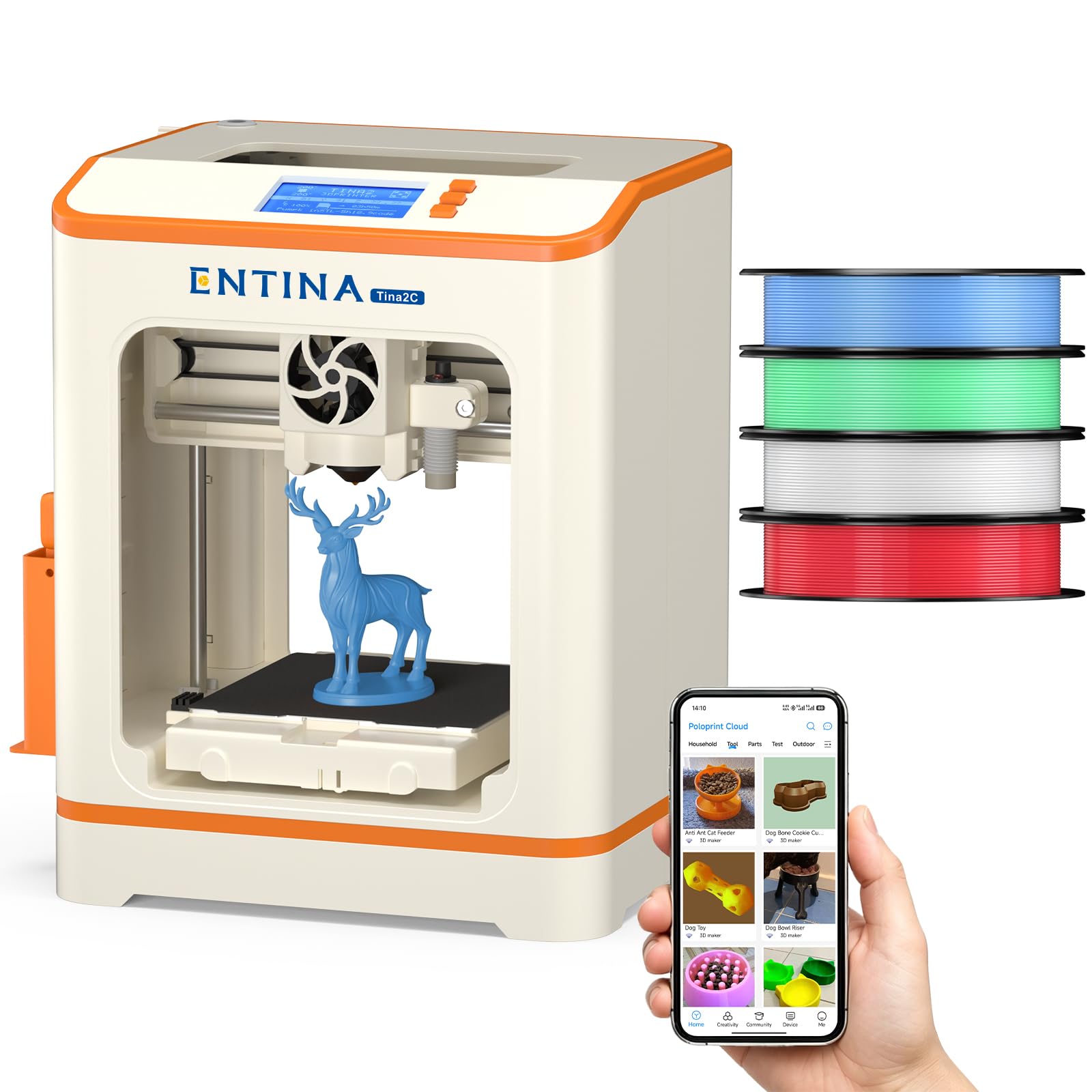
The Entina Tina2C Mini Bundle is the best entry-level value for families who want to dip a toe into 3D printing without a large investment. The bundle includes four spools of PLA filament — white, blue, green, and red — totaling about 1 kg, so you can start making multicolor toys like colored blocks, simple animal figurines, and fidgets on day one without buying extra supplies. The auto leveling system handles bed calibration automatically, and the magnetic build plate makes removing finished toys as easy as flexing the plate.
The Poloprint app gives access to 3,000+ models with AI search and photo-to-print features, ideal for kids who want to turn a sketch into a physical object. Power-loss recovery means prints interrupted by power blips resume automatically, saving hours of rework. The compact design with smooth edges and low noise makes it safe for a living room or classroom environment. The quick-swap nozzle design simplifies cleaning when switching between filament types.
The 3.9 × 3.9 × 3.9 inch build volume is the smallest on this list, limiting users to trinkets and small toys — you cannot print a full action figure in one piece. The app’s 1,500+ model library is generous, but some reported that higher-quality models require manual downloading from external sites and slicing manually. The partially enclosed frame provides some protection but is not fully enclosed, so nozzle burns are still possible if unsupervised children reach inside during operation.
Why it’s great
- Includes 4 colors of PLA — ready to print
- Auto leveling and power-loss recovery
- Very low noise for home use
- Magnetic flex plate for easy removal
- Large app library with AI search
Good to know
- Smallest build volume — trinkets only
- Partially enclosed, not fully enclosed
- Best models need manual downloads
- Single filament feed, no multicolor in one print
FAQ
Is FDM or resin better for printing toys for kids?
What is the ideal build volume for toy printing?
How do I clean and maintain a 3D printer used for toys?
Can a beginner use a resin printer safely for toy making?
What filament types are best for durable toys?
Final Thoughts: The Verdict
For most users, the 3d printer for toys winner is the Bambu Lab A1 Mini Combo because it combines a no-fuss setup, native multicolor printing, and fast high-quality FDM output in a compact, quiet package. If you want the highest detailed miniatures for tabletop gaming or intricate collectibles, grab the ELEGOO Mars 5 Ultra. And for a large-scale resin toy maker capable of full action figures in a single print, nothing beats the Phrozen Sonic Mighty 8K.

Mo Maruf
I created WellFizz to bridge the gap between vague wellness advice and actionable solutions. My mission is simple: to decode the research and give you practical tools you can actually use.
Beyond the data, I am a passionate traveler. I believe that stepping away from the screen to explore new environments is essential for mental clarity and physical vitality.