Our readers keep the lights on and my smoothie glass nicely filled. As an Amazon Associate, I earn from qualifying purchases.
Cutting porcelain tile without chipping, cracking, or burning through blades is one of the most frustrating challenges in any tiling project. The extreme hardness and density of porcelain demand a diamond blade engineered specifically for the material—a standard masonry or ceramic blade will glaze over, overheat, and leave ragged edges that ruin an otherwise clean installation.
I’m Mohammad Maruf — the founder and writer behind WellFizz. I’ve spent years analyzing diamond blade metallurgy, bond matrices, and customer performance data from thousands of real-world tile installations to pinpoint which blades actually deliver on their promises for porcelain tile.
This guide breaks down the critical specs—rim design, kerf thickness, arbor compatibility, and diamond concentration—so you can confidently select the best blade for porcelain tile for your saw and project scope.
How To Choose The Best Blade For Porcelain Tile
Porcelain tile is fired at such high temperatures that it becomes nearly vitreous—more like glass than clay. A blade that works fine on ceramic will struggle here, producing excessive heat, rapid wear, and unacceptable chipping. Focus on these four criteria before making your choice.
Rim Design: Continuous vs. Segmented vs. Turbo Mesh
For porcelain tile, a continuous rim or a turbo mesh rim is the correct choice. Continuous rims (solid diamond edge) produce the smoothest, most chip-free cut but cut slower and run hotter—ideal for wet cutting on a tile saw. Turbo mesh rims add small serrations or a mesh pattern to the continuous edge, increasing cutting speed while maintaining a clean finish. Segmented rims, with gaps between diamond blocks, are too aggressive for porcelain and guarantee chipping.
Kerf Thickness: Thin Is In
The kerf is the width of the cut made by the blade. For porcelain, a thinner kerf (1.0mm–1.2mm for 4.5-inch blades, 0.090 inches for 10-inch blades) reduces stress on the tile and the saw motor, generates less heat, and produces a finer edge finish. A thick kerf blade can push the tile past its fracture point, causing cracking at the end of the cut.
Diamond Bond Hardness and Concentration
Diamond blades use a metal bond matrix that wears away to expose fresh diamond particles. For hard porcelain, you need a relatively soft bond that releases diamonds quickly—otherwise the diamonds glaze over and the blade stops cutting. Premium blades also pack a higher concentration of diamonds per segment, which extends life despite the aggressive wear rate.
Arbor Size and Saw Compatibility
Most tile saws and angle grinders accept either a 5/8-inch or 7/8-inch arbor (or both with reducing bushings). A 4.5-inch blade is the standard for angle grinders, while 7-inch and 10-inch blades are for dedicated tile saws. Always confirm your tool’s arbor size and maximum rated RPM to avoid dangerous mismatches.
Quick Comparison
On smaller screens, swipe sideways to see the full table.
| Model | Category | Best For | Key Spec | Amazon |
|---|---|---|---|---|
| PEARL ABRASIVE P4 | Premium | Chip-free precision on hard porcelain | 0.05″ thin kerf, turbo mesh rim | Amazon |
| DEWALT DW4765 | Mid-Range | Versatile wet/dry cutting with durability | High diamond concentration matrix | Amazon |
| Delta Diamond Piranha | Premium | Large-format tile saw cuts | 10″ continuous rim, 0.090″ kerf | Amazon |
| TOOLEAGUE 10-Pack | Budget | High-volume or disposable use | 4.5″ x 1.2mm, 10 blades per pack | Amazon |
| PEAKIT 5-Pack | Budget | DIY and occasional tile work | 4.5″ turbo mesh, 5-blade value pack | Amazon |
In‑Depth Reviews
1. PEARL ABRASIVE CO. P4 Thin Mesh Turbo Porcelain Blade

The PEARL ABRASIVE P4 is widely regarded by professional tile setters as the gold standard for porcelain cutting. Its defining feature is the ultra-thin 0.05-inch kerf combined with a laminated center hub that suppresses wobble—two engineering choices that directly reduce chipping on the brittle edge of rectified porcelain. The turbo mesh rim pattern keeps the blade running cool even during extended dry cuts, which preserves the diamond bond and extends usable life well beyond most competitors in its class.
Real-world testing on a Dewalt D24000 saw shows the P4 producing cuts on cheap, high-friction Mohawk porcelain that are nearly indistinguishable from the factory edge after a light pass with a rubbing stone. Users who upgraded from stock blades report an immediate elimination of the “blowout” that occurs at the end of a cut. The P4 also handles harder materials like stone and dense ceramic backsplash tiles without hesitation, making it a versatile single-blade solution for mixed-material projects.
The trade-off is longevity. While the P4 cuts beautifully for the first 80% of its life, several long-term users note that performance declines more rapidly after that threshold, especially on heavily abrasive porcelain. At its price point, it is best viewed as a high-performance consumable rather than a permanent fixture in your toolbox. For professional-grade installers who cannot tolerate recuts, the premium is justified by the results.
Why it’s great
- Exceptional chip-free cutting on even cheap, hard porcelain
- Ultra-thin kerf reduces motor strain and tile stress
- Laminated center hub provides superior straight-line stability
- Turbo mesh rim stays cool for longer dry-cut sessions
Good to know
- Cutting life declines noticeably after approximately 80% wear
- Premium pricing per blade compared to multi-pack options
- 30-day warranty is shorter than industry-average lifetime policies
2. DEWALT Diamond Blade for Porcelain Tile, 4-1/2-Inch (DW4765)

The DEWALT DW4765 is the most balanced blade in this lineup, combining a high diamond concentration matrix with a steel core that is tensioned to resist high-temperature distortion. On angle grinders, this blade cuts 12-inch marble and porcelain slabs with minimal chipping—especially when using a flip-cut technique or a sacrificial backing board. The included brass reducing bushing allows the blade to fit both 5/8-inch and 7/8-inch arbors without adapter hassle.
Where this blade truly stands apart is its durability across repeated use. Users report cutting through dozens of porcelain pavers and still having significant diamond life remaining, which is unusual for a blade in its range. The cutting speed is faster than typical continuous-rim designs due to the optimized matrix height, which exposes fresh diamond particles at a steady rate. On a wet tile saw, the DW4765 produces straight, clean cuts on glazed ceramic and porcelain without the glaze chip-out that plagues cheaper segmented blades.
The main drawback reported by some users is minor chipping on very brittle, thin ceramic tiles when used dry on a high-RPM angle grinder. The chipping is generally confined to the cut edge and can be hidden by grout, but it indicates that the DW4765 is slightly less forgiving than the PEARL P4 on delicate materials. For a mid-range option that covers 90% of tile materials with excellent life, this is the strongest recommendation.
Why it’s great
- High diamond concentration delivers excellent blade life on porcelain
- Tensioned steel core resists wobble at high operating temperatures
- Includes both 5/8″ and 7/8″ arbor bushings
- Works effectively wet or dry on tile saws and grinders
Good to know
- May cause minor chipping on thin, brittle ceramic when used dry
- Not the fastest cutting blade for very dense rectified porcelain
3. Delta Diamond Piranha Premium 10 Inch Tile Saw Diamond Blade
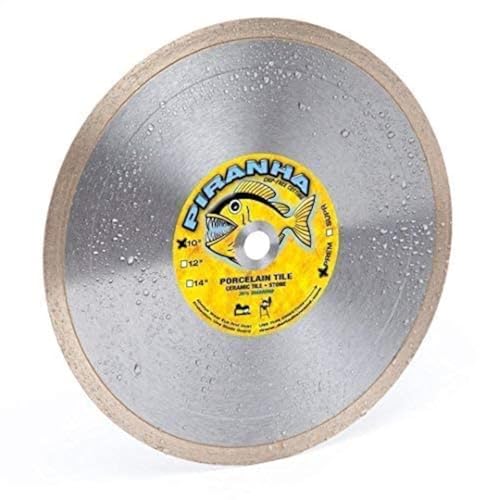
The Delta Diamond Piranha is a dedicated wet-cutting continuous rim blade built for large-format tile saws with a 5/8-inch arbor. Its 0.090-inch kerf is thicker than the ultra-thin 4.5-inch blades, but the continuous rim design compensates by producing a glass-like finish on porcelain, granite, marble, and slate. The 11mm extra-tall diamond rim is a standout feature—it provides significantly more usable diamond depth than standard rims, reducing downtime for blade changes on large jobs.
Users who cut 12×24-inch porcelain floor tiles report that the Piranha glides through the material with minimal feed pressure, leaving an edge that requires almost no dressing. Lapidary hobbyists have also adopted this blade for cutting hard agate and petrified wood, noting that it cuts faster than many dedicated slab saw blades. The blade does require periodic peening (opening the bond with a dressing stone) to prevent glazing on extremely hard stone, a common maintenance step for continuous rim blades on dense material.
The most frequent complaint involves the round center insert (the arbor bushing) being fragile. Several users reported it falling out during cleaning or loosening after extended use, requiring replacement with a salvaged bushing from an older blade. Additionally, some reviews note that blade quality control can be inconsistent—while most units perform exceptionally, a small percentage may dull more quickly than expected. Delta’s lifetime warranty against material defects provides a safety net, but the insert issue is a genuine irritant.
Why it’s great
- Extra-tall 11mm diamond rim extends usable blade life significantly
- Continuous rim produces near-perfect chip-free edges on porcelain
- Lifetime warranty against warping, cracking, and bond separation
- Cuts hard stone faster than many dedicated lapidary blades
Good to know
- Center arbor bushing is fragile and may loosen or fall out
- Requires periodic peening to prevent diamond glazing on dense stone
- Quality control can be inconsistent between individual blades
4. TOOLEAGUE Diamond Saw Blade, 4-1/2 inch, 10-Pack

The TOOLEAGUE 10-pack is the logical choice when you need multiple blades for high-volume cutting or plan to treat blades as consumables on rough jobs. Each blade is 4.5 inches with a 1.2mm kerf and a 22.23mm bore that fits most angle grinders and handheld cutters. The X-gear rim design features small serrations that accelerate cutting speed compared to a plain continuous rim, and the blades can be used wet or dry—though wet cutting produces noticeably cleaner results on porcelain.
Customer reports on 3/4-inch porcelain outdoor pavers show that these blades cut cleanly over dozens of passes without perceptible wear. The thin kerf reduces strain on corded wet saws, and the thicker center hub provides adequate stability for straight cuts. Several users specifically note that the value proposition is strong—at a per-blade cost that is a fraction of premium options, the TOOLEAGUE pack makes economic sense for jobs where blade breakage or premature dulling is a risk.
The compromise is finish quality. While the blades cut cleanly, they do not match the chip-free edge of the PEARL P4 or Delta Piranha on very brittle materials. The X-gear serrations can leave a slightly rougher edge that may require more cleanup. Also, being a lesser-known brand, long-term quality consistency is less documented than DEWALT or Pearl Abrasive. For the DIYer tackling a large tile floor or a contractor on a budget, this pack is the most cost-effective entry point.
Why it’s great
- Extremely low per-blade cost for a 10-pack format
- X-gear rim cuts faster than standard continuous rims
- Thin 1.2mm kerf reduces motor strain on smaller saws
- No perceptible wear after dozens of cuts on porcelain pavers
Good to know
- Edge finish is slightly rougher than premium continuous rim blades
- Long-term quality consistency is less established than major brands
- Best results require wet cutting for chip control
5. PEAKIT Supper Thin Tile Blade 4.5 Inch, 5-Pack

The PEAKIT 5-pack offers a turbo mesh rim design at a per-blade price that undercuts almost every single-blade competitor. The 1.2mm kerf and 4.5-inch diameter are standard for angle grinder use, and the turbo mesh pattern provides a balance of cutting speed and edge finish that suits ceramic tile, marble, and cement backer board. Professional tile installers who tested these blades report that they produce fast, clean cuts with virtually no chipping on standard ceramic tile, making them a strong entry-level option.
On porcelain tile, performance is solid but not flawless. The blades cut through porcelain without stalling or overheating, and the finish is acceptable for most trim and field cuts—especially when wet cutting is employed. For DIY homeowners completing a single bathroom or backsplash, a 5-pack is more than enough blade life to finish the project, and the low cost means you can discard a blade if it starts to dull rather than attempting to sharpen it. Users specifically note the blades handle well on angle grinders with minimal wobble.
The main limitation is longevity on high-volume jobs. Multiple users confirm that the blades dull faster than premium brands when cutting dense porcelain floor tiles over long stretches. Additionally, the blades generate substantial fine dust during dry cutting, so a mask and outdoor ventilation are mandatory. For the price point, the PEAKIT blades deliver excellent value for light to moderate use, but heavy users should budget for more frequent replacement.
Why it’s great
- Excellent value with 5 blades per pack for the price of one premium
- Turbo mesh rim cuts fast with minimal chipping on ceramic
- Works well on angle grinders without excessive wobble
- Suitable for porcelain, ceramic, marble, and cement board
Good to know
- Blades dull faster than premium options on dense porcelain
- Generates significant fine dust during dry cutting
- Not ideal for high-volume professional installations
FAQ
Can I use a segmented blade on porcelain tile?
Should I cut porcelain tile wet or dry?
Why does my diamond blade stop cutting porcelain after a few uses?
What size blade do I need for my tile saw or angle grinder?
Final Thoughts: The Verdict
For most users, the best blade for porcelain tile winner is the DEWALT DW4765 because it combines professional-grade diamond concentration, reliable edge quality, and excellent blade life at a mid-range price point that works for both contractors and serious DIYers. If you prioritize absolute chip-free precision and are willing to pay for it, grab the PEARL ABRASIVE P4—it sets the standard for clean cuts on even the hardest porcelain. And for budget-conscious buyers tackling a large project, the TOOLEAGUE 10-pack delivers reliable performance at a per-blade cost that is hard to beat.

Mo Maruf
I created WellFizz to bridge the gap between vague wellness advice and actionable solutions. My mission is simple: to decode the research and give you practical tools you can actually use.
Beyond the data, I am a passionate traveler. I believe that stepping away from the screen to explore new environments is essential for mental clarity and physical vitality.